Quick Answer
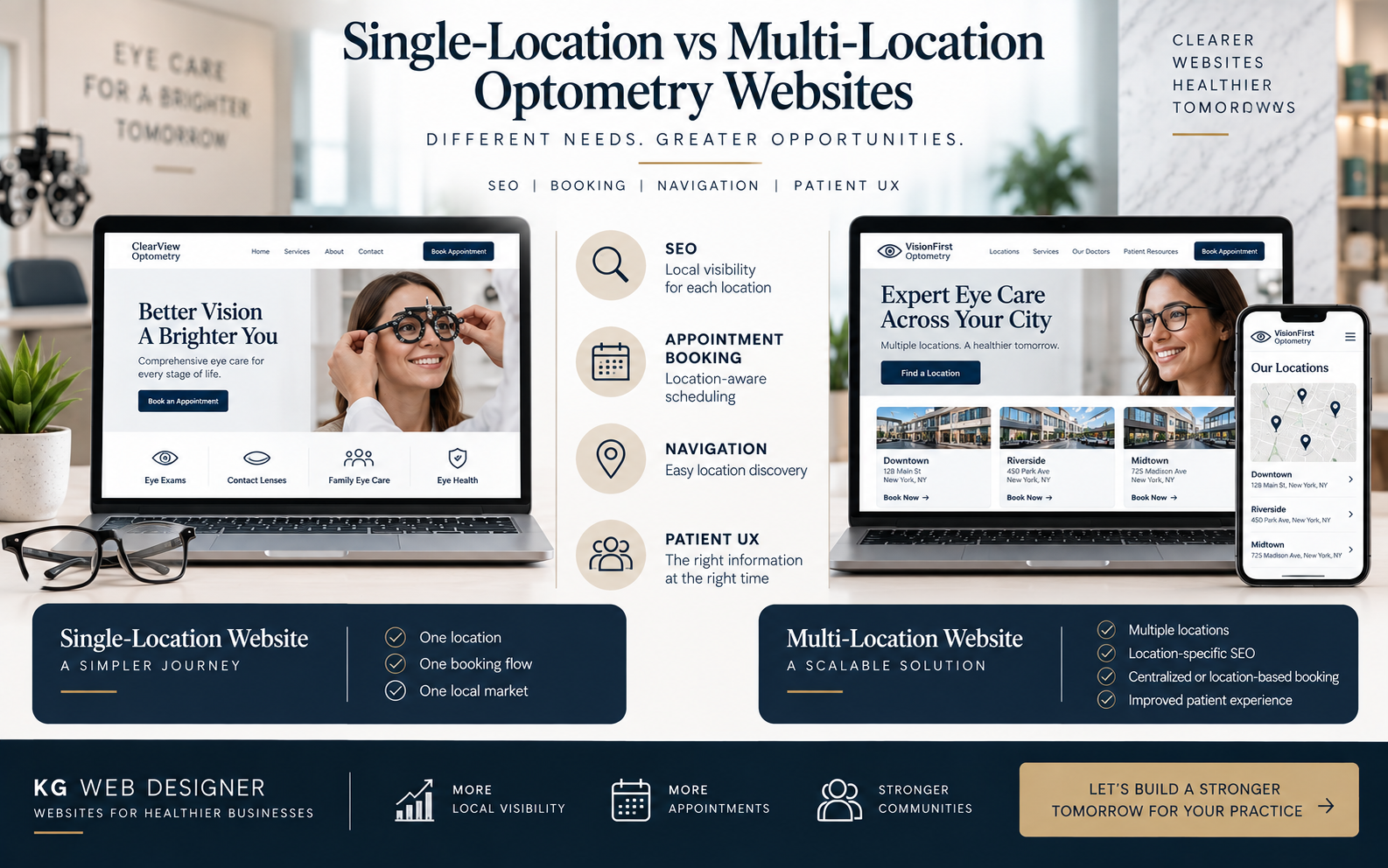
Independent optometrists and multi-location eye care practices require different website strategies because they attract patients in different ways. Independent clinics benefit from emphasizing personal expertise and local trust, while larger organizations need scalable navigation, location-specific content, and consistent branding. Choosing the right optometrist website design services ensures your website supports your growth strategy rather than limiting it.
TL;DR
- Independent optometry practices build trust through personal relationships, local reputation, and physician visibility.
- Multi-location practices require scalable websites with dedicated pages for every clinic and provider.
- Patients expect online appointment booking, fast mobile experiences, and clear service information before contacting a practice.
- Region-specific considerations such as HIPAA, GDPR, ADA accessibility, GOC guidance, and AHPRA advertising requirements should influence website planning.
- A website designed around patient behavior consistently performs better than one designed around an organization’s internal structure.
Buyer Intent Snapshot
| Buyer Stage | Consideration → Decision |
|---|---|
| Primary Goal | Determine which website strategy fits the practice’s growth plans. |
| Questions | Should I redesign my website? Which features matter most? Will this increase patient bookings? |
| Objections | Is a custom website worth the investment? How long will it take? |
| Concerns | Hiring the wrong designer, disrupting SEO, poor ROI, future scalability. |
| What Builds Trust | Industry expertise, healthcare experience, clear process, strategic recommendations, examples of similar projects. |
Website Feature Comparison
| Website Priority | Independent Practice | Multi-Location Practice | Business Impact |
|---|---|---|---|
| Primary Trust Builder | Optometrist’s expertise and reputation | Brand consistency across every clinic | Improves patient confidence before booking |
| Navigation | Simple and focused | Multi-location finder with service filters | Reduces patient frustration |
| Local SEO | One geographic market | Individual optimization for every clinic | Improves visibility for local searches |
| Appointment Booking | Single booking flow | Location and provider selection | Increases booking efficiency |
| Future Growth | Supports additional services | Supports new clinics without rebuilding | Protects long-term investment |
| Compliance Considerations | HIPAA-conscious forms, ADA accessibility (US), GDPR (UK), Privacy Act (AU) | Same requirements across all locations with centralized governance | Reduces operational and legal risk |
Why Do Independent and Multi-Location Practices Need Different Websites?
The answer is straightforward: patients evaluate independent clinics and multi-location organizations differently, so their websites should reflect those expectations.
An independent optometrist is often chosen because of personal reputation, continuity of care, and relationships within the local community. A patient wants to know who will perform their eye exam, what experience the doctor has, and whether scheduling an appointment will be simple.
A multi-location organization is evaluated differently. Patients first want to identify the nearest clinic, confirm available services, and find the appropriate provider before deciding whether to book.
The American Optometric Association recognizes that optometrists practice under different business models, including independent ownership, partnerships, and larger group practices, each with unique operational needs. Those differences should also shape how their websites are planned and organized. A website that serves every business model the same way rarely delivers the best patient experience.
Extractable Fact: The best healthcare websites align with how patients make decisions rather than how clinics organize their internal operations.
At KG Web Designer, we design websites around patient behavior, business goals, and future growth instead of relying on generic healthcare templates. That strategic approach helps practices create stronger first impressions while supporting search visibility and appointment generation.
Expert Insight from Kanika Gupta
One Website Strategy Does Not Fit Every Practice
“One of the most common mistakes we see is clinics trying to copy competitors without considering their own business model. An independent optometrist should build trust through personal expertise and community reputation, while a multi-location organization needs systems that help patients quickly find the right clinic, provider, and services. The website should reflect how patients choose eye care, not simply how the organization is structured.”
Kanika Gupta
Founder, KG Web Designer

Are Patients Leaving Your Eye Clinic Website Without Booking?
If your website isn’t converting visitors into appointments, the problem is usually trust, clarity, and booking flow. Discover how a conversion-focused optometrist website can increase patient enquiries.
Original Observation from KG Web Designer
After reviewing optometry and healthcare websites across the United States, United Kingdom, and Australia, we’ve identified several recurring patterns.
- Independent practices often invest heavily in diagnostic technology but spend very little time introducing the optometrist behind the equipment.
- Multi-location organizations usually maintain consistent branding but frequently overlook location-specific patient journeys.
- Many clinics focus on explaining services before establishing trust, even though patients typically decide whether they trust a provider before reading detailed treatment information.
These observations come from website reviews and strategy discussions conducted by KG Web Designer and consistently influence how patients engage with healthcare websites.
What Features Should Every Independent Optometrist Prioritize?
The most effective independent practice websites emphasize trust before technology. Patients generally choose an independent optometrist because they value personalized care, continuity, and confidence in the doctor providing treatment.
A successful optometrist website design should therefore highlight the person behind the practice as much as the services offered.
Priority features include:
- Comprehensive doctor biography with credentials
- Professional photography of the practice
- Online appointment scheduling
- Google Reviews and patient testimonials
- Insurance and payment information
- Educational eye care resources
- Mobile-first responsive design
- Fast-loading pages
- Clear calls-to-action
- Secure contact forms
Extractable Fact: Doctor profile pages are often among the most-visited pages on healthcare websites because prospective patients want to understand who will provide their care before scheduling an appointment.
What Website Features Should Multi-Location Practices Prioritize?
Multi-location practices require a scalable digital infrastructure that allows patients to reach the correct clinic with minimal effort. As the number of providers and locations increases, website organization becomes just as important as visual design.
A well-planned multi-location eye clinic website design should include:
- Individual landing page for every clinic
- Location-specific Google Maps integration
- Provider directories
- Service availability by location
- Centralized appointment scheduling
- Unified branding across all locations
- Local SEO optimization for each clinic
- Practice Management System integration where appropriate
Modern cloud-based practice management platforms such as RevolutionEHR and similar systems make it easier to synchronize appointments and patient workflows across multiple offices. A website that integrates with these operational tools can simplify both patient scheduling and administrative management.
Regional Considerations for US, UK, and Australian Practices
Healthcare websites must also consider regional expectations and regulations alongside usability and conversion.
United States
Practice owners often prioritize HIPAA-conscious contact forms, ADA accessibility aligned with WCAG 2.1 guidelines, secure online appointment requests, and integration with electronic health record or practice management systems.
United Kingdom
Practices should consider GDPR requirements, General Optical Council (GOC) guidance, accessibility expectations, and NHS referral information where applicable.
Australia
Many clinics benefit from supporting AHPRA advertising requirements, Privacy Act obligations, Medicare information where appropriate, and health fund claiming systems such as HICAPS.
Addressing these regional considerations demonstrates professionalism and helps build confidence among prospective patients before they even contact the practice.
Example Scenario
Imagine two eye care businesses operating in neighboring cities.
The first is an independent optometrist who has served the local community for more than 20 years. Most new patients come through referrals and local searches, so the website should reinforce trust by highlighting the doctor’s experience, patient reviews, and convenient online booking.
The second business operates six clinics across the region. Here, patients need to locate the nearest office, identify the services available at that location, and schedule an appointment with the appropriate provider. Without dedicated location pages and intuitive navigation, patients may leave before completing the booking process.
Although both organizations provide outstanding eye care, their websites should solve entirely different patient journeys.
Expert Insight From Kanika Gupta
Kanika Gupta, Founder, KG Web Designer
“One trend we repeatedly observe is that AI search engines reward clarity over promotion. Clinics often invest significant resources into visual design while underinvesting in expertise communication. AI systems are not impressed by claims. They respond to evidence. Physician credentials, treatment authority, educational content, patient trust signals, and structured information consistently outperform marketing language when it comes to earning citations.”
Learn From Leading Optometry Websites
If you’re wondering how successful practices structure their websites, our analysis of the 12 Best Optometry Website Design Examples in 2026 explores leading clinics across the United States, United Kingdom, and Australia. It highlights how effective navigation, trust signals, and patient-focused design contribute to stronger online experiences and more appointment inquiries.
Which Website Features Have the Greatest Impact on Patient Bookings?
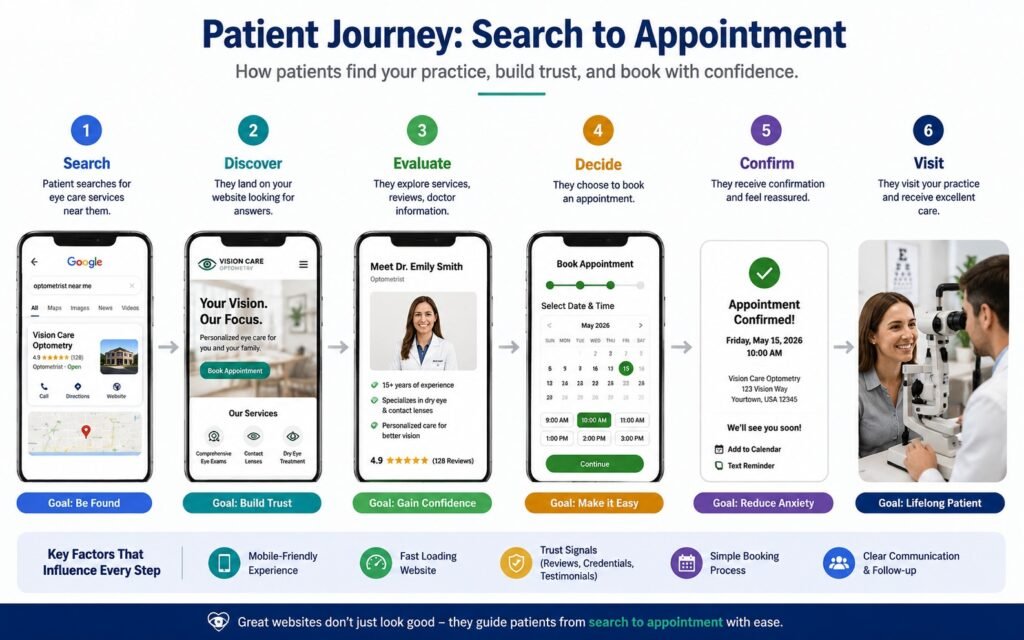
The website features that influence patient bookings are those that remove uncertainty and make taking the next step effortless. Patients don’t visit an optometry website to admire the design. They visit to answer practical questions: Can this practice help me? Can I trust the provider? How quickly can I book an appointment?
At KG Web Designer, we’ve found that websites generating the most qualified inquiries focus on reducing decision friction rather than adding more content. Every page should move a visitor closer to scheduling an appointment.
The most effective booking-focused features include:
- Online appointment scheduling with minimal steps
- Individual doctor profiles with qualifications and specialties
- Service-specific landing pages
- Google Reviews and patient testimonials
- Clear insurance and payment information
- Mobile-first responsive layouts
- Click-to-call functionality
- Fast loading speeds
- Easy-to-find contact information
- Frequently asked questions
Extractable Fact: Patients are more likely to complete an appointment request when they can quickly understand who will provide their care, what services are offered, and how to book without unnecessary navigation.
These principles apply whether you’re investing in eye clinic website design services for a single location or an expanding healthcare organization.
Independent vs. Multi-Location User Experience: What’s Different?
The biggest difference is that independent practices optimize for personal trust, while multi-location organizations optimize for efficient decision-making across multiple locations.
An independent clinic should make the optometrist the focal point of the experience. Patients often choose these practices because they value continuity of care, long-term relationships, and confidence in a specific provider. Every page should reinforce that personal connection.
A multi-location organization, however, serves patients who first need to determine where they should go before deciding who they want to see. The website should guide visitors through location selection, provider availability, and appointment scheduling without creating unnecessary complexity.
| User Experience Element | Independent Practice | Multi-Location Practice |
|---|---|---|
| Homepage Focus | Doctor, philosophy, community trust | Brand overview and clinic finder |
| Primary CTA | Book an Appointment | Find a Location |
| Navigation | Streamlined and personal | Organized by clinic, provider, and service |
| Trust Signals | Doctor credentials, local reviews | Brand reputation plus location-specific reviews |
| SEO Strategy | Single geographic market | Dedicated SEO for each clinic location |
| Growth Strategy | Build loyalty and referrals | Support regional expansion |
Extractable Fact: Navigation should reflect how patients search for care, not how the organization is internally structured.
Original Observation from KG Web Designer
During website strategy sessions, one recurring issue stands out.
Independent practices often hide the doctor’s personality behind clinical descriptions, while larger organizations frequently overwhelm visitors with corporate information instead of helping them find the right clinic.
Neither approach matches how patients actually make healthcare decisions.
Patients typically ask:
- Can this doctor help with my condition?
- Is this clinic convenient?
- Can I book today?
- Do they seem trustworthy?
The websites that answer these questions first consistently create a smoother patient journey.
How Can Local SEO Support Both Types of Practices?
Local SEO helps patients discover your practice when they’re actively searching for eye care services nearby. However, the strategy differs depending on your business structure.
For independent clinics, the objective is to establish authority within a single service area. This involves optimizing your Google Business Profile, creating locally relevant content, maintaining consistent business information across directories, and encouraging authentic patient reviews.
Multi-location practices require a broader strategy. Each clinic should have its own optimized location page, unique business information, localized content, and an associated Google Business Profile. This allows every office to compete effectively in its own market while maintaining a consistent brand identity.
Google recommends providing clear, accurate, and location-specific information for businesses serving multiple areas, making dedicated location pages an important component of local visibility.
Extractable Fact: Each physical clinic location should have its own optimized landing page to improve local search relevance and provide patients with accurate information.
Turn Patient Trust Into More Appointments
Patients don’t just compare clinics — they compare clarity, professionalism, and ease of booking. A well-designed eye clinic website builds confidence before they even call.
What Technology Integrations Should Modern Optometry Websites Include?
A modern website should integrate with the systems your practice already uses to improve efficiency and reduce administrative work.
Useful integrations may include:
- Online appointment scheduling platforms
- Practice Management Systems (PMS)
- Electronic patient forms
- Secure contact forms
- Google Maps
- Google Business Profile
- SMS appointment reminders
- Email confirmation systems
- Live chat where appropriate
- Analytics platforms for measuring patient inquiries
Practices considering custom optometry website development often benefit from selecting integrations that support future growth rather than solving only today’s operational needs.
Regional Website Considerations for Premium Overseas Practices
If your practice serves patients in the United States, United Kingdom, or Australia, your website should also reflect regional expectations.
United States
Patients expect secure online interactions, accessible websites, and transparent information about services and insurance. Practices collecting protected health information should ensure their digital processes support applicable HIPAA requirements, while accessibility should align with ADA expectations and WCAG 2.1 guidelines.
United Kingdom
UK practices should clearly communicate privacy practices under GDPR and ensure advertising and professional information align with General Optical Council guidance. If NHS services or referrals are offered, these should be explained clearly to avoid patient confusion.
Australia
Australian practices often benefit from including information about Medicare eligibility where applicable, HICAPS or private health fund claiming, and ensuring advertising follows AHPRA requirements. These details help patients understand what to expect before their appointment.
Addressing these regional considerations demonstrates professionalism and reassures prospective patients that your practice understands their local healthcare environment.
Example From Our Experience
Problem
During website reviews for expanding healthcare businesses, we’ve seen practices reach a point where a single-location website no longer supports the way the business operates. New clinic locations are added, additional providers join the team, and service offerings expand, but the website continues directing every visitor through the same generic journey.
The result is often confusion. Patients struggle to identify the nearest clinic, compare providers, or determine where specific services are available.
Solution
In our experience, restructuring the website around dedicated location pages, provider profiles, intuitive navigation, and scalable architecture creates a more organized experience for both patients and staff. Rather than rebuilding the website each time a clinic expands, the structure is designed to accommodate future growth from the outset.
Outcome
The immediate benefit is a clearer patient journey. Visitors can identify the appropriate clinic more quickly, locate relevant services with fewer clicks, and complete appointment requests with greater confidence. Operationally, the practice gains a website that is easier to maintain and capable of supporting additional locations without requiring another major redesign.
Why Most Practices Get This Wrong
Many clinics assume that an attractive homepage is enough to compete online.
The reality is that successful healthcare websites are built around patient decision-making, not visual aesthetics alone. A modern design cannot compensate for confusing navigation, inconsistent messaging, or a booking process that creates unnecessary friction.
Another common mistake is copying competitors without understanding why their website works. Independent practices sometimes adopt a corporate style that hides their strongest advantage: personal relationships and continuity of care. Multi-location organizations, on the other hand, often create polished branding while overlooking the localized information patients actually need.
The practices that consistently outperform competitors treat their website as part of their patient acquisition strategy rather than a marketing expense.
If you want to see how these problems appear on an actual patient journey, our eye clinic website redesign live teardown breaks down how we would rethink homepage positioning, treatment pages, doctor credibility, location information, mobile UX, and appointment pathways. It shows why redesign decisions should begin with patient uncertainty and conversion friction rather than simply changing the visual style.
Ready to Get More Patient Bookings From Your Website?
If your current website is not converting visitors into appointments, it’s time to fix the experience. I help optometrists and eye clinics build websites that drive real patient enquiries.
Ready to Evaluate Your Website?
Whether you’re an independent optometrist planning your first redesign or a growing eye care organization expanding into new markets, your website should support your business strategy, not hold it back.
At KG Web Designer, we create conversion-focused websites that combine patient-centered user experience, search visibility, and scalable architecture for practices across the United States, United Kingdom, Australia, Canada, Singapore, and the UAE.
Learn Why Patients Leave Before Booking
Many practices lose prospective patients before they ever reach the appointment form. Our guide on Why Patients Leave Eye Clinic Websites Without Booking explains the most common trust, usability, and messaging issues that prevent visitors from becoming patients, along with practical strategies to improve conversion rates naturally.
What This Means for Your Practice
Your website should support the way your practice grows, not simply reflect how it looks today. Choosing the wrong website strategy can create operational challenges, limit search visibility, and make future expansion more expensive than it needs to be.
For an independent optometrist, success comes from building trust through personal expertise, local reputation, and an effortless appointment experience. For a growing organization, success depends on creating a scalable digital platform that serves every location while maintaining a consistent patient experience.
Investing in professional optometrist website design services is not just about redesigning a website. It’s about creating a patient acquisition system that continues delivering value as your practice evolves.
The long-term business benefits include:
- More qualified appointment requests
- Better local search visibility
- Increased patient confidence
- Lower administrative workload
- Easier website management
- Greater flexibility for future expansion
- Stronger competitive positioning
Extractable Fact: Practices that build scalable website architecture early typically avoid expensive redesigns as they add services, providers, or new clinic locations.
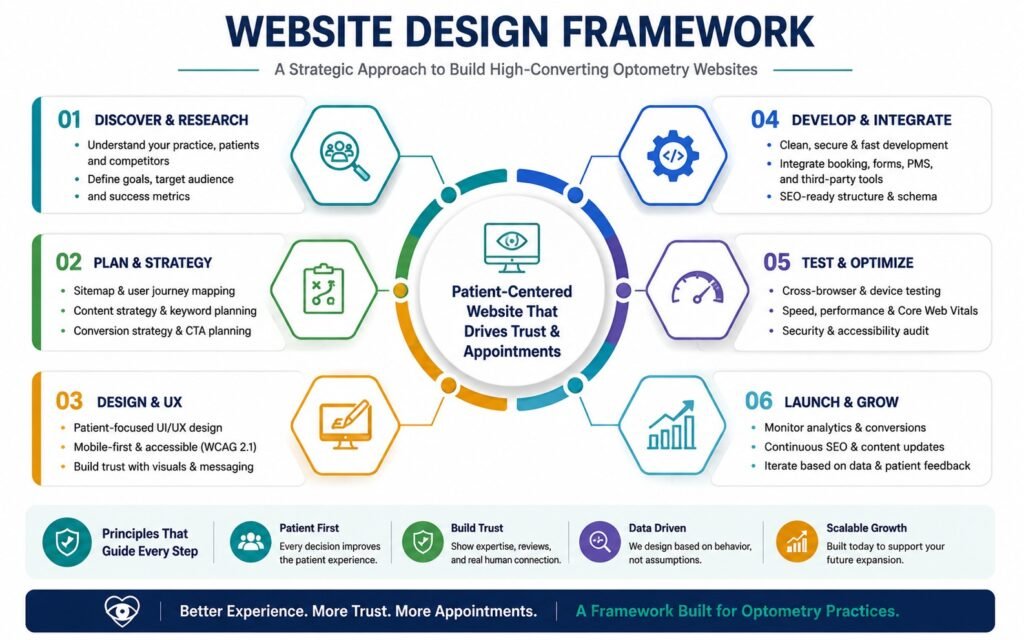
Website Decision Framework
Use this simple framework to determine which website approach best fits your practice.
| If Your Practice… | Your Website Should Prioritize |
|---|---|
| Operates from one location | Doctor branding, community trust, local SEO |
| Plans to open additional clinics | Scalable navigation and expandable architecture |
| Has multiple providers | Individual provider profiles and specialty pages |
| Offers specialty eye care services | Dedicated service landing pages |
| Relies on referrals | Patient education and trust-building content |
| Invests in digital marketing | Conversion optimization and analytics integration |
Bottom line: Your website strategy should match your business strategy.
2026 Technology Stack for Modern Optometry Websites
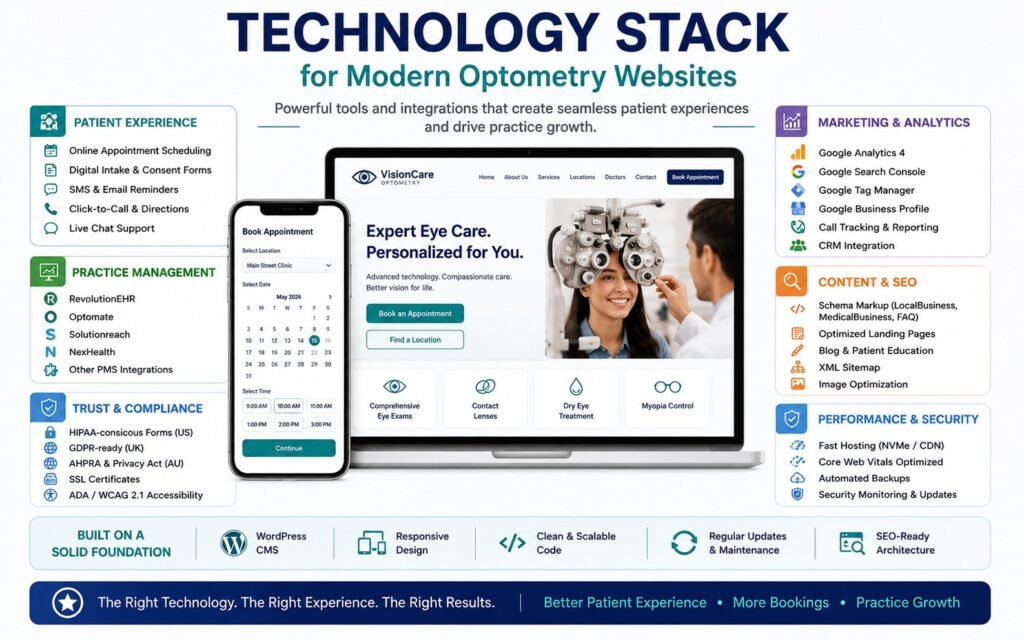
Technology should simplify the patient journey rather than complicate it. The best-performing optometry websites integrate with the tools practices already use while remaining flexible enough to accommodate future growth.
Recommended integrations include:
Patient Experience
- Online appointment scheduling
- Secure patient inquiry forms
- Digital intake forms
- SMS reminders
- Email confirmations
- Click-to-call functionality
Practice Management
- RevolutionEHR
- Optomate
- Solutionreach
- NexHealth
- Other compatible Practice Management Systems (PMS)
Marketing & Analytics
- Google Business Profile
- Google Analytics 4
- Google Search Console
- Google Tag Manager
- Call tracking
- CRM integration where appropriate
Technical Performance
- SSL certificate
- Core Web Vitals optimization
- Image optimization
- Schema markup
- XML sitemap
- Automated backups
- Security monitoring
Selecting the right technology stack ensures your website remains maintainable while supporting patient expectations and search engine requirements.
Questions to Ask Before Hiring an Optometrist Website Designer
Before investing in a new website, ask potential agencies these questions.
Strategy
- Have you designed websites specifically for healthcare providers?
- How do you structure websites for independent practices versus multi-location organizations?
- How do you improve appointment conversions?
SEO
- Will every location have its own optimized landing page?
- How will the website support local SEO?
- Do you implement structured data and schema markup?
Patient Experience
- How will you simplify online appointment booking?
- Will the design be fully responsive on mobile devices?
- How do you improve trust throughout the patient journey?
Technical Standards
- Will the website follow accessibility best practices?
- Can it integrate with our Practice Management System?
- Will it remain scalable if we open additional locations?
A designer who confidently answers these questions is more likely to understand the long-term needs of your practice.
Why KG Web Designer Takes a Different Approach
Many agencies begin with templates.
At KG Web Designer, we begin with your business model.
Before discussing colors or layouts, we focus on understanding:
- How patients currently discover your practice.
- What differentiates you from competitors.
- Which services generate the highest value.
- How your practice plans to grow over the next several years.
- What information patients need before booking.
Only then do we design the website.
This strategy-first approach helps create websites that support marketing, improve patient experience, and remain valuable as your business evolves.
Final Thoughts
An independent optometrist and a multi-location eye care organization may provide similar clinical services, but their websites should solve different business challenges.
Independent practices succeed when they establish personal trust, highlight the doctor’s expertise, and make booking simple. Multi-location organizations succeed by helping patients quickly identify the right clinic, provider, and services while maintaining consistency across every location.
The most effective websites are built around patient behavior, not organizational charts. They answer questions quickly, reduce uncertainty, and guide visitors naturally toward scheduling an appointment.
At KG Web Designer, we specialize in designing strategic websites for healthcare practices that strengthen trust, improve search visibility, and support sustainable business growth across the United States, United Kingdom, Australia, Canada, Singapore, and the UAE.
If you’re considering a new website or redesign, we’d be happy to discuss your goals and recommend the best approach for your practice.
Our Eye Clinic Website Services
Available across US, UK & AU time zones • Fully remote • No obligation consultation.
Frequently Asked Questions
1. Does an independent optometrist need a custom website?
Yes. Independent practices benefit from a custom website because it reflects the doctor’s expertise, local reputation, and unique patient experience. A tailored website also supports local SEO, improves trust, and creates a smoother appointment journey than generic healthcare templates.
2. How is a multi-location optometry website different?
A multi-location website requires dedicated pages for each clinic, location-specific SEO, provider directories, scalable navigation, and centralized branding. These features help patients quickly find the appropriate location while supporting long-term business expansion.
3. What is the most important feature on an optometry website?
The most important feature is an intuitive appointment journey supported by clear trust signals. Patients should immediately understand who will provide their care, what services are available, and how to schedule an appointment without unnecessary steps.
4. Should every clinic location have its own webpage?
Yes. Dedicated location pages improve local search visibility, provide accurate information for patients, and allow each clinic to target its own geographic market while maintaining consistent branding.
5. How often should an optometry website be redesigned?
Most practices should evaluate their website every three to five years or whenever major changes occur, such as adding providers, expanding to new locations, or introducing significant new services. Regular reviews help ensure the website continues supporting business goals.
6. How can a better website improve patient bookings?
A well-designed website builds trust, simplifies navigation, answers patient questions, and reduces friction during appointment scheduling. These improvements help convert more visitors into qualified patient inquiries while supporting long-term growth.
Glossary
Core Web Vitals
Google’s performance metrics that evaluate loading speed, responsiveness, and visual stability.
HIPAA
A US law governing the privacy and security of protected health information.
ADA Accessibility
Standards that help ensure websites are accessible to people with disabilities, commonly implemented using WCAG guidelines.
GOC
The General Optical Council, the UK regulator for optical professionals.
AHPRA
The Australian Health Practitioner Regulation Agency, which regulates registered health practitioners in Australia.
Local SEO
Optimizing a website so patients can find nearby clinics through local search results.
Schema Markup
Structured data that helps search engines better understand website content and can improve eligibility for rich search results.