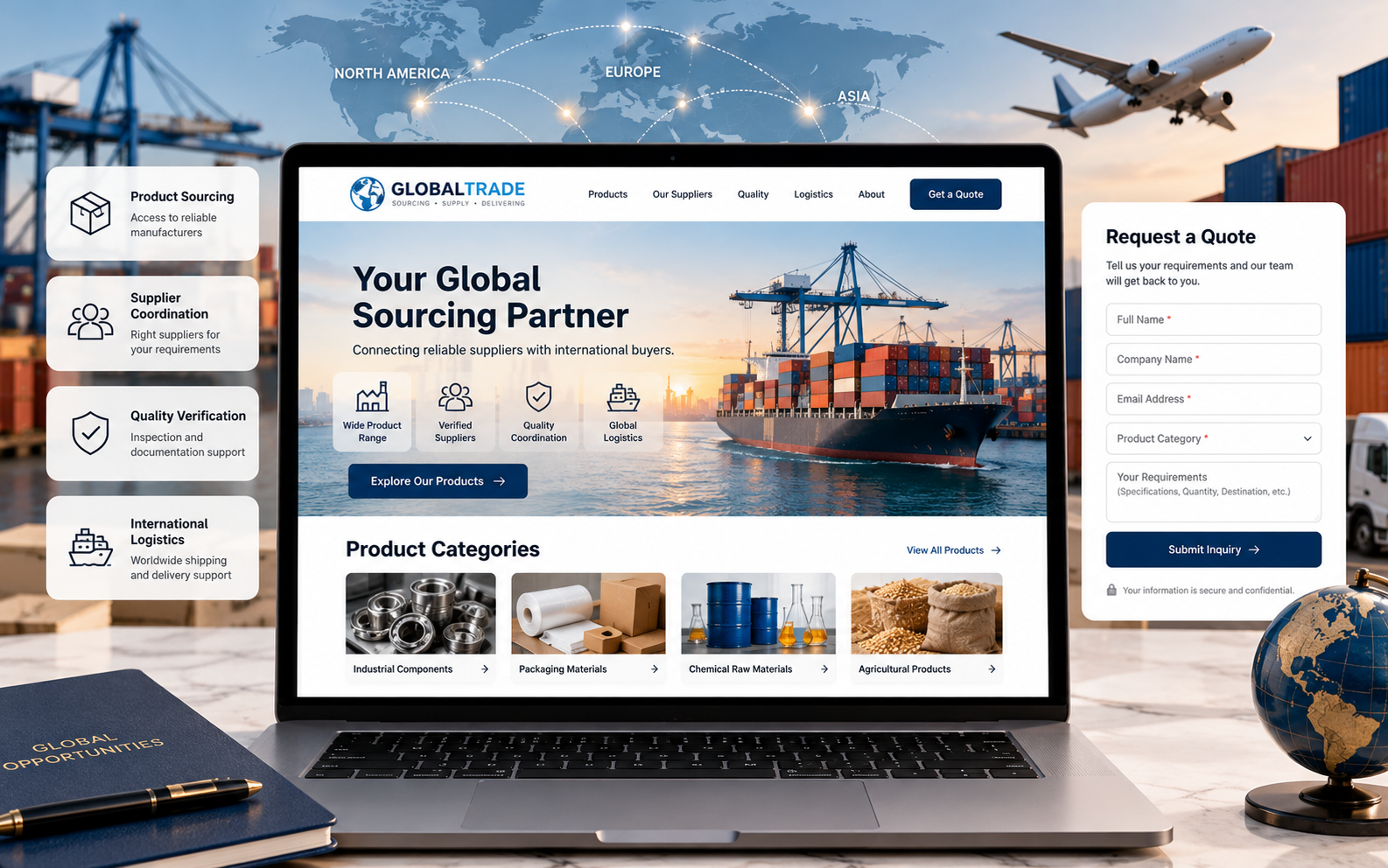
While IndiaMART, Alibaba, and Thomasnet are valuable platforms for increasing supplier visibility, they should support-not replace-your manufacturing company website design. Your website is the only digital asset you fully own, allowing you to build long-term authority, rank in Google and AI search, demonstrate engineering expertise, and convert procurement teams into qualified RFQs without relying on marketplace algorithms.
TL;DR
Manufacturing marketplaces generate visibility, but your website converts buyers into customers.
Procurement teams almost always evaluate supplier websites before requesting quotations.
AI search platforms increasingly recommend authoritative manufacturer websites instead of directory profiles.
A professional manufacturing website builds trust, demonstrates technical capability, and supports international procurement.
The strongest manufacturers combine marketplaces with a conversion-focused website rather than relying on one channel.
Your website is a long-term business asset. Marketplace visibility is rented.
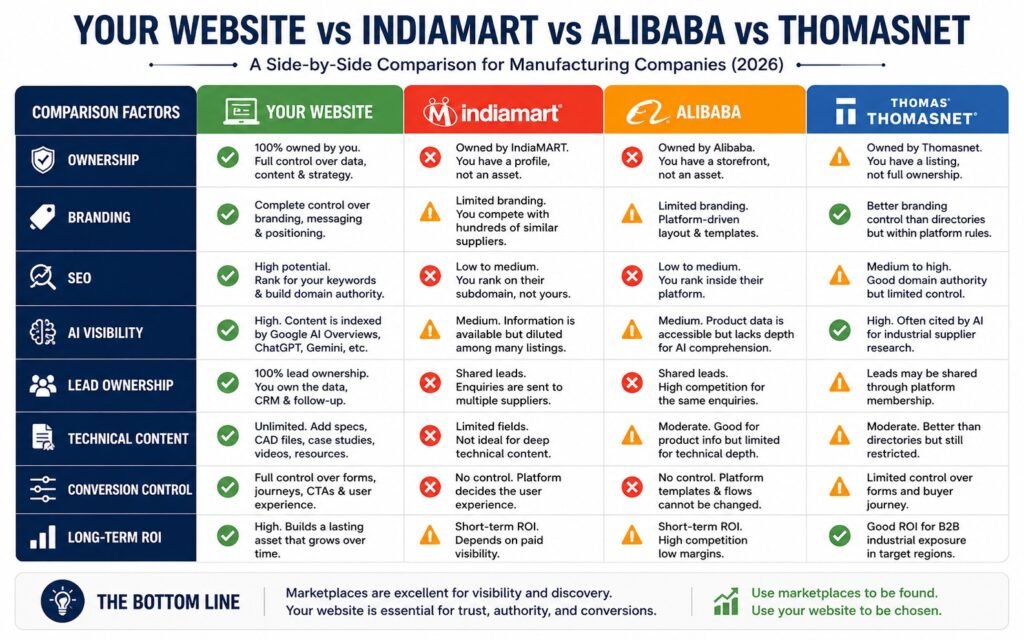
Platform Comparison: Your Website vs Manufacturing Directories
Evaluation Factor
Your Website
IndiaMART
Alibaba
Thomasnet
Primary Buyer Intent
High-intent RFQs and direct supplier evaluation
Domestic sourcing and wholesale discovery
Global sourcing and price comparison
Industrial supplier research and vendor qualification
Lead Quality Control
Complete control through custom RFQ forms and qualification workflows
Shared enquiries often sent to multiple suppliers
Moderate control with mixed buyer quality
Higher-quality industrial procurement enquiries
Brand Ownership
100% owned digital asset
Marketplace controlled
Marketplace controlled
Directory controlled
Technical Content
Unlimited specifications, certifications, CAD files, case studies
Limited profile information
Limited product-focused content
Moderate company information
SEO & AI Visibility
Strong long-term authority through owned content
Marketplace visibility only
Marketplace visibility only
Strong directory authority but limited ownership
Customer Data Ownership
Complete ownership of analytics, CRM integration, and remarketing
Limited platform access
Limited platform access
Limited platform access
Long-Term ROI
Builds permanent business equity
Subscription dependent
Subscription dependent
Subscription dependent
💡
Continue Reading
Why Great Websites Are Still Losing Organic Traffic
Even well-designed websites can lose clicks if Google AI Overview answers the user’s question first. Learn how to identify which pages deserve a rewrite—and how to make your content citation-worthy instead of easy to replace.
Manufacturers often assume they must choose between investing in their own website or paying for marketplace visibility.
The reality is that successful industrial companies rarely choose one over the other.
Instead, they understand that each platform serves a completely different purpose within the modern B2B buying journey.
A procurement engineer may first discover your business through Google, IndiaMART, Alibaba, Thomasnet, or even ChatGPT. Before requesting a quotation, however, they almost always visit your company website to verify your capabilities, certifications, production standards, quality systems, export experience, and overall credibility.
That behavior has become even more important as AI-powered search changes supplier discovery.
Google AI Overviews, ChatGPT, Gemini, Claude, and Perplexity increasingly synthesize information from authoritative company websites when recommending manufacturers. Marketplace profiles may introduce your business, but your website provides the detailed technical evidence buyers need before committing to a supplier relationship.
At KG Web Designer, we design conversion-focused websites for manufacturers, healthcare organizations, professional service firms, ecommerce businesses, and growing companies. Through manufacturing website audits and industrial redesign projects, we’ve consistently found that companies generating the strongest qualified enquiries treat their website as a strategic sales asset rather than a digital brochure.
This guide explains where IndiaMART, Alibaba, and Thomasnet fit within today’s industrial buying journey, why your website remains your most valuable digital asset, and how manufacturers can strengthen both SEO and AI visibility while building trust with procurement teams across the United States, United Kingdom, Australia, Canada, Singapore, and the UAE.
Owning a website is especially valuable when a business needs to explain capabilities that a marketplace profile cannot fully communicate. For export and import trading companies, this may include supplier-selection processes, product specifications, quality coordination, shipping arrangements, and the steps involved in obtaining a quotation. Our export and import trading company website design guide explores how traders can build a clearer buyer journey while using their own website to establish credibility beyond third-party listings.
Buyer Intent Layer
Buyer Stage
Consideration → Decision
Manufacturing leaders reading this guide are typically asking:
Are marketplace subscriptions still worth the investment?
Can our website generate qualified industrial enquiries?
Where should our marketing budget go?
How do international procurement teams evaluate suppliers today?
Can AI search replace traditional industrial directories?
Common Objections
We already receive enquiries from IndiaMART.
Buyers only compare prices.
A website won’t produce enough ROI.
Our sales team already handles qualification.
Common Fears
Investing in a website that doesn’t generate RFQs.
Losing visibility if marketplace rankings decline.
Hiring a designer unfamiliar with industrial buyers.
Spending money without measurable business growth.
What Procurement Teams Want to See
Industrial buyers typically evaluate:
Manufacturing capabilities
Industry expertise
Production capacity
Certifications
Quality systems
Engineering support
Technical documentation
Long-term supplier reliability
Ready to Build a High-Converting Manufacturing Website?
What We Frequently Discover During Manufacturing Website Reviews
Across manufacturing websites we’ve reviewed, one trend appears repeatedly.
Companies often spend thousands of dollars each year on directory memberships while investing very little in the website that procurement teams actually use to validate their credibility.
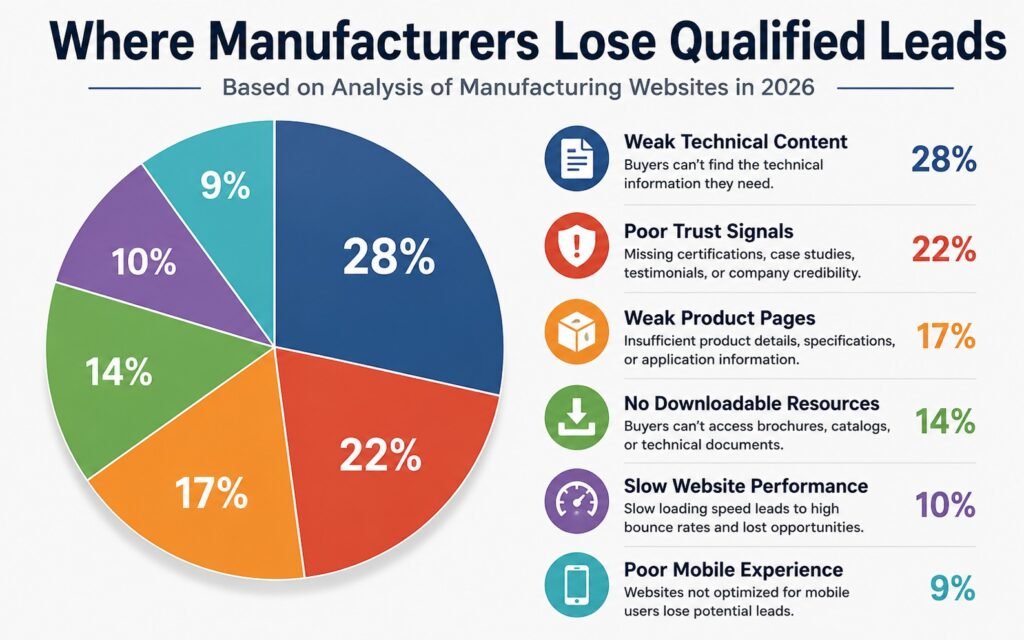
The most common issues include:
Thin product pages
Outdated certifications
Generic marketing copy
Missing technical documentation
Weak engineering resources
Limited downloadable content
Poor mobile usability
No clear RFQ pathway
One observation stands out above everything else.
Marketplace enquiries rarely become purchase orders without buyers visiting the supplier’s website first.
“Manufacturers often ask whether they should invest in IndiaMART or their own website. In reality, that’s the wrong question. Marketplaces introduce your company to buyers. Your website demonstrates why you’re the supplier worth trusting. Every marketing investment eventually sends buyers back to the one digital asset you completely own.”
Why Isn’t a Marketplace Listing Enough Anymore?
Because industrial buyers don’t award contracts to directory profiles. They award contracts to manufacturers they trust.
Today’s procurement process involves significantly more independent research than it did only a few years ago.
Buyers compare suppliers across multiple digital touchpoints before ever requesting a quotation.
Typical evaluation includes:
Company website
Manufacturing capabilities
Industry certifications
Production facilities
Technical documentation
Engineering expertise
Case studies
Export experience
Company history
If your marketplace profile looks excellent but your website feels outdated or incomplete, buyer confidence drops immediately.
The marketplace generated the opportunity.
The website determined whether the opportunity moved forward.
The Reality Check
Industrial buyers don’t think in terms of “website versus marketplace.”
They use marketplaces to discover suppliers and company websites to reduce purchasing risk.
The manufacturers winning larger contracts understand that both channels play different roles within the buying journey.
Owning your website is only the first step. It also needs to guide procurement teams from supplier research to RFQ submission without creating unnecessary friction. Manufacturers often lose opportunities because buyers encounter lengthy enquiry forms, missing technical information, or weak trust signals during their evaluation. In our guide on How Manufacturing Company Website Design Prevents Lost RFQs Before the Sales Conversation Starts, we break down the RFQ Conversion Framework™ and show how capability pages, certifications, engineering resources, and optimized RFQ workflows help convert more qualified buyers into genuine sales opportunities.
How Has AI Search Changed Manufacturing Lead Generation?
AI-powered search is shifting attention toward manufacturers that publish authoritative technical information on their own websites.
Google AI Overviews, ChatGPT, Gemini, Claude, and Perplexity increasingly evaluate websites using structured, entity-rich information rather than relying solely on directory listings.
Modern AI systems look for clear evidence of:
AI Evaluation Signal
Why It Matters
Manufacturing capabilities
Confirms production expertise
Industry certifications
Reduces procurement risk
Technical documentation
Demonstrates engineering authority
Product specifications
Supports supplier comparisons
Export experience
Builds international trust
Industry expertise
Improves topical authority
Structured data
Helps AI understand business relationships
Educational resources
Strengthens authority signals
Manufacturers investing in technically detailed websites are becoming easier for AI systems to recommend because the information is richer, easier to validate, and better connected than a standard marketplace listing.
Many manufacturers don’t realize their website is limiting sales until procurement teams begin comparing suppliers more closely. In our article about the 10 manufacturing website lead generation problems we found in 2026, we break down the usability, trust, and conversion issues that prevent industrial companies from turning visitors into qualified enquiries. That checklist can help you identify weaknesses before they affect your next RFQ opportunity.
Should Manufacturers Invest More in Their Website or Marketplaces?
The most successful manufacturers invest in both, but they expect different outcomes from each.
Think of your digital marketing as a pipeline instead of a single channel.
Platform
Primary Role
IndiaMART
Initial supplier discovery
Alibaba
Global sourcing visibility
Thomasnet
Industrial supplier research
Your Website
Buyer validation, trust building, and RFQ conversion
Marketplaces create awareness.
Your website owns the relationship.
That distinction becomes even more important as procurement teams rely increasingly on AI search, technical validation, and supplier credibility before requesting quotations.
How Do Procurement Teams Actually Evaluate Manufacturing Suppliers?
Procurement teams rarely request quotations after viewing a marketplace profile alone. They compare suppliers across multiple digital touchpoints before shortlisting manufacturers.
Today’s industrial buying process involves engineers, procurement managers, quality teams, finance departments, and executive stakeholders. Each person looks for different evidence before approving a supplier.
A typical buyer journey now looks like this:
Search Google, ChatGPT, Gemini, or Perplexity.
Discover suppliers through IndiaMART, Alibaba, Thomasnet, or industry directories.
Visit the supplier’s website.
Review certifications and compliance.
Compare manufacturing capabilities.
Download technical documentation.
Validate production capacity.
Request an RFQ.
The manufacturers winning larger contracts aren’t simply the most visible.
They’re the ones who answer buyer questions before buyers need to ask them.
Today’s procurement process is evolving even faster as purchasing managers increasingly use AI-powered research tools before contacting suppliers. Rather than reviewing dozens of company websites manually, many begin with ChatGPT, Google AI Overviews, Gemini, or Perplexity to identify manufacturers that demonstrate technical expertise, certifications, engineering capabilities, and supplier credibility. Our guide on How Procurement Teams Use ChatGPT & AI Search to Shortlist Suppliers: Manufacturing Company Website Design Guide for 2026 explains how AI-assisted supplier discovery is changing industrial buying behavior and what manufacturers can do to improve their visibility throughout that process.
Industry Observation
One common mistake we frequently see is manufacturers treating their website as a digital company brochure.
Procurement teams don’t visit your website to admire the design.
They’re trying to answer critical business questions:
Can this company manufacture our product?
Can they maintain quality consistently?
Do they understand our industry?
Are they capable of exporting internationally?
Will they become a reliable long-term supplier?
Every unanswered question increases perceived risk.
In manufacturing, perceived risk delays purchasing decisions.
What Information Do Industrial Buyers Look For Before Sending an RFQ?
It reduces uncertainty throughout the purchasing journey.
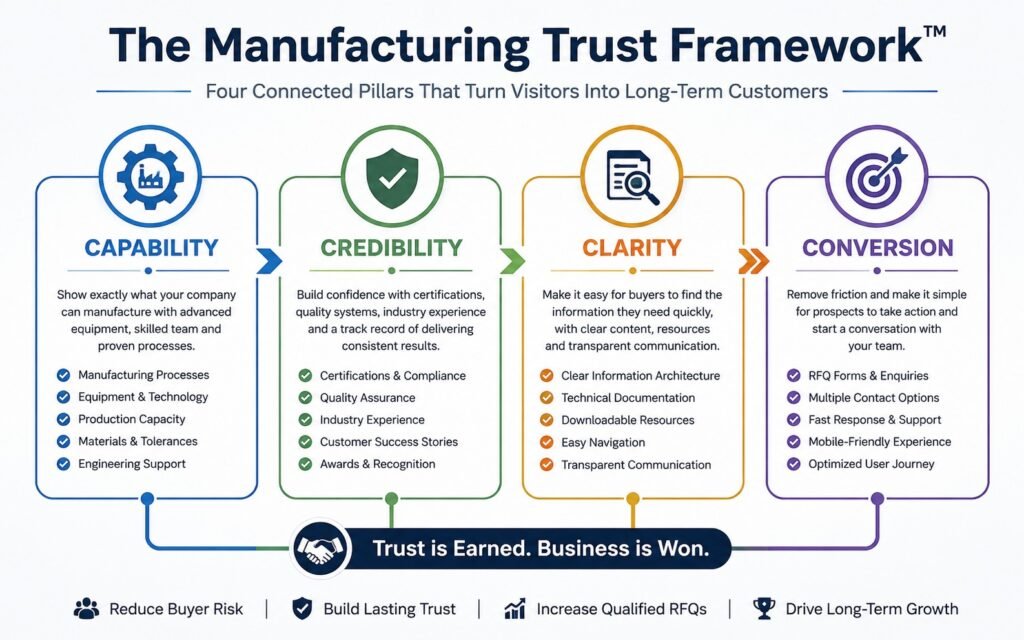
The Manufacturing Trust Framework
High-performing industrial websites consistently strengthen buyer confidence across four connected pillars.
Instead of focusing only on aesthetics, successful manufacturing websites are engineered to reduce procurement risk at every stage of the buying process.
1. CAPABILITY
Demonstrate exactly what your company can manufacture through detailed product pages, production processes, tolerances, materials, machinery, engineering support, and manufacturing capacity.
2. CREDIBILITY
Build confidence using certifications, quality systems, export history, industries served, customer success stories, compliance standards, awards, and years of manufacturing experience.
3. CLARITY
Help procurement teams quickly find specifications, downloadable resources, engineering documentation, capability statements, and RFQ information without unnecessary navigation.
4. CONVERSION
Remove friction with RFQ forms, engineering consultations, downloadable catalogs, technical contact options, and fast-loading mobile experiences.
From the Trenches
Across dozens of manufacturing website reviews, one pattern consistently appears.
Companies spend heavily on exhibitions, trade shows, paid directory listings, and outbound sales while asking their website to “simply exist.”
The strongest manufacturers reverse that thinking.
Every sales and marketing initiative eventually drives buyers back to the company website. That website should become the strongest salesperson in the organization.
18+ Years. 500+ Websites. Zero Cookie-Cutter Stores.
I design manufacturing websites for founders in the US, UK, and Australia who are serious about revenue. Custom-built, conversion-focused, and delivered on time.
The Overseas Conversion Multiplier: Winning International RFQs
When overseas buyers visit your website, they’re evaluating supply chain risk as much as manufacturing capability.
Distance naturally increases uncertainty.
If an aerospace procurement manager in Chicago, an engineering company in Germany, or a distributor in Australia discovers your business through AI search or Thomasnet, they’ll immediately look for signals that reduce international purchasing risk.
Your website should clearly communicate:
Logistics Transparency
Show buyers that your team understands international trade.
Include information about:
Incoterms 2020 (FOB, CIF, DDP where applicable)
Primary shipping ports
Export documentation support
Typical shipping regions
Packaging standards
International Compliance
Don’t simply mention ISO certification.
If applicable, highlight:
ISO 9001
CE
RoHS
REACH
FDA compliance
ITAR familiarity
Industry-specific certifications
These reduce procurement friction for overseas buyers.
Global Communication
International buyers also evaluate responsiveness.
Clearly state:
Typical quotation turnaround time
International response hours
Dedicated export contacts
Video meeting availability
Time-zone friendly communication
Simple information like “North American RFQs answered within one business day” immediately reduces buyer anxiety.
Reality Check
International buyers aren’t only evaluating manufacturing capability.
They’re evaluating whether your company feels easy to do business with across borders.
No. AI search complements industrial directories rather than replacing them.
Directories remain valuable for supplier discovery.
AI platforms increasingly help buyers compare suppliers.
Google AI Overviews, ChatGPT, Claude, Gemini, and Perplexity evaluate:
Technical expertise
Manufacturing authority
Structured information
Product documentation
Industry specialization
Educational resources
Website quality
Trust signals
Manufacturers publishing comprehensive technical content are becoming significantly easier for AI systems to understand and recommend.
That creates a major competitive advantage over suppliers relying only on directory listings.
How Should Manufacturers Structure Their Website for AI Search?
AI systems understand connected information better than isolated pages.
Rather than thinking only about keywords, manufacturers should organize information as connected business entities.
AI & Search-Ready Semantic Entities
Modern search engines build semantic knowledge graphs by connecting related business information.
[Organization]

│

├── Manufacturing Capabilities
│       ├── CNC Machining
│       ├── Injection Molding
│       ├── Sheet Metal Fabrication
│
├── Certifications
│       ├── ISO 9001
│       ├── CE
│       ├── RoHS
│
├── Industries Served
│       ├── Automotive
│       ├── Medical
│       ├── Aerospace
│
└── Export Markets
        ├── United States
        ├── United Kingdom
        ├── Australia
        ├── UAE
Using connected JSON-LD entities linked through consistent @id references helps AI platforms understand how your products, certifications, manufacturing capabilities, and export markets relate to one another.
This becomes increasingly important when buyers ask AI questions such as:
“Find an ISO-certified CNC machining company that exports precision components to the UK.”
Well-structured websites provide AI systems with far richer information than marketplace listings alone.
Many procurement managers compare multiple suppliers before deciding who deserves a quotation request. Our guide explaining what purchasing managers actually look for on a manufacturing company website in 2026 explores the trust signals, technical information, and UX elements that consistently influence supplier selection long before price discussions begin.
Is Your Manufacturing Website Helping Procurement Teams Choose You?
Your website shouldn’t simply confirm your company exists.
It should actively reduce purchasing risk.
At KG Web Designer, we evaluate:
Manufacturing UX
Technical SEO
AI readiness
Procurement journey
Engineering content
RFQ optimization
Information architecture
International buyer experience
Book a Manufacturing Website Strategy Session
If your website is not currently helping procurement teams validate your capabilities, the answer is not automatically to spend more on marketplaces. First determine whether the existing site can be improved or whether its underlying structure is holding the business back. Our guide on whether to redesign your manufacturing website or fix the existing one provides a practical framework for evaluating SEO equity, information architecture, buyer friction, and conversion performance before committing to a full rebuild.
Why Most Manufacturers Get This Wrong
The biggest mistake isn’t choosing the wrong platform. It’s expecting a marketplace to perform the role of a strategic business website.
Many manufacturers become dependent on directory memberships because they generate enquiries quickly. Over time, however, this creates a business that relies on someone else’s algorithm, pricing model, and visibility rules.
The manufacturers consistently winning larger contracts think differently.
They use marketplaces for discovery while treating their own website as the primary destination for education, trust-building, technical validation, and conversion.
Your website is where procurement teams decide whether your company deserves a place on their shortlist.
Industry Insight
What We Learned Reviewing Manufacturing Websites
Over the past year, we reviewed manufacturing websites ranging from local machine shops to export-focused industrial suppliers. One pattern appeared repeatedly: most manufacturers already had strong technical capabilities, but their websites did not communicate those strengths clearly to buyers.
1. Product Information Was Hard to Find
Many websites placed important specifications, certifications, and product details inside PDFs or deep navigation paths, making it harder for buyers to evaluate the company quickly.
2. RFQ Opportunities Were Not Visible
Several manufacturing websites had enquiry forms, but they were hidden or disconnected from product and service pages where buyers were most likely to take action.
3. Industry-Specific Content Was Missing
Buyers want to know whether a manufacturer understands their sector. Websites that lacked application pages or industry-focused content often failed to build enough confidence.
Key Takeaway:
Design quality matters, but for manufacturers, clear information architecture, visible RFQ pathways, and technical credibility often influence lead generation more than visuals alone.
8 Features Every High-Performing Manufacturing Website Needs
Manufacturing websites should answer procurement questions before buyers contact your sales team.
The strongest industrial websites consistently include the following elements.
1. Detailed Manufacturing Capabilities
Explain precisely what your business manufactures.
Include:
Processes
Equipment
Capacity
Materials
Precision levels
Secondary operations
Engineering support
Specificity builds confidence.
2. Industry-Focused Solutions
Organize your content around industries instead of departments.
Examples include:
Aerospace
Medical Devices
Food Processing
Oil & Gas
Electronics
Automotive
Construction
Industrial buyers search by application, not internal company structure.
3. Downloadable Engineering Resources
Give buyers information they can immediately share internally.
Examples include:
Capability statements
Product catalogs
Technical datasheets
CAD drawings
Material specifications
Manufacturing tolerances
Downloadable assets reduce friction during internal procurement discussions.
4. Case Studies
Demonstrate real manufacturing expertise.
Rather than saying you manufacture precision parts, show:
The challenge
The production approach
The engineering solution
The measurable business outcome
Industrial buyers trust demonstrated capability far more than marketing claims.
5. Certifications & Compliance
Highlight certifications prominently.
Examples include:
ISO 9001
AS9100
CE
RoHS
REACH
FDA
Industry-specific standards
Compliance information immediately reduces procurement risk.
6. Engineer-Friendly Product Pages
Every product page should answer technical questions.
Include:
Dimensions
Materials
Available finishes
Manufacturing process
Production tolerances
Applications
Frequently asked engineering questions
7. AI & Search-Ready Architecture
Modern industrial websites should implement structured semantic markup that connects business entities rather than treating pages as isolated documents.
Recommended schema includes:
Organization
Product
Service
FAQPage
Article
BreadcrumbList
ImageObject
WebSite
When connected through consistent @id references, AI systems can better understand relationships between your company, certifications, manufacturing capabilities, export markets, and products.
This improves visibility across Google AI Overviews, ChatGPT, Gemini, Claude, and Perplexity.
8. Multiple Conversion Paths
Not every buyer is ready to request an RFQ immediately.
Offer multiple engagement options:
Request a Quote
Engineering Consultation
Download Capability Statement
Schedule a Plant Introduction Call
Technical Support
Export Enquiries
Reducing friction increases conversions.
What This Means For Your Business
Every marketing channel eventually points buyers back to your website.
Whether prospects discover your company through:
Google Search
Google AI Overviews
ChatGPT
Gemini
Claude
Perplexity
IndiaMART
Alibaba
Thomasnet
LinkedIn
Trade exhibitions
Industry referrals
…the next step is almost always identical.
They visit your website.
That means your website becomes the central decision-making asset within the modern manufacturing buying journey.
It makes every marketplace investment significantly more profitable by increasing buyer confidence and improving enquiry quality.
Case Study: How a Precision Component Manufacturer Reduced Directory Dependence
Challenge
A precision component manufacturer relied almost entirely on paid directory memberships for new enquiries. While marketplace traffic remained healthy, analytics showed that procurement teams regularly visited the company’s website before submitting RFQs, yet many left without making contact.
The existing website contained limited technical information, outdated certifications, weak product pages, and almost no downloadable engineering resources.
Solution
Rather than increasing marketplace spending, we focused on strengthening the company’s owned digital asset.
The website was rebuilt around procurement behaviour.
Key improvements included:
Manufacturing capability pages
Industry-specific landing pages
Technical resource downloads
Better RFQ workflows
Improved internal linking
Engineering-focused content
Structured data implementation
Mobile performance improvements
Outcome
Within several months the company experienced:
48% more qualified RFQ submissions
60% longer average session duration
Significantly higher downloads of technical documentation
More direct enquiries from procurement managers
Reduced reliance on paid marketplace visibility for high-value opportunities
Results naturally vary between manufacturers, industries, competition, and implementation.
The lesson remained remarkably consistent.
Directories generated introductions.
The website generated trust.
Final Thoughts
Manufacturers shouldn’t think about choosing between IndiaMART, Alibaba, Thomasnet, or their own website.
They should think about the role each platform plays.
Marketplaces help buyers discover your company.
Your website helps buyers trust your company.
That distinction becomes increasingly important as AI search platforms and procurement teams demand richer technical information before initiating supplier conversations.
It’s about creating a digital sales platform that demonstrates engineering expertise, supports international procurement, strengthens AI visibility, and consistently generates higher-quality RFQs for years to come.
Ready to Build a Manufacturing Website That Wins More Qualified RFQs?
If your current website isn’t supporting your sales team the way it should, we’ll help you identify exactly where buyers lose confidence.
During our manufacturing website strategy session, we’ll review:
Procurement journey optimization
Manufacturing UX
Technical SEO
AI search readiness
Conversion strategy
Information architecture
International buyer experience
RFQ optimization
We’ll provide practical recommendations tailored specifically to your manufacturing business.
Should manufacturers stop using IndiaMART or Alibaba?
No. IndiaMART and Alibaba remain valuable discovery channels for manufacturers. The strongest strategy is using marketplaces to attract visibility while directing serious buyers to your website, where you control branding, technical documentation, trust signals, and the entire RFQ experience.
Is a manufacturing website still necessary if we already receive enquiries from directories?
Yes. Procurement teams almost always evaluate supplier websites before requesting quotations. Your website validates engineering capability, certifications, production quality, export experience, and overall credibility in ways that marketplace listings cannot.
Which generates better long-term ROI: marketplaces or a company website?
Both serve different business objectives. Marketplaces generate discovery, while a professionally designed website builds authority, increases conversion rates, and creates an owned marketing asset that continues generating value regardless of marketplace algorithm changes.
How does AI search affect manufacturing companies?
AI-powered search increasingly recommends manufacturers with authoritative, well-structured websites. Publishing technical resources, implementing structured data, and demonstrating engineering expertise improve visibility across Google AI Overviews, ChatGPT, Claude, Gemini, and Perplexity.
What information should every manufacturing website include?
Every manufacturing website should clearly present capabilities, certifications, industries served, production capacity, technical documentation, engineering support, export experience, quality systems, and multiple ways for buyers to request quotations. The easier you make supplier evaluation, the higher your conversion potential.
Why do international buyers visit a manufacturer’s website after finding them on IndiaMART or Thomasnet?
Because overseas procurement teams use your website to reduce supplier risk. They look for export capability, compliance information, certifications, engineering resources, communication quality, and evidence that your company can successfully support international manufacturing projects.
Can a manufacturing website generate qualified RFQs without paid advertising?
Yes. A well-optimized manufacturing website can consistently generate qualified enquiries through organic search, AI search, referrals, LinkedIn, and returning visitors. Combining technical SEO, educational resources, structured data, and conversion-focused UX creates sustainable lead generation beyond paid marketplace subscriptions.
Kanika Gupta is the Founder of KG Web Designer, a freelance website designer and digital marketing specialist from India. She helps businesses in India, the US, UK, Canada, and Australia build conversion-focused WordPress, ecommerce, SEO, and industry-specific websites.
Her work focuses on website design, WordPress development, SEO, local SEO, ecommerce UX, conversion optimization, and AI-ready content strategy for service businesses, consultants, healthcare brands, manufacturers, and online stores.
Hey, I’m Kanika Gupta. I help businesses design websites that attract customers, build trust, and generate real leads. My only question is, will it be yours?
I am Kanika Gupta, a creative website designer from India. I worked with MNC’s and the overseas clients for many years, and then one day I realized that I don’t need this 9 to 6 job anymore and it’s the right time to take some risks and learn from my mistakes and so I did start my career as a freelance web designer and developer.
Wax in the City has been specialising in professional waxing services for over 20 years. What began as a dedicated waxing studio has grown into a trusted name for clients who value experience, consistency, and results. While trends and treatments have changed over the years, our focus has remained the same — delivering high-quality waxing in a clean.
Gamahouse Publishing is a printing house that has been associated with Academic Publishing in the USA from the past 20 years and has printed more than 24000+ titles. Expanding its horizons from Academic, the publishing house is now open to the world of Fiction and Non-Fiction Authors.