Quick Answer
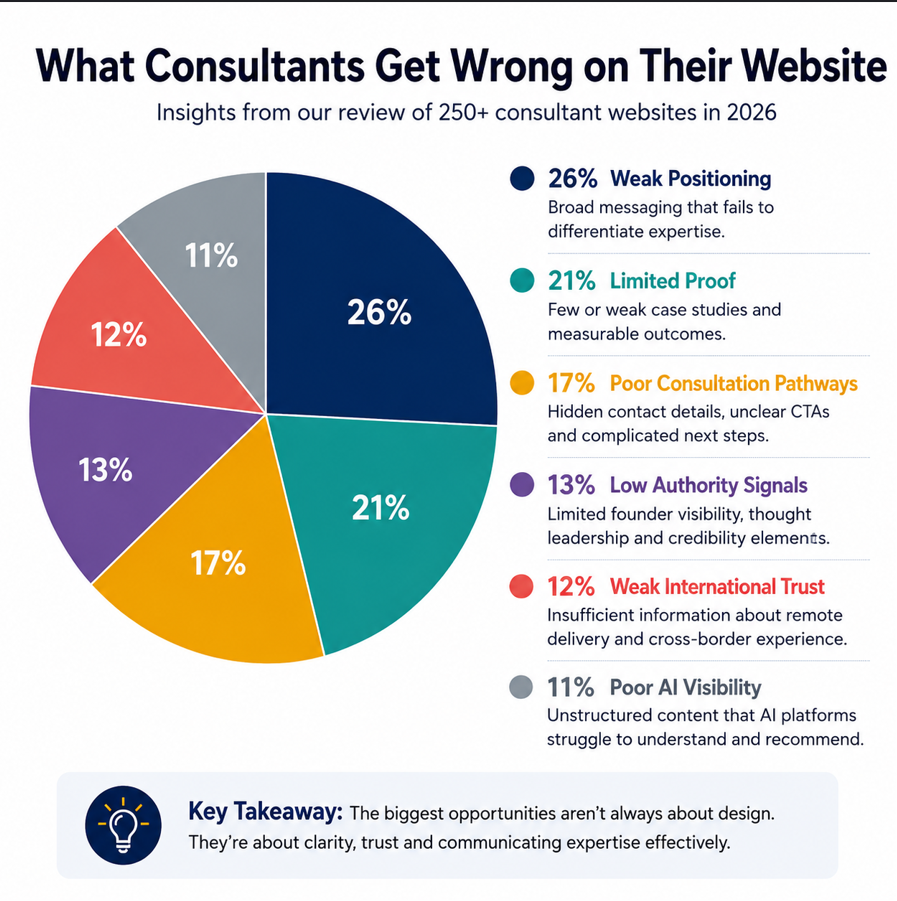
Our KG Web Designer 2026 Consultant Website Benchmark Report reviewed more than 250 consultant and boutique consulting firm websites across New York, London, Sydney, Toronto, Dubai, and Singapore. The highest-performing firms all shared one characteristic: their consultant website design made expertise immediately obvious, reduced buyer uncertainty, demonstrated measurable business outcomes, and helped executives feel confident enough to schedule a strategic conversation.
TL;DR
- Most consultant websites fail because prospects cannot immediately understand what makes the consultant different.
- Executive buyers evaluate trust long before they evaluate pricing.
- Strong positioning consistently generates more qualified consultations than broad service messaging.
- AI platforms increasingly recommend consultants with structured expertise, original insights, and measurable proof.
- International buyers expect websites to reduce the perceived risks of remote consulting engagements.
- Small improvements in authority positioning often increase consultation requests without increasing marketing spend.
Top 10 Lead Generation Problems Covered In This Guide
Jump directly to any section.
- Generic positioning
- Outcome-free service pages
- Weak case studies
- High-friction consultation pathways
- Limited personal authority
- Poor international buyer confidence
- Weak AI visibility
- Broken buyer journeys
- Generic thought leadership
- Low trust architecture
Inside The KG Web Designer 2026 Consultant Website Benchmark Report
Between Q4 2025 and Q2 2026, we evaluated more than 250 consultant and boutique consulting firm websites across eleven major business hubs.
Our review included consultants serving clients in:
- New York
- Boston
- Chicago
- London
- Manchester
- Sydney
- Melbourne
- Toronto
- Vancouver
- Dubai
- Singapore
Rather than focusing on visual design alone, every website was measured against our proprietary Consultant Trust Framework.
This framework evaluates the five areas that consistently influence consultation requests and premium client acquisition.
| Consultant Trust Framework | What We Evaluated |
|---|---|
| Positioning | Market differentiation and value proposition clarity |
| Proof | Case studies, measurable outcomes, testimonials and credibility |
| Authority | Founder expertise, thought leadership and industry trust |
| Conversion | Consultation pathways and buyer journey |
| AI Visibility | Structured content, expertise signals and discoverability |
This report was designed to answer one question.
Why do some consulting firms consistently attract premium clients while equally experienced competitors struggle to generate inquiries?
Many consultants focus on fixing individual website issues without recognizing how prospects now discover expertise through AI-powered search platforms. Before exploring the most common lead generation mistakes, it’s worth understanding how ChatGPT, Google AI Overviews, Gemini, and Perplexity evaluate consulting websites. Our guide on How Clients Find Consultants Through ChatGPT & AI Search explains how AI-driven search is changing consultant visibility and why website structure now plays a direct role in winning qualified inquiries.
What We Learned From Reviewing 250+ Consultant Websites
The results were remarkably consistent.
Most consulting firms were not losing business because they lacked expertise.
They were losing opportunities because prospects could not recognize that expertise quickly enough.
Professional services operate differently from ecommerce or product-based businesses.
Decision-makers rarely make impulsive purchasing decisions.
Instead, they gradually reduce risk.
Every page they visit either increases confidence or introduces doubt.
When websites fail to communicate expertise efficiently, prospects simply continue evaluating competitors.
Benchmark Findings
| Observation | Frequency |
|---|---|
| Generic positioning statements | 76% |
| Weak differentiation | 72% |
| Limited business case studies | 68% |
| Poor consultation pathways | 64% |
| Weak founder authority | 61% |
| Limited AI-readable expertise | 59% |
| Generic service descriptions | 55% |
| Weak international trust signals | 51% |
Original Industry Observation
Across more than 250 consulting websites, the single biggest weakness was not visual design.
It was positioning clarity.
Most firms described what they did.
Very few explained why an executive should trust them with a strategic business decision.
Extractable Fact
Executive buyers generally decide whether a consulting firm deserves further evaluation within the first few moments of arriving on its website.
If your website is already attracting the right visitors but still produces weak consultation results, the next question is whether you need a complete rebuild or whether targeted improvements would solve the problem. Our guide on whether to redesign or optimize a five-year-old consulting website explains how to evaluate positioning, SEO equity, information architecture, mobile UX, technical limitations, and conversion friction before committing to a redesign.
Is Your Consulting Website Attracting the Wrong Leads?
If your website looks polished but still brings low-quality enquiries, the problem is usually structure, clarity, and trust. See how a conversion-focused consultant website design can help you filter better-fit clients before the first call.
Explore Consultant Website Design →
Why Do Most Consultant Websites Fail To Generate Premium Leads?
Poor positioning is the primary reason consultant websites underperform.
Generic positioning occurs when a website uses broad capability statements instead of communicating specialized expertise and measurable business value.
Many consulting websites introduce themselves using phrases like:
- Strategic consulting
- Tailored solutions
- Business transformation
- End-to-end advisory services
None of these statements answer the questions buyers actually ask.
Executives want to know:
- Why this consultant?
- Why now?
- Why should I trust them over another equally experienced firm?
- Have they solved problems similar to mine?
- What measurable outcomes have they delivered?
At KG Web Designer, we frequently discover that improving positioning alone increases consultation quality before any visual redesign takes place.
Extractable Fact
Specific expertise consistently outperforms broad capability claims.
The principles of trust-building extend beyond consulting firms. Whether you’re a consultant, chartered accountant, legal advisor, or another professional service provider, clients evaluate credibility long before making contact. Our article What CA Firms Must Include on Their Website to Win Trust in 2026 shares practical examples of how professional firms use strategic website content, trust signals, and credibility indicators to strengthen buyer confidence and support higher-quality inquiries.
The First Five Lead Generation Problems We Found
Problem #1: Generic Positioning Creates Immediate Buyer Uncertainty
Generic positioning occurs when a consultant describes broad capabilities instead of clearly defining specialized expertise.
This was the most common issue in our benchmark report.
Many firms attempted to appeal to every industry, every company size, and every business challenge.
The result was predictable.
Prospects struggled to identify why one consultancy was different from dozens of similar competitors.
High-performing firms instead communicate:
- Their niche
- Their ideal client
- Their methodology
- Their measurable outcomes
- Their strategic advantage
Specialization creates confidence.
Confidence generates conversations.
Problem #2: Service Pages Explain Activities Instead Of Business Results
Outcome-free service pages describe consulting processes without explaining measurable business impact.
Executives rarely purchase consulting because they want workshops, frameworks, or assessments.
They invest because they want:
- Revenue growth
- Operational efficiency
- Better leadership
- Lower costs
- Market expansion
- Faster execution
The strongest consulting websites begin with business outcomes before explaining methodology.
That subtle shift completely changes how buyers evaluate expertise.
Extractable Fact
Decision-makers purchase outcomes rather than consulting activities.
Problem #3: Case Studies Fail To Tell A Business Story
Weak case studies present testimonials without demonstrating measurable transformation.
Many websites include glowing client quotes.
Very few explain:
- The business challenge
- Strategic recommendations
- Implementation process
- Quantifiable improvements
- Long-term business impact
Business leaders trust evidence.
Evidence creates confidence.
Confidence generates premium inquiries.
Industry Observation
One common mistake we notice is that consultants assume credentials automatically establish authority.
In reality, executives place greater confidence in demonstrated business outcomes than professional biographies.
Problem #4: Consultation Pathways Introduce Unnecessary Friction
Consultation friction occurs whenever a qualified prospect encounters unnecessary obstacles before scheduling a conversation.
Examples include:
- Hidden contact pages
- Generic inquiry forms
- No qualification process
- Weak calls-to-action
- Unclear next steps
High-performing consulting firms make scheduling remarkably simple.
Every page naturally guides the reader toward the next stage of the buying journey without feeling overly promotional.
Problem #5: Founder Authority Is Underdeveloped
Authority gaps occur when the consultant behind the business remains largely invisible throughout the website.
Consulting is fundamentally a trust business.
Executives hire people before they hire firms.
Prospective clients want to understand:
- Professional background
- Industry expertise
- Strategic philosophy
- Speaking engagements
- Published insights
- Leadership experience
This is where consulting firm website design becomes a strategic growth asset rather than simply a branding exercise.
Strong founder authority consistently reduces perceived buying risk.
Expert Insight From Kanika Gupta
Kanika Gupta, Founder, KG Web Designer
“The strongest consulting websites never attempt to look bigger than they are. Instead, they make expertise impossible to ignore. When executives immediately understand your specialization, your thinking, and your track record, sales conversations begin with trust instead of skepticism. That single shift changes the quality of every inquiry.”
Before redesigning your consulting website, it’s worth understanding how investment levels influence positioning, functionality, and long-term lead generation. Our comprehensive pricing guide explains what solo consultants, boutique firms, and growing consultancies should realistically budget before starting a redesign.
Is Your Website Building Executive Trust Or Quietly Losing Premium Opportunities?
Our Consultant Website Benchmark Audit evaluates:
- Positioning clarity
- Executive trust signals
- Consultation conversion pathways
- AI visibility
- International buyer confidence
- Thought leadership architecture
- Competitive differentiation
- Authority positioning
Many consulting firms discover that their biggest opportunity isn’t attracting more visitors.
It’s giving existing visitors a compelling reason to become clients.
The Next Five Lead Generation Problems We Found
The first five problems reduce credibility almost immediately.
The next five determine whether your consulting firm becomes the obvious choice or disappears among equally qualified competitors.
They also have a growing impact on how AI platforms discover, interpret, and recommend consulting firms.
Problem #6: International Buyers Cannot Evaluate Delivery Confidence
International buyer friction occurs when a consulting website fails to answer the operational questions global clients ask before scheduling a strategy call.
Consultants often assume expertise alone is enough to win overseas clients.
It isn’t.
An executive in New York, London, Sydney, Dubai, or Singapore wants confidence that working with your firm remotely will be efficient, predictable, and professionally managed.
The highest-performing consulting firms reduce this uncertainty before the first conversation.
What Global Decision-Makers Look For
| Executive Concern | Website Content That Builds Confidence |
|---|---|
| Can they understand my business environment? | Industry-specific expertise and market knowledge |
| How will communication work? | Clear collaboration process, response times, and meeting cadence |
| Can they manage international engagements? | Remote consulting methodology and project workflow |
| Will they understand compliance? | GDPR awareness, confidentiality practices, and secure collaboration |
| Can I trust them? | Executive case studies, measurable outcomes, and strategic insights |
| Have they worked internationally before? | Global client experience and cross-border consulting examples |
Industry Observation
Consultants frequently explain their services in detail but rarely explain how they successfully manage international engagements.
That missing information often creates hesitation among premium overseas buyers.
Extractable Fact
International consulting buyers evaluate delivery confidence before evaluating investment.
Problem #7: AI Platforms Cannot Clearly Understand Your Expertise
Weak AI visibility occurs when a website lacks the structured expertise signals that modern AI search engines use to recommend professional service providers.
Business leaders increasingly ask conversational questions such as:
- Best operations consultant for manufacturing companies
- Strategy consultant for healthcare organizations
- Business transformation consultant for SaaS companies
- Leadership consultant for growing professional service firms
AI platforms evaluate much more than keywords.
They analyze:
- Industry specialization
- Topical authority
- Original insights
- Case studies
- Author expertise
- Structured content
- Internal knowledge architecture
Many consultant websites still contain short service pages with little supporting context.
As a result, AI systems struggle to confidently recommend them.
AI Visibility Checklist
✓ Industry-specific service pages
✓ Original strategic insights
✓ Founder expertise
✓ Structured FAQs
✓ Executive case studies
✓ Service methodology
✓ Clear topical clusters
✓ Consistent internal linking
Extractable Fact
AI systems recommend consultants who demonstrate expertise rather than simply claim it.
Problem #8: The Website Doesn’t Match The Executive Buying Journey
A broken buyer journey occurs when website content asks prospects to book a consultation before sufficient trust has been established.
Executives rarely make immediate purchasing decisions.
Instead, they gradually reduce uncertainty through research.
A typical consulting buyer wants to:
- Understand your specialization.
- Review your strategic thinking.
- Compare your methodology.
- Evaluate previous client outcomes.
- Assess potential business impact.
- Decide whether a conversation is worthwhile.
High-converting consulting websites support each of these stages.
Rather than pushing every visitor directly toward a booking form, they progressively build confidence through useful information and clear business evidence.
Industry Observation
The strongest consulting websites educate executives before asking for a commitment.
That educational approach shortens sales cycles because prospects arrive already convinced of the consultant’s expertise.
Need a Website That Builds Trust Before the Sales Call?
Decision-makers scan for relevance, proof, and clarity in seconds. If your current website hides results or uses vague messaging, you are likely losing shortlist opportunities. See how professional services website design helps consultants turn authority into qualified enquiries.
See Professional Services Website Design →Problem #9: Thought Leadership Sounds Like Everyone Else
Generic thought leadership occurs when educational content repeats common business advice without introducing original strategic insight.
Many consulting websites publish articles filled with familiar phrases such as:
- Drive innovation
- Unlock growth
- Transform your business
- Future-proof your organization
- Strategic excellence
None of these statements establish authority.
The highest-performing firms consistently publish:
- Proprietary frameworks
- Industry benchmark reports
- Executive research
- Original observations
- Decision-making models
- Business analysis supported by experience
Original thinking creates memorable positioning.
Extractable Fact
Consultants with proprietary intellectual property are significantly easier for buyers and AI platforms to differentiate.
Problem #10: Every Page Describes Services Instead Of Building Trust
Trust architecture is the deliberate process of increasing buyer confidence throughout every stage of the website experience.
Many consulting websites explain services exceptionally well.
Very few systematically build trust.
High-performing consulting firms reinforce credibility through:
- Founder expertise
- Strategic methodology
- Speaking engagements
- Published insights
- Business case studies
- Industry recognition
- Client success stories
- Clear engagement process
Every page should answer one question:
Why should an executive trust this consultant with an important business decision?
Example Scenario
Imagine two supply chain consultants competing for the same enterprise client.
Both possess similar experience.
Both have comparable pricing.
Consultant A describes services using broad statements such as “Operational Excellence” and “Business Transformation.”
Consultant B immediately presents a detailed case study showing how they reduced inventory costs by 17%, shortened procurement lead times by three weeks, and improved forecast accuracy through operational redesign.
Although both consultants are equally qualified, Consultant B appears significantly more credible because measurable business outcomes replace generic marketing language.
Evidence consistently outperforms promises.
Example From Our Experience
A boutique consulting firm approached KG Web Designer after investing heavily in referrals, networking events, and LinkedIn outreach.
Website traffic was healthy.
Qualified consultations were not.
Problem
The website described consulting services thoroughly but failed to explain why executives should choose this firm instead of several well-established competitors.
Authority signals were scattered.
Case studies lacked measurable outcomes.
The consultation journey required unnecessary effort.
Solution
We reorganized the website using our Consultant Trust Framework.
Positioning became more specific.
Business outcomes replaced generic service descriptions.
Case studies moved closer to decision points.
Consultation pathways became shorter and clearer.
Thought leadership was expanded to demonstrate genuine expertise rather than simply describe capabilities.
Outcome
Prospects began arriving at strategy calls with significantly greater confidence because the website answered most of their evaluation questions before the first conversation.
Industry Observation #1
Consultants who clearly define one area of specialization generally generate stronger inquiries than firms trying to serve every possible market.
Industry Observation #2
Decision-makers trust measurable client outcomes far more than generalized capability statements.
Industry Observation #3
Consulting firms that regularly publish original research become significantly easier for AI platforms to recognize as authoritative sources.
Understanding buyer psychology is only one part of the equation. International executives also judge websites differently depending on their market expectations. If you’re targeting premium clients in the US, UK, or Australia, this guide explains the trust signals global buyers expect before scheduling a consultation.
Why Is AI Visibility Becoming A Competitive Advantage For Consultants?
AI-assisted search is fundamentally changing how executives shortlist consulting firms.
Instead of browsing dozens of websites, business leaders increasingly ask AI platforms for recommendations.
The consultants who appear most frequently share several characteristics.
They publish:
- Original research
- Industry-specific expertise
- Detailed case studies
- Structured service pages
- Clear founder authority
- Comprehensive FAQs
- Consistent topical content
This is why consultant website design services have become much more than a branding investment.
They now influence visibility across both traditional search engines and AI-powered recommendation systems.
What High-Performing Consulting Firms Do Differently
They build websites that help:
- Executives understand expertise quickly.
- AI systems interpret specialization accurately.
- Buyers reduce perceived consulting risk.
- Sales conversations begin with confidence rather than skepticism.
Consulting firms that invest in authority-driven websites today are positioning themselves for both traditional search and the next generation of AI-assisted buyer discovery.
Why Most Consulting Firms Get This Wrong
Most consulting firms assume their website exists to explain what they do.
That assumption creates the largest conversion gap we identified in our benchmark report.
A consulting website should not function as an online brochure. It should function as a decision-support tool that progressively reduces uncertainty for executive buyers.
The strongest consulting websites guide visitors through a logical trust-building process. Every page reinforces expertise, answers business objections, and provides evidence that the consultant can solve complex strategic challenges.
During our benchmark review, we found that many firms invested heavily in networking, referrals, conferences, paid advertising, and LinkedIn thought leadership while overlooking what happened after prospects arrived on their website.
Instead of building confidence, many websites interrupted the buying journey through weak positioning, limited proof, and unclear consultation pathways.
Common Misconceptions
| Common Belief | What High-Performing Firms Actually Do |
|---|---|
| A professional design automatically builds trust. | Trust comes from expertise, proof, and strategic positioning. |
| More website traffic means more clients. | Better positioning often improves conversions before additional traffic is needed. |
| Listing consulting services is enough. | Decision-makers want measurable business outcomes and industry expertise. |
| Testimonials alone establish credibility. | Buyers expect detailed case studies supported by real business impact. |
| Every visitor is ready to schedule a consultation. | Most executives require multiple trust signals before making contact. |
Extractable Fact
Executive buyers reduce perceived risk before they schedule strategic conversations.
What This Means For Your Business
Every consulting website is either strengthening your positioning or weakening it.
There is very little middle ground.
A strategically designed website influences:
- Consultation requests
- Lead quality
- Client confidence
- Sales cycle length
- Premium pricing
- Referral opportunities
- AI visibility
- Long-term authority
At KG Web Designer, we regularly find that improving positioning, trust architecture, and authority signals produces stronger business results than simply redesigning visual elements.
Many firms already possess the expertise required to attract premium clients.
Their website simply doesn’t communicate it effectively.
The Consultant Trust Framework In Action
Throughout this benchmark report, one pattern consistently appeared.
The highest-performing consulting firms excelled across five interconnected areas.
| Framework Element | Business Impact |
|---|---|
| Positioning | Immediately differentiates your expertise from competitors. |
| Proof | Demonstrates measurable client outcomes and reduces buyer risk. |
| Authority | Builds executive confidence before conversations begin. |
| Conversion | Makes scheduling consultations simple and friction-free. |
| AI Visibility | Improves discoverability across Google AI, ChatGPT, Gemini, and Perplexity. |
Weakness in any one area reduces the effectiveness of the others.
The firms generating the strongest pipeline consistently invest across all five.
How Should Consulting Firms Prepare For AI-Powered Search?
AI-assisted search is becoming a standard part of executive research.
Business leaders increasingly ask conversational questions instead of browsing multiple websites.
Examples include:
- Which consultant specializes in operational transformation?
- Best strategy consultant for professional service firms
- Leadership consultant for healthcare organizations
- Business growth consultant for manufacturing companies
Consultants that clearly define expertise, industries served, methodologies, and measurable outcomes are significantly more likely to appear in AI-generated recommendations.
This is why consultant website for lead generation now extends beyond traditional SEO.
Modern consulting websites should include:
✓ Original research
✓ Industry-specific service pages
✓ Detailed case studies
✓ Executive FAQs
✓ Author expertise
✓ Structured content hierarchy
✓ Internal topical clusters
✓ Consistent thought leadership
Extractable Fact
AI platforms recommend consultants whose expertise is supported by structured evidence rather than marketing claims.
One of the strongest ways to reinforce executive trust is through detailed business case studies. Instead of relying solely on testimonials, explain the client’s challenge, your strategic approach, measurable outcomes, and long-term business impact. That combination improves both buyer confidence and AI visibility.
Final Thoughts
Reviewing more than 250 consultant websites revealed one consistent pattern.
The firms winning premium engagements were rarely those with the flashiest designs.
They were the firms that communicated expertise with exceptional clarity.
They positioned themselves around business outcomes instead of consulting activities.
They demonstrated measurable proof instead of relying on broad claims.
And they systematically reduced buyer uncertainty throughout every stage of the website experience.
Investing in consultant website design is no longer simply about creating a better-looking website.
It is about building a digital platform that strengthens authority, improves AI visibility, increases executive trust, and consistently generates qualified consultations.
The consulting firms that communicate expertise most effectively are becoming the firms most frequently recommended by both human decision-makers and AI-powered search platforms.
Ready To Position Your Consulting Firm As The Obvious Choice?
Whether you’re an independent consultant, executive advisor, or growing boutique consulting firm, your website should actively support business development instead of simply describing your services.
| Your Challenge | Recommended Next Step | Business Outcome |
|---|---|---|
| Consultation requests are lower than expected | Consultant Website Benchmark Audit | Identify positioning gaps, trust leaks, conversion issues, and AI visibility opportunities. |
| Your expertise isn’t clearly differentiated | Strategy Session | Develop stronger market positioning, authority messaging, and premium consultation pathways. |
| Your website no longer reflects your firm’s expertise | Website Transformation Consultation | Receive a customized roadmap covering content strategy, UX improvements, AI optimization, timeline, and investment guidance. |
Direct Access
| Service | Link |
|---|---|
| Book a 30-Minute Strategy Session | https://calendly.com/kanika-kgwebdesigner/30min |
| Contact Kanika Gupta Directly | https://kgwebdesigner.com/contact-me/ |
Available across US, UK, Australia, Canada, Singapore, and UAE time zones. Fully remote. No commitment required.
Ready to Turn Your Consulting Website Into a Client-Filtering System?
If your website is attracting traffic but not the right enquiries, it is time to improve the messaging, trust signals, and conversion flow. I help consultants build websites that support premium positioning and better-fit leads.
Frequently Asked Questions
Why isn’t my consulting website generating qualified leads?
Most consulting websites describe services instead of demonstrating strategic expertise. Executive buyers want evidence that you understand their industry, have solved similar business problems, and can deliver measurable outcomes before scheduling a consultation.
What makes a consulting website generate more premium inquiries?
A successful consulting website combines clear positioning, measurable case studies, authority-building content, founder credibility, structured consultation pathways, and educational resources that reduce buyer uncertainty throughout the decision-making process.
Should consulting firms specialize their messaging?
Yes. Consulting firms that communicate a clear specialization generally attract better-qualified prospects than firms trying to appeal to every industry. Specific positioning increases trust and improves conversion rates.
How important are case studies for consulting firms?
Case studies are among the strongest trust signals available. They demonstrate strategic thinking, explain how business challenges were solved, and provide measurable evidence that your methodology produces results.
Can AI platforms influence consulting lead generation?
Absolutely. Executives increasingly use AI platforms to research consultants before visiting individual websites. Firms with structured expertise, original insights, and comprehensive authority content are more likely to appear in AI-generated recommendations.
How do international clients evaluate consulting firms?
International buyers evaluate more than expertise. They also consider communication processes, time-zone collaboration, remote delivery methodology, confidentiality practices, and previous experience serving global clients.
What should every consulting homepage include?
A high-performing homepage should clearly explain who you help, the business problems you solve, measurable client outcomes, strategic methodology, founder credibility, and a simple path to booking a consultation.