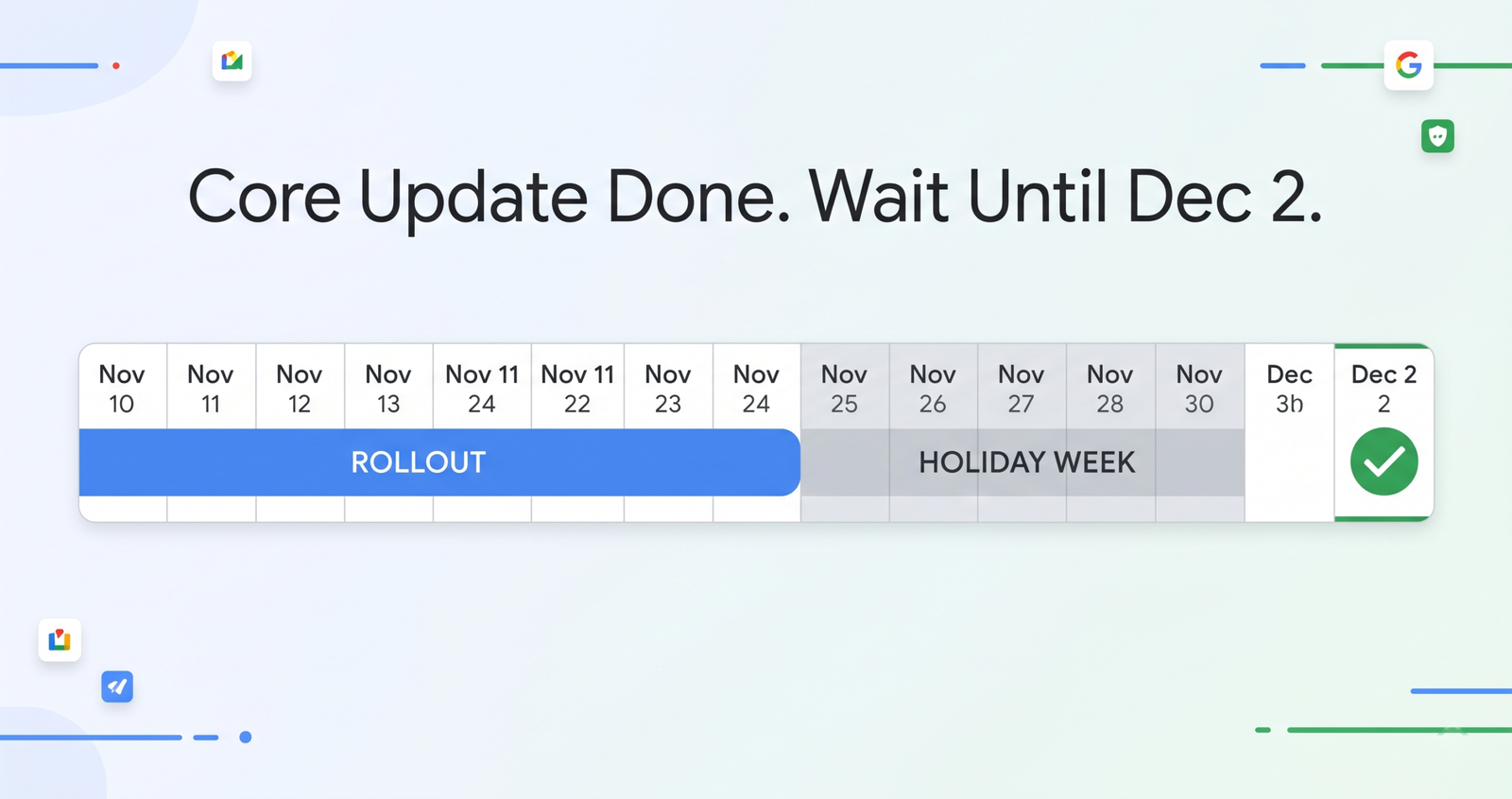
The November 2026 core update is done. Google’s ranking change finished rolling out on Tuesday, November 24. Many business owners will open Search Console tonight to see if they won or lost. Please don’t. Not yet. Google itself says to wait a full week after a core update ends. This year, that week lands on Thanksgiving, Black Friday and Cyber Monday. Your traffic will swing for holiday reasons that have nothing to do with rankings.
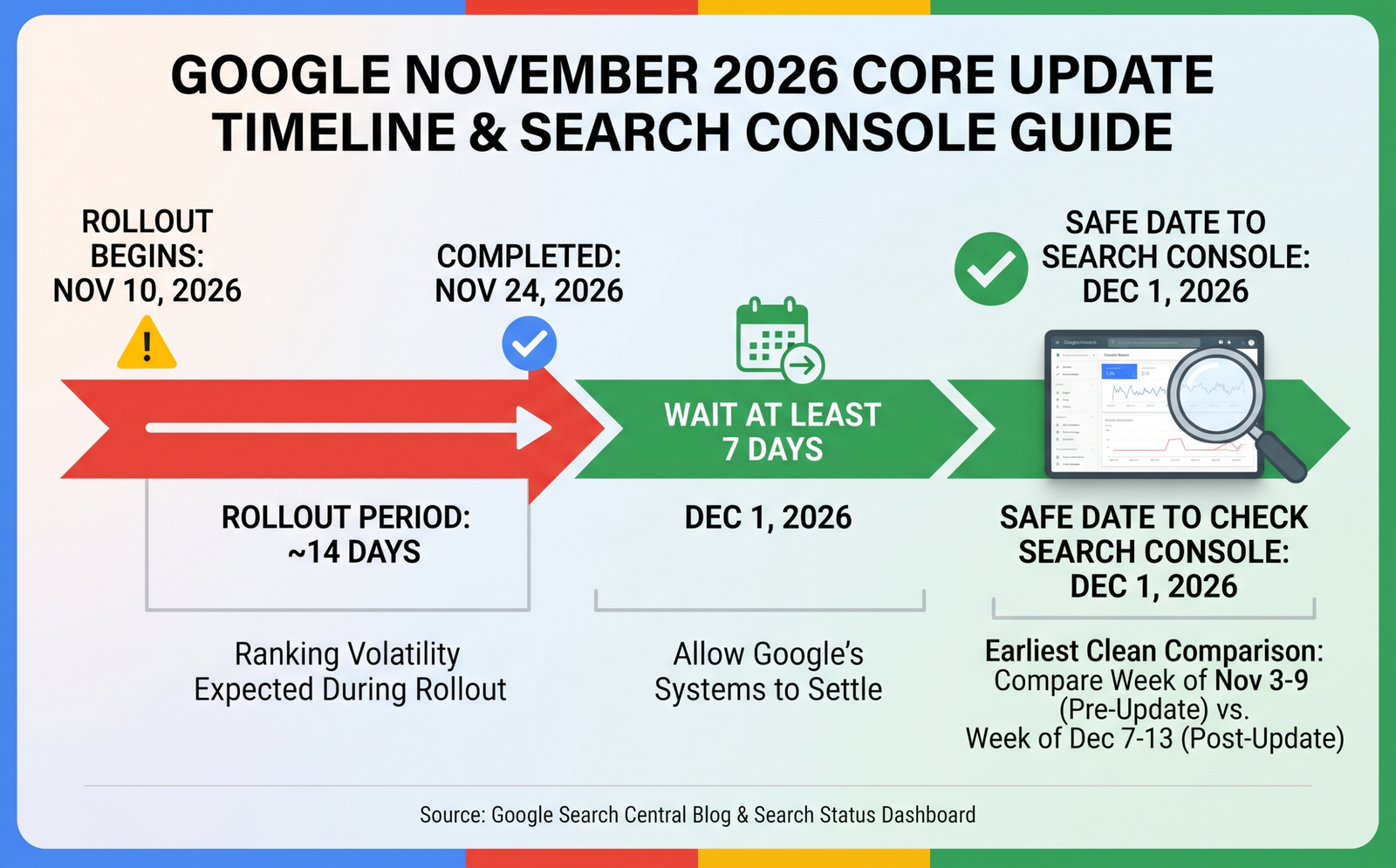
The short answer: the November 2026 core update ran from November 10 to November 24, 2026, worldwide and in all languages. Wait until at least December 2 before you judge it. Then compare average position, not just clicks, against the week of November 3 to 9 and against last year’s holiday week.
Below, I’ll show you which dates to compare, what to check for your type of business, and what to leave alone.
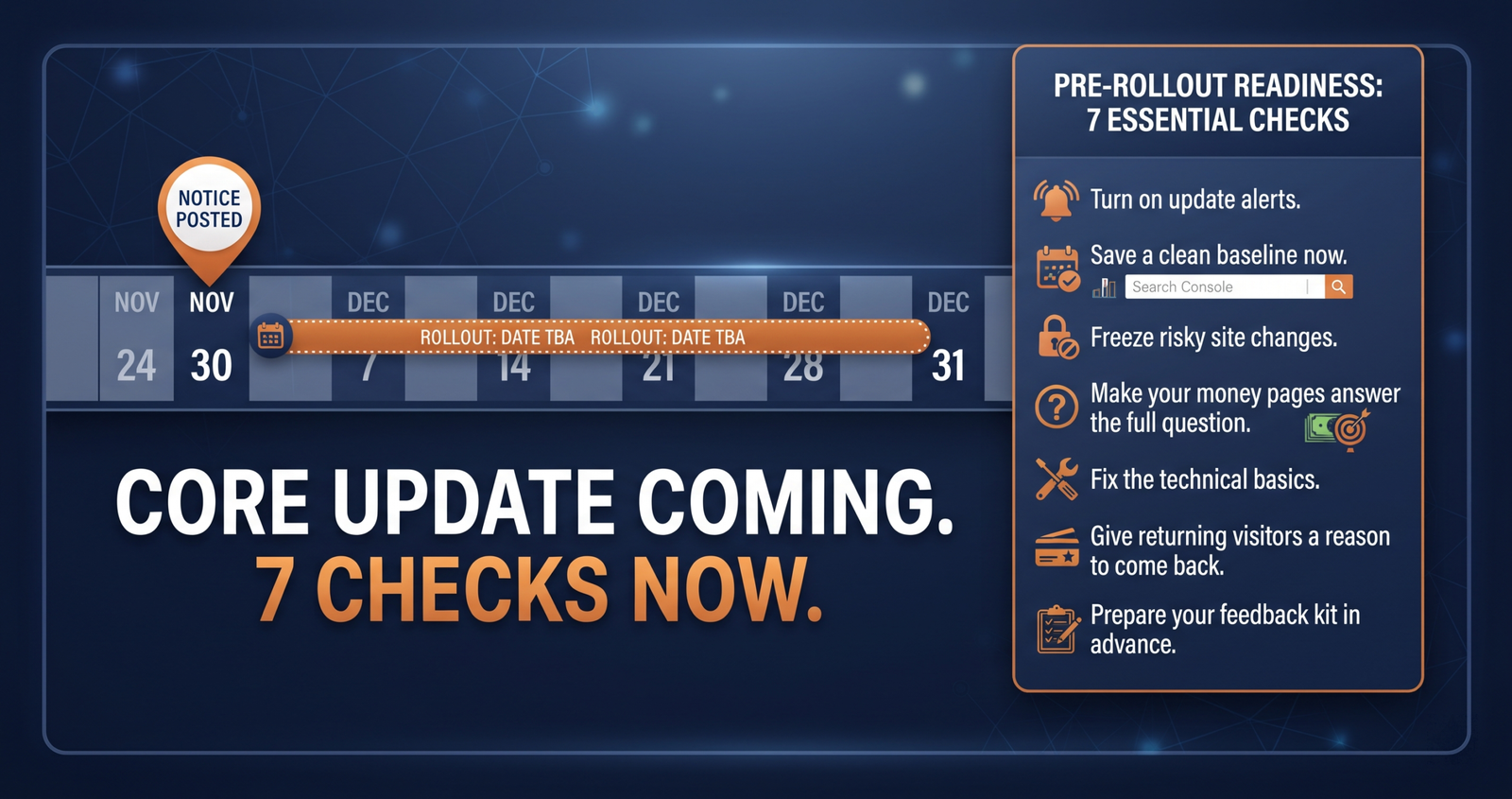
Google has also pre-announced another update for December, so keep the two apart. Here’s what to prepare before the December 2026 core update starts.
What Google Confirmed About the November 2026 Core Update
Google posted the update on its Search Status Dashboard on November 10. The rollout began at 10:06 a.m. Pacific time, and the entry says it applies globally and to all languages, with a rollout of up to two weeks. In its announcement that day, Google called it a regular update meant to surface “relevant, satisfying content for searchers from all types of sites.”
On November 24, Search Engine Journal and Search Engine Roundtable both reported that Google had marked the rollout complete on its dashboard. Search Engine Journal gave the end time as 6:03 a.m. Pacific, for a total of 13 days, 19 hours and 57 minutes. That makes it the longest of the three core updates in 2026. The March update took about 12 days and the May update took just under 12.
A few more facts worth knowing:
- It is not a penalty. Core updates are broad changes. Google says they don’t target specific sites or pages.
- The impact came late. Search Engine Roundtable noted that the first real impact showed up around Friday, November 13, and most sites noticed it on November 14.
- The advice hasn’t changed. Google’s core update guide (last updated December 10, 2025) still points to helpful, reliable content made for people.
Why Your First Week of Data Will Mislead You
Google’s core update guide gives a simple rule. Wait at least a full week after the update completes. Then compare that week with a week before the rollout started.
The problem is the calendar. The first full week after November 24 includes three of the biggest shopping days of the year:
- Thanksgiving: Thursday, November 26
- Black Friday: Friday, November 27
- Cyber Monday: Monday, November 30
Stores may see clicks jump. In my experience, law firms, clinics and B2B firms can see the opposite, because people are shopping and traveling instead of booking consultations. Either way, the change can look like a ranking win or loss when it isn’t. Google’s own traffic drop guide lists seasonality as a main cause of drops. Its example is turkey searches in November.
Search Engine Journal suggested the November 3 to 9 baseline and the holiday caution. Here’s how I’d put that into practice:
| Comparison | Dates | What it tells you |
|---|---|---|
| Rankings check | Nov 25 to Dec 1 vs Nov 3 to 9 | Average position change per page and query |
| Holiday reality check | Nov 25 to Dec 1 vs same week in 2025 | Whether clicks moved more than normal seasonality |
| Clean follow-up | Dec 2 to 8 vs Nov 3 to 9 | A quieter week to confirm what you saw |
In my experience, Search Console data often lags by a day or two. That’s why I suggest December 2 for the first check. Take a second look after December 9.
Who Should Watch Most Closely
Every site can move in a core update. But the holiday week hits business types in different ways, so read your data with your own business in mind.
Online stores and premium brands
Your clicks may well rise this week no matter what happened to rankings. Watch average position on category and product pages instead. If a key category slipped from the top three, act on it after the holidays. Thinking of buying ads to cover a dip? First read my guide on deciding between paid ads, CRO and a redesign.
Clinics: eye care, dental, skin and medical
In my experience, booking searches often slow over a holiday, so a dip in clicks this week can be normal. Check whether service pages lost position, not just traffic. For practices, my post on how optometry SEO differs from ranking a normal business site covers the local signals.
Law firms, HVAC and local service businesses
Map results and regular organic results don’t always move together. If calls drop, check your Google Business Profile insights as well as Search Console before you blame the update. Emergency services like HVAC may even see a lift if cold weather hits.
Manufacturers, logistics and B2B firms
Many buyers are out of office this week, so fewer RFQs and quote requests would not be unusual. Use the December 2 to 8 window as your real test.
Consultants and campaign sites
In my experience, blog and thought-leadership pages tend to swing most in core updates. Pages that repeat what everyone else says look most exposed. Pages with your own experience, examples and data tend to hold up better.
Your 7-Step Check, Starting December 2
This is the order I’d run it in. It takes about an hour for a small site.
- Save your baseline today. In Search Console, export the Performance report for November 3 to 9 by page and by query. Write down the date so you don’t mix it up later.
- Look at average position first. On December 2, compare November 25 to December 1 with November 3 to 9. Turn on Average position. Clicks will be noisy this week, so I’d read position alongside clicks and impressions, with position as the steadier signal.
- Run the year-over-year check. Set the range to the last 16 months, as Google’s traffic drop guide suggests. Then look at the same week in 2025, when Thanksgiving fell on November 27. If last year dropped or spiked the same way, it’s the season, not the update.
- Split by search type. Check Web, Images, Video and News separately. A drop in one type often points to one cause.
- Find the pages that moved most. Sort the Pages table by click difference. Is it the whole site, one section, or one important page? A whole-site drop calls for a different response than a single page.
- Rule out other causes. Open the Page indexing, Crawl stats, Security issues and Manual actions reports. A hacked plugin or a server problem can look like an algorithm hit. If your site runs WordPress, make sure you’ve applied our WordPress 7.1.5 security checklist. Slow servers can also hurt crawling, which is where website speed optimization services can help.
- Check AI features separately. If impressions held but clicks fell, the cause may be AI Overviews or a weaker title, not the update. Learn how to diagnose an AI Overview click drop before rewriting anything.
Did pages that bring you leads take a real, lasting drop? Then a content or site review makes sense. Our website design services start with that kind of review before any rebuild.
Not sure what the update did to you?
Did the November core update cost you leads, or is it just the holidays?
I’ll compare your Search Console data the right way, separate holiday swings from real ranking changes, and tell you which pages need work and which to leave alone.
- ✓ 18+ years building and growing business websites
- ✓ Clear, practical plan before any work starts
- ✓ Free 30-minute call, no obligation
Prefer to talk now? Call +91 99719 66296
Small Drop or Large Drop? What Each One Means
Google splits ranking drops into two kinds: small and large. I’ve added a third row for a case I see often.
| Type of drop | What to do | Example |
|---|---|---|
| Small drop | Leave the page alone and keep watching | Position 2 to 4 |
| Large drop | Review the site and affected pages honestly | Position 4 to 29 |
| No drop, fewer clicks (my addition) | Check season, titles and AI features | Same position, lower clicks |
For a large drop, Google points to its self-assessment questions on helpful content. Look at your site as a whole, not just one page. Ask someone outside your business to review it too. Then improve the pages that lost the most, starting with the ones that bring you customers. Real proof helps here, such as client case studies, named experts and clear answers.
Recovery takes patience. Google says some changes show up in days, but others take months. Sometimes a site only recovers at the next core update, although smaller unannounced updates can also help.
Mistakes to Avoid This Week
- Judging the update on Black Friday traffic. Holiday demand can hide or fake a ranking change.
- Quick fixes. Google warns against removing page elements just because you heard they’re bad for SEO.
- Deleting content in a hurry. Google calls deletion a last resort for content that can’t be saved.
- Changing pages that still rank well. If a page only slipped a little, editing it can do more harm than good.
- Buying ads to cover a dip you haven’t measured. Run a website conversion audit first so paid traffic doesn’t land on a weak page.
FAQ: November 2026 Core Update
When did the November 2026 core update start and end?
It started on November 10, 2026 at 10:06 a.m. Pacific time, per Google’s Search Status Dashboard. Industry reports confirm Google marked it complete on November 24, 2026.
When should I check Search Console after the update?
Google recommends waiting at least one full week after a core update finishes. For this update, December 2 is a sensible first check, with a second look after December 9.
Is a traffic drop this week caused by the core update?
Not necessarily. Thanksgiving, Black Friday and Cyber Monday fall in the first week after the rollout. Compare average position and last year’s holiday week before you blame the update.
Is a core update a penalty?
No. Google says core updates are broad changes that don’t target specific sites. Pages that drop are not necessarily bad; other pages may simply be judged more helpful.
What should I do if my rankings dropped a lot?
Review your whole site against Google’s helpful content questions. Focus on the pages that lost the most, and make lasting improvements. Avoid quick fixes and mass deletions.
How long does recovery take?
Some improvements show up in days, but others take several months. Sometimes recovery only comes with the next core update.
The Bottom Line
The November 2026 core update is finished, but the honest answer to “how did it affect me?” won’t be ready until early December. Save your baseline now. Let the holidays pass. Then compare position before clicks and check last year’s holiday week. Only fix pages that lost real ground and real business. In my experience, calm, measured work beats a panicked rewrite.
Want a calm, clear read on your rankings after the holidays?
On the call, I’ll walk through your Search Console data with you, show which pages truly moved, and give you a short list of fixes worth doing first.
- ✓ 500+ projects for clients in the USA, UK, Australia, Canada, UAE and India
- ✓ Work directly with Kanika, not a junior account manager
- ✓ Free 30-minute call, no obligation
Prefer to talk now? Call +91 99719 66296
Sources and How We Checked This
- Google Search Status Dashboard, November 2026 core update, November 10 to 24, 2026
- Google Search Central, Google Search’s core updates and your website, last updated December 10, 2025
- Google Search Central, Debugging drops in Google Search traffic, last updated December 10, 2025
- Search Engine Journal, Google Confirms November 2026 Core Update Is Complete, November 24, 2026
- Search Engine Roundtable, Google November 2026 Core Update Has Completed Rolling Out, November 24, 2026