Quick Answer
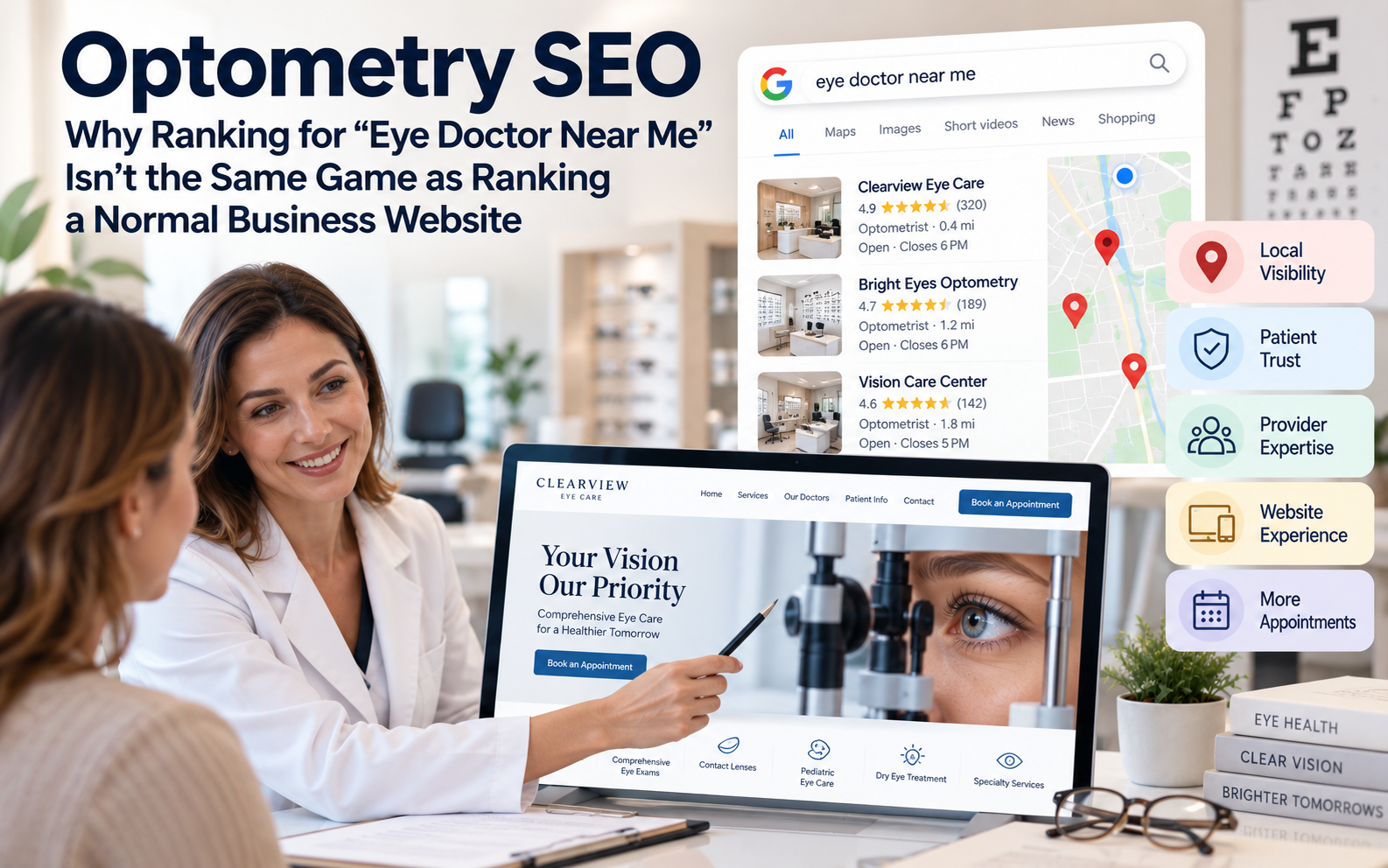
Optometry SEO is different because “eye doctor near me” is a high-intent local healthcare search, not a normal service keyword. Google evaluates relevance, distance, prominence, business information, reviews, and website content when determining local visibility. A successful eye clinic therefore needs more than keyword optimization. It needs strong local signals, clinically credible content, clear service pages, provider authority, mobile usability, and an easy path from search result to appointment.
TL;DR: What Eye Clinics Need to Know
- “Eye doctor near me” is a local-intent healthcare search where geography and prominence matter alongside relevance.
- Google says local results are primarily influenced by relevance, distance, and prominence.
- An eye clinic can rank for informational searches while remaining weak for high-intent local searches.
- Provider credentials, reviews, service clarity, location information, insurance details, and booking accessibility influence the patient’s decision after discovery.
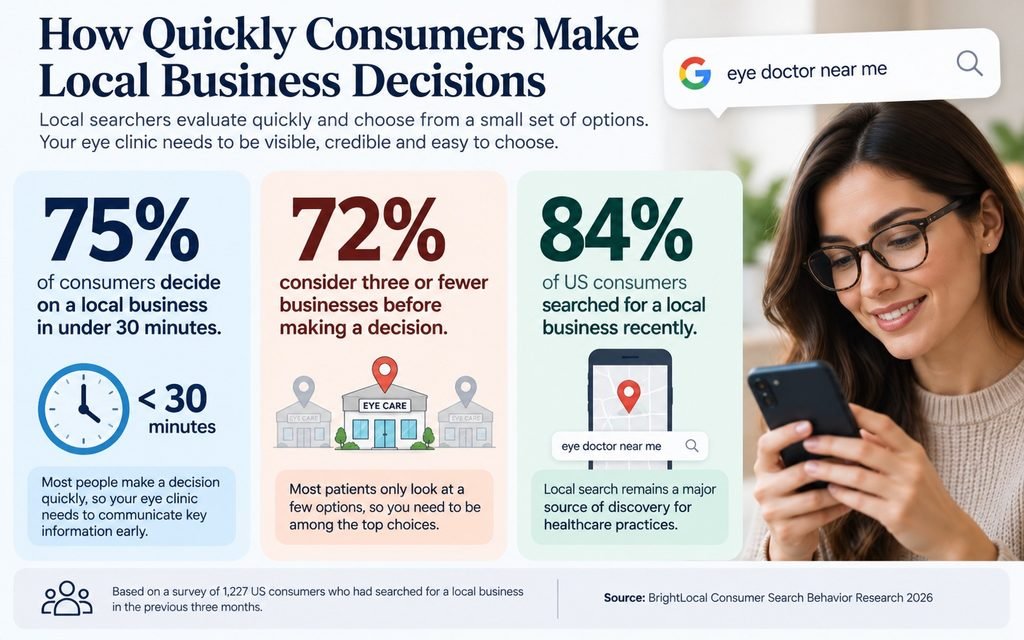
- BrightLocal’s 2026 research found that 75% of US consumers make local-business decisions in less than 30 minutes, while 72% consider three or fewer businesses.
- The objective is not simply to rank for “eye doctor near me.” The objective is to become one of the few practices a nearby patient trusts enough to choose.
Why Is “Eye Doctor Near Me” Different From a Normal Business Search?
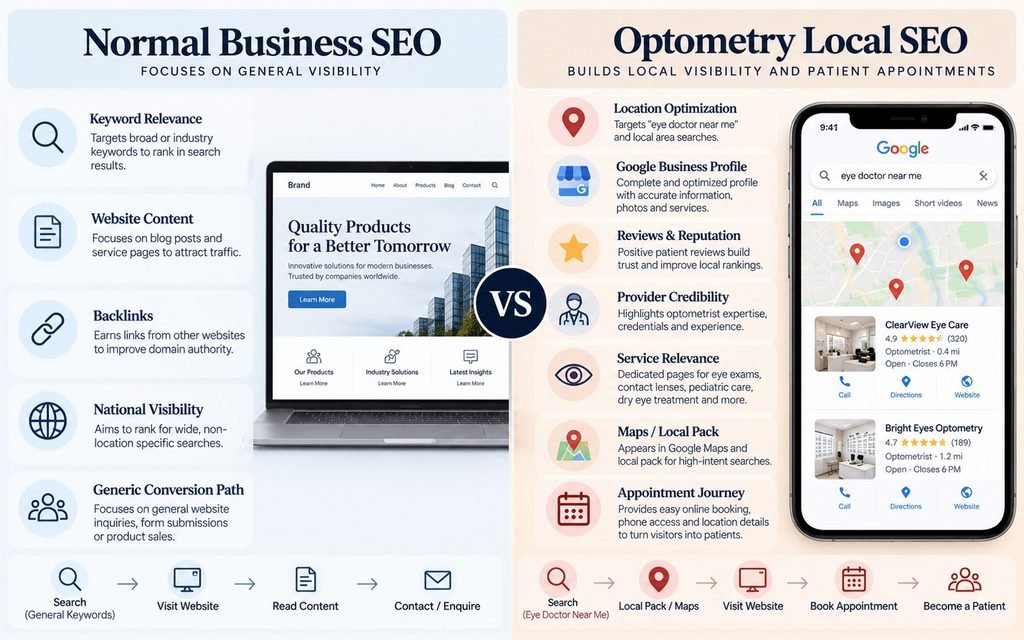
“Eye doctor near me” is different because the search combines immediate geographic intent with a healthcare decision. A patient is not simply researching a product or comparing a generic service. They are trying to identify a credible professional they can realistically visit.
Google says local search results are mainly determined by relevance, distance, and prominence. Relevance describes how well a business matches the search, distance considers how far the business is from the searcher, and prominence reflects how well-known or established the business is. Google also notes that reviews and links can contribute to prominence.
That creates a fundamentally different optimization problem for an eye clinic.
A normal professional-services company might build a national content strategy around a broad service keyword. An optometry practice needs to establish several things simultaneously:
- What services does the practice provide?
- Where is the practice located?
- Which patients does it serve?
- Which providers deliver the care?
- What makes the practice credible?
- Can patients easily understand the services?
- Can they book an appointment?
- Does the practice appear trustworthy on mobile?
The search result itself is only the first stage.
A patient may discover a practice through Google Maps, the local pack, organic search, reviews, or other local sources. Google also explains that information from a business website, third-party sources, user contributions, and other signals can contribute to how a local business is represented.
That means the website and Google Business Profile should not be treated as unrelated marketing assets.
They are parts of the same patient acquisition system.
What Does the Data Tell Us About Local Eye-Care Searches?
Published research shows that Google search visibility does not necessarily mirror the real-world distribution of eye-care professionals. A JAMA Ophthalmology study examined “eye doctor near me” searches across 2,955 US counties and found that ophthalmologists were underrepresented in Google results compared with their representation in the study dataset in 67.3% of states and territories.
That study is not a current 2026 ranking benchmark, so it should not be used to predict today’s rankings.
Its strategic value is different.
It demonstrates that real-world availability and search visibility are not the same thing.
A clinic can exist in a market, have qualified doctors, and provide excellent patient care while still being poorly represented in search.
More recent local-search research reinforces the commercial importance of that visibility. BrightLocal’s 2026 US consumer research surveyed 1,227 people who had searched for a local business during the previous three months. It found that 84% had searched for a local business, 75% made their decision in under 30 minutes, and 72% considered three or fewer businesses.
For an eye clinic, this creates a narrow competitive window.
If a patient sees three credible practices and your clinic is not among them, the rest of your website investment may never get a chance to influence that patient.
Local Search Data Worth Paying Attention To
| Finding | Published figure | Why it matters to an eye clinic |
|---|---|---|
| US consumers who searched for a local business recently | 84% | Local discovery remains commercially important |
| Consumers deciding in under 30 minutes | 75% | Patients need useful information quickly |
| Consumers considering three or fewer businesses | 72% | Visibility within the initial consideration set matters |
| Ophthalmology search-ad conversion rate | 18.29% | Paid healthcare search can capture strong intent |
| Ophthalmology average CPC | $4.95 | Paid visibility has a measurable acquisition cost |
| Ophthalmology average CPL | $30.88 | Paid campaigns should be evaluated against qualified patient value |
The ophthalmology figures come from LocaliQ’s 2026 healthcare search advertising benchmark, based on 3,542 US healthcare campaigns running from October 2024 through September 2025. Ophthalmology is not identical to optometry, so these numbers are directional rather than promises for an optometry practice.
The business lesson is simple: when local intent is strong, visibility and conversion need to work together.
What Should an Eye Clinic Optimize Beyond Keywords?
An eye clinic should optimize the entire patient-facing entity rather than simply inserting “eye doctor near me” into website copy. The practice needs to make its location, services, providers, credibility, reputation, and next action clear to both Google and prospective patients.
The core areas are:
1. Google Business Profile
Maintain accurate:
- Practice name
- Address
- Phone number
- Business category
- Hours
- Services
- Appointment URL where appropriate
- Practice photographs
2. Location relevance
Make the practice location unmistakable through:
- Clear contact information
- Useful location pages
- Accurate local references
- Consistent business information
- Legitimate multi-location pages where applicable
3. Service relevance
Create useful pages for important services rather than forcing every service into one generic page.
Examples may include:
- Comprehensive eye exams
- Contact lenses
- Pediatric eye care
- Dry eye care
- Myopia management
- Specialty vision services
- Emergency or urgent eye-care information where appropriate
4. Clinical authority
Patients should be able to understand who is providing care.
Useful information can include:
- Provider credentials
- Areas of expertise
- Professional affiliations
- Experience
- Clinical interests
- Appropriate educational content
5. Conversion architecture
Make it easy to:
- Call
- Request an appointment
- Book online
- Find the clinic
- Understand insurance information
- Identify the appropriate service
- Understand what happens next
This is where optometric SEO becomes more than a keyword exercise.
It becomes the process of making the practice understandable and credible at every stage of the local patient journey.
When Someone Searches “Eye Doctor Near Me,” Google Isn’t Just Looking for the Best Website.
Local intent changes the search game. Location relevance, clinic information, reviews, services, local signals and website quality all contribute to how easily patients can discover and evaluate your practice.
Strengthen Your Local Presence →How Should an Optometrist Build a Local Search Architecture?
A strong architecture should connect the practice, locations, services, providers, educational resources, and appointment journey. The structure should help search engines understand the relationships between these entities while helping patients move from broad discovery to specific intent.
A practical structure might look like:
Homepage
→ Primary location
→ Eye exams
→ Contact lenses
→ Pediatric eye care
→ Dry eye services
→ Specialty services
→ Provider profiles
→ Insurance and payment information
→ Patient resources
→ Appointment booking
For a legitimate multi-location practice, each location should have genuinely useful information specific to that office.
A strong location page can include:
- Exact address
- Hours
- Phone number
- Parking or access information
- Providers working at that location
- Services offered
- Insurance information where appropriate
- Authentic photographs
- Appointment options
- Relevant local information
Google recommends using the most specific applicable LocalBusiness subtype in structured data and providing accurate business information. Structured data can help Google understand a business, although it does not guarantee a particular search appearance.
This is also why a good optometrist website SEO checklist should include website structure, local information, service architecture, provider credibility, technical SEO, and conversion tracking rather than focusing only on keywords.
If you are evaluating the wider website architecture, our analysis of 12 leading optometry website designs across the US, UK, and Australia provides useful examples of how strong practices handle booking, provider information, mobile UX, trust, and patient education.
Author Insight
Kanika Gupta is the Founder of KG Web Designer. Her approach to healthcare website strategy combines website design, search visibility, UX, conversion architecture, content structure, and patient decision-making to help clinics build stronger digital acquisition systems.
Relevant Service: Optometrist and eye clinic website design focused on patient trust, local visibility, mobile usability, service architecture, and appointment conversion.
What Should Patients See Before Choosing an Eye Doctor?
Patients need enough information to reduce uncertainty before committing to an appointment. The website should answer the practical questions they are already asking instead of forcing them to call simply to discover basic information.
A prospective patient may want to know:
- Is the clinic near me?
- Does it provide the service I need?
- Who will examine me?
- What are the provider’s credentials?
- Does the clinic accept my insurance?
- Can I book online?
- What should I expect?
- Is this the right practice for children or families?
- Where exactly is the office?
- What happens if I have an urgent concern?
This is where many practices underestimate the role of website content.
A Google Business Profile may introduce the patient to the clinic, but the website frequently becomes the place where the patient verifies the decision.
A clinic that ranks well but has a generic homepage, weak doctor profiles, thin service pages, outdated photography, or an awkward booking process can lose the patient after winning the search.
At KG Web Designer, we frequently see this distinction between visibility and decision confidence. The strongest websites do not simply provide more information. They provide the right information at the moment the patient needs it.
How Important Is Google Business Profile for an Eye Clinic?
Google Business Profile is important because it places the practice inside the local discovery environment where high-intent searches can become shortlists. It should therefore be treated as part of the patient acquisition system rather than as a profile that is created once and forgotten.
Google states that local ranking is primarily based on relevance, distance, and prominence. It also identifies reviews and links as factors that can contribute to prominence.
A practice should therefore maintain:
- Accurate core business information
- Appropriate categories
- Relevant services
- Current hours
- Authentic photography
- Appointment information
- Consistent website information
- Genuine reviews
- Thoughtful review responses
Reviews are especially important because they serve two audiences.
Google can use review-related information in its local systems, while patients use reviews as evidence during their decision process.
BrightLocal’s consumer review research found that 74% of consumers use at least two websites when reading reviews before deciding on a local business.
For an eye clinic, reputation management therefore belongs inside the wider acquisition strategy.
If your clinic is deciding whether the main issue is local visibility, advertising, or the website itself, our guide on where an eye clinic should invest first to get more patients provides a diagnosis-first framework for deciding which investment should come first.
How Does AI Search Change Local Visibility for Eye Clinics?
AI search makes clear, trustworthy, well-structured information even more important because patients increasingly discover businesses through conversational search experiences as well as traditional search. Google says AI Overviews and AI Mode use its existing Search systems and that there are no special technical requirements or separate “AI schema” requirements for inclusion.
Google continues to recommend fundamentals such as making important content available in text, maintaining strong internal linking, providing good page experience, keeping Business Profile information current, and ensuring structured data matches visible content.
For an eye clinic, that means AI optimization should not be a separate layer pasted onto an old website.
The underlying information needs to be clear.
Instead of:
“We provide comprehensive eye care for patients of all ages.”
Use useful, specific information such as:
“Our practice provides comprehensive eye exams, contact lens evaluations, pediatric eye care, and dry eye services at our Sydney location.”
The second statement is easier for a patient to understand and provides clearer relationships between the practice, services, and location.
Google’s guidance on AI features also emphasizes that existing SEO fundamentals remain important for AI search visibility.
That is why SEO for eye clinics should increasingly be understood as a combination of local entity clarity, useful content, clinical authority, technical foundations, and patient experience.
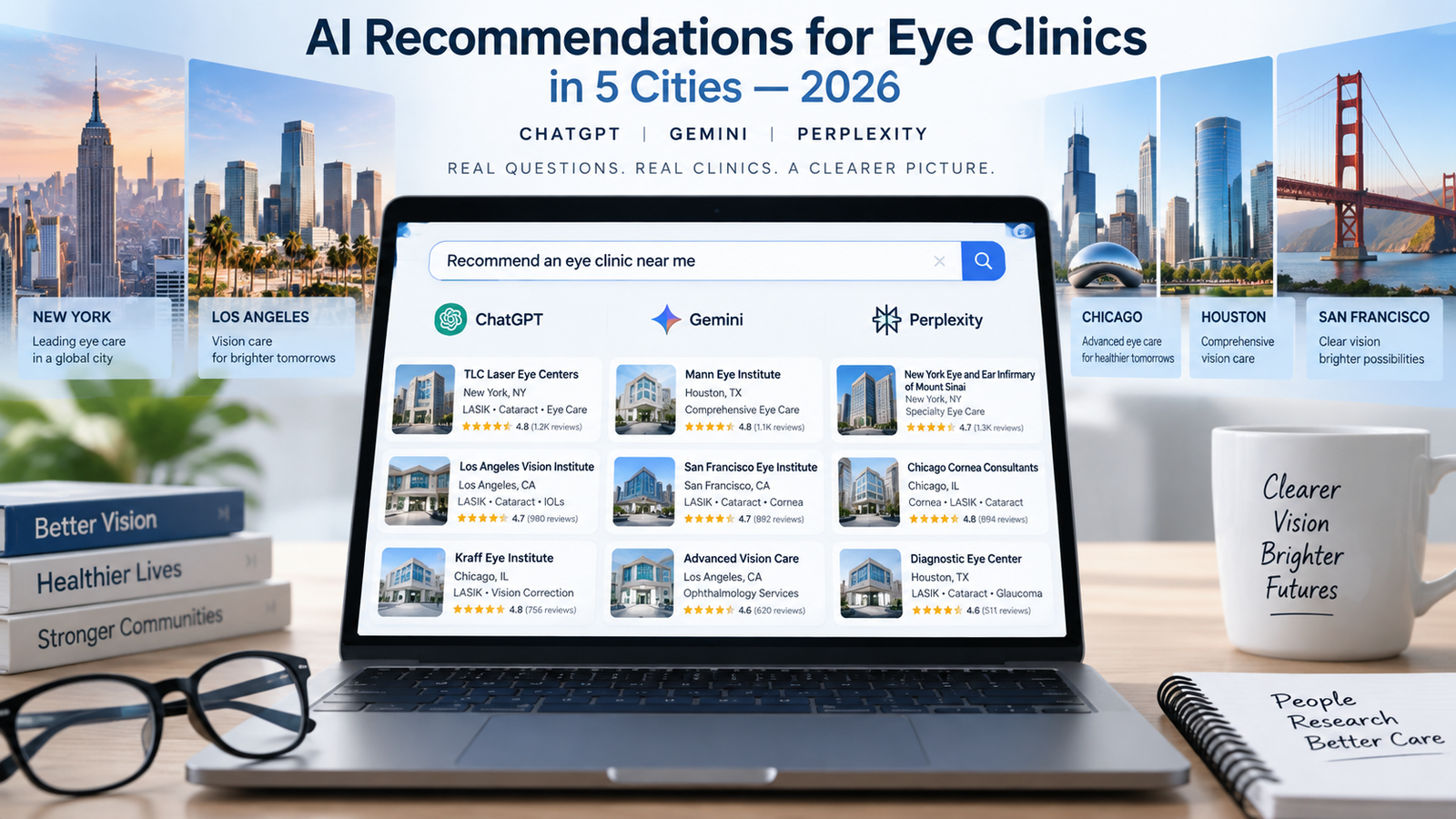
For clinics that want to understand this AI layer in more detail, our guide on how AI search is recommending eye clinics explains how traditional search visibility connects with emerging conversational discovery.
Your Website Is One Signal. Local Eye Clinic Visibility Is the Bigger System.
A patient searching nearby is giving the search engine location intent. That means your clinic’s digital presence needs to connect geography, services, reputation and website relevance.
VISIBILITY
Don’t treat “eye doctor near me” like another generic keyword. Build a local search ecosystem around the clinic.
Review My Local Visibility →What Should an Eye Clinic Fix First, Second, and Third?
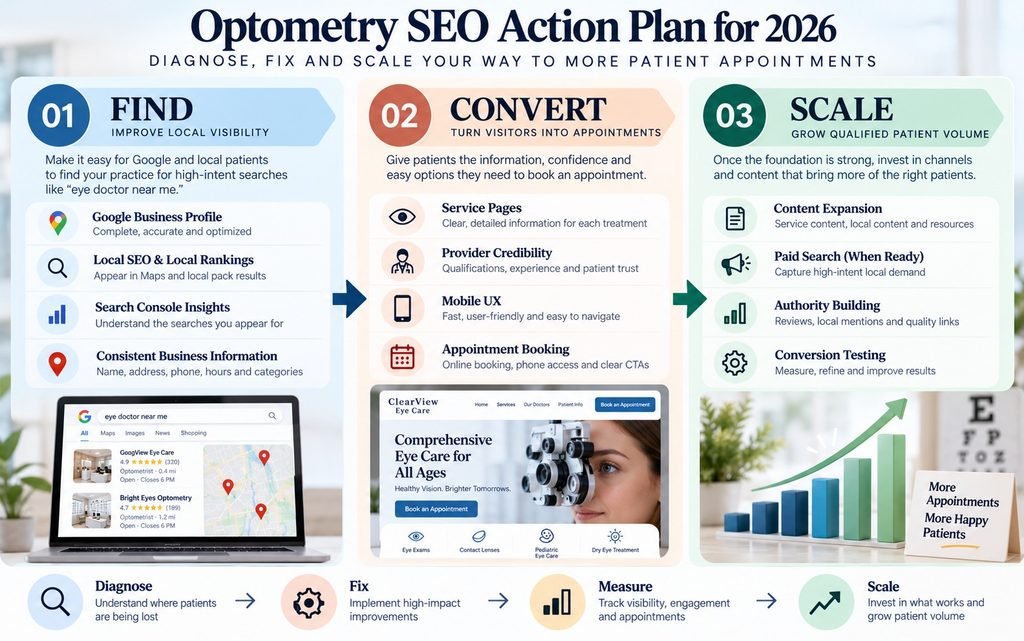
The first priority should be diagnosis, the second should be the highest-impact visibility or conversion problem, and the third should be scaling what has already demonstrated value. This sequence prevents a clinic from increasing traffic before understanding whether its local presence and website are capable of converting that traffic.
First: Fix local discoverability
Review:
- Google Business Profile
- Local visibility
- Search Console queries
- Non-branded searches
- Location information
- Service pages
- Reviews
- Local authority
Second: Fix patient decision friction
Review:
- Mobile navigation
- Appointment buttons
- Provider profiles
- Insurance information
- Service-page clarity
- Location information
- Page speed
- Accessibility
- Booking workflow
Third: Scale qualified demand
Once the foundation is sound, consider:
- Additional service content
- Local content
- Paid search
- Reputation development
- Authority building
- Educational resources
- Conversion testing
- Legitimate location expansion
This order matters financially.
If a clinic is paying for additional clicks before fixing the booking experience, it may simply be paying to send more patients into the same broken journey.
What Should You Not Do With Local SEO?
The biggest mistake is treating local SEO as a volume game where more city pages, more keywords, and more content automatically create more patients. That approach can produce a larger website without creating a stronger local entity.
Avoid:
- Creating artificial neighborhood pages
- Repeating city names unnaturally
- Publishing near-identical location pages
- Creating generic AI-written healthcare articles at scale
- Buying or manufacturing reviews
- Hiding provider information
- Sending every paid visitor to the homepage
- Treating desktop UX as sufficient
- Measuring only rankings
- Assuming more traffic means more appointments
Healthcare content requires an even higher standard of trust.
Google’s people-first guidance says systems place greater weight on strong E-E-A-T for topics that can affect people’s health and well-being. Google also emphasizes accuracy, originality, expertise, and content created primarily to help people.
This matters because healthcare searchers have more at stake than someone comparing ordinary commercial services.
A practice should never manufacture clinical authority for SEO.
Example Scenario
Imagine two optometry practices operating in the same metropolitan market.
Practice A has strong local visibility, hundreds of reviews, and an established Google Business Profile. Its website, however, has a generic homepage, buried appointment information, limited provider details, and thin service pages.
Practice B has fewer locations and a smaller marketing budget. Its website clearly explains its services, introduces providers, provides location and insurance information, and makes appointment actions obvious on mobile.
Practice A may have stronger raw authority.
Practice B may create greater decision confidence.
The important point is that local search visibility and website conversion are different problems.
If Practice A is already appearing for “eye doctor near me,” spending more money simply to generate additional exposure may not solve its appointment problem.
The better move would be to determine where patients are hesitating.
I would ask:
- Are we appearing for the right local searches?
- Are those searches attracting relevant patients?
- Can visitors understand why they should choose us?
- Can they book without unnecessary friction?
If the answer to the first question is no, fix visibility.
If the answer to the second is no, fix intent and targeting.
If the answer to the third or fourth is no, fix trust, UX, content, or booking.
Example From Our Experience
Problem: KG Web Designer reviewed 12 leading optometry and vision-care websites across the US, UK, Australia, and Europe using a consistent qualitative framework covering booking experience, mobile UX, trust, educational content, navigation, and accessibility/performance.
Solution: We evaluated the sites from a patient perspective: Can someone identify the service they need? Can they understand who provides care? Can they establish trust? Can they find the location? Can they book?
Outcome: The review showed that the strongest examples consistently prioritized booking accessibility, mobile experience, provider credibility, patient education, and clear practice information. These were qualitative website assessments, not private analytics or claimed conversion results.
That distinction is important.
A responsible website strategist should not claim that changing a button color or publishing a specific number of articles will automatically produce a fixed percentage increase in appointments.
The better process is to establish a baseline, make a defined change, and measure the relevant patient action.
For example:
Problem → weak service-page engagement
Solution → improve service-page clarity, internal linking, trust information, and appointment path
Measurement → service-page engagement, appointment clicks, booking starts, completed bookings
That is a more defensible approach to healthcare CRO.
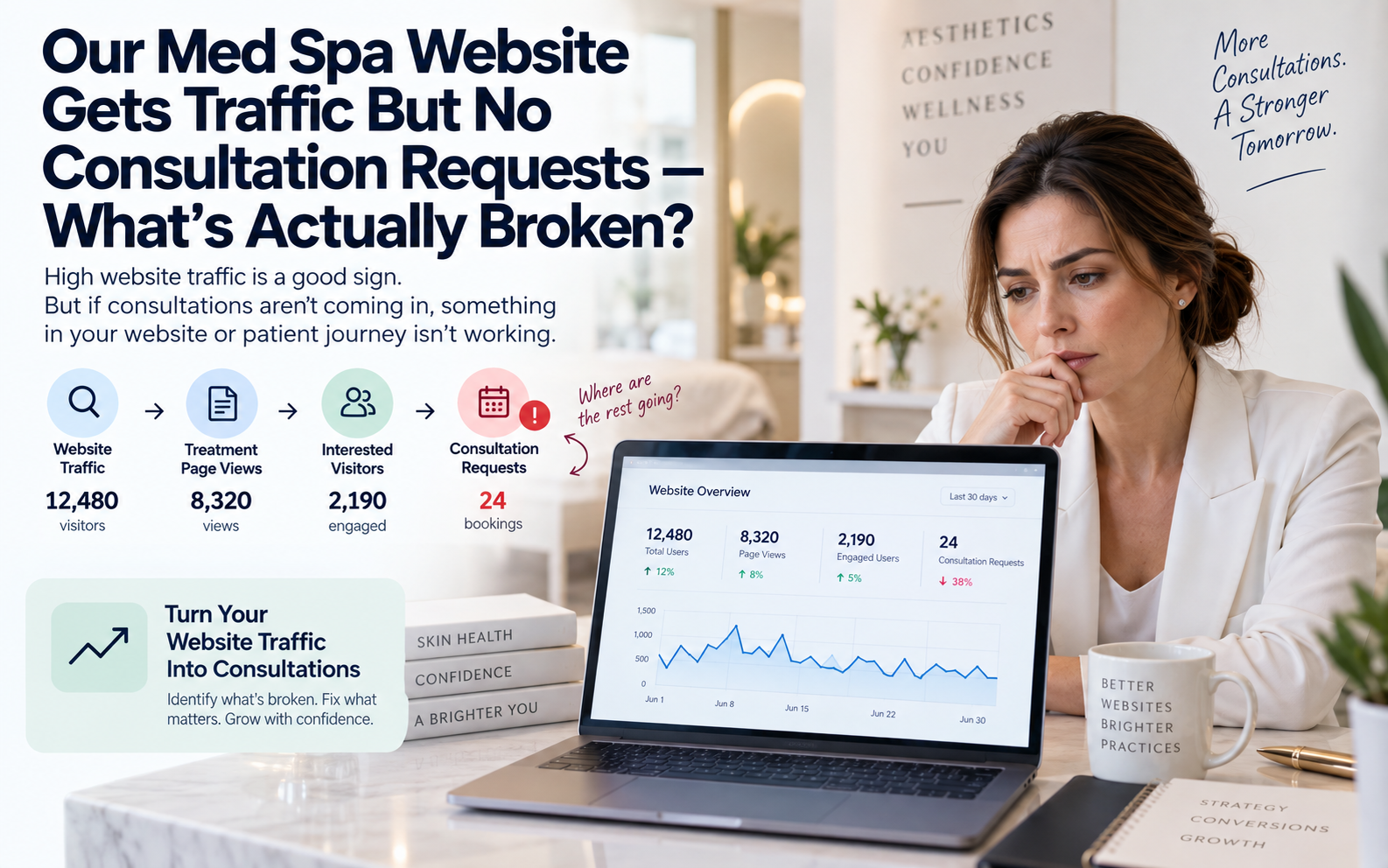
If you want to see how the broader patient journey can fail even when traffic is present, our analysis of why an optometry website gets traffic but few bookings focuses specifically on the gap between website visitors and appointment actions.
Why Most Businesses Get This Wrong
Most optometry practices get this wrong because SEO, website design, Google Business Profile management, paid advertising, and appointment booking are treated as separate marketing activities. The patient experiences none of those boundaries.
The patient experiences one journey:
Search → listing → website → trust → service evaluation → location verification → booking
A weakness at any stage can reduce the value of the stages before it.
Common misconceptions include:
- “If we rank, patients will automatically book.”
- “We only need more blog posts.”
- “The homepage should rank for everything.”
- “Reviews are separate from SEO.”
- “Provider credentials belong only on the About page.”
- “Mobile means making the desktop layout responsive.”
- “AI content can replace clinical expertise.”
- “More traffic automatically means more patients.”
Successful practices approach the problem differently.
They build the website around patient decisions first and search visibility second.
They also measure what happens after the click.
That is the difference between a website that merely attracts attention and one that contributes to patient acquisition.
Ranking for “Eye Doctor Near Me” Isn’t the Finish Line. It’s the Start of the Patient Decision.
Once someone finds your clinic, the website still has to turn local visibility into enough confidence to take the next step.
What Does This Mean For Your Business?
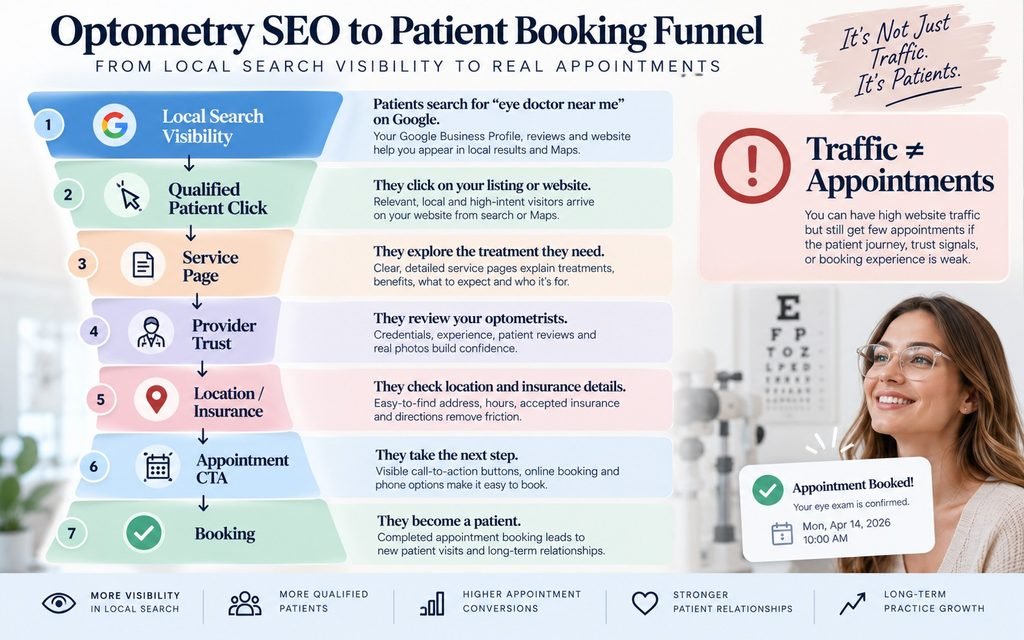
It means your local search strategy should be evaluated as a revenue system rather than a ranking report. A ranking matters because it creates an opportunity to be considered, but the business value appears only when the right patient chooses the practice.
For an eye clinic, the commercial chain looks like this:
Local visibility → qualified visitor → trust → service understanding → appointment action → completed appointment → patient relationship
A weakness at any stage can reduce the value of everything before it.
If your clinic has strong rankings but weak appointment activity, investigate conversion.
If your website converts well but local visibility is poor, investigate local authority.
If both are strong but patient volume is insufficient, investigate acquisition.
If multiple locations perform inconsistently, investigate location-level architecture and measurement.
The central principle is that optometry SEO should be designed around the patient decision journey, not around a keyword list.
The opportunity is larger than one Google position.
A strong local presence can strengthen brand recognition, reduce dependence on paid clicks, improve marketing efficiency, and create a digital asset that supports every legitimate service and location the practice operates.
Expert Insight from Kanika Gupta
“If this were my website, I would not start by asking whether I can rank for ‘eye doctor near me.’ I would ask whether a patient who finds my clinic has enough evidence to choose it within the first few minutes. If the answer is no, I would fix the patient journey before expanding the SEO campaign.”
That is the distinction many practices miss.
A keyword ranking is a visibility outcome.
A patient choosing your clinic is a business outcome.
The website’s job is to connect the two.
At KG Web Designer, we frequently see clinics focus heavily on the first half of that equation and underestimate the second. The strongest opportunities often appear when search architecture, provider credibility, local information, service content, accessibility, and booking UX are treated as one connected system.
What Should an Optometry Practice Measure Every Month?
An optometry practice should measure qualified search visibility, website behavior, appointment actions, and business outcomes together. Ranking position alone is too narrow to determine whether local search is producing commercial value.
Visibility
- Local pack visibility
- Google Business Profile actions
- Non-branded local queries
- Service-level organic visibility
- Location-level visibility
Website engagement
- Organic landing pages
- Mobile engagement
- Service-page engagement
- Provider-profile views
- Appointment CTA clicks
- Phone clicks
Conversion
- Appointment starts
- Completed bookings
- Appointment-request forms
- Calls from organic traffic
- Qualified inquiries
- Booking completion rate
Commercial performance
- New-patient appointments
- Cost per qualified acquisition
- Revenue by service where measurable
- Patient acquisition by location
- Paid versus organic acquisition
- Appointment show rate where available
A clinic should avoid optimizing for a metric simply because it is easy to report.
More impressions can be positive.
More clicks can be positive.
More traffic can be positive.
But if none of those changes produces more qualified patient actions, the marketing system has not necessarily improved.
When Does Professional Help Make Sense?
Professional help makes sense when the problem crosses several disciplines and the practice cannot confidently identify which constraint is responsible. If local visibility, website architecture, technical SEO, patient UX, content, provider authority, and booking behavior all need to be evaluated together, isolated fixes can become inefficient.
You probably need a strategic audit when:
- Rankings have plateaued despite publishing more content.
- Google Business Profile visibility is inconsistent.
- Traffic is increasing but appointments are not.
- Several service pages compete for the same intent.
- Multiple locations perform inconsistently.
- The website is difficult to expand.
- The booking system creates friction.
- Mobile usability is poor.
- Provider credibility is not clearly communicated.
- Your agency reports rankings but cannot connect them to patient actions.
This is also where choosing the right specialist matters.
An optometry practice does not simply need someone who can install WordPress or redesign a homepage.
It needs someone who understands local search, healthcare trust, service architecture, accessibility, patient behavior, conversion tracking, and the commercial priorities of the practice.
KG Web Designer approaches healthcare websites from that broader perspective, combining website strategy, UX, search visibility, conversion architecture, and content structure.
Before You Spend More on Search, Check the Conversion Path
If your practice already receives relevant search traffic, the next investment should not automatically be more traffic. First determine whether visitors can understand your services, evaluate the optometrists, verify location and insurance information, and reach an appointment action without unnecessary friction.
If the website is creating the bottleneck, additional advertising may simply increase the cost of sending more people into the same weak patient journey.
If local visibility is the bottleneck, the strategy should focus on the Business Profile, local authority, service relevance, reviews, location architecture, and other legitimate local signals.
If the practice has both problems, address the conversion foundation before aggressively scaling acquisition.
That diagnosis-first approach is particularly important for premium practices competing in markets such as New York, London, Sydney, Los Angeles, Melbourne, or other high-competition metropolitan areas where patients have many credible alternatives.
A Practical 30-Day Action Plan
The first 30 days should focus on diagnosis and high-impact improvements rather than publishing large quantities of new content.
Days 1–7: Establish the baseline
Review:
- Google Business Profile
- Local visibility
- Search Console
- Analytics
- Appointment tracking
- Phone tracking
- Top landing pages
- Service-level traffic
- Location-level performance
Days 8–14: Audit the patient journey
Test the website as a prospective patient.
Check:
- Homepage
- Service pages
- Provider pages
- Location pages
- Insurance information
- Mobile navigation
- Appointment CTA
- Booking process
- Contact options
- Page speed
- Accessibility
Days 15–21: Fix the biggest bottlenecks
Prioritize:
- Incorrect local information
- Weak service-page relevance
- Poor provider credibility
- Missing trust information
- Difficult booking paths
- Weak mobile UX
- Technical problems affecting important pages
Days 22–30: Validate and plan growth
Compare:
- Search visibility
- Engagement
- Appointment actions
- Booking completion
- Phone calls
- Qualified inquiries
Only then decide whether the next investment should be additional content, technical improvements, paid search, a website redesign, or broader authority building.
Once the technical and conversion foundations are in place, the next step is improving organic visibility for the searches that matter most to your practice. Our guide on how eye clinics can rank higher on Google SERP explains how local SEO, service-focused content, technical optimization, internal linking, and patient trust signals work together to strengthen search visibility and attract more qualified patients.
Not Showing Up When Local Patients Search for Eye Care?
Let’s review how your clinic appears across the local patient journey — from search visibility and location relevance to service pages, trust and appointment conversion.

Final Thoughts
Ranking for “eye doctor near me” is not simply a matter of putting the phrase on an optometry website more times. Local search combines relevance, geography, prominence, entity information, trust, website quality, and the patient’s ability to move from discovery to action.
The practices that perform best understand that the Google result is only the beginning.
The patient still needs to decide:
Is this the right clinic?
Can I trust the provider?
Can they help me?
Is the location convenient?
Can I use my insurance?
Can I book easily?
That is why optometry SEO should be treated as a connected acquisition and conversion system rather than a keyword campaign.
If this were my website, I would first determine whether the clinic is losing patients because it is invisible, because it is attracting the wrong searches, or because the website fails to convert the people who already find it.
Only after identifying that bottleneck would I decide where to invest next.
If your eye clinic needs a website that connects local visibility, patient trust, service discovery, and appointment conversion, a focused website and search strategy review is a better starting point than another generic SEO package.
Frequently Asked Questions
How important is “eye doctor near me” for an optometry practice?
It can be commercially important because the query expresses strong local intent, but no single keyword should become the entire strategy. Google says local results depend primarily on relevance, distance, and prominence, so practices need a complete local presence connecting their Business Profile, website, services, reviews, location information, and patient experience.
Should an optometrist create a page specifically for “eye doctor near me”?
Usually, no. Creating a page simply to repeat the exact phrase can produce thin, unnatural content. A stronger approach is to create useful location and service pages that clearly explain who the practice serves, where it operates, what services it provides, who provides care, and how patients can schedule an appointment.
Does Google Business Profile matter more than the website?
Neither should be treated as completely separate. The Business Profile supports local discovery, while the website gives patients more information to verify their choice. Google also says information from a business website and other sources can contribute to the information presented about a local business.
Can an optometry practice rank locally without publishing lots of blog posts?
Yes. A practice does not need hundreds of blog posts to establish useful local visibility. Strong service pages, legitimate location information, provider expertise, Business Profile completeness, reviews, technical quality, internal linking, and genuinely useful patient education can be more valuable than publishing large quantities of generic content.
Should I spend more on Google Ads if my organic rankings are weak?
Not automatically. Paid search can provide immediate visibility, but the economics depend on landing-page quality and the appointment journey. LocaliQ’s 2026 healthcare benchmark demonstrates that paid search carries meaningful acquisition costs, so a clinic should measure qualified appointments and acquisition economics rather than clicks alone.
How can I tell whether my website or SEO is the real problem?
Separate the patient journey into visibility, intent, trust, action, and completion. If relevant patients cannot find the clinic, investigate local search. If they arrive on the wrong pages, investigate intent. If they reach the right pages but do not act, investigate trust, UX, calls to action, and booking friction.
How long does it take to improve local visibility for an eye clinic?
There is no reliable universal timeline because competition, existing authority, location, website quality, reviews, and the practice’s current search presence all differ. Establish a baseline and measure changes in local visibility, qualified traffic, appointment actions, and business outcomes rather than promising a fixed ranking date.