Quick Answer
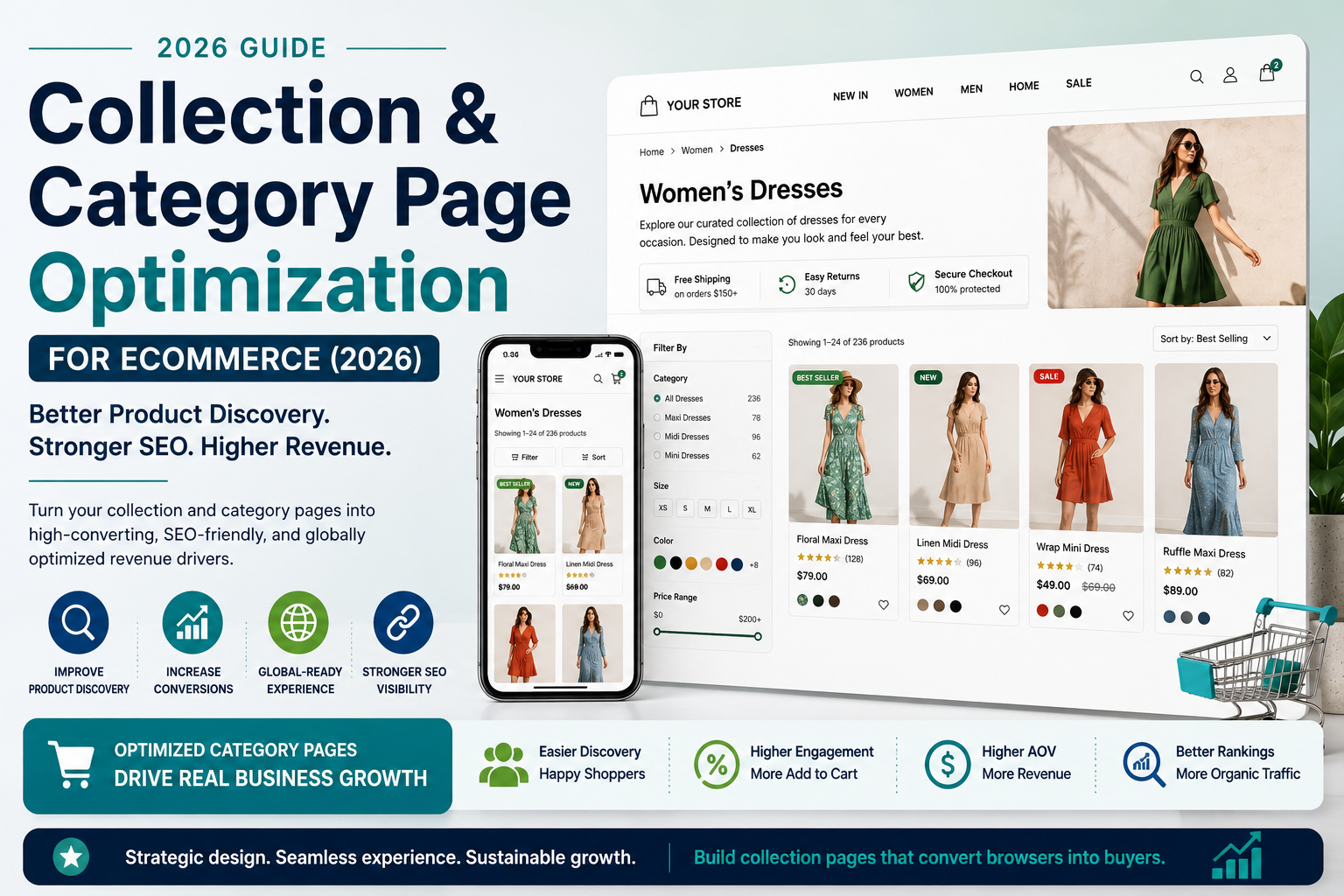
Category and collection pages are often the highest-traffic commercial pages on an ecommerce website because they help shoppers discover, compare, and shortlist products before reaching individual product pages. A strategic ecommerce website design approach improves navigation, filtering, merchandising, internal linking, and user experience, leading to stronger SEO performance, better product discovery, and higher conversion potential.
TL;DR
- Category pages influence SEO, product discovery, and revenue more than many ecommerce businesses realize.
- Better navigation and filtering reduce browsing friction and help shoppers reach products faster.
- Well-optimized collection pages strengthen internal linking and improve crawlability.
- International ecommerce brands should design category pages for multiple currencies, localized shopping experiences, and regional payment preferences.
- Collection pages should be treated as revenue-generating assets rather than simple product listings.
- Businesses that optimize product discovery often improve conversions before increasing advertising spend.
Quick Facts About Ecommerce Category Pages
| Fact | Why It Matters |
|---|---|
| Category pages are often the first shopping pages visitors land on from search engines. | They create the first buying impression for many potential customers. |
| Clear navigation and filtering improve product discovery. | Shoppers reach relevant products faster and with less effort. |
| Well-structured category pages strengthen internal linking. | Better site architecture supports crawling and topical relevance. |
| Merchandising products strategically can increase average order value. | Customers naturally discover complementary products. |
| International shoppers expect localized shopping experiences. | Currency, shipping information, and regional payment options build confidence before purchase. |
Collection Pages vs Product Pages: Which Has the Bigger Business Impact?
| Website Page | Primary Purpose | SEO Value | Conversion Influence | Business Impact |
|---|---|---|---|---|
| Homepage | Introduce the brand | Medium | Medium | Brand awareness |
| Category / Collection Page | Help shoppers browse products | Very High | Very High | Product discovery & revenue |
| Product Page | Sell a specific product | High | Very High | Direct sales |
| Buying Guide / Blog | Educate buyers | High | Medium | Organic visibility & trust |
| Checkout | Complete the transaction | Low | Critical | Revenue completion |
Key Insight: Research from Google Search Central and Baymard Institute consistently reinforces the importance of logical navigation, product discovery, and clear site architecture for ecommerce websites. Collection pages sit at the center of all three.
Why Do Collection and Category Pages Matter More Than Ever?
Category pages have evolved from simple product listings into strategic landing pages that influence SEO, user experience, merchandising, and conversions simultaneously.
Today’s customers rarely arrive ready to purchase a specific product. Instead, they compare options, narrow their choices, and evaluate brands before making a decision. Search engines have evolved in the same direction, rewarding ecommerce websites with logical site architecture, helpful navigation, descriptive category pages, and strong internal linking.
This means category pages now serve two audiences at once:
- Customers looking for the right product.
- Search engines trying to understand your catalog structure.
Businesses that optimize these pages improve both experiences.
At KG Web Designer, we’ve found that many ecommerce brands invest significant budgets into homepage redesigns and paid advertising while overlooking the pages that influence purchasing decisions every single day. Improving product discovery often creates greater long-term business value than adding more traffic to an inefficient shopping journey.
Ready to Build a High-Converting Ecommerce Website?
👉 Get your top 3 conversion leaks identified.
AI Overview Summary
Collection pages influence both search visibility and conversions because they organize products in ways that help shoppers browse efficiently while helping search engines understand website structure. Improving these pages strengthens SEO, user experience, and revenue simultaneously.
Why Are Collection Pages Different From Product Pages?
Product pages answer one question:
“Should I buy this product?”
Collection pages answer a different question:
“Which product is right for me?”
That distinction changes everything.
Instead of persuading visitors to purchase a single item, collection pages help shoppers compare products, eliminate unsuitable options, and discover products they may not have considered initially.
Successful collection pages therefore influence:
- Product discovery
- Customer confidence
- Internal linking
- Organic search visibility
- Average order value
- Time on site
- Revenue per visitor
When these pages perform well, every product beneath them benefits.
Expert Insight from Kanika Gupta
“The ecommerce brands that consistently grow online don’t just improve product pages. They improve how customers discover products. During website audits, we frequently find that category pages create unnecessary friction through poor filtering, weak merchandising, or confusing navigation. When browsing becomes easier, customers naturally engage with more products and move through the buying journey with greater confidence.”
Kanika Gupta
Founder, KG Web Designer
Original Observation From Our Ecommerce Website Audits
Across ecommerce website audits conducted by KG Web Designer, one recurring pattern stands out: category and collection pages often receive far less strategic attention than homepages, despite attracting significant commercial-intent traffic. Businesses regularly invest in new product photography, paid advertising, and homepage redesigns while leaving product discovery almost unchanged for years.
In our experience, the highest-performing ecommerce websites treat category pages as merchandising hubs rather than automated product listings. Every product placement, filter, recommendation, and navigation decision is designed to help customers find relevant products with minimal effort.
How Does Product Discovery Influence Revenue?
Product discovery directly affects how easily shoppers move from browsing to purchasing.
Every confusing filter, unclear category name, or poorly organized product grid introduces unnecessary friction. While some visitors continue searching, many simply leave and compare products elsewhere.
Google’s ecommerce guidance emphasizes clear site architecture and descriptive navigation because both improve usability and search visibility. Baymard Institute’s usability research similarly highlights filtering, sorting, and product discovery as recurring pain points for online shoppers.
For business owners, this means collection page optimization is no longer only a UX improvement. It is a revenue strategy.
AI Overview Summary
Businesses that make products easier to discover typically create better shopping experiences, stronger internal linking, and higher conversion opportunities without necessarily increasing website traffic.
At KG Web Designer, We Frequently See These Collection Page Mistakes
After reviewing ecommerce websites across multiple industries, we’ve identified several recurring issues that limit both customer experience and revenue growth:
- Generic category names that don’t reflect how customers search.
- Inconsistent product filtering across collections.
- Overcrowded product grids that overwhelm shoppers.
- Weak internal links between related categories.
- Missing buying guidance for first-time visitors.
- Category pages designed around inventory rather than customer intent.
Many of these issues can be addressed without rebuilding an entire ecommerce website. Strategic improvements to information architecture, navigation, and merchandising often deliver meaningful gains while supporting long-term SEO and conversion performance.
Expert Advice from Kanika Gupta
Founder, KG Web Designer
“Businesses often ask how they can make their ecommerce website look more premium. I usually ask a different question: ‘How can we make buying easier?’ The brands that consistently outperform competitors aren’t necessarily the most visually impressive. They’re the ones that remove uncertainty at every step, from product discovery to checkout. When customers don’t have to work to understand your products or trust your business, conversions become a natural outcome.”
What Makes high-converting ecommerce category pages Different?
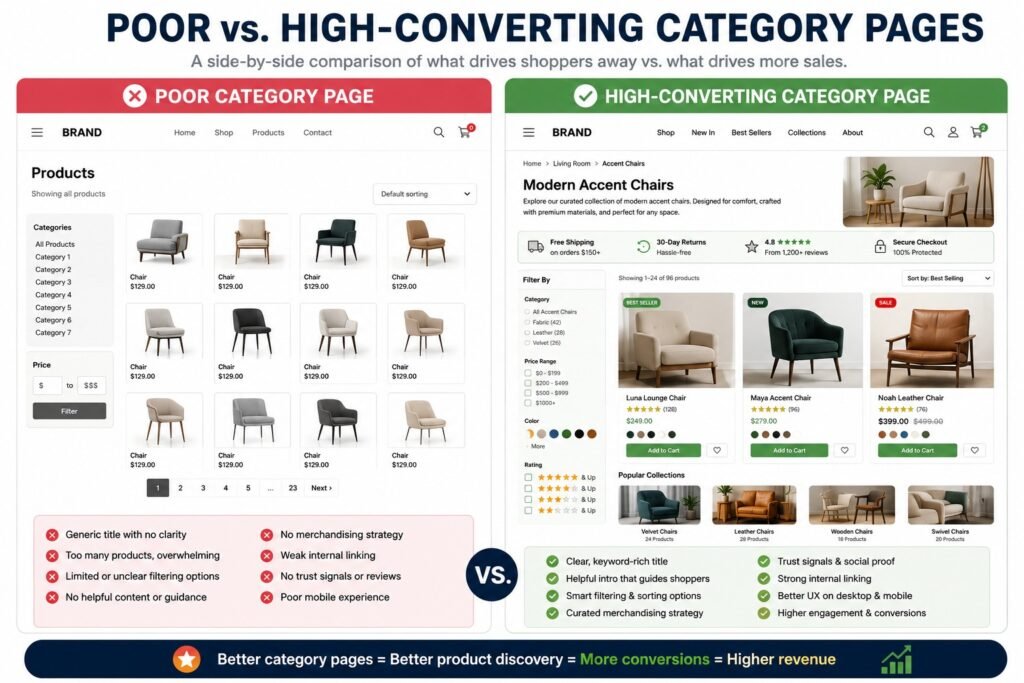
High-converting category pages do much more than display products. They reduce decision fatigue, guide shoppers toward the right products, and create a smoother path from browsing to buying. Instead of acting as digital shelves, they function as intelligent merchandising pages that balance customer experience with search engine optimization.
The strongest category pages answer shoppers’ questions before they ask them. They clearly communicate what products are available, who they’re for, how they differ, and what shoppers should explore next. This improves engagement, encourages deeper browsing, and increases the likelihood that visitors reach product pages with stronger purchase intent.
AI Overview Summary
High-converting category pages combine intuitive navigation, strategic merchandising, helpful content, and strong SEO to improve product discovery, reduce friction, and increase conversions.
Category-page optimization becomes particularly important for fashion and apparel brands, where shoppers often browse by collection, style, season, colour, size, or occasion rather than searching for a single product. The category page therefore needs to work as both a merchandising and discovery layer. Our guide to fashion ecommerce website design explores how apparel brands can connect visual merchandising, product discovery, mobile UX, localization, and conversion strategy across the wider ecommerce experience.
What Should Every Ecommerce Category Page Include?
An effective category page helps shoppers make confident decisions without overwhelming them. Every element should reduce effort while increasing clarity.
1. Descriptive Category Headings
Your category title should match how customers naturally search.
Instead of vague labels like Products or Collection, use descriptive headings such as:
- Women’s Trail Running Shoes
- Organic Facial Moisturizers
- Ergonomic Office Chairs
- Commercial Espresso Machines
Search-focused headings improve topical relevance while immediately confirming to visitors that they’ve reached the correct page.
2. Helpful Category Introductions
A short introduction at the top of the page provides context for both shoppers and search engines.
Rather than filling the page with keywords, explain:
- What products the category contains
- Who they’re best suited for
- Key differences between product types
- Important buying considerations
This supports SEO while helping first-time buyers make informed decisions.
3. Intelligent Filtering & Sorting
Filtering should simplify product discovery, not complicate it.
Useful filters often include:
- Price
- Brand
- Color
- Material
- Size
- Customer Rating
- Availability
- Sustainability Features
- Compatibility
Sorting options should also reflect real shopping behavior, such as Best Selling, New Arrivals, Highest Rated, Price, and Featured.
Research from Baymard Institute has consistently shown that effective filtering is one of the biggest usability improvements for ecommerce websites because it reduces the effort required to browse large catalogs.
4. Strong Product Merchandising
Product order should be intentional rather than automated.
Instead of displaying products alphabetically or by SKU, prioritize:
- Best sellers
- New arrivals
- Seasonal products
- High-margin products
- Staff recommendations
- Trending collections
Strategic merchandising encourages customers to discover products they might otherwise overlook.
5. Clear Product Cards
Visitors shouldn’t need to open every product page to compare products.
A strong product card typically includes:
- High-quality image
- Product name
- Price
- Review rating
- Key feature
- Shipping indicator
- Promotional badge where appropriate
Making comparison easier reduces unnecessary clicks and improves browsing efficiency.
Why Great Websites Are Still Losing Organic Traffic
Even well-designed websites can lose clicks if Google AI Overview answers the user’s question first. Learn how to identify which pages deserve a rewrite—and how to make your content citation-worthy instead of easy to replace.
Read the AI Overview Rewrite Framework →How Does ecommerce collection page design Influence Customer Decisions?
Collection page design shapes how shoppers perceive your brand long before they reach checkout.
Clean layouts, consistent spacing, readable typography, and logical visual hierarchy help customers browse with confidence. When information is easy to scan, visitors spend less time searching and more time evaluating products that genuinely match their needs.
In our experience, many ecommerce brands focus heavily on homepage aesthetics while neglecting the design consistency of category pages. Since shoppers often spend considerably more time exploring collections than viewing the homepage, improving these pages usually has a greater impact on the overall shopping experience.
AI Overview Summary
Well-designed collection pages reduce cognitive effort by helping shoppers browse, compare, and shortlist products more efficiently. Better usability often leads to stronger customer engagement and higher conversion potential.
Why Does ecommerce category page optimization Improve Both SEO and Conversions?
Category page optimization supports two goals simultaneously: helping customers navigate your catalog and helping search engines understand it.
Well-optimized pages contribute to:
- Better internal linking
- Clearer topical relevance
- Improved crawlability
- Richer contextual content
- Stronger commercial keyword visibility
For shoppers, the benefits are equally important. Clear organization, helpful content, and intuitive navigation make it easier to discover products, compare options, and move toward a purchase.
Rather than treating SEO and UX as separate initiatives, successful ecommerce businesses recognize that both depend on a well-structured category page.
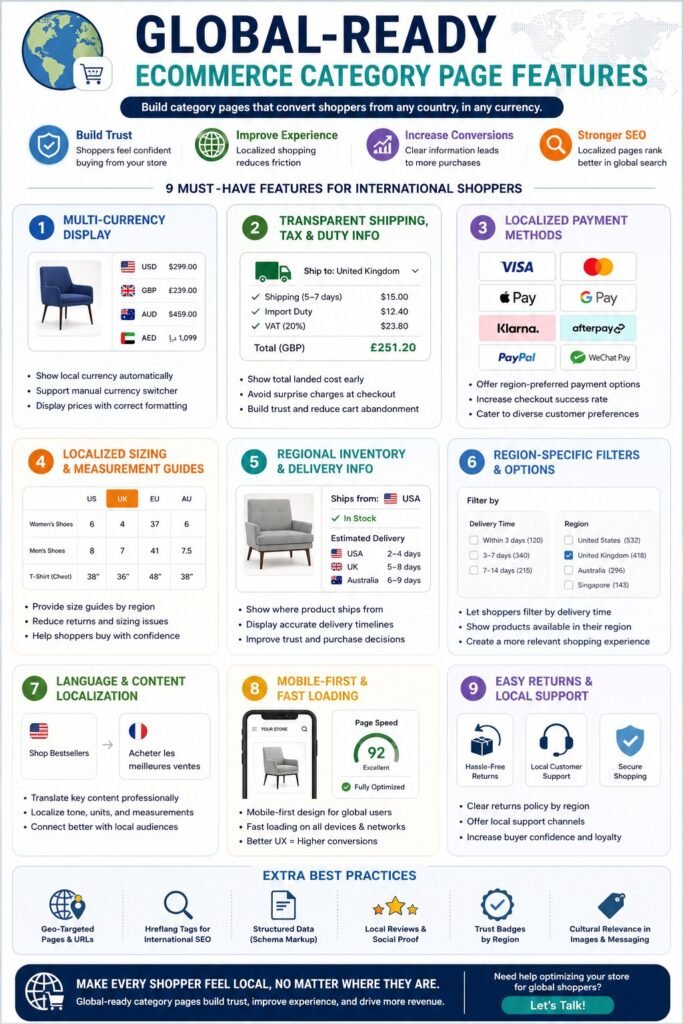
Global-Ready Usability for International Ecommerce Brands
If your business serves customers in the United States, United Kingdom, Australia, Canada, Singapore, or the UAE, category pages should reduce the uncertainty that often accompanies cross-border shopping.
Consider incorporating:
- Multi-currency pricing
- Transparent shipping estimates
- Duty and tax information where applicable
- Localized sizing guides
- Regional inventory availability
- Preferred payment methods such as Apple Pay, Google Pay, Klarna, and Afterpay
- Delivery timeframe filters for different markets
These features help international shoppers make purchasing decisions with greater confidence while reducing pre-purchase friction.

18+ Years. 500+ Websites. Zero Cookie-Cutter Stores.
I design ecommerce websites for founders in the US, UK, and Australia who are serious about revenue — not just a pretty storefront. Custom-built, conversion-focused, and delivered on time.
How Does ecommerce UX for product collections Affect Revenue?
User experience directly influences purchasing behavior because customers are more likely to continue shopping when they can find relevant products quickly.
Good ecommerce UX for product collections answers three essential questions within seconds:
- Am I looking at the right products?
- Can I easily narrow my options?
- Which products best fit my needs?
When the answers are obvious, customers continue browsing.
When they’re not, they often return to search results or visit a competitor’s website.
At KG Web Designer, we frequently find that improving navigation, spacing, filtering, and information hierarchy creates meaningful business improvements without requiring additional advertising investment.
Example Scenario
Imagine two premium furniture retailers selling nearly identical dining tables.
Store A
The category page displays more than 200 products with limited filtering, inconsistent product images, and no buying guidance. Customers scroll through dozens of options before abandoning the site because narrowing their choices requires too much effort.
Store B
The category page immediately offers filters for seating capacity, material, finish, price range, and delivery time. A concise buying guide explains the differences between solid wood, engineered wood, and extendable tables. Popular collections and best sellers appear first, allowing shoppers to identify suitable products quickly.
Both retailers sell comparable products.
The difference lies in how efficiently customers discover them.
Example From Our Experience
During ecommerce website audits, we often meet businesses that believe declining sales are caused by insufficient website traffic.
However, a closer review frequently reveals that customers struggle to browse the product catalog because collections lack clear hierarchy, meaningful filters, and logical merchandising.
Rather than immediately recommending additional advertising, we focus on improving information architecture, simplifying navigation, and strengthening category page strategy.
Once customers can discover products more easily, existing traffic usually delivers greater business value before additional marketing investment becomes necessary.
Related Reading
A well-optimized category page becomes even more effective when combined with broader conversion-focused website strategy. In our guide on How Premium Brands Use Ecommerce Website Design Services to Increase Average Order Value, we explain how merchandising, navigation, and customer psychology work together to encourage larger purchases while strengthening long-term customer value.
Why Most Businesses Get This Wrong
Many ecommerce businesses assume category pages simply need to display products.
That assumption leaves significant revenue opportunities untapped.
The highest-performing ecommerce brands approach category pages as strategic sales tools. They use customer intent, merchandising, search behavior, and UX research to help shoppers reach confident buying decisions with minimal effort.
Instead of asking:
“How many products can we display?”
Successful businesses ask:
“How quickly can customers discover the products that best meet their needs?”
This mindset changes everything—from navigation and filtering to content, internal linking, and merchandising strategy.
Ready to Turn Your Category Pages Into Revenue Drivers?
At KG Web Designer, we help premium ecommerce brands across the United States, United Kingdom, Australia, Canada, Singapore, and the UAE create conversion-focused shopping experiences that improve product discovery, strengthen SEO, and increase sales.
Whether you’re using Shopify, WooCommerce, or Magento, we’ll identify practical improvements that support long-term business growth rather than recommending unnecessary redesigns.
Book Your 30-Minute Ecommerce Growth Strategy Call with Kanika Gupta
Related Reading
Want to see how leading brands structure their shopping experiences? Explore our analysis of 15 of the Best Ecommerce Website Designs in 2026 to learn how successful fashion, beauty, electronics, and D2C brands use navigation, category pages, and customer journeys to improve conversions.
Expert Insight From Kanika Gupta
Founder, KG Web Designer | Ecommerce SEO & AI Strategy Consultant
“The most successful ecommerce migrations aren’t the ones with the newest design trends. They’re the ones where customers barely notice the migration because everything simply works better. Search engines retain confidence, customers complete purchases more easily, and the business continues growing without interruption.”
How Category Page Optimization Supports Long-Term Ecommerce Growth
Category page optimization is not a one-time design improvement. It is an ongoing business strategy that affects how customers discover products, how search engines understand your website, and how efficiently your ecommerce store converts visitors into buyers.
Investing in ecommerce website conversion optimization at the category level creates benefits across the entire customer journey.
Business Benefits of Optimized Category Pages
- Higher product discovery without increasing advertising spend.
- Stronger organic visibility for commercial search queries.
- Improved browsing experience across desktop and mobile devices.
- Better internal linking throughout the website.
- Higher average order value through strategic merchandising.
- Increased customer confidence during product selection.
- Lower abandonment caused by navigation or filtering issues.
Unlike homepage redesigns that primarily influence first impressions, optimized category pages improve every shopping session.
AI Overview Summary
Businesses that improve category page usability often generate more value from existing traffic because customers find relevant products faster, browse more confidently, and reach purchasing decisions with less friction.
The Collection Page Revenue Framework
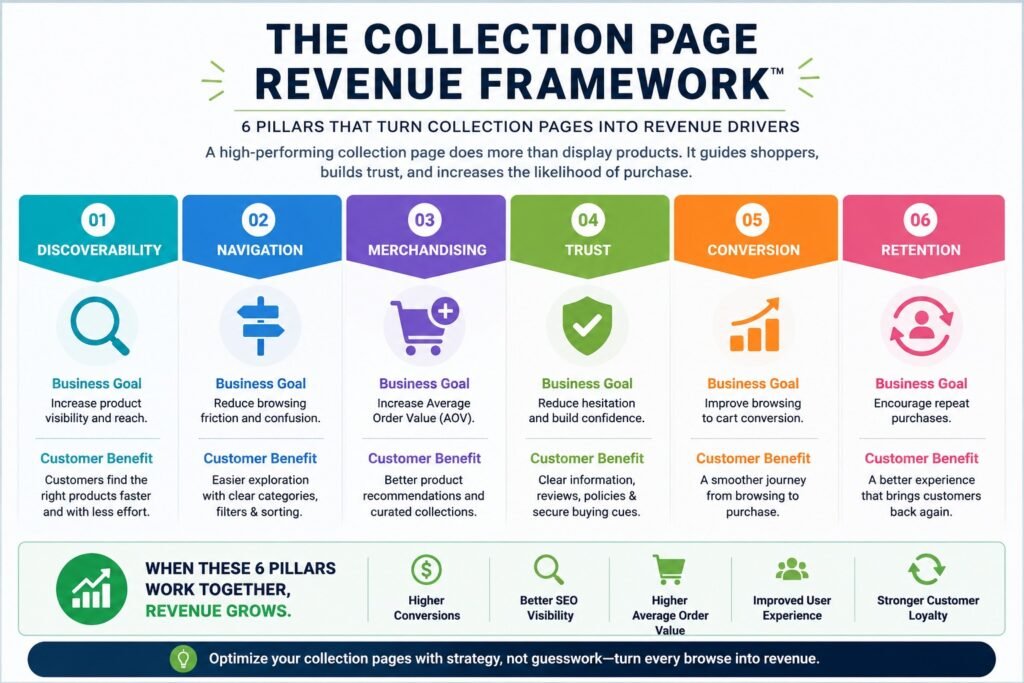
At KG Web Designer, we encourage ecommerce businesses to evaluate category pages using six interconnected pillars rather than focusing only on appearance.
| Pillar | Business Goal | Customer Benefit |
|---|---|---|
| Discoverability | Increase product visibility | Customers find products faster |
| Navigation | Reduce browsing friction | Easier exploration |
| Merchandising | Increase Average Order Value | Better product recommendations |
| Trust | Reduce purchase hesitation | Greater buying confidence |
| Conversion | Improve browsing-to-cart rate | Simpler purchase journey |
| Retention | Encourage repeat purchases | Better long-term customer experience |
When these six elements work together, category pages become one of the strongest revenue-generating assets on an ecommerce website.
Ready to Improve Your Ecommerce Conversions?
You now know what the right investment looks like. The next step is a quick call — no pitch, no pressure. Just clarity on what your store needs and what it’ll cost to build it right.
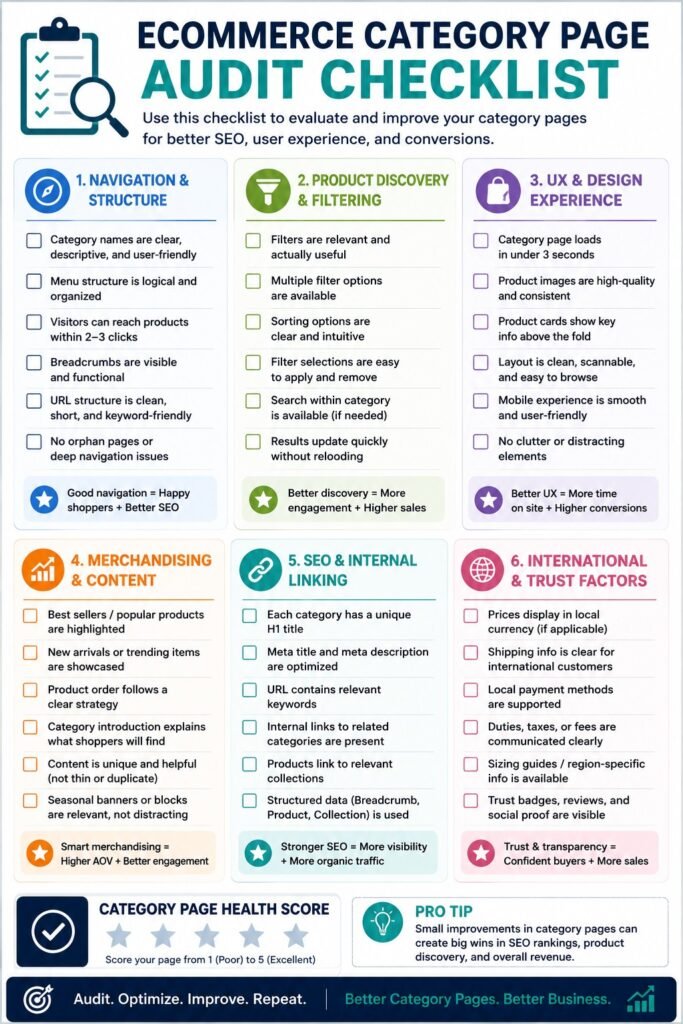
Ecommerce Category Page Audit Checklist
Before investing in SEO or a complete website redesign, review whether your category pages answer these questions.
Navigation
- Are categories named using customer-friendly language?
- Is the menu structure logical?
- Can visitors reach products within two or three clicks?
Product Discovery
- Are filters relevant and easy to use?
- Is sorting intuitive?
- Are best-selling products prioritized?
User Experience
- Are product images consistent?
- Does the layout work well on mobile?
- Is important information visible without unnecessary scrolling?
SEO
- Does each category include unique introductory content?
- Are internal links connecting related collections?
- Are breadcrumbs implemented correctly?
International Ecommerce
- Is pricing localized where appropriate?
- Are delivery expectations clear?
- Are regional payment methods supported?
- Are sizing guides available for different markets?
The more questions answered with “yes,” the more likely your category pages are supporting both search visibility and conversions.
Industry Observation
One trend becoming increasingly important is AI-assisted shopping.
Customers using Google AI Overviews, ChatGPT, Perplexity, Gemini, and other AI-powered search tools expect websites to present information in a logical, well-structured format. Collection pages with descriptive headings, organized product groupings, and clear contextual information are more likely to support these evolving discovery experiences than pages consisting solely of endless product grids.
As AI-powered search continues to influence ecommerce, category pages will become even more valuable as structured entry points into your product catalog.
What We Frequently See During Ecommerce Website Audits
Across ecommerce website audits conducted by KG Web Designer, we regularly identify opportunities such as:
- Collection pages built around inventory management rather than customer intent.
- Generic category descriptions duplicated across multiple collections.
- Filters that fail to match how customers actually narrow their choices.
- Weak merchandising that displays products alphabetically instead of strategically.
- Missed opportunities to connect related collections through contextual internal links.
These observations consistently reinforce that improving product discovery often produces greater business impact than simply increasing website traffic.
Final Thoughts
Collection and category pages are no longer secondary pages within an ecommerce website.
They influence product discovery, search visibility, merchandising, customer confidence, and long-term revenue growth.
Businesses that invest in improving these pages create better experiences for customers while also strengthening the signals that search engines use to understand website structure and relevance.
Rather than viewing category pages as automated product listings, successful ecommerce brands treat them as strategic revenue assets that guide customers from exploration to purchase.
A thoughtful ecommerce website design strategy recognizes that every stage of the customer journey matters, and category pages are often where purchasing decisions truly begin.
Ready to Improve Your Ecommerce Store?
If your ecommerce website attracts visitors but product discovery feels difficult, your category pages may be limiting growth opportunities.
At KG Web Designer, we help premium ecommerce brands across the United States, United Kingdom, Australia, Canada, Singapore, and the UAE build conversion-focused shopping experiences that combine strategy, SEO, UX, merchandising, and AI-ready website architecture.
Whether you’re launching a new ecommerce website or improving an existing Shopify, WooCommerce, or Magento store, we’ll identify the highest-impact opportunities for sustainable growth.
Why Work With KG Web Designer?
- Conversion-focused ecommerce strategy
- Custom website design tailored to your business goals
- SEO and AI search optimization built into every project
- Expertise in Shopify, WooCommerce, and Magento
- Fully remote collaboration across US, UK, Australia, Canada, Singapore, and UAE time zones
- No-obligation discovery call with actionable recommendations
Our E-Commerce Website Design Services
Frequently Asked Questions
Why are category pages more important than product pages for SEO?
Category pages target broader commercial search intent and organize related products into logical groups. This helps search engines understand your site structure while giving customers an easier way to browse products before making purchasing decisions.
How often should ecommerce category pages be updated?
Review category pages at least quarterly or whenever new product lines, seasonal collections, or customer behavior changes. Regular updates keep navigation relevant, improve internal linking, and ensure category content reflects current inventory and search trends.
What is the ideal length for category page content?
Most category pages benefit from a concise introduction of approximately 100–250 words that explains the collection, highlights important buying considerations, and naturally incorporates relevant keywords without distracting shoppers from browsing products.
Do collection pages help AI-powered search engines?
Yes. Well-structured collection pages with descriptive headings, clear navigation, contextual content, and logical internal linking provide signals that help AI-powered search systems better understand product relationships and website organization.
Should every category page include buying guidance?
Where appropriate, yes. Brief buying advice, comparison information, or links to buying guides help shoppers make informed decisions while also providing additional context for search engines.
What industries benefit most from category page optimization?
Any ecommerce business with multiple products can benefit, including fashion, beauty, furniture, electronics, health products, industrial equipment, automotive parts, sporting goods, and home décor brands.
Can category page optimization improve Average Order Value?
Yes. Better merchandising, intelligent product recommendations, and related collection links encourage customers to discover complementary products, increasing the likelihood of larger purchases.
Is category page optimization worth doing before investing in paid advertising?
In many cases, yes. Improving product discovery and reducing browsing friction helps existing traffic convert more effectively, ensuring future advertising budgets deliver stronger returns.