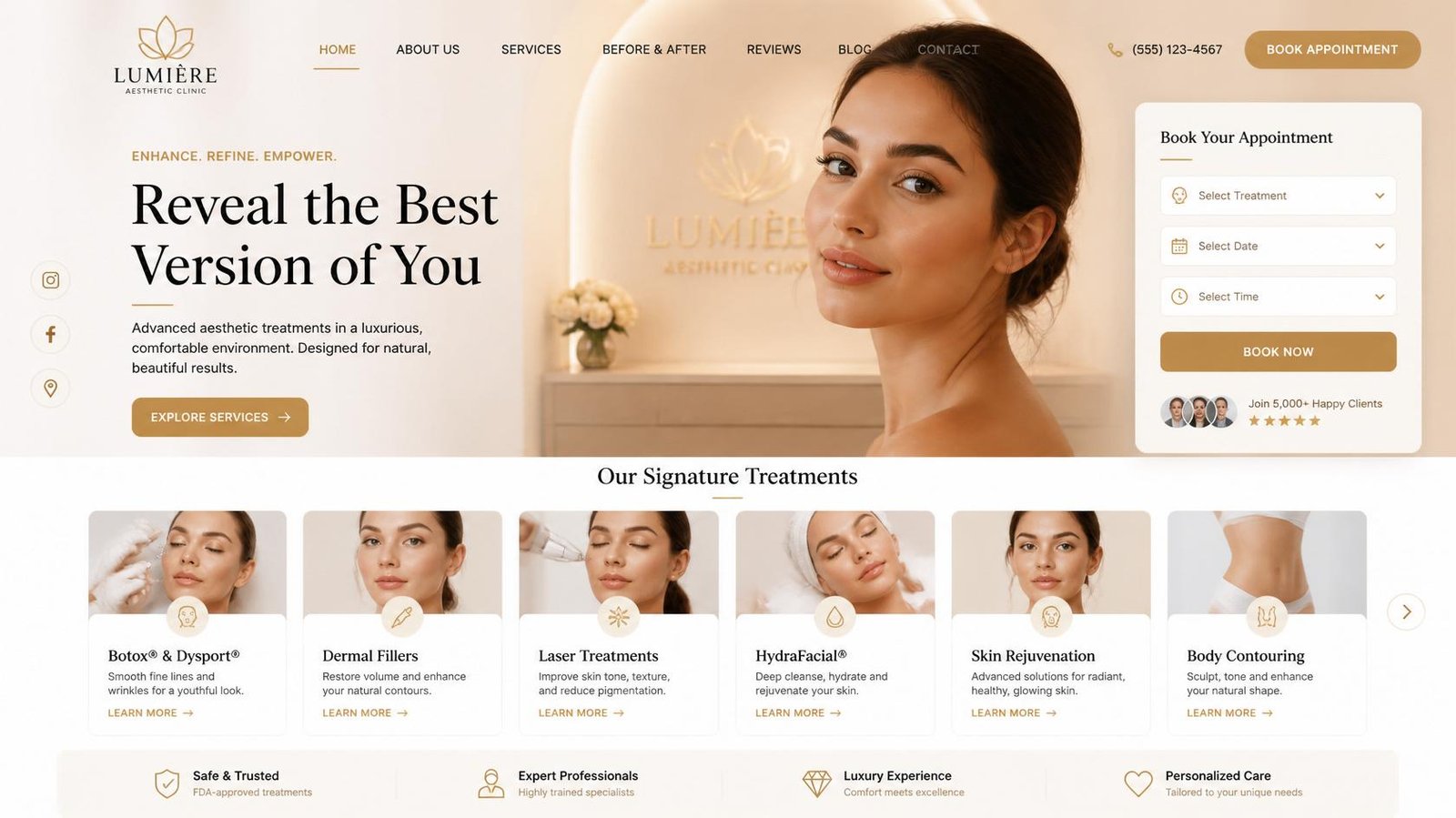
A premium aesthetic clinic website design should do far more than impress visitors visually. It should establish clinical credibility, answer patient concerns, demonstrate regulatory awareness, and make booking a consultation effortless. Clinics that combine trust-building content, conversion-focused UX, AI-ready SEO, and patient-centered design consistently generate more qualified consultation requests than those focused on aesthetics alone.
TL;DR
Beautiful design attracts attention, but patient trust generates consultation bookings.
Most clinic websites lose inquiries because they create friction during the decision-making journey, not because they lack traffic.
Google AI Overviews and AI search platforms increasingly reward websites that demonstrate expertise, structured information, and topical authority.
International patients expect secure booking, practitioner transparency, and compliance with local healthcare regulations.
A conversion-focused website becomes a long-term patient acquisition asset instead of simply an online brochure.
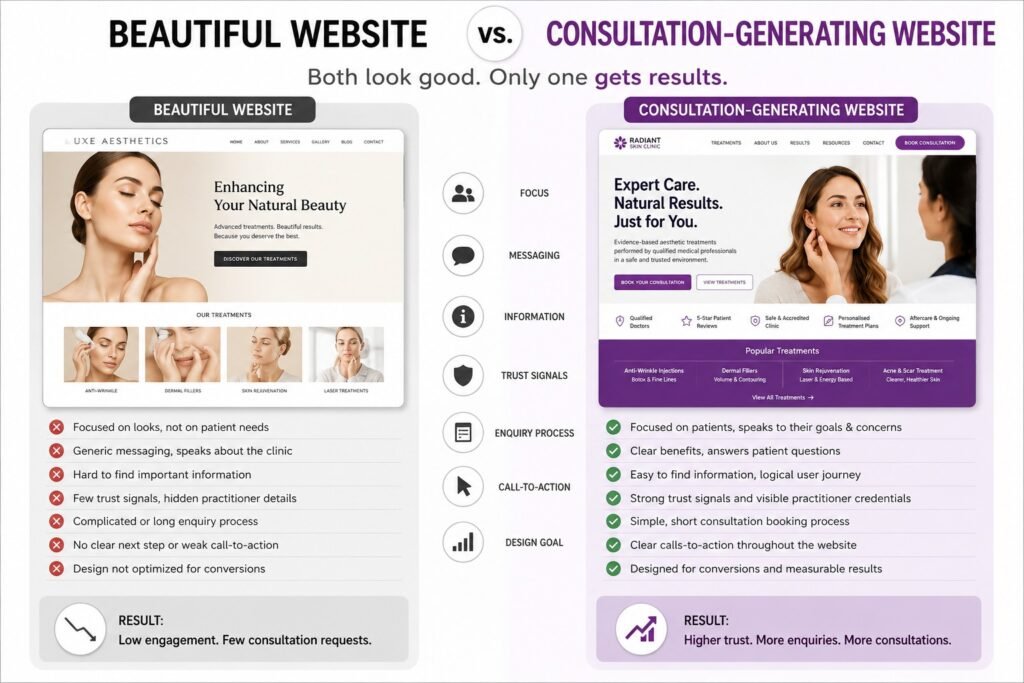
Website Audit: Beautiful Website vs. Consultation-Generating Website
Evaluation Area
Beautiful Website
Consultation-Generating Website
First Impression
Premium photography and animations
Premium visuals supported by immediate trust signals
Is Your Clinic Website Attracting the Wrong Type of Patient?
If your treatments are premium but your enquiries are price-sensitive, your website may be creating the wrong first impression. A refined clinic website can help position your brand for higher-value consultations.
Multi-location clinic groups expanding into competitive markets
If your clinic receives website traffic but consultation bookings remain inconsistent, this guide will help identify where your website may be losing prospective patients.
Questions We Frequently Hear During Strategy Calls
Why isn’t our website converting visitors into consultations?
Should we redesign or optimize our existing website?
What makes one clinic website outperform another?
How do AI search engines influence patient acquisition?
What should a premium clinic website include in 2026?
These questions all point to the same challenge: patients are evaluating much more than design before deciding to contact your clinic.
Why High-End Aesthetic Clinic Websites Fail to Convert Traffic into Paid Consultations
The answer is simple.
Patients don’t choose the clinic with the most beautiful website.
They choose the clinic they trust the most.
Unlike ecommerce customers making quick purchases, aesthetic patients often spend days or weeks researching treatments, comparing practitioners, reading reviews, and evaluating clinics before requesting a consultation. Every page on your website either builds confidence or creates uncertainty.
At KG Web Designer, we’ve found that many clinics invest heavily in branding, cinematic videos, and premium photography while overlooking the information patients actually need before making contact.
The highest-performing clinic websites consistently answer four questions early in the patient journey:
Is this practitioner qualified?
Is this clinic trustworthy?
Is this treatment right for me?
What happens if I book a consultation?
If your website doesn’t answer these questions quickly, many prospective patients simply continue comparing competitors.
Industry Data: How Patients Research Aesthetic Clinics Today
The patient journey has changed dramatically over the last few years.
According to Google’s healthcare search research, most healthcare journeys now begin online, with prospective patients researching providers, reading reviews, comparing treatments, and evaluating trust signals before making contact. Mobile devices account for the majority of healthcare-related searches, making mobile usability and page speed critical components of patient acquisition rather than optional design enhancements.
Research from Think with Google also shows that healthcare consumers increasingly expect immediate access to trustworthy information, simple navigation, and friction-free digital experiences before committing to appointments.
For aesthetic clinics, this means your website now serves three equally important roles:
Marketing platform.
Patient education resource.
Consultation booking system.
Clinics that excel in all three areas consistently outperform those relying on visual appeal alone.
What We Learned From Auditing Clinic Websites
Original Observation from KG Web Designer
After reviewing clinic websites across healthcare, wellness, and professional service industries, we’ve noticed a remarkably consistent pattern.
The websites generating the highest-quality inquiries are rarely the most visually elaborate.
Instead, they focus relentlessly on reducing patient uncertainty.
Across our website audits, we repeatedly see these issues:
Practitioner credentials hidden on secondary pages.
Consultation forms requesting excessive information.
Treatment pages written like advertisements instead of educational resources.
Calls-to-action appearing only after long sections of content.
Mobile navigation requiring too many steps before booking.
Homepages emphasizing services instead of patient outcomes.
These aren’t design problems.
They’re patient experience problems.
When clinics improve these areas, they often create a smoother consultation journey without dramatically changing their branding.
Extractable Insight: Conversion problems usually begin with patient uncertainty rather than poor visual design.
A visually impressive website may capture attention, but it won’t consistently generate consultation requests unless it guides visitors through a structured decision-making journey. That’s why we recommend designing every clinic website around a consultation funnel rather than a simple “Book Now” approach. Our detailed guide, The Consultation Funnel Every Skin Clinic Needs: A Complete Aesthetic Clinic Website Design Services Guide for 2026, explains how treatment pages, trust signals, practitioner credibility, and consultation-focused UX work together to turn more website visitors into qualified patient inquiries.
The Three Pages Every High-Performing Aesthetic Clinic Website Needs
One of the biggest differences we see between average-performing and high-performing clinic websites is their information architecture.
Instead of treating every page equally, successful clinics invest heavily in three core pages.
1. Practitioner Profile Page
Patients want reassurance before they book.
An effective practitioner profile should include:
Clinical qualifications
Certifications
Professional memberships
Years of experience
Areas of specialization
Personal treatment philosophy
Speaking engagements or publications where applicable
2. Treatment-Specific Landing Pages
Every major treatment deserves its own educational resource rather than being grouped into a general services page.
Strong treatment pages answer:
Who is this treatment for?
Who should avoid it?
Recovery expectations
Consultation process
Frequently asked questions
Risks and realistic expectations
This approach supports both patient education and topical SEO authority.
3. Consultation Booking Page
One common mistake we notice is treating booking as an afterthought.
Instead, consultation pages should explain:
What happens during the appointment
Expected consultation duration
Preparation instructions
Available booking methods
Privacy and patient confidentiality
Next steps after submitting an enquiry
Patients are significantly more comfortable booking when they know exactly what to expect.
“One of the first things we review during every clinic website audit is the consultation journey rather than the homepage design. We’ve found that clinics often spend thousands on branding while unintentionally creating friction through lengthy booking forms, unclear practitioner information, or generic treatment pages. Improving these areas usually has a far greater impact on enquiry quality than another visual redesign because patients make decisions based on confidence, not aesthetics.”
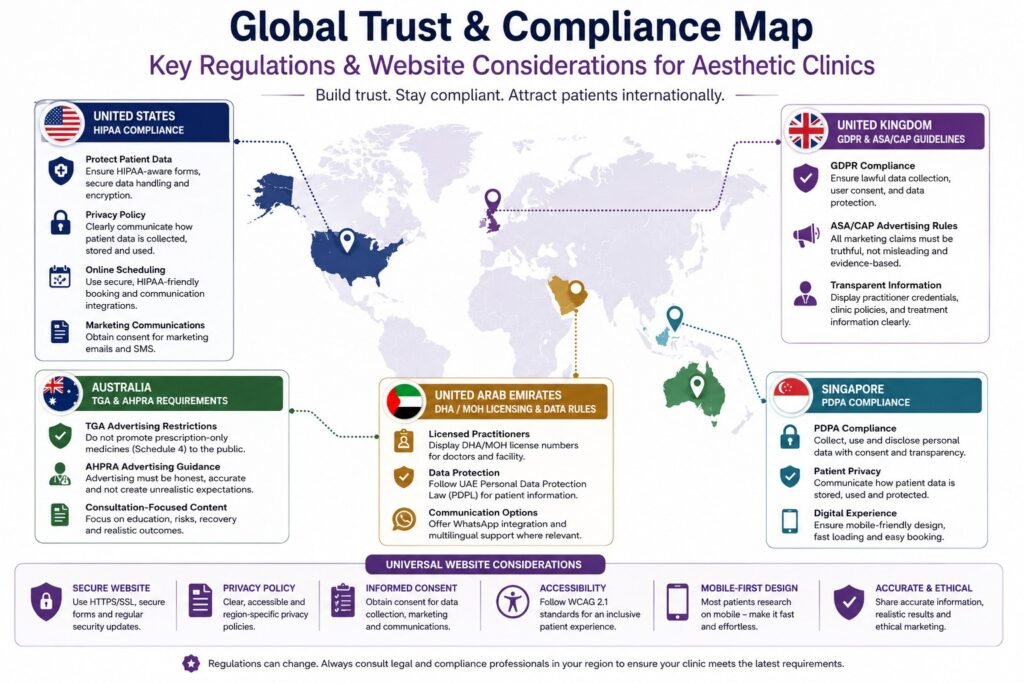
International Trust Signals That Premium Patients Expect
If your clinic serves patients across the United States, United Kingdom, Australia, Canada, Singapore, or the UAE, your website should demonstrate an understanding of regional expectations without offering legal advice.
GDPR compliance, ASA/CAP advertising guidance, CQC registration where applicable, and accurate practitioner credentials in line with professional standards.
Australia
Awareness of TGA advertising restrictions, including the prohibition on promoting Schedule 4 prescription medicines to the public, adherence to AHPRA advertising guidance, and consultation-focused educational messaging.
UAE
Clear practitioner licensing, multilingual support where appropriate, secure enquiry forms, and optional WhatsApp integration for patient convenience.
Singapore
PDPA-aware privacy practices, practitioner transparency, fast mobile booking, and efficient patient communication.
Canada
Strong privacy practices, accessible website design, transparent consultation expectations, and bilingual support where appropriate.
These trust signals reinforce professionalism while helping international patients feel confident before making first contact.
“The clinics generating the strongest organic growth rarely publish the most pages. They publish the most helpful ones. Patients don’t reward keyword stuffing, and neither do modern search engines. Every treatment page should reduce uncertainty, demonstrate expertise, and naturally guide visitors toward scheduling a consultation.”
Build Authority Beyond Your Homepage
Ranking for competitive treatment keywords requires more than a beautiful website. Developing a comprehensive aesthetic clinic SEO strategy with treatment-focused content, topical clusters, and internal linking helps clinics attract patients who are actively researching procedures while strengthening visibility in Google Search and AI-powered search experiences.
What Website Features Actually Turn Website Visitors into Consultation Requests?
The answer is that every feature should reduce uncertainty, reinforce credibility, and shorten the path between interest and action. High-performing clinics don’t ask visitors to “contact us.” They guide prospective patients through a carefully designed decision-making journey that builds confidence at every step.
At KG Web Designer, we approach website strategy by asking one simple question:
“What information does a patient need before they feel comfortable booking a consultation?”
Everything on the website should answer that question.
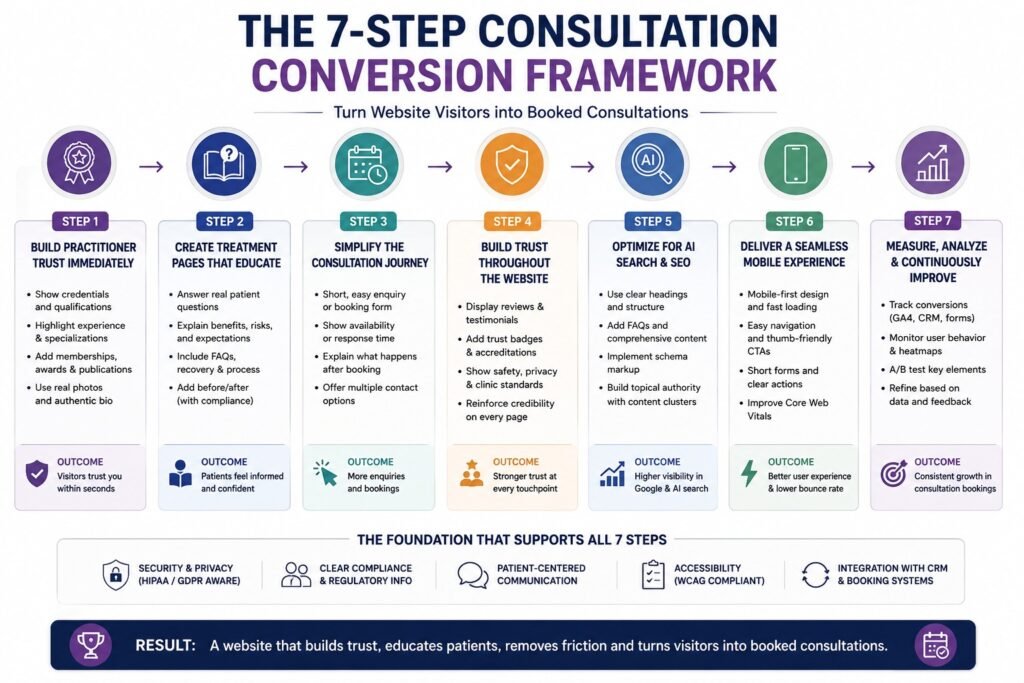
The 7-Step Consultation Conversion Framework We Use
Rather than starting with colors or layouts, we begin with the patient’s decision-making process.
Step 1. Build Practitioner Trust Immediately
Patients book practitioners, not websites.
One common mistake we notice is that clinics hide their most valuable asset—the expertise of their medical team—inside an “About Us” page that few visitors reach.
Instead, practitioner credibility should appear throughout the website.
Include:
Medical qualifications
Professional registrations
Clinical experience
Areas of specialization
Conference presentations
Published research (where applicable)
Professional memberships
Philosophy of care
These details reassure visitors before they compare pricing or treatments.
Extractable Insight: Practitioner credibility should appear before promotional messaging, not after it.
Step 2. Create Treatment Pages That Answer Real Patient Questions
Patients don’t search for “Our Services.”
They search for:
Botox alternatives
Acne scar treatment
PRP for hair loss
Laser pigmentation removal
Morpheus8 recovery
Chemical peel downtime
Every treatment deserves its own educational landing page.
A high-converting page explains:
Who the treatment is suitable for
Expected outcomes
Risks and contraindications
Recovery expectations
Frequently asked questions
Consultation process
Aftercare recommendations
When patients should avoid treatment
This type of content improves patient confidence while strengthening topical authority for search engines and AI platforms.
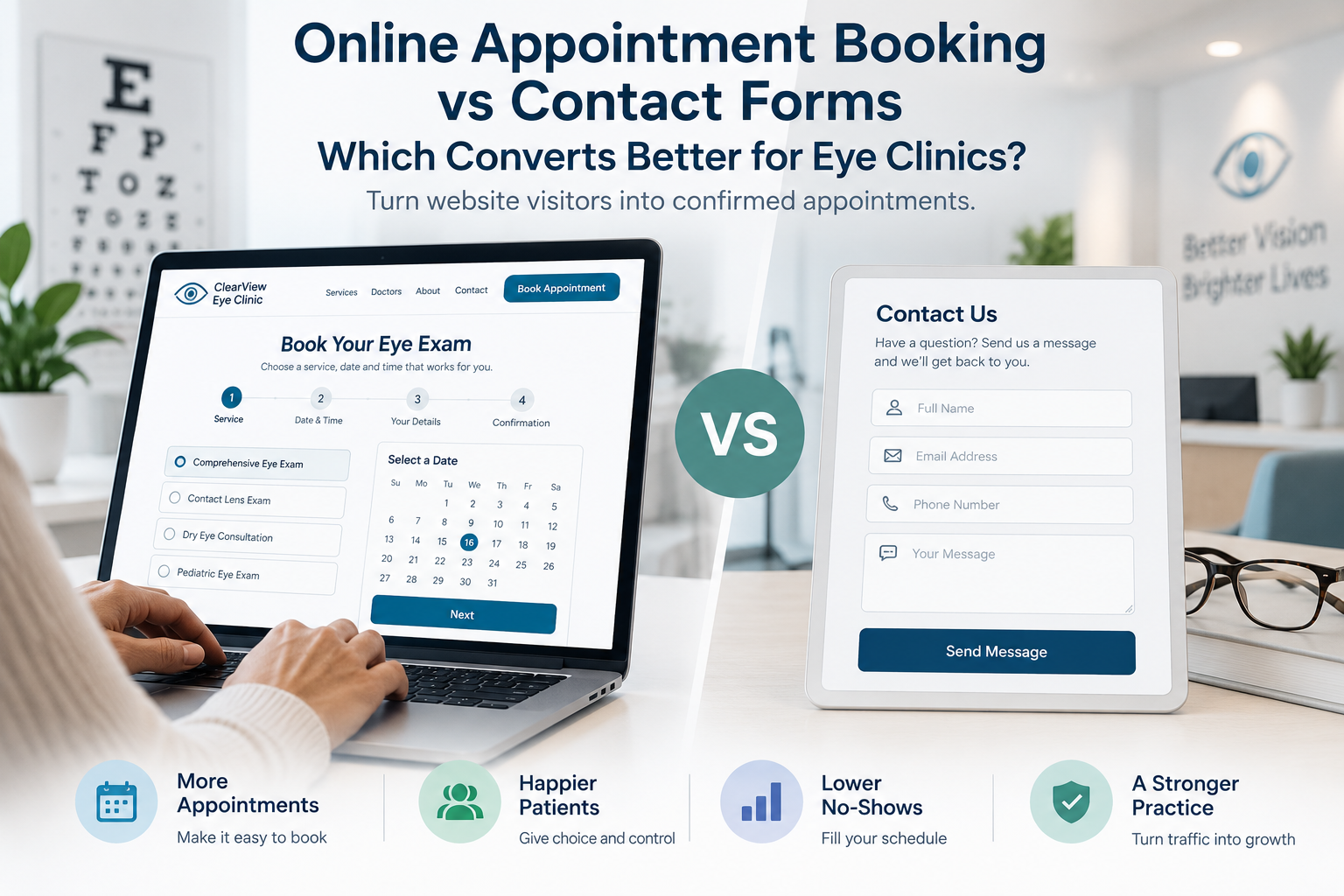
Step 3. Simplify the Consultation Journey
The easier it is to book, the more likely patients are to enquire.
One recurring issue we identify during website audits is unnecessary friction.
Examples include:
Asking for home addresses before scheduling.
Requiring lengthy medical questionnaires before first contact.
Hiding booking buttons beneath large image galleries.
Redirecting visitors through multiple pages before showing availability.
If your booking form asks for information that can be collected after the consultation is scheduled, you’re likely reducing conversion rates unnecessarily.
Instead:
Keep initial enquiry forms short.
Explain exactly what happens after submission.
Offer clear response time expectations.
Allow patients to choose their preferred contact method.
Patients appreciate clarity as much as convenience.
Consultation Booking Friction Audit
Common Issue
Business Impact
Better Alternative
Long enquiry forms
Lower enquiry completion
Request only essential information
Generic “Contact Us” button
Lower click-through rate
“Book Your Consultation” CTA
Hidden booking options
Lost enquiries
Persistent consultation button
Generic treatment pages
Lower patient confidence
Dedicated educational pages
Poor mobile experience
Higher bounce rates
Mobile-first UX with fast loading
No consultation explanation
Increased hesitation
Explain the booking journey clearly
Step 4. Build Trust Throughout the Website, Not Just on One Page
Trust should never depend on a testimonials page alone.
Patients evaluate credibility continuously while exploring your website.
Effective trust signals include:
Verified patient reviews
Professional memberships
Clinic awards
Media appearances
Safety protocols
Practitioner certifications
Privacy policies
Secure enquiry forms
Educational resources
Frequently asked questions
Rather than grouping all trust signals together, distribute them naturally across treatment pages, practitioner profiles, and consultation pages.
Expert Insight from Kanika Gupta
Kanika Gupta, Founder, KG Web Designer
“One of the biggest differences between high-performing clinic websites and average ones isn’t visual design—it’s how confidence is built throughout the patient journey. We’ve reviewed websites where beautiful branding was undermined by hidden practitioner credentials, confusing navigation, or lengthy enquiry forms. Small strategic improvements often have a greater impact than an expensive redesign because they remove the hesitation that prevents patients from taking the next step.”
Step 5. Optimize for AI Search, Not Just Google Rankings
Patients are no longer relying exclusively on traditional search engines.
Many now ask questions in Google AI Overviews, ChatGPT, Gemini, Perplexity, and voice assistants before visiting individual clinic websites.
These platforms favor websites that demonstrate:
Clear topical authority
Logical heading structures
Comprehensive treatment information
Frequently asked questions
Practitioner expertise
Structured content
Consistent internal linking
Instead of publishing isolated blog posts, clinics should build interconnected content clusters around treatments, patient concerns, aftercare, and consultation guidance.
This approach strengthens both traditional SEO and Generative Engine Optimization (GEO).
Extractable Insight: AI search engines increasingly recommend clinics that educate patients rather than simply promote treatments.
Step 6: Deliver a Seamless Mobile Experience
Most prospective patients research aesthetic treatments on their phones. Prioritize fast loading, intuitive navigation, thumb-friendly buttons, readable typography, Core Web Vitals, and mobile-first consultation forms.
Outcome: Lower bounce rates and more completed consultation requests.
Step 7: Measure, Test, and Continuously Improve
A high-performing website is never finished. Monitor GA4 conversions, CRM data, call tracking, heatmaps, session recordings, and A/B tests to identify opportunities for ongoing improvement.
Outcome: Continuous increases in consultation bookings and marketing ROI.
Want Your Website to Feel as Premium as Your Clinic?
High-end clients notice design quality, photography, trust signals, and booking flow within seconds. Let’s identify what your current website is communicating before patients ever contact you.
What We Would Change First If We Took Over Your Website Tomorrow
When conducting strategy sessions, we rarely recommend redesigning everything at once.
Instead, we prioritize the improvements that create the greatest business impact.
Our first recommendations usually include:
1. Rewrite the Homepage Around Patient Outcomes
Most clinic homepages describe services.
Successful homepages explain how patients’ lives improve after treatment.
2. Simplify Consultation Booking
Reduce unnecessary fields, explain the process clearly, and place consultation calls-to-action throughout the website rather than only in the navigation.
3. Strengthen Practitioner Authority
Move qualifications, experience, certifications, and memberships higher on important pages where patients naturally look for reassurance.
4. Expand Treatment Content
Create educational pages that answer real patient questions instead of relying on short service descriptions.
5. Improve Internal Linking
Connect treatment pages, practitioner profiles, FAQs, and educational articles so visitors naturally continue their research without leaving the website.
6. Optimize for Mobile First
Fast-loading pages, readable typography, and thumb-friendly navigation remain essential because most patients begin their research on mobile devices.
7. Prepare for AI Search
Use structured headings, FAQ sections, schema markup, and topical authority rather than relying on keyword repetition.
Case Study: How We Helped Taruj Aesthetics Build a Website That Reflects Their Premium Brand
At KG Web Designer, we partnered with Taruj Aestheticsto create a website that reflects the clinic’s commitment to professional care, patient education, and premium aesthetics.
Rather than focusing solely on visual design, the project centered on creating a website that would establish trust from the very first visit and guide prospective patients toward booking a consultation.
Our approach included:
Designing a clean, mobile-first website experience
Creating a structured navigation that helps visitors quickly find treatments
Showcasing practitioner expertise and clinic credibility
Developing dedicated treatment pages with patient-focused content
Improving page speed and mobile usability
Building an SEO-friendly website architecture for long-term visibility
Implementing clear calls-to-action throughout the consultation journey
The outcome
The new website provides a significantly stronger digital presence that aligns with Taruj Aesthetics’ premium positioning. Visitors can now easily explore treatments, understand the clinic’s expertise, and book consultations through a streamlined user journey designed to build confidence before the first appointment.
Expert Observation: One of the biggest improvements wasn’t simply the new visual design. It was reorganizing the website around the questions prospective patients ask before choosing an aesthetic clinic. When information is easy to find and trust is established early, the consultation journey becomes far more effective.
Original Observation from KG Web Designer
One trend has become increasingly obvious during our clinic website audits.
The websites generating the highest-quality enquiries aren’t necessarily the ones receiving the most traffic.
They’re the ones converting a greater percentage of existing visitors because every page removes uncertainty instead of adding friction.
That’s why we always recommend auditing the consultation journey before increasing advertising budgets.
Improving conversion rates often delivers a better return on investment than simply purchasing more traffic.
Evaluate the Journey
If your website looks impressive but consultation bookings haven’t kept pace with your business goals, it may be time to evaluate the patient journey instead of the visual design.
At KG Web Designer, our aesthetic clinic website design services combine premium branding with conversion strategy, AI-ready SEO, user experience optimization, and consultation-focused website architecture. Every project is planned around measurable business outcomes rather than design trends.
Work With an International Team
We support clinics across the United States, United Kingdom, Australia, Canada, Singapore, and the UAE with:
Strategy sessions across multiple time zones
USD, GBP, AUD, CAD, and AED invoicing
Asynchronous project communication for busy medical teams
Compliance-aware website planning
Secure collaboration from discovery through launch
Book a strategy call to discover how a conversion-focused website can help your clinic generate more qualified consultation requests.
Related Resource
If you want to improve how your clinic appears in Google AI Overviews, ChatGPT, and other AI-powered search experiences, explore our AI search guide for aesthetic clinics, where we explain how topical authority, structured content, and patient-focused website architecture influence AI recommendations.
Why Most Aesthetic Clinics Still Struggle to Generate Consultation Bookings
The answer is that most clinics optimize for appearance before optimizing for patient decision-making.
Many owners assume that if they invest in premium branding, professional photography, and paid advertising, consultation requests will naturally follow. However, our experience has shown that the biggest barrier isn’t attracting visitors—it’s giving them enough confidence to take the next step.
At KG Web Designer, we’ve reviewed websites that ranked well on Google and attracted thousands of monthly visitors but still generated relatively few qualified inquiries. The problem wasn’t traffic. It was friction.
Common issues include:
Homepages focused on treatments instead of patient outcomes.
Generic calls-to-action like “Contact Us.”
Practitioner qualifications hidden several clicks away.
Consultation forms asking for unnecessary information.
Educational content that answered very few patient questions.
Slow mobile experiences that frustrated users before they could book.
Every one of these issues increases the likelihood that a patient will continue researching another clinic.
Extractable Insight: More traffic rarely solves a poor consultation journey. Improving conversion often produces a higher return than increasing advertising spend.
The Cost of Doing Nothing
Many clinics delay improving their website because it “still looks modern.”
Appearance isn’t the problem.
Performance is.
When a website fails to convert prospective patients, the business consequences compound over time.
If Nothing Changes
Long-Term Business Impact
Low consultation conversion
More advertising required to achieve growth
Weak practitioner credibility
Patients choose more trustworthy competitors
Generic treatment pages
Lower organic visibility and weaker AI recommendations
Poor mobile experience
Higher bounce rates and abandoned enquiries
Complicated booking process
Lost high-value consultation opportunities
Weak educational content
Reduced authority and patient confidence
Even a modest improvement in consultation conversion can generate significantly more revenue than increasing advertising budgets alone.
How AI Search Is Changing Patient Acquisition
Patients are no longer relying exclusively on Google search results.
Increasingly, they ask questions such as:
Who is the best aesthetic clinic near me?
How do I choose a qualified cosmetic practitioner?
Is laser resurfacing worth it?
What happens during a Botox consultation?
AI-powered platforms like Google AI Overviews, ChatGPT, Gemini, and Perplexity answer these questions by identifying websites that consistently demonstrate expertise, authority, and trustworthiness.
Rather than emphasizing keyword density, these systems prioritize:
Comprehensive treatment content
Clear practitioner expertise
Helpful FAQs
Structured page hierarchy
Internal topic clusters
Consistent terminology
Author credibility
Original insights and experience
This is why clinics that invest in educational content often gain greater visibility across both traditional search and AI-assisted search experiences.
Extractable Insight: AI search favors clinics that teach before they sell.
2026 Website Features That Premium Aesthetic Clinics Should Prioritize
Technology should simplify the patient experience rather than create additional complexity.
The most successful clinic websites now integrate features that improve convenience, transparency, and trust.
Examples include:
Patient Experience
Online consultation scheduling
Mobile-first booking journey
Live availability calendars
Automated appointment confirmations
Secure online enquiry forms
Trust & Compliance
Practitioner registration details
Privacy-first patient forms
WCAG accessibility improvements
SSL security
GDPR and HIPAA-aware website architecture where applicable
Growth & Analytics
GA4 conversion tracking
CRM integration
Call tracking
Heatmap analysis
AI chatbot for common patient questions
Marketing automation
These technologies support the consultation process without replacing the personal relationship between practitioner and patient.
International Patient Expectations
One of the biggest differences between local and internationally competitive clinics is their ability to create confidence before the first conversation.
Patients from different regions also have different expectations.
Consultation booking with transparent practitioner information
Australia
Educational consultation-first messaging aligned with TGA and AHPRA advertising requirements
UAE
WhatsApp communication alongside online booking
Singapore
Mobile-first scheduling and rapid enquiry response
Canada
Privacy-focused consultation booking with transparent communication
We’ve also found that project delivery expectations vary internationally.
Many overseas clients appreciate:
Flexible meeting times across time zones
Asynchronous communication
USD, GBP, AUD, CAD, and AED invoicing
Clear project milestones
Recorded strategy sessions
Transparent documentation throughout the project
These operational details often become important differentiators when selecting a website partner.
Example From Our Experience
One aesthetic clinic approached KG Web Designer after investing significantly in advertising while experiencing inconsistent consultation bookings.
Rather than immediately recommending a redesign, we conducted a consultation journey audit.
Our review identified several opportunities:
The homepage promoted treatments before establishing practitioner credibility.
Individual treatment pages answered very few patient questions.
Booking required visitors to complete an unnecessarily long enquiry form.
Internal links between related treatments were limited.
Mobile users had to scroll extensively before reaching a consultation button.
Instead of redesigning everything, we prioritized strategic improvements.
We recommended:
Rewriting treatment pages around patient concerns.
Introducing stronger practitioner trust signals.
Simplifying the consultation workflow.
Improving internal linking.
Optimizing page hierarchy for AI search.
Making booking calls-to-action visible throughout the patient journey.
The result was a website that aligned much more closely with how prospective patients research and evaluate aesthetic providers. Staff also reported that new enquiries arrived better informed because patients had already found answers to many of their questions before making contact.
What This Means for Your Business
If your clinic serves patients in competitive markets like New York, London, Sydney, Toronto, Dubai, or Singapore, your website has become one of your most important business assets.
Patients evaluate your expertise before they evaluate your treatments.
They judge your professionalism before they speak with your team.
And they decide whether to trust your clinic long before submitting a consultation request.
The clinics leading the industry in 2026 understand that design, content, SEO, AI optimization, and patient experience are no longer separate disciplines. They work together to create sustainable business growth.
It is judged by how effectively it earns trust, educates prospective patients, removes friction from the consultation journey, and converts interest into booked appointments.
As AI-powered search, patient expectations, and digital healthcare experiences continue to evolve, clinics that prioritize strategy over aesthetics will consistently outperform those relying on design alone.
At KG Web Designer, we build custom websites that combine premium design, SEO, AI optimization, conversion strategy, and patient-centered user experience for clinics across the United States, United Kingdom, Australia, Canada, Singapore, and the UAE. Every project is tailored to support measurable business growth rather than simply creating a visually attractive website.
Ready to Build a Website That Generates More Qualified Consultations?
Book a strategy call to discuss your clinic’s goals and receive practical recommendations tailored to your practice.
What to expect when you work with us:
Strategy sessions across multiple time zones
USD, GBP, AUD, CAD, and AED invoicing
Fully remote collaboration
Compliance-aware website planning
SEO, GEO, AIO, and CRO strategy integrated from day one
“Pricing should never become the headline of an aesthetic clinic website. Patients invest in expertise, safety, and outcomes. When your website explains those factors first, pricing becomes easier to understand and far less likely to become the deciding objection.”
Building a successful pricing strategy also requires an effective website structure. Our article Why Some Aesthetic Clinic Websites Convert Better (and How to Structure Yours) explains how patient journeys, treatment pages, trust signals, and conversion-focused design work together to generate more consultation requests.
Frequently Asked Questions
Why doesn’t a premium-looking clinic website generate more consultation requests?
Because appearance alone doesn’t reduce patient uncertainty. Prospective patients want to understand who will perform the treatment, what the consultation involves, whether the clinic is trustworthy, and what results they can realistically expect before making contact.
Should every aesthetic treatment have its own landing page?
Yes. Dedicated treatment pages answer specific patient questions, improve topical authority, and increase visibility for high-intent searches. They also help AI search platforms understand your expertise more effectively.
How important is mobile performance for aesthetic clinics?
Extremely important. Most patients begin researching providers on mobile devices. Fast loading, intuitive navigation, readable content, and friction-free booking significantly influence whether visitors continue exploring your website or leave.
Does AI search change how clinic websites should be written?
Yes. AI search engines prioritize websites that provide comprehensive answers, demonstrate practitioner expertise, use logical heading structures, and organize content around patient intent rather than keyword repetition.
What compliance considerations should international clinics keep in mind?
Requirements vary by jurisdiction. Clinics should be aware of regulations such as HIPAA in the United States, GDPR in the UK and Europe, ASA/CAP advertising guidance in the UK, TGA and AHPRA advertising requirements in Australia, and applicable privacy regulations in other markets. Always seek legal advice to confirm compliance for your specific practice.
When should a clinic redesign its website?
A redesign should be driven by business performance rather than aesthetics alone. If your website no longer generates qualified enquiries, performs poorly on mobile devices, or fails to reflect your clinic’s expertise, a strategic redesign is likely to deliver greater long-term value.
Kanika Gupta is the Founder of KG Web Designer, a freelance website designer and digital marketing specialist from India. She helps businesses in India, the US, UK, Canada, and Australia build conversion-focused WordPress, ecommerce, SEO, and industry-specific websites.
Her work focuses on website design, WordPress development, SEO, local SEO, ecommerce UX, conversion optimization, and AI-ready content strategy for service businesses, consultants, healthcare brands, manufacturers, and online stores.
Hey, I’m Kanika Gupta. I help businesses design websites that attract customers, build trust, and generate real leads. My only question is, will it be yours?
I am Kanika Gupta, a creative website designer from India. I worked with MNC’s and the overseas clients for many years, and then one day I realized that I don’t need this 9 to 6 job anymore and it’s the right time to take some risks and learn from my mistakes and so I did start my career as a freelance web designer and developer.
Wax in the City has been specialising in professional waxing services for over 20 years. What began as a dedicated waxing studio has grown into a trusted name for clients who value experience, consistency, and results. While trends and treatments have changed over the years, our focus has remained the same — delivering high-quality waxing in a clean.
Gamahouse Publishing is a printing house that has been associated with Academic Publishing in the USA from the past 20 years and has printed more than 24000+ titles. Expanding its horizons from Academic, the publishing house is now open to the world of Fiction and Non-Fiction Authors.