Quick Answer
The most profitable ecommerce brands are not the ones constantly chasing new traffic. They are the ones building customer retention directly into the shopping experience. Strong UX, emotional branding, frictionless navigation, post-purchase trust, and personalization all influence whether a first-time buyer returns or disappears after one order.
TL;DR
Most ecommerce stores focus heavily on acquisition and ignore retention.
That creates an expensive growth model.
Modern ecommerce brands increase profitability by designing websites that:
- encourage repeat purchases
- build emotional trust
- reduce post-purchase friction
- create stronger customer experiences
- improve long-term loyalty
Retention-focused design increases customer lifetime value while reducing dependence on paid ads.
Key Takeaways
- Repeat customers are significantly more profitable than first-time buyers
- UX directly impacts retention and long-term loyalty
- Emotional trust matters as much as product quality
- Post-purchase experience affects repeat purchase behavior
- Mobile usability influences customer retention heavily
- Premium ecommerce brands optimize for lifetime value, not just conversions
- Strong retention design reduces customer acquisition pressure
The Ecommerce Design Strategy That Turns One-Time Buyers Into Repeat Customers
A customer buys from your ecommerce store for the first time.
What happens next determines whether your brand grows profitably or remains stuck in a constant acquisition cycle.
Most ecommerce brands obsess over:
- ad performance
- landing pages
- click-through rates
- first-time conversions
while overlooking the metric that matters most long term:
customer retention.
This is why ecommerce website design for customer retention has become one of the most important ecommerce growth strategies in 2026.
In highly competitive markets like New York, London, and Sydney, customer acquisition costs continue rising every year.
Brands that rely entirely on new customer acquisition eventually hit profitability ceilings.
The smartest ecommerce companies design experiences that encourage customers to return repeatedly.
That changes:
- customer lifetime value
- profitability
- ad efficiency
- brand perception
- long-term scalability
dramatically.
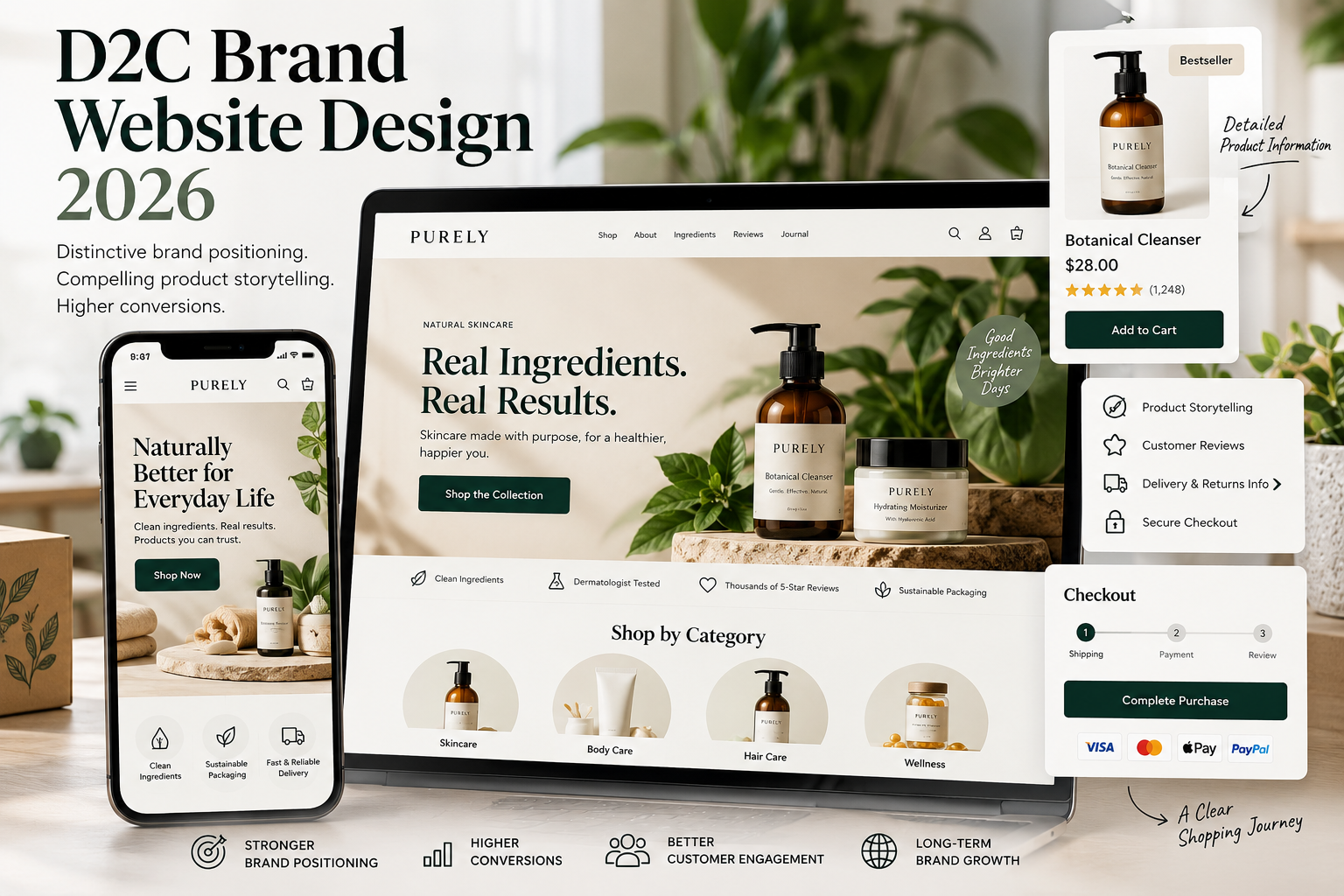
For brands selling directly to customers, retention starts with a consistent experience across product discovery, checkout, and post-purchase interactions. Our guide to website design for direct-to-consumer brands explores how brand positioning, product presentation, and a thoughtfully structured online store can support customer confidence beyond the first purchase.
Why Most Ecommerce Stores Quietly Lose Customers
Many ecommerce brands believe retention problems are caused only by:
- pricing
- product quality
- competition
In reality, poor UX quietly destroys repeat purchase behavior.
Customers rarely say:
“The website experience made me lose trust.”
But they feel it subconsciously.
Weak ecommerce experiences create friction through:
- confusing navigation
- inconsistent branding
- poor mobile usability
- slow load times
- frustrating checkout systems
- weak post-purchase communication
Every small friction point reduces emotional trust.
And emotional trust drives loyalty.
In my experience designing ecommerce brands targeting premium international customers, the biggest retention issue is usually not the product.
It is the experience surrounding the product.
Many of the loyalty-building techniques discussed here can be seen in action in our review of the 15 Best Ecommerce Website Designs in 2026, where we analyze how successful brands create memorable shopping experiences that encourage repeat purchases.
Ready to Build a High-Converting Ecommerce Website?
👉 Get your top 3 conversion leaks identified.
The Financial Advantage of Retention-Focused Ecommerce Design
Customer retention changes ecommerce economics completely.
Acquiring a new customer is significantly more expensive than retaining an existing one.
Yet most brands allocate:
- more budget to acquisition
- more effort to advertising
- more attention to top-of-funnel growth
while underinvesting in retention-focused UX.
This is where ecommerce website design for repeat customers becomes financially critical.
Strong retention design improves:
- repeat purchase rates
- average order value
- customer lifetime value
- referral behavior
- brand trust
without requiring constant increases in ad spend.
That creates healthier long-term growth.
Why Premium Ecommerce Brands Think Differently
Sophisticated ecommerce brands do not optimize only for the first sale.
They optimize for the second, third, and tenth purchase.
This changes how websites are structured completely.
Premium brands prioritize:
- trust consistency
- emotional continuity
- post-purchase reassurance
- customer familiarity
- intuitive UX patterns
because loyalty is built through repeated positive experiences.
A luxury fashion brand in London, a premium skincare company in New York, and a lifestyle ecommerce business website in Sydney all face the same challenge:
How do you create an experience customers want to return to?
That answer is rarely:
“More discounts.”
It is usually:
“Better customer experience.”
The Psychology Behind Repeat Purchase Behavior
Customers return when the buying experience feels:
- easy
- trustworthy
- emotionally satisfying
- predictable
- premium
Most ecommerce stores focus heavily on persuasion.
Retention-focused brands focus on reassurance.
That distinction matters enormously.
A customer who feels confident during:
- browsing
- checkout
- delivery
- post-purchase support
is dramatically more likely to return.
This is where ecommerce store design for customer loyalty becomes a major competitive advantage.
Strong retention UX reduces cognitive friction.
And lower friction creates stronger loyalty.
The 7 Design Principles That Increase Customer Retention
1. Consistent Brand Identity Across Every Touchpoint
Customers trust familiarity.
When branding feels inconsistent across:
- homepage
- product pages
- emails
- checkout
- mobile experience
trust weakens.
The strongest ecommerce brands maintain:
- visual consistency
- messaging consistency
- emotional consistency
throughout the customer journey.
This creates a stronger memory association with the brand.
And stronger memory associations improve repeat behavior.
2. Faster Mobile Experiences
Mobile retention matters more than most brands realize.
A customer who struggles to browse products on mobile rarely returns.
Premium ecommerce experiences prioritize:
- fast-loading pages
- thumb-friendly navigation
- simplified menus
- frictionless checkout
- optimized product discovery
because mobile convenience directly influences customer loyalty.
This becomes especially important in high-intent ecommerce categories like:
- fashion
- skincare
- wellness
- lifestyle products
where customers browse repeatedly before purchasing again.
3. Simplified Navigation Structures
Retention depends heavily on usability.
Returning customers should feel:
- familiar with the store
- confident navigating quickly
- emotionally comfortable browsing
Complex navigation destroys this familiarity.
Strong ecommerce UX simplifies:
- collections
- filtering
- search functionality
- product discovery
- category hierarchy
This is where ecommerce UX design for repeat purchases directly affects long-term profitability.
4. Trust-Driven Product Pages
Most product pages focus only on conversion.
Retention-focused brands optimize for confidence.
That means:
- accurate product imagery
- transparent policies
- sizing clarity
- delivery expectations
- realistic product descriptions
Customers return when expectations consistently match reality.
Trust compounds over time.
5. Strong Post-Purchase UX
The retention journey begins after checkout.
This is one of the most overlooked ecommerce growth opportunities.
Premium ecommerce brands invest heavily in:
- branded confirmation pages
- delivery transparency
- post-purchase communication
- onboarding experiences
- loyalty incentives
because post-purchase anxiety directly affects repeat behavior.
Customers who feel uncertain after purchasing are significantly less likely to buy again.
6. Emotional Personalization
Modern ecommerce personalization should feel intelligent, not invasive.
Strong retention-focused stores personalize:
- recommendations
- browsing experiences
- email flows
- reorder suggestions
- loyalty experiences
without overwhelming customers.
This strengthens emotional connection with the brand.
And emotional connection increases lifetime value dramatically.
7. Frictionless Account Experiences
Many ecommerce stores unintentionally make returning difficult.
Customers forget passwords, struggle finding previous orders, or experience checkout friction repeatedly.
Premium ecommerce brands simplify:
- account access
- saved preferences
- reorder functionality
- wishlist systems
- checkout continuity
because convenience influences loyalty heavily.
This is where retention-focused ecommerce website design creates measurable revenue impact.

18+ Years. 500+ Websites. Zero Cookie-Cutter Stores.
I design ecommerce websites for founders in the US, UK, and Australia who are serious about revenue — not just a pretty storefront. Custom-built, conversion-focused, and delivered on time.
Why First Impressions Still Affect Long-Term Loyalty
Customer retention actually begins during the first visit.
The emotional impression created during those first few seconds shapes:
- trust
- confidence
- perceived professionalism
- brand memory
We explored this in more detail in our guide on how ecommerce website design influences buying decisions in 5 seconds, including the visual and psychological triggers that influence whether visitors trust a brand instantly.
Brands that create strong first impressions usually retain customers more effectively over time.
Real Client Result: When UX Changed, Retention Improved
A premium skincare ecommerce brand targeting customers in the US and UK approached us because repeat purchase rates remained weak despite strong ad performance.
The issue was not traffic.
It was customer experience inconsistency.
Their previous website suffered from:
- confusing navigation
- weak mobile UX
- inconsistent product hierarchy
- slow product page loading
- unclear post-purchase communication
We restructured the experience around:
- cleaner UX flow
- mobile-first navigation
- stronger product trust signals
- simplified checkout
- post-purchase reassurance
Within a few months:
- repeat purchases increased significantly
- customer support tickets decreased
- time-on-site improved
- return customer revenue grew steadily
The products did not change.
The experience did.
And experience determines loyalty.
Why Cheap UX Decisions Become Expensive Long Term
Many ecommerce founders underestimate how expensive weak UX becomes over time.
Poor experiences increase:
- customer churn
- refund rates
- support costs
- ad dependency
- acquisition pressure
This is why premium brands invest strategically in UX instead of viewing design as a cosmetic expense.
We explored this further in our guide on ecommerce website design costs in 2026, including why strategic ecommerce UX directly affects long-term profitability and brand scalability.
The strongest ecommerce brands think beyond launch costs.
They think about customer lifetime value.
Why Loyalty Is Now a UX Problem
Many founders still believe retention belongs entirely to:
- email marketing
- loyalty programs
- SMS campaigns
But retention actually begins with UX.
A poorly designed store creates:
- emotional friction
- browsing fatigue
- decision overwhelm
- trust instability
even before retention marketing begins.
This is why ecommerce customer experience design strategy now plays a central role in ecommerce profitability.
Customers return when shopping feels:
- intuitive
- premium
- emotionally consistent
- reliable
The best ecommerce stores feel effortless.
That effortlessness increases loyalty.
Mid-Article Insight: Loyalty Begins Before Checkout
One of the biggest mistakes ecommerce brands make is treating checkout as the finish line.
It is actually the beginning of the retention cycle.
Customers evaluate:
- delivery confidence
- communication quality
- support responsiveness
- account usability
- reorder simplicity
after the purchase just as heavily as before it.
This is why sophisticated ecommerce brands invest in:
- retention UX
- customer reassurance
- post-purchase trust systems
rather than focusing only on acquisition metrics.
The Role of Emotional Branding in Retention
Customers stay loyal to brands that create emotional familiarity.
This is especially important for:
- fashion brands
- wellness brands
- skincare companies
- luxury ecommerce businesses
where identity and perception strongly influence buying behavior.
Strong emotional branding includes:
- consistent tone
- memorable visual identity
- recognizable UX patterns
- cohesive product storytelling
because retention is not purely transactional.
It is psychological.
Why Returning Buyers Expect Different UX
Returning customers behave differently from first-time visitors.
They expect:
- faster navigation
- simplified product discovery
- quicker checkout
- account familiarity
- personalized recommendations
Most ecommerce stores fail because they treat every customer like a first-time visitor.
That creates unnecessary friction.
This is where ecommerce website optimization for returning buyers becomes a major competitive advantage.
Retention-focused UX removes repetition.
And reduced repetition improves loyalty.
Why Retention Creates Stronger Brand Economics
Retention-focused brands eventually outperform acquisition-heavy competitors financially.
Why?
Because repeat customers:
- buy more frequently
- trust faster
- require less persuasion
- reduce advertising dependency
- increase referral growth
This improves:
- margins
- profitability
- scalability
- operational stability
dramatically.
The most profitable ecommerce brands are usually not the ones spending the most on ads.
They are the ones building stronger customer relationships.
Technical UX Also Influences Retention
Modern ecommerce retention also depends heavily on technical performance.
Strong ecommerce websites prioritize:
- Core Web Vitals optimization
- fast mobile performance
- accessibility standards
- structured navigation
- intelligent search functionality
AI-driven search systems increasingly evaluate UX quality signals when ranking ecommerce websites.
That means retention-focused UX now improves:
- conversions
- SEO
- GEO visibility
- long-term discoverability
simultaneously.
Why Overseas Ecommerce Brands Need Stronger UX Standards
Customers in markets like:
- New York
- London
- Sydney
- Toronto
- Singapore
- Dubai
expect polished digital experiences.
Premium international customers compare ecommerce brands globally.
That means:
- weak UX feels outdated quickly
- generic branding reduces trust
- poor mobile performance damages loyalty
We work fully remotely with ecommerce brands across the US, UK, Australia, Canada, Singapore, and UAE, helping premium businesses improve customer retention through strategic UX, conversion psychology, and loyalty-focused ecommerce experiences.
Conclusion: Loyalty Is Designed, Not Accidental
Most ecommerce brands focus too heavily on acquisition.
The smartest brands focus on retention.
That is why ecommerce website design for customer retention directly affects:
- profitability
- customer lifetime value
- repeat purchases
- brand loyalty
- long-term scalability
The strongest ecommerce brands do not simply convince customers to buy once.
They create experiences customers want to return to repeatedly.
Ready to Build an Ecommerce Store That Retains Customers Better?
If your ecommerce brand is generating traffic but struggling with repeat purchases, the issue may not be your products.
It may be the experience surrounding them.
We help premium ecommerce brands create conversion-focused stores that combine:
- retention psychology
- trust-focused UX
- premium branding
- mobile optimization
- long-term loyalty strategy
Available across US, UK, and AU time zones. Fully remote. No commitment required.
Ready to Improve Your Ecommerce Conversions?
You now know what the right investment looks like. The next step is a quick call — no pitch, no pressure. Just clarity on what your store needs and what it’ll cost to build it right.
FAQs
Why is customer retention more profitable than customer acquisition?
Retention increases customer lifetime value while reducing dependence on paid advertising. Returning customers also convert faster, trust more easily, and require less persuasion than first-time buyers.
How does ecommerce UX influence repeat purchases?
UX affects emotional trust, convenience, and shopping comfort. Customers are significantly more likely to return when navigation, checkout, mobile browsing, and post-purchase communication feel smooth and reliable.
What design elements improve ecommerce customer loyalty?
Strong loyalty-focused ecommerce design includes:
- fast mobile UX
- simplified navigation
- personalized experiences
- trust-focused product pages
- consistent branding
- frictionless account systems
These elements reduce friction and improve customer confidence over time.
Why do premium ecommerce brands invest heavily in UX?
Premium brands understand that UX directly affects:
- retention
- profitability
- perceived value
- customer loyalty
- scalability
Strong UX also reduces support costs and improves long-term customer relationships.
Do you work with ecommerce brands internationally?
Yes. We work fully remotely with ecommerce brands across the US, UK, Australia, Canada, Singapore, and UAE, helping businesses improve conversions, retention, UX strategy, and long-term customer loyalty through premium ecommerce design.