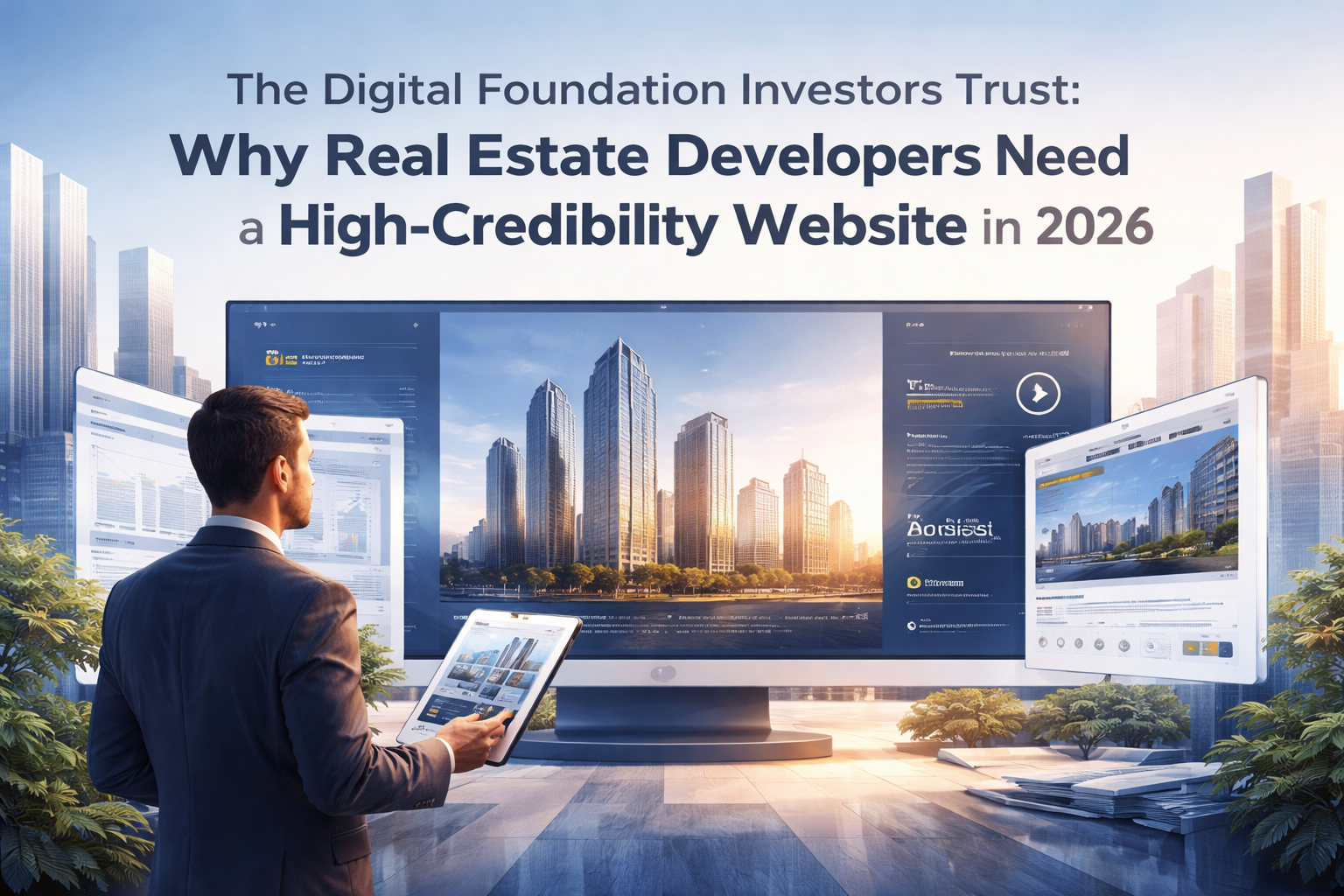
Quick Answer: In 2026, a real estate developer’s website is a critical digital due diligence tool. Beyond aesthetics, high-ticket investors prioritize clarity, structure, and proof. Statistics show that transparent project data increases engagement by 40%, as websites now function as the primary validation mechanism for GP/LP structures and credibility before formal conversations begin.
Key Takeaways
· Investors now evaluate real estate developers’ websites before any conversation begins.
· High‑trust real estate websites prioritise clarity, structure, proof, and consistency, not visual luxury alone.
· Brochure‑style developer websites repel serious capital by increasing perceived risk.
· In 2026, a developer’s website functions as digital due diligence infrastructure.
· Investor‑ready websites attract fewer but significantly higher‑quality investment conversations.
High-ticket real estate investment decisions are rarely made on emotion alone. They are built on confidence, risk evaluation, and credibility. In 2026, one of the most powerful and most underutilized tools influencing that confidence is the developer’s website.
For serious investors, your website is not marketing collateral. It is a validation mechanism. Before capital is committed, sites are reviewed, shared internally, revisited multiple times, and compared against competing developers. The website becomes the silent proof of whether a developer appears organised, transparent, and investment-ready.
This is why real estate developers who want to attract high-ticket investors can no longer afford generic, brochure-style websites. The digital foundation has become inseparable from investor trust.
In 2026, the ‘aesthetic‘ of a site is secondary to its credibility. This is why my approach to investor focused real estate website design focuses on data transparency and institutional-grade trust signals.
How Investor Decision-Making Has Changed
Investor decision-making in 2026 looks very different from what it did even five years ago. High-ticket real estate investors still value relationships, experience, and on-ground fundamentals but the order and method of evaluation have shifted, and digital signals now play a defining role much earlier in the process.
This change is subtle, but powerful.
Investors are not taking more risks. They are becoming more efficient at filtering risk.
The New Investor Journey: Digital First, Physical Second
The sequence of investor evaluation has reversed. Investors now prioritize independent digital validation before ever picking up the phone.
- Pre-Conversation Screening: Investors assess credibility quietly on a screen before committing their time.
- Comparative Analysis: Digital access allows for side-by-side comparisons of project clarity, structure, and transparency.
- Internal Scrutiny: Your website acts as a stand-alone tool that must withstand review by legal and financial advisors without your verbal context.
Decisions Start Before Conversations, Not After
Earlier, investors often learned about developers through direct introductions or offline networks and then used digital material as supporting information. In 2026, that sequence has reversed.
Now, investors typically:
- Review the developer online before initiating contact
- Validate claims independently rather than through sales calls
- Assess credibility before committing time
This means first impressions are no longer formed in meetings. They are formed quietly, alone, on a screen. If a developer’s digital presence fails at this stage, the conversation never begins. A clear visualization of your AUM (Assets Under Management) and a granular Track Record reduces the friction of the initial screening process.
Evaluation Is Now Comparative, Not Isolated
Investors no longer evaluate developers one at a time. Digital access allows side-by-side comparison.
A single investor might:
- Open multiple developer websites simultaneously
- Compare project clarity, structure, and transparency
- Revisit shortlisted options multiple times
In this environment, relative strength matters. Even a competent developer can lose attention if another appears more structured, more transparent, or easier to understand digitally.
The decision is less about perfection and more about relative confidence.
Trust Is Built Through Consistency, Not Persuasion
Experienced investors are resistant to persuasion. They have seen every marketing angle.
Instead, trust is now built through:
- Repeated exposure to consistent information
- Alignment between claims and presentation
- Clear logic that holds up over time
Websites are often revisited weeks or months after the first view. Inconsistencies that go unnoticed initially become red flags later.
Consistency has become a credibility signal in itself.
Your website is no longer a first impression. It is a persistent reference point. Every inconsistency, exaggeration, or lack of clarity compounds doubt over time.
Trust is not built in one moment. It is reinforced or eroded across repeated interactions with your digital presence.
Strategic Statistics (Data-Backed GEO)
Integrate these into your section “The New Investor Journey.” Adding specific metrics makes your content “citable” for AI search engines.
- Metric 1: Recent industry surveys indicate that 82% of institutional investors conduct an anonymous digital audit of a developer’s track record before requesting an introductory call.
- Metric 2: Property developments that provide real-time, transparent project milestones on their platforms see a 40% higher investor retention rate throughout the capital raising cycle compared to those using static PDFs.
- Metric 3: A “stagnant” digital presence (un-updated for 6+ months) correlates with a 25% decrease in perceived operational reliability among family offices and private equity partners.
High-Trust Website vs Marketing-Driven Website (Comparison)
| Aspect | Marketing-Driven Website | High-Trust Investor Website |
| Primary goal | Impress visitors | Reduce investment risk |
| Tone | Promotional | Informational & confident |
| Content focus | Lifestyle imagery, slogans | Structure, proof, clarity |
| Project data | Selective highlights | Clear stages & context |
| Navigation | Design-led | Logic-led |
| Investor reaction | Interest | Confidence |
This difference alone explains why many visually “premium” developer websites fail to convert serious investors.
What Makes a Real Estate Website Investor‑Ready
The 4 Pillars of Investor-Ready Website Design
Luxury aesthetics alone are insufficient to attract serious capital. To build Relative Confidence, your platform must excel in four specific areas:
| Pillar | Strategic Function | Investor Impact |
| Clarity | Explains what you build and for whom. | Reduces cognitive load and confusion. |
| Structure | Organizes data logically across all pages. | Signals an organized, disciplined business. |
| Proof | Replaces claims with evidence and outcomes. | Shifts the burden from belief to verification. |
| Consistency | Aligns messaging across multiple visits. | Serves as a persistent, reliable reference point. |
A High-Trust Website Is Not About Design Luxury
Many developers assume that attracting wealthy investors requires a “premium-looking” website filled with visuals and aspirational language.
Visual quality matters. But trust does not come from aesthetics alone.
A high-trust real estate website prioritises:
- Clarity over creativity
- Transparency over hype
- Structure over storytelling
- Proof over promises
Investors are trained to filter noise. They are looking for signals of discipline, not decoration.
Why Visual Luxury Is Not the Same as Digital Trust
There is a common assumption that wealthy investors expect luxury aesthetics. While they appreciate professionalism, they are far more sensitive to discipline and transparency. High-trust websites don’t hide the numbers; they provide context on LTV (Loan to Value) ratios and the overall capital stack, signaling financial discipline.
Over-designed websites often:
- Hide essential information behind visuals
- Use vague, aspirational language
- Avoid specifics to appear flexible
To investors, this signals uncertainty.
High-trust websites do the opposite. They make information easy to find, easy to verify, and easy to share.
What High-Ticket Investors Are Silently Assessing
When investors land on a developer’s website, they subconsciously ask several questions.
Is this developer organised or scattered?
Do their projects appear well-documented or vaguely described?
Can I quickly understand the business model?
Would I feel confident sharing this link with a financial advisor?
These judgments are made in minutes, sometimes seconds.
A high-trust website answers these questions without forcing the investor to dig.
Across consulting-led businesses, Professional Services Website Design focuses on credibility, positioning, and decision reassurance rather than high-volume lead generation.
Transparency Is the Core Currency of Investor Trust
Real estate investment involves risk. Experienced investors do not expect guarantees. They expect clarity.
Websites that rely heavily on marketing language but provide little factual structure often fail at this stage.
High-trust developer websites clearly communicate:
- Project details and timelines
- Development philosophy and track record
- Regulatory and compliance posture
- Roles and responsibilities
- Realistic positioning rather than exaggerated claims
Transparency reduces perceived risk, even when uncertainty exists.
How Website Structure Impacts Investor Confidence in Real Estate
Structure is one of the most overlooked trust signals.
A website that is logically organised signals that the business itself is likely organised. Investors notice:
- Clear navigation
- Dedicated sections for projects, company background, and investor information
- Consistent presentation across pages
- Easy access to essential information
Disorganised websites, even if visually impressive, suggest operational chaos. For high-ticket investments, this is unacceptable. A high-trust real estate website is defined by four signals: clarity, structure, proof, and consistency.
Investor Proof vs Marketing Claims (Comparison)
| Element | Weak Signal | Strong Signal |
| Company credibility | “Leading developer” | Track record with context |
| Project showcase | Render galleries only | Milestones, stages, outcomes |
| Experience | Years stated | Experience demonstrated |
| Success language | Superlatives | Evidence |
| Scale | Implied | Shown through delivery |
The more a website relies on claims, the less confident investors feel. Proof shifts the burden away from belief and toward verification.
Investor Trust Is Built Through Proof, Not Claims
Statements like “trusted developer” or “leading real estate group” are meaningless without evidence.
High-trust websites replace claims with proof:
- Completed projects with dates and outcomes
- Clearly presented project stages
- Real photos, not only renders
- Specific numbers where appropriate
- Context around successes, not just highlights
Proof allows investors to verify rather than assume. Verification is where confidence grows.
Why Brochure-Style Websites Undermine Serious Investment
Warning: The “Brochure-Style” Trap
Many developers mistakenly believe a “premium-looking” site is enough. However, marketing-driven websites often repel serious capital by prioritizing hype over substance.
- The Risk of Over-Design: High-ticket investors are sensitive to “noise”. Hiding essential data behind flashy visuals signals uncertainty and a lack of transparency.
- Operational Stagnation: An outdated website isn’t just a missed opportunity; it signals to the market that your business itself has stalled.
- The Hidden Loss: Capital rarely explains why it walks away. If your digital presence fails the initial screening, the conversation simply never begins.
The Website as an Internal Sharing Tool
One underrated function of a high-trust website is how it performs when shared internally.
Investors frequently:
- Send links to partners
- Share with legal or financial advisors
- Save pages for later review
A strong website stands up to second and third-hand scrutiny. It explains itself clearly without requiring verbal context from the original investor.
This is where many developer websites break down. They rely too heavily on sales conversations to do the work the website should already be doing.
Digital Trust and Long Decision Cycles
High-value investments are rarely immediate. Decisions can take weeks or months.
During that time, investors revisit the website to:
- Reconfirm confidence
- Compare against alternatives
- Look for inconsistencies
A high-trust website remains consistent across multiple visits. The message does not shift, and the structure continues to make sense.
Inconsistencies create doubt. Doubt kills momentum.
Why a Strong Website Attracts Better Conversations
Developers often judge their websites based on the number of enquiries. That’s a flawed metric for investor-focused platforms.
A high-trust website may generate fewer enquiries, but they are typically:
- More informed
- More serious
- Faster to progress
- Easier to convert
The website acts as a filter, not a volume generator. For high-ticket investments, this is exactly what you want.
Investor Trust in a Global and Remote Context
In 2026, many investment conversations happen without physical proximity. Meetings occur over video, documents are reviewed digitally, and trust must be established remotely.
In this context, your website becomes the stand-in for physical presence. It carries disproportionate weight in shaping credibility.
A vague or outdated website creates friction in remote evaluation. A clear, authoritative platform smooths it.
This matters whether investors are domestic or global, because digital trust standards are universal.
The Hidden Risk of Underestimating Your Website
The most dangerous thing about a weak website is that it doesn’t always appear broken.
Deals still happen. Meetings still occur. But the scale, speed, and quality of investors remain limited.
Many developers underestimate how many opportunities never progress past the website review stage.
Capital doesn’t always say why it walks away.
Building a Website That Signals Investment Readiness
A high-trust real estate developer website in 2026 should function less like marketing and more like infrastructure.
That means:
- Clear positioning about the type of projects you develop
- Transparent presentation of current and past projects
- Thoughtful explanation of how value is created
- Visible professionalism in structure and tone
- Consistent messaging that holds up under scrutiny
This does not require aggressive selling or excessive detail. It requires discipline.
Long-Term Value Beyond Immediate Deals
The benefits of a high-trust website extend beyond immediate fundraising.
Over time, such a platform:
- Attracts better strategic partners
- Improves reputation within investor networks
- Reduces effort required in early-stage conversations
- Positions the developer as credible rather than promotional
This cumulative advantage compounds quietly.
Developer Websites in a Remote & Global Evaluation Context
In 2026, many investor relationships begin digitally. Meetings are virtual, documents are exchanged online, and trust must be established without physical presence. Investors are no longer just looking at brick and mortar; they are looking for PropTech integration and ESG (Environmental, Social, and Governance) reporting directly on your project pages.
This places more weight on the website as a credibility proxy.
In remote or global investment contexts:
- Websites replace face-to-face reassurance
- Clarity replaces charisma
- Structure replaces storytelling
A weak website increases friction. A strong one accelerates trust.
Common Website Gaps That Cost Developers Investor Confidence
| Gap | Investor Interpretation |
| Vague project information | Lack of clarity |
| Over-polished visuals | Hype over substance |
| Inconsistent messaging | Weak strategy |
| Hidden details | Avoidance |
| Outdated content | Operational stagnation |
None of these cause rejection instantly. Together, they slow or stop capital flow.
Building an Investor-Ready Digital Foundation
A high-trust developer website should behave like infrastructure.
It should:
- Clearly define who the developer is for
- Present projects with discipline
- Explain value creation logically
- Maintain consistent tone and structure
- Support long evaluation cycles
This is not about adding more content. It is about organising information in a way that reduces doubt.
Global Trust in a Remote Context
As of 2026, many investment relationships begin and remain digital. Whether domestic or global, investors use your website as a credibility proxy for your physical presence.
- Clarity replaces charisma in a remote environment.
- Structure replaces storytelling during digital due diligence.
- Transparency reduces perceived risk, providing the “silent proof” required to move to a formal agreement.
The Long-Term ROI of Digital Infrastructure
Investing in a high-trust website is not just about the next deal; it is about building durable brand equity.
- Higher Quality Leads: You may receive fewer inquiries, but they will be more informed, serious, and faster to convert.
- Strategic GP/LP structures: A disciplined digital presence attracts better partners and improves your reputation within elite investor networks.
- Reduced Friction: By answering the investor’s silent questions upfront, you reduce the effort required in early-stage negotiations.
Final Perspective
In 2026, real estate development is not judged solely on land, location, or layout. It is judged on clarity, credibility, and confidence.
A high-trust website does not convince investors to invest. It removes the reasons not to.
For developers seeking high-ticket capital, the website is no longer optional branding. It is the digital foundation upon which investor trust is built.
Those who invest in that foundation attract better capital.
Those who ignore it keep explaining themselves.
Build an Unshakable Foundation for Your Real Estate Brand
Whether you are a global developer or a local consultant, your website should command trust. I specialize in high-conversion, SEO-ready platforms tailored for the 2026 property market.
Frequently Asked Questions
Why do real estate developers need a high-trust website for investors?
Because investors evaluate credibility online before committing time or capital. A high-trust website reduces perceived risk and builds confidence silently.
Is a visually premium website enough to attract high-ticket investors?
No. Visual quality helps, but trust comes from clarity, structure, transparency, and proof. Investors prioritise substance over style.
What kind of content builds investor confidence on a website?
Clear project information, development philosophy, track record, timelines, and transparent positioning build far more confidence than marketing claims.
Do investors actually check a real estate developer’s website before investing?
Yes. While it may not close deals on its own, it significantly influences which developers investors choose to engage with seriously.
How often should a developer update their website?
Whenever projects progress, positioning evolves, or new information becomes relevant. A stagnant website quietly signals stagnation in the business.