
📌 Key Takeaways for Clinics in 2026
- • A clinic’s website is no longer a branding asset — it’s a trust and care-access system that directly impacts bookings and patient confidence.
- • Visually attractive websites fail when they prioritise aesthetics over speed, clarity, mobile usability, and performance.
- • Clinics lose visibility not because of competition, but because poor structure weakens SEO for clinics and doctors.
- • High-converting clinic websites guide patients calmly toward action instead of overwhelming them with information.
- • Choosing a healthcare-experienced partner with global expertise (India, USA, Australia) matters more than design trends or templates.
In 2026, effective clinic website design plays a direct role in whether patients feel confident enough to book, trust, and follow through with care.
Yet many clinics still choose a website designer using outdated criteria – focusing on looks, trends, or price – and later wonder why:
- Appointment bookings stay low
- Google visibility is weak
- Patients drop off before contacting
- Competitors consistently outrank them
The problem isn’t a lack of effort.
It’s choosing the wrong website partner for the wrong reasons.
This article explains how clinics choose a website designer in 2026, where most go wrong, and what actually matters if the goal is patient trust, visibility, and bookings.
1. The “Aesthetic Trap”: Pretty Websites That Don’t Perform
One of the most common mistakes clinics make in 2026 is choosing a website designer based almost entirely on how the website looks.
During demos or portfolio reviews, clinics are shown:
- Clean layouts
- Modern colors
- Smooth animations
- Stylish typography
Everything appears professional. Everything feels “premium.” Many modern doctor website designs look impressive in demos but quietly fail when it comes to speed, usability, and real patient behaviour.
And yet, months later, the website fails to deliver results.
This is what we call the Aesthetic Trap – when visual appeal masks poor performance.
Why Clinics Fall for the Aesthetic Trap
Clinics are understandably cautious about their public image. Healthcare is built on perception, trust, and professionalism. So when a website looks modern and visually polished, it feels like a safe choice.
But visual polish is only one small layer of a clinic website.
In reality, most patients never evaluate design consciously. They react to:
- Speed
- Ease of use
- Clarity of information
- How quickly they can act
If any of these fail, aesthetics stop mattering.
What “Pretty” Often Hides in 2026
A common issue with many website designs for doctor websites is that visual priorities override performance, especially on mobile devices.
Many visually impressive clinic websites struggle with:
- Slow load times due to heavy graphics
- Complex layouts that confuse older patients
- Poor mobile navigation
- Hidden contact or booking options
- Decorative elements that distract from action
From a patient’s perspective, these sites feel:
- Hard to use
- Unreliable
- Slightly frustrating
And frustration is deadly in healthcare environments.

The Mobile Reality Clinics Can’t Ignore
In 2026, the majority of clinic website visits happen on mobile devices.
Patients are often:
- Searching during discomfort
- Booking between appointments
- Checking details quickly before deciding
A site that looks stunning on desktop but:
- Loads slowly on mobile
- Requires zooming
- Uses small tap targets
…creates immediate doubt.
Mobile performance is not optional. It is the baseline of trust.
Function First, Then Design – Not the Other Way Around
High-performing clinic websites follow a strict priority order:
- Functionality – Can patients find what they need easily?
- Speed – Does the site load quickly on all devices?
- Clarity – Are services and next steps obvious?
- Accessibility – Can all age groups use it comfortably?
- Aesthetics – Does the design support the experience?
The mistake clinics make is starting at step five.
In 2026, design must support function, not compete with it.
Why Performance Is Now a Trust Signal
Patients don’t articulate this consciously, but they feel it.
A slow or clunky website triggers thoughts like:
- “If the website is disorganised, what about the clinic?”
- “If this is hard, maybe booking will be difficult too”
- “I’ll check another option”
Even when the medical care is excellent, a poor digital experience erodes confidence.
Performance is no longer technical – it’s psychological.
Real-World Example (Seen Across Clinics)
Many clinics discover this pattern:
- Website redesign looks great
- Bounce rates increase
- Bookings stagnate or drop
Why? Because:
- Animations delay loading
- Navigation requires too many taps
- Information isn’t prioritised for real patient behaviour
The website impresses designers, but fails patients.
How Smart Clinics Avoid the Aesthetic Trap
Clinics that get this right do not reject aesthetics. They simply place it in the correct position.
They ask better questions:
- “Will this load fast on a basic smartphone?”
- “Is booking visible within 5 seconds?”
- “Can a stressed patient use this easily?”
- “Does design reduce confusion or add to it?”
When these questions guide decisions, design choices become purposeful – not decorative.
The Key Shift Clinics Must Make in 2026
A clinic website is not a branding exercise.
It is a care-access tool.
In 2026, effective clinic website design determines how confidently patients move from first impression to booking and follow-through. They are:
- Calm
- Clear
- Fast
- Predictable
These qualities build confidence far more effectively than visual sophistication.
2. The SEO Blind Spot: Websites That Look Good but Are Invisible
One of the most damaging mistakes clinics make in 2026 is assuming that a good-looking website automatically supports SEO for doctors.
It won’t.
Many clinic websites look modern, professional, and credible – yet receive little to no organic traffic. Appointments remain dependent on ads, referrals, or third-party platforms, while the website quietly sits in the background doing almost nothing.
This gap between appearance and visibility is the SEO blind spot.
Most website designers are trained to optimise for visual outcomes, not search behaviour. They focus on layout, branding, and UI consistency – all important – but often ignore how search engines and patients actually discover medical services.
In healthcare, this disconnect is especially costly.
Patients don’t search using brand language. They search using problems, symptoms, urgency, and location cues. When a clinic website isn’t built around that reality, it becomes invisible at the exact moment patients are looking.
Why Clinic Websites Fail at SEO in 2026
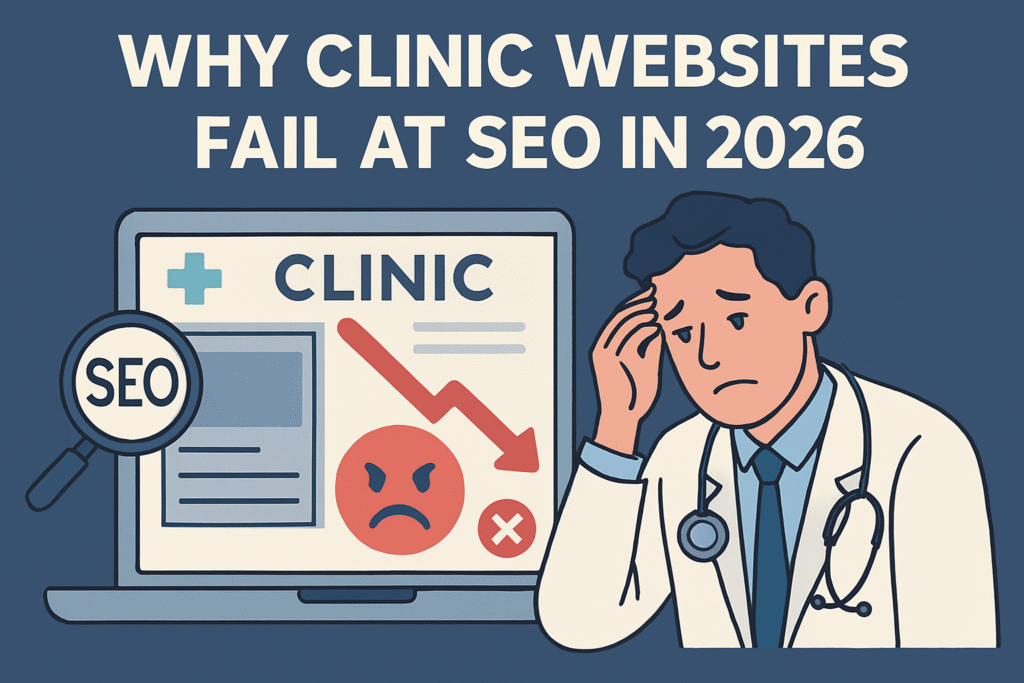
The first issue is keyword misunderstanding.
Many clinic websites are written around internal service names instead of patient language. Pages might be titled “Our Services” or “Eye Care Solutions” while patients are searching for very specific needs like blurred vision, eye irritation, or routine eye exams.
Effective SEO for clinics depends on aligning content structure with how patients actually search for symptoms, conditions, and treatments. Search engines prioritise relevance. When content doesn’t align with real search behaviour, it doesn’t surface.
The second issue is structural SEO failure.
Some websites place all services on a single page or hide them deep inside menus. From a search engine’s perspective, this makes expertise unclear. There’s no strong signal that the clinic is authoritative for a specific service or condition.
In 2026, search visibility requires clarity and depth, not design cleverness.
Medical SEO Is Not General SEO
Healthcare websites operate under different trust standards.
Search engines evaluate medical content more strictly because accuracy and safety matter. Clinics that rely on generic templates or copied service descriptions often fail to meet these implicit quality thresholds.
Medical SEO requires:
- Clear, service-specific pages
- Plain language explanations
- Structured headings that reflect patient intent
- Consistency between content, navigation, and metadata
Design-first websites frequently miss these fundamentals, even when they look polished.
Why “Pretty but Shallow” Content Doesn’t Rank
Many visually impressive clinic websites use minimal copy – short sections, catchy headings, and lots of whitespace.
While this may look modern, it often creates thin content.
Thin content sends weak signals to search engines. It lacks:
- Context
- Depth
- Relevance for multiple search queries
In competitive medical niches, this is a serious disadvantage. Clinics with clearer, more informative pages consistently outperform visually superior but content-light websites.
Looking for Aesthetic Specialization?
Building for skincare and aesthetic clinics requires a balance of medical E-E-A-T and premium visual appeal. Explore my framework for Skin & Aesthetic Clinic Website Design to see how I engineer patient-first conversion systems.
The Cost of Being Invisible
When SEO underperforms, clinics are often forced to rely heavily on digital marketing for clinics, increasing costs while reducing long-term control over patient acquisition. A clinic doesn’t feel “broken” when SEO is missing. That’s what makes this issue so dangerous.
Instead, the clinic experiences:
- Fewer organic enquiries
- Higher dependence on paid ads
- Missed searches from high-intent patients
- Lost bookings to better-positioned competitors
Because the website still looks good, the real problem goes unnoticed.
How Smart Clinics Close the SEO Visibility Gap
Clinics that avoid the SEO blind spot build websites around discovery, not decoration.
They:
- Create dedicated pages for each core service
- Use patient-language, not internal jargon
- Structure content logically so search engines understand relevance
- Maintain consistency between page titles, headings, and descriptions
- Update content as services and patient needs evolve
This approach doesn’t sacrifice design. It simply ensures design supports discoverability.
A Quiet Shift in 2026: Search Is Not Just Google
Patients increasingly discover clinics through:
- AI-generated answers
- Voice search
- Local intent queries
- Recommendation summaries
Websites that aren’t structured clearly are less likely to appear in these contexts.
Visibility now depends on clarity and structure as much as optimisation.
The Real Consequence Clinics Often Miss
When a clinic website is invisible in search, the clinic doesn’t just lose traffic. It loses control.
It becomes dependent on:
- Aggregator platforms
- Paid listings
- Advertising spend
- Third-party directories
A strategically built clinic website restores control by making the clinic discoverable on its own terms.
3. Conversion vs. Information: Why a Clinic Website Is Not a Brochure
One of the most subtle – and expensive – mistakes clinics make in 2026 is treating their website like a digital brochure.
Many clinic websites are full of information:
- Service descriptions
- Doctor qualifications
- Equipment lists
- Medical explanations
On paper, this seems responsible and informative.
In practice, it often fails to convert visitors into patients.
The reason is simple: information alone does not drive action – especially in healthcare.
How Patients Actually Use Clinic Websites in 2026
Patients do not visit clinic websites to study them.
They arrive with:
- A concern or symptom
- A sense of urgency or anxiety
- Limited time and attention
Their goal is not to “learn everything.”
Their goal is to decide whether it’s safe to proceed.
When a website overwhelms them with information but offers no clear next step, hesitation increases.
Information Without Direction Creates Friction
Brochure-style clinic websites usually have:
- Long explanatory paragraphs
- Medical terminology without context
- Multiple services listed with equal emphasis
- Contact details buried at the end
From a patient’s perspective, this creates uncertainty:
- “Where do I start?”
- “Is this relevant to my problem?”
- “What should I do next?”
Even though the information is accurate, the lack of guidance causes drop-offs.

Conversion Does Not Mean Aggressive Selling
A common misconception is that “conversion-focused” means pushy.
In healthcare, the opposite is true.
Effective conversion design in 2026 is:
- Calm
- Clear
- Reassuring
- Predictable
A conversion-focused clinic website doesn’t pressure patients.
It reduces decision stress.
What Conversion Looks Like on a Modern Clinic Website
Conversion is not a button – it’s a flow.
A high-performing clinic website includes:
- Clear service paths (“Eye Check-up”, “Dental Consultation”, “Diagnostic Tests”)
- Visible “Book Appointment” options at the right moments
- Gentle guidance explaining what happens after booking
- Simple reassurance that patient data is handled securely
This creates momentum without urgency.
Why Trust Signals Must Sit Near Actions
Brochure-style websites often separate:
- Information on one page
- Trust elements on another
- Contact details somewhere else
In real behaviour, patients decide at the moment of action.
That’s why modern clinic websites place:
- Testimonials near booking buttons
- Doctor credentials near service explanations
- Privacy and security cues near forms
Trust must be present where hesitation appears, not hidden elsewhere.
The Role of Secure and Transparent Forms
Forms are where most brochure-style websites fail.
Common problems include:
- Long, intimidating forms
- No explanation of how information will be used
- No clarity on response time
In 2026, conversion-friendly clinic forms should:
- Ask for minimal, relevant information
- Explain the next step clearly
- Reassure patients about privacy and compliance
This is especially critical in healthcare, where fear of misuse or exposure can stop action entirely.
Information Supports Conversion – It Shouldn’t Replace It
This doesn’t mean clinics should remove information.
It means information should be layered, not dumped.
Smart clinic websites:
- Provide brief summaries first
- Allow patients to expand details if needed
- Keep critical actions visible throughout
This respects both anxious first-time visitors and detail-oriented patients.
Why Brochure Websites Fail Quietly
The biggest danger of brochure-style websites is that they don’t fail loudly.
The website:
- Loads fine
- Looks professional
- Contains accurate content
Yet bookings remain lower than expected.
This creates false confidence – clinics assume the website is “working” when it is actually neutral or inactive.
The 2026 Reality Clinics Must Accept
In 2026, clinic websites are not educational archives.
They are decision-support tools.
Patients don’t need every answer upfront.
They need:
- The right answers
- In the right order
- With the right reassurance
When a website balances information with conversion, it becomes helpful.
When it only informs, it becomes passive.
4. The “Expertise Gap”: Why Generalist Designers Are a Risk
One of the most underestimated risks clinics face in 2026 is hiring a generalist website designer for a healthcare project.
At first glance, generalists appear to be a safe and flexible choice. They often have attractive portfolios, broad experience across industries, and competitive pricing. For clinics that haven’t built or redesigned a website before, this can feel reassuring.
In reality, this is where many long-term problems begin.
Generalist designers are trained to solve design problems.
Clinic websites present healthcare problems.
The difference matters more in 2026 than ever before.
Healthcare Websites Are Not Just Another Industry
Healthcare websites sit at the intersection of:
- Trust
- Regulation
- Emotion
- Urgency
Patients are anxious, cautious, and often uncomfortable. They are not browsing for inspiration or comparing features the way they would on a retail or corporate site.
A designer who doesn’t understand this often defaults to patterns that work elsewhere – but fail in medical contexts.
Compliance Is Not Optional, and It’s Rarely Obvious
Many generalist designers underestimate the importance of:
- Patient data handling
- Privacy cues
- Form security
- Disclaimers and consent language
Even when they technically “add” these elements, they often:
- Place them incorrectly
- Use generic text
- Treat compliance as an afterthought
For clinics, this is not a minor oversight. It directly affects patient confidence and, in some cases, exposes the clinic to risk.
A specialist understands that compliance is not just legal – it is psychological reassurance.
Patient Psychology Is a Design Requirement in 2026
Generalist designers design for:
- Aesthetics
- Engagement
- Brand appeal
Healthcare specialists design for:
- Reassurance
- Ease under stress
- Predictable behaviour
This affects everything from:
- Color usage
- Spacing and readability
- Language tone
- Call-to-action placement
A visually interesting layout that works for a tech startup can feel overwhelming or unsafe in a clinic setting. Patients need clarity, not creativity.
The 18+ Years Difference: Experience Reduces Risk
Experience in healthcare projects changes priorities.
A specialist with 18+ years of experience has seen:
- How patients hesitate online
- Where drop-offs actually occur
- Why certain layouts fail despite looking good
- How small UX changes affect bookings
This experience leads to quieter, stronger decisions:
- Simpler flows
- Fewer distractions
- Better placement of trust signals
- Stronger alignment with real-world clinic operations
Generalists often compensate for uncertainty with over-design. Specialists compensate with restraint.
SEO and Discovery Require Medical Context
Search visibility in healthcare is not generic.
A specialist understands:
- Condition-based search behaviour
- Local and urgency-driven queries
- How patients phrase problems vs services
- How to structure content to support medical authority
Generalists often apply broad SEO tactics that miss nuance. As a result, clinics look good but don’t appear where and when patients search.
In 2026, invisibility is not a cosmetic issue – it’s a growth problem.
When Generalist Work Starts to Cost Clinics Later
The real cost of the expertise gap is delayed.
Clinics often realise it when:
- Redesigns don’t improve bookings
- SEO underperforms despite good design
- Sites need major fixes within a year
- Trust issues persist despite investment
At that point, fixing the site costs more than doing it right originally.
Why Specialists Think in Systems, Not Pages
A healthcare website specialist doesn’t think in isolated pages.
They design:
- Patient journeys
- Decision checkpoints
- Trust reinforcement loops
- Operational alignment
This system-level thinking ensures the website:
- Supports real clinic workflows
- Aligns with appointment handling
- Reduces administrative friction
- Builds long-term credibility
Generalists usually optimise page-by-page. Clinics need end-to-end thinking.
5. The 2026 Edge: AI-Search Optimisation for Clinics
Search behaviour is changing – fast.
In 2026, many patients no longer type queries. They ask:
“Who is the best eye doctor near me?”
“Which clinic treats this condition?”
These questions are increasingly answered by AI-powered search systems, not just traditional Google results.
What this means for clinic websites
AI systems prioritise websites that:
- Clearly explain services
- Use structured, readable content
- Show authority and relevance
- Answer real patient questions
This is called AI-Search Optimisation – designing content so AI can confidently recommend your clinic. For instance, my work on Optometrist & Eye Clinic Website Design ensures that clinics appear as the top recommendation when patients ask AI for the best local care.
A clinic website built only for visuals or basic SEO will struggle in this environment. A strategically built medical website positions the clinic for future-ready discovery, not just today’s rankings.
Why Most Clinics Still Get This Decision Wrong
Most clinics don’t choose poorly because they don’t care.
They choose poorly because no one explains what really matters.
They are shown:
- Design mockups instead of performance outcomes
- Portfolios instead of healthcare results
- Trends instead of patient journeys
In healthcare, these shortcuts are costly.
The Real Investment Perspective
“In the wellness industry, a beautiful website is a cost, but a strategically built medical platform is an investment that pays for itself in patient trust.”
This mindset shift is crucial in 2026.
A clinic website should:
- Support medical credibility
- Attract the right patients
- Reduce administrative friction
- Build long-term visibility
When built correctly, it doesn’t just look good – it works quietly in the background, day after day.
Final Thought
Choosing a website designer in 2026 is no longer a design decision.
It’s a strategic healthcare decision.
Clinics that choose partners based on:
- Function over looks
- Visibility over vanity
- Expertise over generalisation
Are the ones that win patient trust, rankings, and bookings over time.
The rest keep redesigning – without fixing the real problem.
Frequently Asked Questions
Why is clinic website design so important in 2026?
Because patients evaluate trust, safety, and professionalism online before booking. A well-structured clinic website reduces hesitation and improves follow-through.
Do doctors and clinics really need SEO-specific website design?
Yes. Effective SEO for doctors and clinics requires medical-context understanding, patient-language content, and clear service structure — not generic SEO tactics.
What’s the biggest mistake clinics make with their websites?
Choosing designers based on looks instead of performance. Websites that are slow, confusing, or poorly structured quietly lose patients.
Is a clinic website supposed to inform or convert?
Both — but in the right order. A clinic website should first reassure patients, then guide them toward booking without pressure.
Can a good website reduce dependence on paid digital marketing for clinics?
Yes. A strategically built clinic website improves organic visibility and conversions, reducing long-term reliance on ads and third-party platforms.