Quick Answer
The strongest apparel ecommerce best practices start with purchase confidence, not visual trends. Before launching or redesigning, Apparel Ecommerce Website Design should be evaluated across product discovery, sizing, fit information, photography, reviews, shipping, returns, mobile UX, checkout, SEO, and merchandising. Apparel shoppers cannot physically try products online, so the website must remove uncertainty at every important decision point before asking them to buy.
TL;DR: What Should You Fix First?
- Product pages should answer fit, sizing, quality, delivery, returns, and availability questions before the shopper leaves.
- Mobile navigation, filtering, product evaluation, cart, and checkout should work as one continuous buying journey.
- Apparel SEO should connect categories, collections, products, internal links, structured data, and indexable product information.
- Reviews are particularly valuable because apparel shoppers use them to understand fit, not simply to judge product quality.
- Premium brands should use the website to justify perceived value rather than compete primarily through discounts.
- A redesign should solve the biggest commercial bottleneck first instead of adding visual features simply because competitors have them.
What Does the 2026 Apparel Ecommerce Landscape Tell Us?
The biggest opportunity is not adding more technology. It is reducing uncertainty at the moments when shoppers decide whether a product is worth buying.
Baymard’s 2026 apparel and accessories research surveyed 1,922 U.S. online shoppers and found that apparel shoppers experience uncertainty throughout the journey, including product discovery, size and fit evaluation, reviews, delivery, returns, and loyalty. Most importantly, 48% said size accuracy and fit details were information they look for in customer reviews, ahead of quality and durability at 43%.
That finding changes how an apparel website should be evaluated.
A product page is not simply a digital catalog entry. It is performing part of the job previously performed by a salesperson, fitting room, garment label, store associate, and physical product inspection.
| Area | What a 2026 audit should check | Commercial risk if weak |
|---|---|---|
| Product discovery | Categories, navigation, search, filters and sorting | Shoppers cannot find relevant products |
| Product pages | Images, fit, sizing, reviews and variants | Purchase hesitation |
| Mobile UX | Navigation, filtering, product viewing and checkout | Mobile abandonment |
| Trust | Reviews, policies, brand proof and contact information | Lower purchase confidence |
| Shipping | Cost, timing and delivery expectations | Cart hesitation |
| Returns | Visibility, clarity and process | Perceived purchase risk |
| SEO | Architecture, indexation, internal links and product data | Lost organic visibility |
| Checkout | Payment, errors, guest purchase and clarity | Lost cart value |
| Merchandising | Cross-sells, bundles and related products | Lower order value |
| Retention | Loyalty, email, recommendations and post-purchase UX | Weak customer lifetime value |
Why Is Apparel Ecommerce Different From Ordinary Ecommerce?
Apparel ecommerce is different because shoppers are making a physical-fit decision without being able to touch, try on, or compare the garment in person.
Baymard’s research describes customer reviews as functioning partly as a substitute for the fitting room. The research also found that shoppers want evidence from people whose experience helps them judge whether a garment will actually fit.
That means the website has to compensate for information that is naturally available in a physical store.
The core purchase questions are usually:
- Does it look like I expect?
- Will it fit me?
- What size should I choose?
- What does the material feel like?
- Is the quality worth the price?
- When will it arrive?
- Can I return or exchange it easily?
- Can I trust this brand?
- Is the product actually available?
- What should I buy with it?
A website that answers those questions clearly can reduce friction before the shopper reaches checkout.
Your Apparel Store May Look Ready. Is the Shopping Experience Ready?
What Should You Audit First Before Launching or Redesigning an Apparel Store?
Start with the pages closest to revenue, particularly product pages, then work backward through discovery and forward into checkout.
A homepage can be beautiful and still have very little influence on whether a shopper buys if the product page leaves basic questions unanswered.
At KG Web Designer, we frequently see apparel websites where the visual identity is strong but the purchase information is fragmented. A shopper may have to move from the product page to a size chart, then to shipping information, then to a separate returns page before feeling confident enough to buy.
That is not necessarily a design-quality problem. It is a purchase-confidence problem.
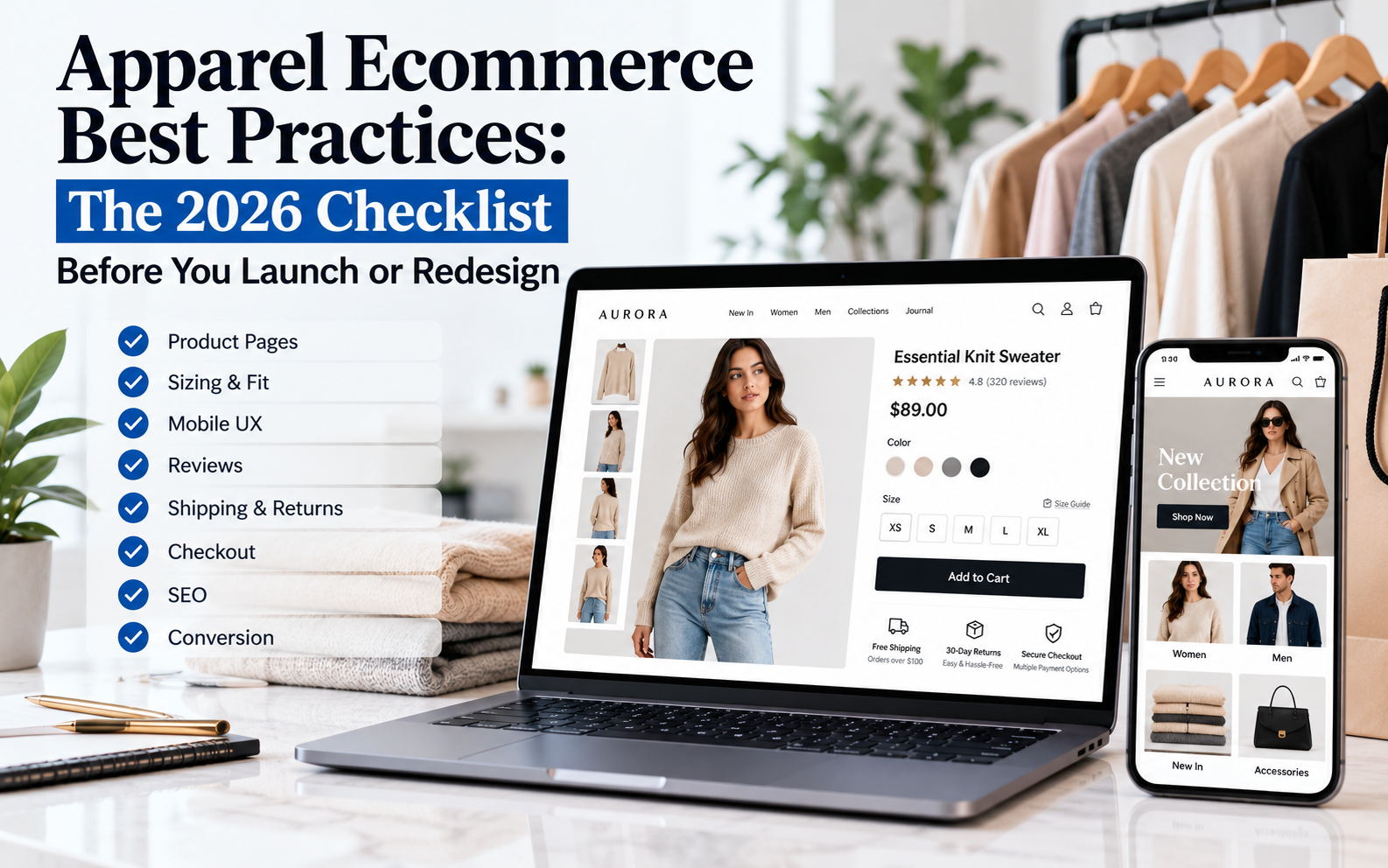
The first audit should examine:
- Product photography
- Product descriptions
- Fit information
- Size selection
- Model measurements
- Customer reviews
- Fit-related review information
- Material and care details
- Product availability
- Shipping information
- Returns and exchanges
- Add-to-cart visibility
- Related products
- Mobile interactions
- Page speed
- Internal links
- Structured data
- Analytics and conversion tracking
Baymard’s earlier apparel research found that 83% of desktop apparel sites and 87% of mobile apparel sites failed to provide sufficient sizing information.
That is why an apparel store website audit should treat sizing as a revenue issue, not a minor content detail.
Expert Insight from Kanika Gupta
Kanika Gupta, Founder, KG Web Designer
My strongest judgment for apparel ecommerce is this: do not add sophistication to a store that has not solved basic purchase confidence.
If this were my website, I would first make the product page exceptionally clear. I would want the shopper to understand what the garment looks like, how it fits, what size to choose, what it is made from, when it will arrive, and what happens if it needs to be returned.
That is the type of judgment that generic AI-generated ecommerce advice often misses.
Technology can tell you that personalization, AI recommendations, advanced filtering, and loyalty systems exist. It cannot determine which uncertainty is costing your particular business money without examining the actual customer journey.
I would also resist copying a major fashion retailer simply because its website looks impressive.
The right ecommerce architecture depends on the catalog, customer, price point, brand positioning, operational model, platform, and growth stage.
What Should an Apparel Product Page Include?
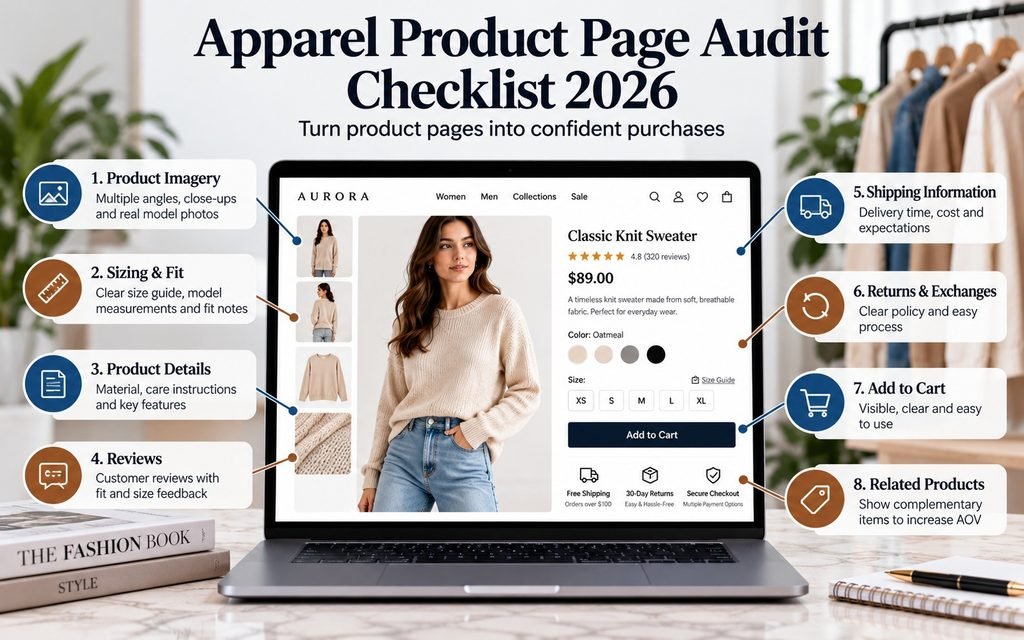
An apparel product page should make the shopper confident enough to choose a product and size without having to leave the buying journey for basic information.
The essential product-page elements include:
- Multiple product views.
- Close-up images where material or construction matters.
- Model height and worn size.
- Product-specific fit information.
- Conventional and numeric sizing where relevant.
- Measurements.
- International size conversions where appropriate.
- Material and care information.
- Color and size availability.
- Reviews.
- Fit information within reviews.
- Shipping expectations.
- Return and exchange information.
- Clear add-to-cart action.
- Relevant complementary products.
Google specifically supports product structured data for information such as price, availability, shipping, returns, reviews, and apparel product variants.
This means product information is not only a UX consideration. It is also part of making ecommerce data understandable across Google’s shopping ecosystem.
How Important Is Sizing and Fit Information?
Sizing and fit information should be treated as one of the highest-priority conversion elements on an apparel product page.
Baymard’s 2026 research found that 48% of surveyed apparel shoppers look for size accuracy and fit details in reviews. Earlier Baymard testing also found that sizing uncertainty was a common reason users hesitated or abandoned apparel products.
A basic size chart is often not enough.
A stronger system can include:
- Conventional sizes
- Numeric sizes
- Inches and centimeters
- International conversions
- Measurement instructions
- Product-specific sizing
- Model measurements
- Worn size
- Fit description
- “Runs small” or “runs large” guidance
- Fit information in reviews
For international brands, this becomes even more important because shoppers may be familiar with different sizing conventions.
This is one area where ecommerce best practices checklist thinking should become very practical: ask whether the shopper can actually choose a size confidently, rather than simply asking whether a size chart exists.
What Role Do Reviews Play in Apparel Conversion?
Reviews should help shoppers answer the questions that product descriptions cannot answer from the brand’s perspective.
For apparel, that includes:
- Does it run small?
- Does it run large?
- Is the fabric heavier or lighter than expected?
- Does the garment stretch?
- Does the color match the photographs?
- How does it fit different body types?
- What size did the reviewer purchase?
- What are the reviewer’s relevant measurements?
Baymard’s 2026 research found that size accuracy and fit details were the most sought-after information in apparel reviews among the measured review concerns.
Baymard has also found that shoppers can struggle when fit information is buried inside individual reviews. An aggregate fit indicator can reduce the effort required to understand the overall pattern.
The lesson is straightforward: do not treat reviews as decorative stars beneath the product title. For apparel, they can function as decision-support content.
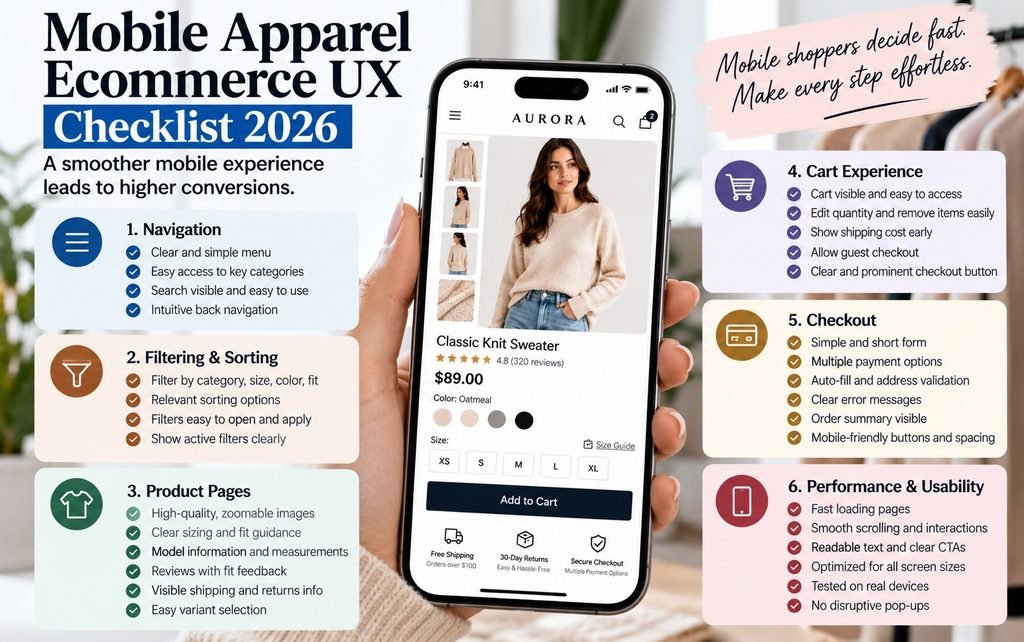
How Should Mobile UX Be Audited for an Apparel Store?
Mobile UX should allow a shopper to discover, evaluate, select, and purchase products without repeatedly losing context.
The mobile audit should test:
- Navigation opening speed
- Category visibility
- Filter usability
- Size filtering
- Color filtering
- Sorting
- Product image interaction
- Variant selection
- Sticky purchase actions
- Shipping visibility
- Returns visibility
- Cart editing
- Checkout fields
- Payment experience
- Error recovery
Baymard’s apparel research has also shown that apparel shoppers can rely heavily on category navigation and browsing rather than using site search. That makes the structure of menus, categories, filters, and collection pages particularly important.
This is why Clothing Store Website Design should not be judged only by whether the desktop homepage looks polished.
The real question is whether a shopper can move from “I want this type of product” to “I know which product and size I want” with minimal friction.
For a deeper discussion of how hierarchy affects product discovery and purchase decisions, naturally connect this section to your article on visual hierarchy in ecommerce design.
How Should Apparel SEO and Site Architecture Be Structured?
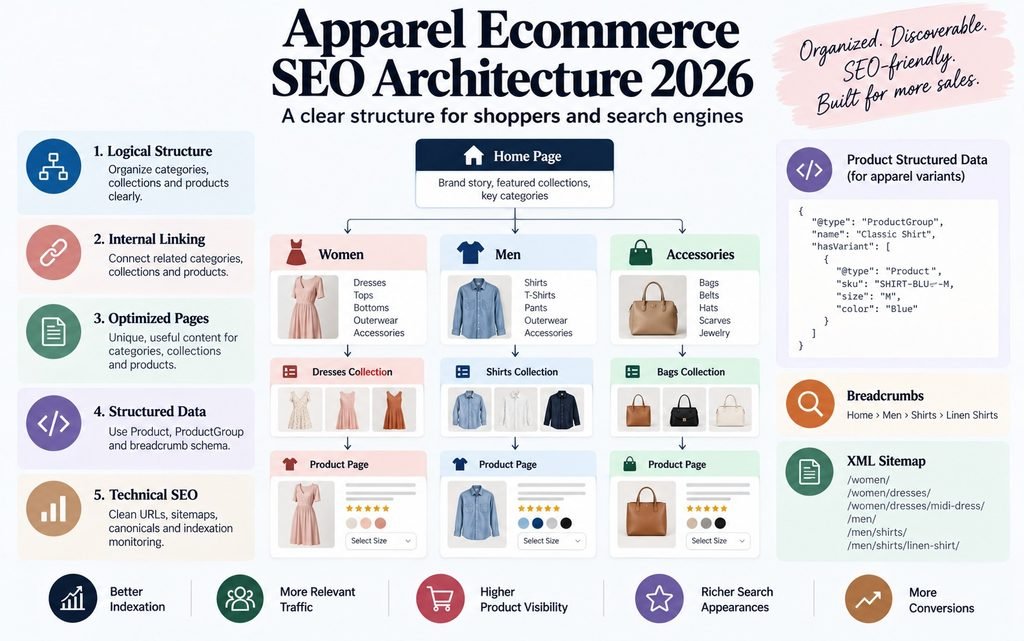
Apparel SEO should make the relationship between categories, collections, products, and supporting content obvious to both shoppers and search engines.
A practical structure might look like:
Home → Women → Dresses → Midi Dresses → Product
or:
Home → Men’s → Shirts → Linen Shirts → Product
Google explains that ecommerce site structure and internal linking help it understand the relationships and relative importance of pages. Google specifically recommends linking from menus to categories, from categories to subcategories, and from subcategories to product pages.
A strong SEO foundation should include:
- Crawlable category pages
- Useful collection pages
- Clean product URLs
- Internal links
- Breadcrumbs
- XML sitemaps
- Canonical controls
- Accurate product information
- Product structured data
- Variant structured data where appropriate
- Image optimization
- Search Console monitoring
- Merchant Center product data
Google states that Product structured data can make ecommerce pages eligible for richer search appearances and can communicate information such as price, availability, shipping, returns, and variants.
For Apparel Website Design, this means SEO architecture should be planned at the same time as UX architecture, not added after the visual design is finished.
For brands building or redesigning a fashion-focused store, the website architecture needs to balance visual storytelling with product discovery, SEO, and conversion. Our guide to fashion ecommerce website design explains how apparel brands can structure the experience around product discovery, mobile shopping, brand presentation, and online sales.
What Should You Avoid Before Spending Money on a Redesign?
Do not redesign simply because the current site looks older than a competitor’s. A redesign should solve a measurable business problem.
Avoid:
- Rebuilding the homepage before auditing product pages.
- Choosing a theme because its demo looks impressive.
- Adding animation that slows product discovery.
- Hiding fit information below unnecessary tabs.
- Using generic size charts for every product.
- Treating reviews as visual decoration.
- Designing desktop first and adapting later.
- Ignoring international sizing.
- Launching without SEO migration planning.
- Increasing ad spend before investigating conversion friction.
- Adding apps without checking their performance impact.
- Assuming more products automatically produce more revenue.
The principle I would use is simple:
A redesign should be justified by a business problem, not by visual boredom.
That distinction protects your budget and keeps the project commercially accountable.
A Beautiful Product Photo Gets Attention. The Rest of the Page Has to Earn the Sale.
Apparel shoppers can’t touch the fabric, try the fit or inspect the product in person. Your product page has to reduce those uncertainties digitally.
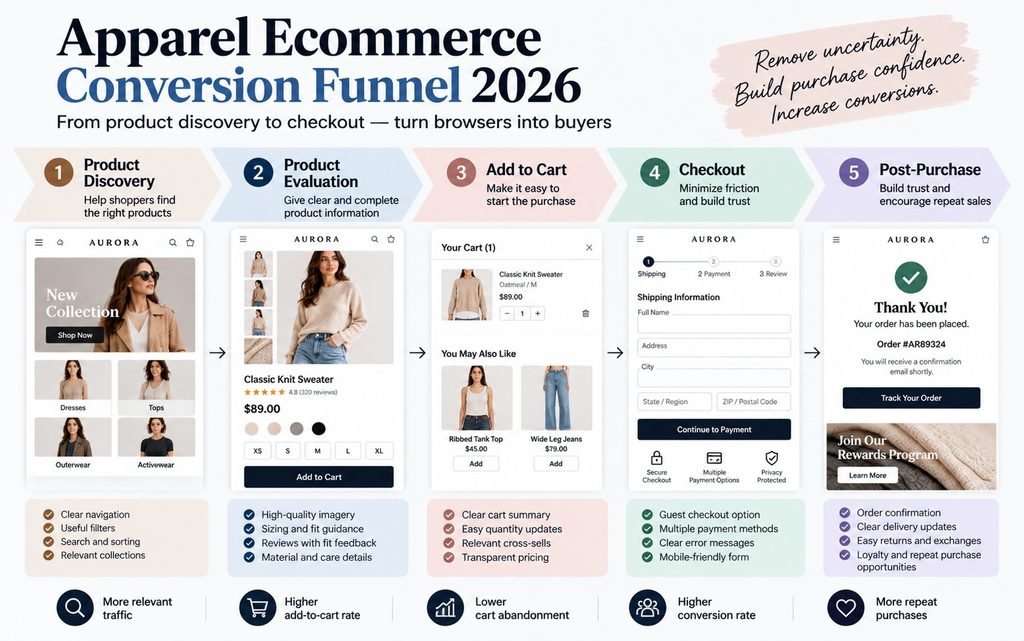
What Is the Apparel Purchase Confidence Stack?
The Apparel Purchase Confidence Stack is a practical way to identify where an ecommerce store is losing potential customers.
1. Discovery confidence
Can shoppers find the right product?
2. Visual confidence
Can they understand what the garment actually looks like?
3. Fit confidence
Can they determine whether it will fit?
4. Quality confidence
Can they judge the material, construction, and value?
5. Delivery confidence
Do they know when and how the order will arrive?
6. Returns confidence
Do they understand what happens if the purchase does not work?
7. Brand confidence
Do they trust the company enough to give it their money?
8. Checkout confidence
Can they complete the purchase without unnecessary friction?
At KG Web Designer, this is the type of framework I would use before recommending a redesign.
It prevents the common mistake of treating every ecommerce problem as a visual-design problem.
How Does Website Design Affect a Premium Apparel Brand’s Price Perception?
A premium apparel website should make the price feel credible before the shopper reaches the checkout.
A customer does not evaluate price in isolation. They evaluate the relationship between price, product presentation, brand credibility, perceived quality, social proof, service expectations, and purchase risk.
This is where Fashion Ecommerce Website Design becomes more than visual styling.
A premium brand should use:
- Consistent photography
- Strong typography
- Controlled visual hierarchy
- Clear product storytelling
- Material information
- Detailed fit guidance
- High-quality reviews
- Editorial brand content
- Clear shipping expectations
- Professional returns information
- Consistent packaging and post-purchase messaging
The website should communicate why the product deserves its price.
If the product is premium but the website looks generic, the brand may be forcing the shopper to justify the price without giving them enough evidence.
That is a missed commercial opportunity.
Which Changes Should You Make First?
Fix purchase confidence first, product discovery second, technical foundations third, and growth features fourth.
Priority 1: Remove purchase uncertainty
Fix:
- Sizing
- Fit
- Photography
- Reviews
- Product information
- Shipping
- Returns
Priority 2: Improve discovery
Fix:
- Navigation
- Collections
- Filters
- Sorting
- Search
- Internal linking
- Merchandising
Priority 3: Protect search visibility
Fix:
- Indexation
- Redirects
- Canonicals
- Structured data
- Product variants
- Internal links
- Sitemaps
- Product feeds
Priority 4: Increase commercial value
Then evaluate:
- Cross-sells
- Bundles
- Recommendations
- Loyalty
- Personalization
- Repeat-purchase journeys
- AOV opportunities
This is what I mean when I prioritize clothing ecommerce best practices 2026: fix the barriers closest to revenue before adding complexity.
What Should a 30-Day Apparel Ecommerce Action Plan Look Like?
A 30-day plan should produce measurable improvements rather than a long list of theoretical recommendations.
Days 1–7: Diagnose
Review:
- Analytics
- Search Console
- Product-page behavior
- Mobile behavior
- Conversion paths
- Cart abandonment
- Product discovery
- Indexation
- Top landing pages
Identify high-traffic pages that fail to generate proportionate commercial activity.
Days 8–14: Improve product confidence
Prioritize:
- Fit information
- Sizing
- Reviews
- Product imagery
- Material details
- Shipping
- Returns
Days 15–21: Improve discovery
Review:
- Navigation
- Categories
- Filters
- Search
- Collections
- Related products
- Internal links
Days 22–30: Strengthen technical foundations
Validate:
- Product structured data
- Variant structured data
- Canonicals
- Redirects
- XML sitemap
- Mobile performance
- Core Web Vitals
- Merchant Center data
- Conversion tracking
If you are launching a completely new store, Google recommends verifying ownership, requesting indexing, submitting a sitemap for larger sites, monitoring indexation, and using Merchant Center for additional product information.
What Does a Good Pre-Launch Audit Look Like?
A good pre-launch audit should test whether the website is ready to receive real customers, not merely whether the development team has completed the design.
Shopping experience
- Can shoppers find products quickly?
- Are filters meaningful?
- Are categories understandable?
- Can shoppers compare relevant products?
Product experience
- Are images accurate?
- Is sizing clear?
- Is fit explained?
- Are reviews useful?
- Are variants easy to select?
Trust
- Are shipping and returns visible?
- Is the company clearly identifiable?
- Are customer-service options accessible?
- Does the site look credible at the intended price point?
Checkout
- Are costs clear?
- Are payment methods appropriate?
- Can customers purchase without unnecessary friction?
- Are errors understandable?
SEO
- Are important pages indexable?
- Are redirects mapped?
- Are canonical URLs correct?
- Are product and variant data accurate?
- Are important products reachable through internal links?
Analytics
- Are purchases tracked?
- Are add-to-cart events tracked?
- Are checkout events tracked?
- Can revenue be attributed to acquisition channels?
Your Store Can Look Great and Still Make Shopping Hard.
Before you launch or redesign, look beyond the visual design. A strong apparel ecommerce experience should help shoppers discover products, understand fit, compare options, build confidence and complete a purchase without unnecessary friction.
Don’t judge readiness by the homepage alone. Review the complete shopping journey.
Can shoppers move from navigation and categories to the right products quickly?
Check NavigationCan shoppers narrow products by size, colour, style and other useful attributes?
Check FindabilityDoes the website reduce uncertainty around sizing, measurements and fit?
Check ConfidenceDo imagery, product details, variants and fabric information support the buying decision?
Check PDPIs browsing, selecting options and adding products to cart simple on smaller screens?
Check Mobile UXCan customers understand delivery, returns and payment options without last-minute surprises?
Check ConversionWhy Do Most Apparel Businesses Get This Wrong?
Most apparel businesses get this wrong because they optimize what is easiest to see rather than what is most expensive to ignore.
A homepage redesign produces an obvious visual result. Improving size information, product filtering, internal links, shipping clarity, or review structure is less dramatic, but those changes can address much closer-to-purchase friction.
Looking at leading ecommerce stores can help identify these patterns, but the goal should be to understand the strategy behind the experience rather than copy another brand’s interface. We analyzed 15 of the best ecommerce website designs in 2026 across fashion, beauty, electronics, and D2C brands to identify the UX patterns worth adapting.
We frequently see three patterns:
Observation 1: Brands invest heavily in photography but underinvest in fit explanation.
Observation 2: Filters are often organized around the internal product catalog rather than the way customers actually narrow choices.
Observation 3: Premium brands sometimes hide shipping and returns information because they worry it will make the page look too commercial, even though those details can reduce purchase anxiety.
A fourth issue appears during redesigns: SEO is often considered after the new templates are approved. That reverses the correct order.
The site architecture should be designed with SEO, UX, merchandising, and conversion requirements together.
What Does This Mean For Your Business?
Your ecommerce website should be treated as a commercial system, not a digital brochure.
For an emerging label, Clothing Brand Website Design should create a scalable structure for collections, products, campaigns, content, and future growth.
For brands selling across multiple markets, Ecommerce Website Design for Clothing Brands also needs to account for currency, sizing conventions, shipping, taxes, duties, returns, and regional expectations.
Once the core buying journey is working well, the next opportunity is increasing the value of each transaction through better merchandising, bundles, complementary products, and product recommendations. Our strategic guide on ecommerce website design services to increase average order value explains how premium brands can use website architecture and merchandising to create those opportunities.
For brands competing at a premium price point, Ecommerce Website Design for Fashion Brands should make quality and value visible before the shopper compares price.
That is where website design becomes a commercial advantage.
Example Scenario
Imagine a premium clothing brand receiving consistent traffic from Google, Instagram, email, and paid campaigns.
The analytics show that shoppers reach product pages, but add-to-cart activity is weaker than expected.
I would not immediately increase advertising.
I would inspect:
- Product imagery.
- Size confidence.
- Fit reviews.
- Model measurements.
- Shipping visibility.
- Returns visibility.
- Mobile variant selection.
- CTA placement.
- Product availability.
- Page speed.
If several of those elements are weak, buying more traffic simply sends more potential customers into the same friction.
The better strategy is to diagnose the conversion bottleneck first.
Example From Our Experience
At KG Web Designer, one recurring ecommerce audit pattern is a visually polished store where the primary commercial problem is not the homepage.
The product page contains the right information, but it is distributed across separate areas of the experience. A shopper may need to open another section for sizing, search elsewhere for delivery information, and move to a separate policy page before feeling comfortable purchasing.
Problem
The store looks premium, but purchase-critical information is fragmented.
Solution
The audit focuses on consolidating decision-support information, strengthening product-page hierarchy, improving fit guidance, clarifying delivery and returns, and making the primary purchase action easier to understand.
Outcome
The result is a prioritized redesign roadmap rather than a generic list of visual improvements. The business can then measure changes in product engagement, add-to-cart behavior, checkout progression, and revenue.
I would never attach a conversion percentage to an audit unless the underlying analytics support it. That is an important part of credible ecommerce consulting.
Acquisition is only one part of ecommerce growth. Once the first purchase is working, the website should also encourage customers to return through better product discovery, personalized recommendations, loyalty opportunities, and post-purchase experiences. Our guide on designing an ecommerce store for repeat customers explores how the website can support customer lifetime value rather than optimizing only for the first sale.
How Should You Decide Between CRO, SEO, and a Full Redesign?
The correct investment depends on where the commercial bottleneck sits.
| What you see | Likely problem | First investment |
|---|---|---|
| High traffic, low product engagement | Product-page UX | CRO/product-page audit |
| Strong product engagement, weak add-to-cart | Fit, trust or value communication | Product-page improvements |
| Good cart activity, weak checkout completion | Checkout friction | Checkout optimization |
| Strong conversion, weak organic discovery | SEO architecture/content | SEO improvement |
| Poor mobile experience across the site | Structural UX issue | Responsive redesign |
| Outdated technology limits merchandising | Platform/architecture | Strategic redesign |
| Strong sales but weak repeat purchases | Retention | Post-purchase/retention strategy |
| Multiple problems across the journey | Structural issue | Full ecommerce redesign |
This decision model is important because a redesign is not automatically the answer.
Sometimes the best commercial decision is to fix the existing store.
Sometimes the website has become so structurally constrained that continuing to patch it is more expensive than rebuilding.
The job of a professional partner is to tell you which situation you are actually in.
When Does Professional Ecommerce Help Make Sense?
Professional help makes sense when website problems have become too closely connected to revenue, growth, SEO, or brand positioning to solve through isolated design changes.
That is particularly true when:
- The store is preparing for a major launch.
- The catalog is expanding quickly.
- International markets are being added.
- Paid acquisition is increasing.
- Organic traffic is important to revenue.
- The brand is moving upmarket.
- The current platform limits merchandising.
- A redesign could affect existing rankings.
- Internal teams disagree about what should be fixed first.
A specialist should be able to explain not only what they want to redesign, but why each change matters commercially.
KG Web Designer approaches ecommerce projects from that perspective: diagnose the business problem, prioritize the buying journey, protect search visibility, and then design the experience around those requirements.
Final Thoughts
The strongest apparel ecommerce best practices are not about adding more features. They are about making the buying decision easier.
A successful apparel store helps shoppers find the right product, understand how it will fit, evaluate its quality, trust the brand, understand delivery and returns, and complete checkout without unnecessary friction.
Fashion Website Design should therefore be judged by both brand perception and buying behavior. Apparel Website Design should make future growth easier, so new collections, products, markets, and merchandising changes do not require rebuilding the entire store.
A premium Online Clothing Store Website Design should make the store easier to shop, easier to understand, easier for search engines to interpret, and easier for the business to grow.
The question before a redesign should not be:
“How can we make the website look newer?”
It should be:
“Where is the current buying journey losing revenue?”
That question leads to a much better investment decision.
If your apparel store is receiving traffic but not converting at the level you expect, KG Web Designer can help identify whether the problem is product-page confidence, discovery, mobile UX, SEO architecture, checkout, merchandising, or the broader ecommerce strategy.
Relevant next step: request an ecommerce website audit and get a prioritized recommendation for what should be fixed, redesigned, or left alone.
Author Box
Kanika Gupta is the Founder of KG Web Designer, a conversion-focused website design specialist working with businesses and brands across the United States, United Kingdom, Australia, Canada, Singapore, and UAE. Her work focuses on ecommerce UX, conversion optimization, SEO-ready architecture, and website strategy.
Before You Launch or Redesign, Make Sure You’re Solving the Right Problems.
A successful apparel ecommerce website isn’t just about how the store looks. Let’s review the shopping journey, product experience, mobile usability and conversion friction before you invest in the next version of your website.

FAQs
What should I check before launching an apparel ecommerce website?
Start with product discovery, product-page information, sizing and fit guidance, mobile UX, shipping, returns, checkout, SEO, structured data, analytics, and conversion tracking. Apparel deserves particular attention to fit because online shoppers cannot physically try products before purchasing.
Should I redesign my fashion ecommerce website if it already gets traffic?
Not necessarily. First determine whether the problem is traffic quality, product discovery, product-page conversion, checkout friction, or retention. If qualified visitors already reach the right products but fail to progress, targeted CRO may deliver more value than a full redesign.
What should an apparel product page include?
A strong apparel product page should include high-quality imagery, product details, size and fit guidance, model information, variants, reviews, delivery expectations, return information, and a clear purchase action. The objective is to answer the questions that could otherwise cause shoppers to leave.
How important are size guides for clothing ecommerce?
Size guidance is critical because fit uncertainty is a defining challenge of online apparel shopping. Baymard’s research has repeatedly identified sizing information as an important purchase factor, while its 2026 research found that 48% of shoppers looked for size accuracy and fit details in reviews.
How do I know whether my apparel website needs a full redesign?
A full redesign makes more sense when problems are structural, such as confusing navigation, weak mobile UX, poor product-page architecture, outdated technology, difficult merchandising, weak SEO foundations, or inefficient checkout. If the problems are isolated, targeted UX and CRO work may be more commercially sensible.
Should an apparel brand spend more on advertising if sales are weak?
Not automatically. If the website is sending qualified visitors into a high-friction buying journey, more advertising can increase acquisition costs without solving the underlying problem. Diagnose product-page engagement, add-to-cart behavior, checkout completion, and customer acquisition economics first.
What makes a premium fashion ecommerce website feel worth its price?
Premium perception comes from consistency between product quality, photography, typography, information quality, trust signals, brand storytelling, UX, and service expectations. A premium product paired with a generic or difficult shopping experience can weaken the customer’s perception of value.
What should I fix first if my ecommerce website gets traffic but few sales?
Start with the closest point to revenue. Review product-page engagement, sizing and fit information, reviews, shipping, returns, mobile UX, add-to-cart behavior, and checkout completion before increasing traffic. The objective is to determine whether the bottleneck is acquisition or conversion.