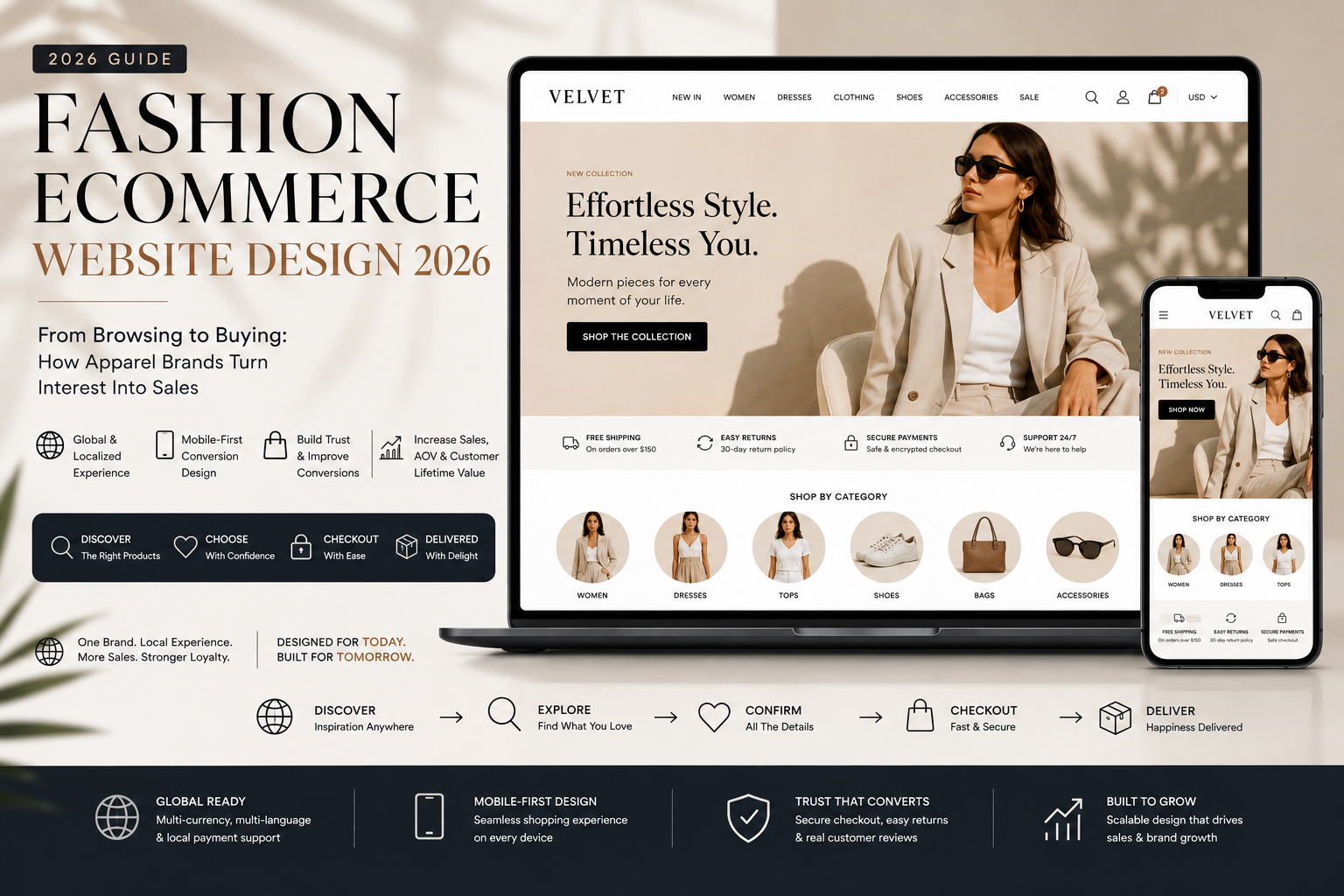
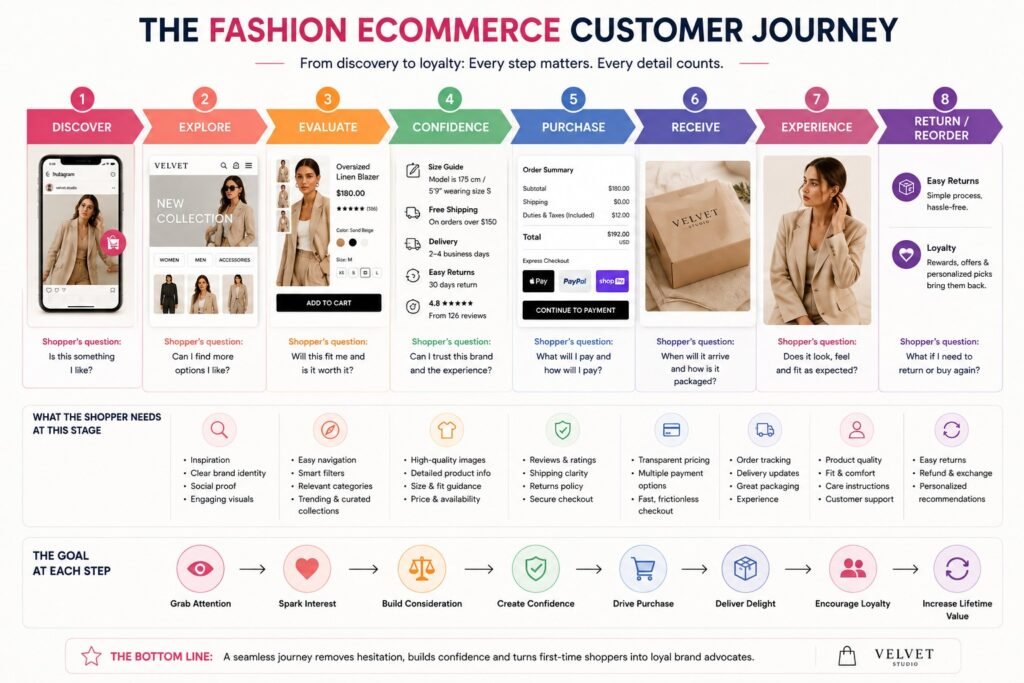
Fashion ecommerce website design plays a critical role in increasing online sales by reducing the friction between product discovery and purchase. High-performing apparel stores combine strong visual merchandising with intuitive navigation, detailed product information, regional sizing, mobile-first UX, transparent shipping and returns, trusted payment options, fast performance, and relevant personalization. For international fashion brands, the experience should also account for local currency, taxes, duties, delivery expectations, payment preferences, and returns. The objective is not to add more design features—it is to make every important buying decision easier.
Product pages should answer questions about fit, size, material, quality, delivery, and returns.
Mobile ecommerce needs to be designed intentionally rather than treated as a smaller desktop experience.
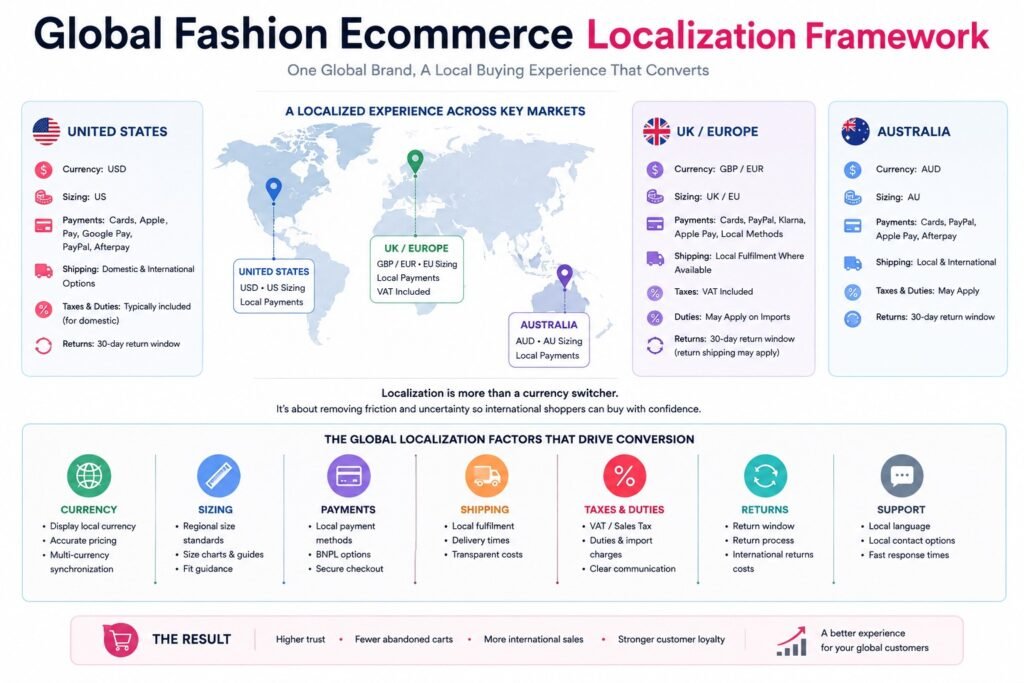
International shoppers need more than a currency switcher.
Localized pricing, sizing, shipping, duties, taxes, payments, and returns can reduce cross-border uncertainty.
Product discovery should combine strong navigation, filtering, search, merchandising, and recommendations.
Fashion websites need to balance high-quality imagery with technical performance.
AI personalization can improve discovery, but it should support—not replace—a strong ecommerce architecture.
Structured data should accurately describe products, the organization, and eligible FAQ content.
The most useful ecommerce improvements are the ones connected to measurable customer friction.
Why Fashion Ecommerce Website Design Matters More Than Ever
Fashion ecommerce website design has moved beyond making an online store look premium.
For apparel brands, the website now has to help shoppers discover products, understand fit, evaluate quality, trust the brand, understand the final cost, and complete a purchase—often from a mobile device and sometimes from another country.
That is why the strongest fashion ecommerce experiences balance two things:
A visually impressive fashion website can still underperform if shoppers cannot find the right products, understand sizing, calculate the real cost of an international order, or feel confident about returns.
For brands selling across borders, the challenge becomes even greater. Currency, regional sizing, duties, taxes, shipping, payment methods, and delivery expectations all become part of the user experience.
This guide explains how apparel brands can approach WooCommerce website design as a complete conversion system rather than simply a visual storefront.
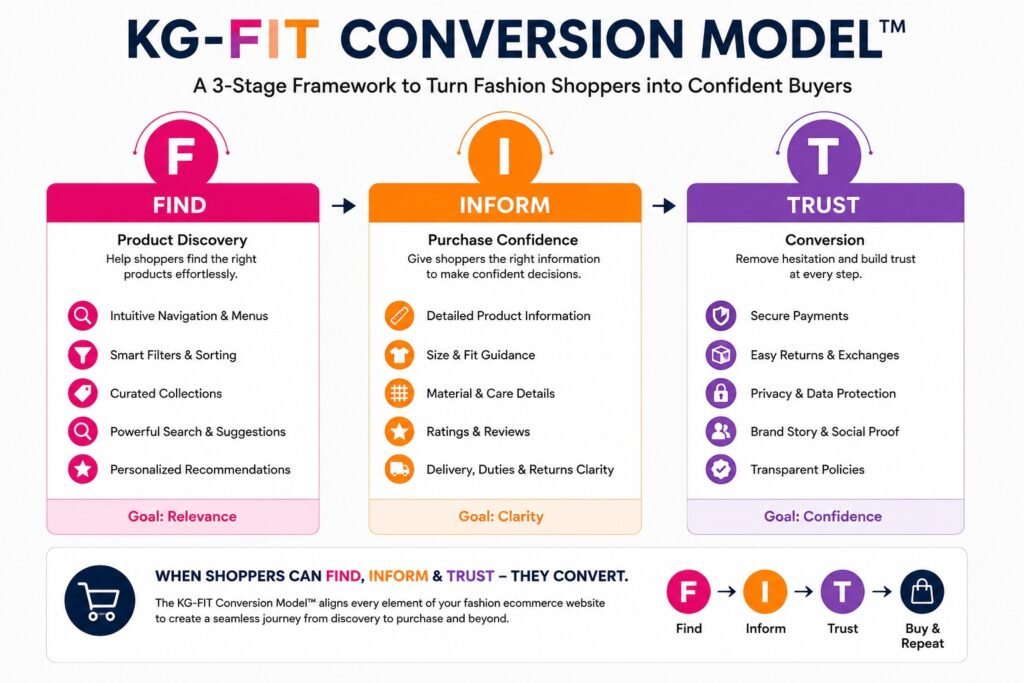
The KG-Fit Conversion Model for Fashion Ecommerce
At KG Web Designer, I would frame fashion ecommerce optimization around a simple model:
FIT = Find → Inform → Trust
F — Find Can the shopper quickly discover the right product?
I — Inform Does the website provide enough information to evaluate it confidently?
T — Trust Does the shopper understand the price, delivery, payment, returns, and brand credibility well enough to purchase?
This creates a practical framework for evaluating almost every major ecommerce page.
Find
Navigation, search, category pages, filters, merchandising, recommendations and visual discovery help shoppers reach relevant products.
Inform
Product imagery, videos, sizing, fit guidance, materials, reviews, availability, delivery and product details answer purchase questions.
Trust
Transparent pricing, payment options, shipping, returns, customer reviews, contact information and credible brand signals reduce perceived risk.
If a fashion ecommerce website fails at any one of these three stages, adding more visual effects rarely fixes the underlying conversion problem.
Ready to Build a High-Converting Ecommerce Website?
Fashion is different from many functional ecommerce categories because customers are buying both a product and an experience.
They evaluate:
Style
Identity
Quality
Fit
Brand perception
Value
Convenience
Social proof
This makes website design part of the sales process.
A customer may love the product photography but leave because the size guide is unclear.
They may want to purchase but hesitate because international delivery costs are hidden.
They may find the perfect product but abandon the store because checkout does not support a payment method they trust.
The problem, therefore, is rarely just:
“The website doesn’t look good enough.”
The more useful question is:
“Where does the customer lose confidence?”
That question should guide a fashion ecommerce redesign.
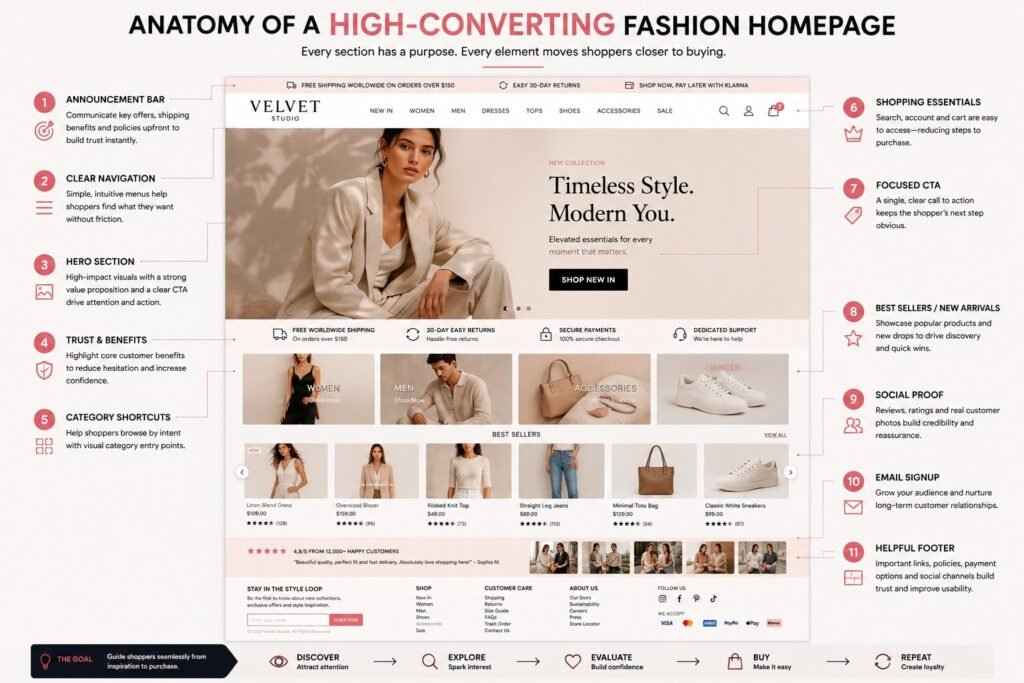
1. Build a Homepage That Communicates the Brand Immediately
The homepage should establish three things quickly:
What do you sell?
Who is it for?
Why should the shopper explore further?
A fashion homepage does not need to display every collection.
It needs to create a clear route into the shopping experience.
Strong homepage elements can include:
Clear brand positioning
Strong editorial imagery
Featured collections
New arrivals
Best sellers
Seasonal campaigns
Social proof
Brand differentiators
Shipping or returns reassurance
Region-aware information
Clear shopping CTAs
The hierarchy matters more than the number of elements.
A premium fashion homepage should make the next action obvious without turning the screen into a collection of competing banners.
Designing the Homepage for International Buyers
An international shopper has an additional question:
“Does this store actually understand customers in my market?”
A generic:
Free Shipping
may create less confidence than a specific, accurate statement such as:
Free Shipping to Selected US, UK & EU Destinations
The exact wording should reflect the brand’s actual shipping policy.
Similarly, international shoppers may need to know:
Which countries are supported
Which currency is displayed
Whether duties are included
Estimated delivery time
Return conditions
Available payment methods
These details do not necessarily need to dominate the hero section.
They simply need to be easy to find before the customer reaches checkout.
Not every fashion or luxury purchase should follow the same checkout path. For higher-value products, bespoke collections, limited-edition pieces, or products that require personal guidance, the website may need to support consultation and enquiry alongside ecommerce checkout. Our guide to luxury ecommerce website strategy explains how to design that decision journey without adding unnecessary friction.
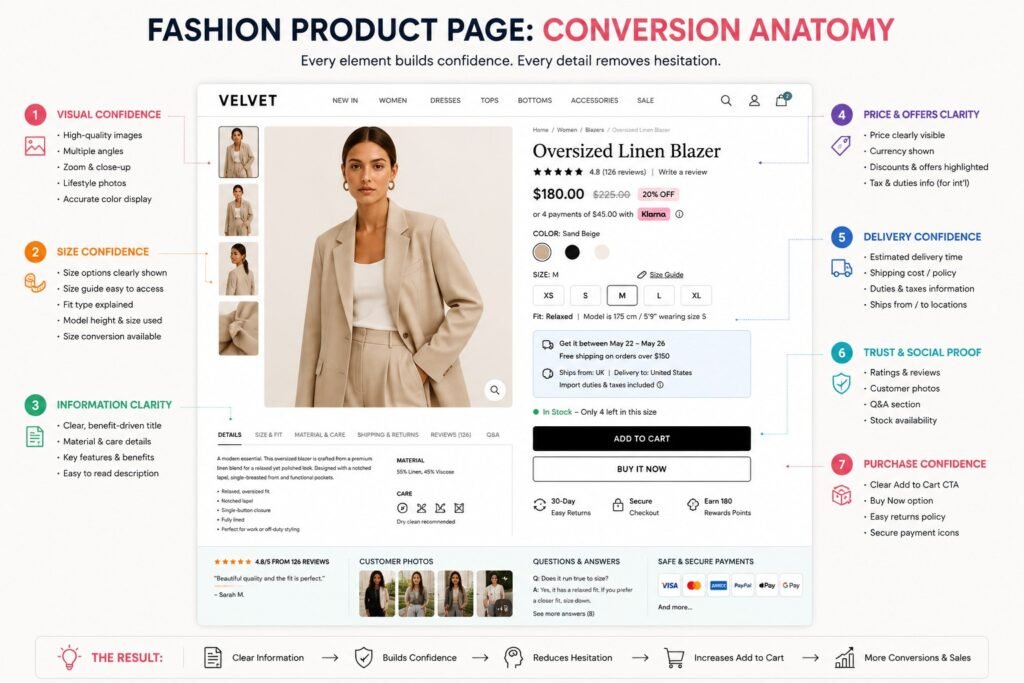
2. Turn Product Pages Into Purchase-Confidence Pages
The product page is where fashion browsing becomes a buying decision.
Online shoppers cannot touch the fabric, inspect the stitching, try the garment on, or compare the fit physically.
Your product page therefore needs to compensate for that limitation.
It should answer:
What does it look like?
How does it fit?
What is it made from?
Which size should I choose?
How much does it cost?
When will it arrive?
Can I return it?
Essential product-page components
High-quality product photography
Multiple product angles
Zoom
Lifestyle photography
Video where useful
Clear product description
Material information
Care instructions
Size and fit guidance
Regional size conversion
Stock availability
Product reviews
Delivery information
Returns information
Clear Add to Cart CTA
The principle is simple:
Photography creates desire. Product information creates confidence.
A fashion ecommerce website needs both.
For premium and designer fashion brands, there is another layer to this equation: perceived value. A product page can contain excellent photography and complete specifications yet still make the brand feel ordinary if the visual hierarchy, storytelling, typography, trust signals, and overall experience do not support the product’s positioning. If you are working with higher-priced fashion products, our guide on how a cheap-looking website can make a premium product harder to sell explains the connection between website experience, perceived value, and purchase confidence.
An Illustrative Micro-Case: When a Size Guide Becomes a Conversion Tool
Consider a hypothetical international women’s apparel brand receiving strong product-page traffic but frequent customer questions about sizing.
The original product page provides only:
Size: M
The redesigned experience adds:
US / UK / EU size equivalents
Body measurements
Garment measurements
Fit description
Model height and worn size
A clearly visible size guide
The redesign does not promise a particular conversion increase without testing.
Instead, the business can measure whether the improved information produces changes in:
“Businesses often ask how they can make their ecommerce website look more premium. I usually ask a different question: ‘How can we make buying easier?’ The brands that consistently outperform competitors aren’t necessarily the most visually impressive. They’re the ones that remove uncertainty at every step, from product discovery to checkout. When customers don’t have to work to understand your products or trust your business, conversions become a natural outcome.”
3. Make Mobile Fashion Ecommerce a First-Class Experience
Mobile design should not be treated as the desktop website squeezed into a smaller screen.
For fashion stores, mobile needs to make visual discovery and purchasing comfortable.
Important considerations include:
Thumb-friendly controls
Easy navigation
Accessible filters
Fast image loading
Clear product cards
Simple size selection
Visible Add to Cart controls
Easy cart access
Readable product information
Minimal checkout typing
Watch for these common mobile problems:
Oversized hero imagery Beautiful on desktop, but it pushes products too far down on mobile.
Tiny filter controls Customers struggle to refine large product collections.
Slow product galleries High-resolution fashion imagery becomes a performance problem.
Aggressive pop-ups They interrupt the shopping journey before the customer has explored the product.
Hidden purchase information Customers have to scroll excessively to find size, shipping, returns, or availability.
Mobile-first fashion ecommerce design should preserve the shopping intent, not simply the desktop composition.
4. Make Product Discovery Easier
A fashion customer may enter the store knowing exactly what they want:
black oversized blazer
Another may enter with only a vague intention:
something for a summer event
The website needs to support both.
Useful discovery features include:
Predictive search
Search suggestions
Category navigation
Smart filters
Colour filters
Size filters
Price filters
Availability filters
New arrivals
Best sellers
Trending collections
Shop-the-look merchandising
Related products
Visual discovery can be particularly useful for fashion.
For example:
Shop Similar Styles
can turn visual inspiration into a product-discovery pathway.
The goal is not to add every possible AI or search feature.
It is to reduce the distance between what the shopper wants and what the store can offer.
5. Treat International Localization as Part of Conversion Design
A currency switcher alone does not make an ecommerce store global.
International fashion ecommerce requires a broader localization layer.
Currency
Display prices in the customer’s expected currency where appropriate.
Sizing
Support regional sizing conventions where relevant.
Taxes and Duties
Explain whether applicable taxes and import duties are included, estimated, or payable separately.
Shipping
Communicate realistic delivery expectations.
Language
Localize important shopping information where the target market genuinely requires it.
Returns
Explain how international returns work before checkout.
Payments
Offer payment options that make sense for the market being targeted.
The exact implementation depends on the brand’s ecommerce platform, fulfilment model, markets, tax structure, and payment infrastructure.
The principle is:
Localization should remove uncertainty, not simply translate the interface.
These principles become even more important for premium and luxury fashion brands selling across borders, where the customer may be evaluating a significantly higher-value purchase before ever interacting with the product physically. Our guide to international luxury ecommerce website design looks specifically at how currency, shipping, duties, trust, returns, and premium UX can be combined into a more confident international buying journey.
A shopper may trust the brand but hesitate if their preferred payment option is unavailable.
Depending on the market and customer segment, an ecommerce business may need to consider options such as:
Credit and debit cards
Apple Pay
Google Pay
PayPal
Klarna and other buy-now-pay-later options
Afterpay in supported markets
Pix for Brazilian customers
Local bank-based payment methods
Region-specific wallets
The right payment mix depends on the countries being targeted, average order value, product category, fraud profile, margins, and payment-provider availability.
Do not add every possible payment method simply to appear global.
Instead, ask:
Which payment methods are actually familiar and useful to our target customers?
Payment localization should also work with multi-currency pricing.
If the website displays USD on the product page but unexpectedly changes currency or creates a different total at checkout, the resulting friction can undermine trust.
Pricing, currency, taxes, discounts, shipping and payment calculations should therefore remain synchronized throughout the buying journey.
💡
Continue Reading
Why Great Websites Are Still Losing Organic Traffic
Even well-designed websites can lose clicks if Google AI Overview answers the user’s question first. Learn how to identify which pages deserve a rewrite—and how to make your content citation-worthy instead of easy to replace.
8. Consider Multi-Warehouse Inventory in the Customer Experience
International fashion brands with multiple fulfilment locations have another UX challenge:
Where is the product actually shipping from?
A customer may see:
In Stock
but still have to wait two weeks because the product is being shipped internationally.
Where relevant, inventory systems and ecommerce UX should work together to communicate:
Local availability
Warehouse availability
Estimated dispatch time
Estimated delivery
Regional stock status
For example:
Available from our UK warehouse — estimated delivery 2–4 business days
can be significantly more useful to a UK customer than simply:
In Stock
This becomes particularly valuable when a fashion business operates fulfilment centres across North America, Europe, Asia-Pacific, or other regions.
The objective is not to expose complex warehouse logic to customers.
It is to translate that complexity into clear delivery expectations.
9. Build Trust Before Asking for the Purchase
Fashion ecommerce depends heavily on confidence.
Customers need to believe that the product they see online will meet their expectations in the real world.
Useful trust signals include:
Verified customer reviews
Product-specific reviews
Customer photographs
Clear return policies
Delivery information
Secure payment options
Contact information
Material details
Care instructions
Authenticity information where relevant
For premium fashion brands, trust can also come from:
Press coverage
Designer or founder information
Brand history
Retail partnerships
Certifications where genuinely relevant
Sustainability evidence
Manufacturing information
Avoid filling the interface with generic trust badges.
A useful trust element answers a real customer question.
For example:
“Can I return this from the UK?”
A clear international returns explanation is more useful than another generic security badge.
10. Keep Fashion Websites Visually Rich Without Making Them Slow
Fashion brands need photography.
They also need performance.
That creates a constant design tension.
Large editorial images, videos, animations, tracking scripts, review tools, chat systems, personalization tools, and ecommerce apps can collectively make a website heavy.
Common performance problems include:
Oversized images
Uncompressed product photography
Heavy video backgrounds
Too many third-party scripts
Excessive animation
Unoptimized fonts
Redundant ecommerce apps
Better practices include:
Responsive image delivery
Proper image sizing
Modern formats where appropriate
Lazy loading for non-critical imagery
Optimized video
Careful third-party script management
Lightweight font strategies
Regular performance testing
The goal is not to remove the visual character from a fashion store.
It is to ensure that every visual element earns the performance cost it creates.
11. Use AI to Improve Discovery-Not to Replace UX
AI can make fashion ecommerce experiences more relevant.
Potential applications include:
Product recommendations
Personalized collections
Search refinement
Outfit suggestions
Complementary products
Recently viewed products
Behaviour-based merchandising
Conversational product discovery
Imagine a shopper viewing a blazer.
Instead of showing random products, the website could intelligently surface:
Complete the Look
with relevant trousers, shirts, shoes or accessories.
That can shorten the discovery journey.
But AI should not compensate for poor information architecture.
Customers should still be able to browse categories, search products, use filters, and understand the catalogue without depending on an AI assistant.
The rule is simple:
Use AI to reduce discovery friction—not to hide structural UX problems.
18+ Years. 500+ Websites. Zero Cookie-Cutter Stores.
I design ecommerce websites for founders in the US, UK, and Australia who are serious about revenue — not just a pretty storefront. Custom-built, conversion-focused, and delivered on time.
Category pages should not exist simply to hold a grid of product images.
Where useful, they can also provide:
Clear category context
Useful filters
Internal links
Buying guidance
Related collections
FAQs
Relevant supporting content
This gives search engines more context while helping shoppers navigate the catalogue.
The important principle is to avoid adding text merely to increase keyword usage.
Every piece of content should serve a search, discovery, or buying purpose.
Category pages should not exist simply to hold a grid of product images. They should help shoppers discover relevant products, narrow their choices and move naturally toward product pages. For a deeper look at this approach, see our guide to ecommerce category page optimization.
13. Use Structured Data to Make Ecommerce Content Machine-Readable
Structured data can help search engines understand what a page represents.
For a fashion ecommerce website, the implementation should be based on the actual content and eligibility of each page rather than adding schema simply for SEO.
Product Schema
Product pages can use appropriate Product structured data to communicate information such as:
Product name
Image
Description
Brand
SKU
Offers
Price
Currency
Availability
Review information where eligible
The markup should accurately reflect what users can see on the page.
Organization Schema
A fashion brand can use Organization structured data to help establish the relationship between the website and the business.
Relevant information may include:
Brand name
Logo
Website
Contact information
Social profiles where supported
LocalBusiness Schema
If the fashion business operates physical stores, showrooms, boutiques, or other eligible local locations, appropriate LocalBusiness structured data can be considered for those pages.
It should represent the actual business location and information rather than being used simply to create additional search markup.
FAQ Schema
FAQ content should be marked up only when it genuinely qualifies under Google’s current structured-data guidelines and reflects visible content on the page.
The larger objective is:
Make the website easier for machines to understand without creating artificial content for search engines.
Structured data is a supporting layer—not a replacement for useful ecommerce content.
14. Measure the Website as a Revenue System
Traffic alone does not tell a fashion brand whether its website is working.
A better measurement framework follows the entire journey.
Discovery
Organic traffic
Internal search usage
Category engagement
Product discovery
Evaluation
Product-page engagement
Image interaction
Size-guide usage
Review interaction
Purchase
Add-to-cart rate
Checkout initiation
Checkout completion
Conversion rate
Commercial performance
Average order value
Revenue per visitor
Repeat purchase rate
Revenue by market
International performance
Conversion by country
Revenue by region
Cart abandonment by market
Returns by market
Delivery-related support queries
This creates a much more useful question than:
“Did the redesign look better?”
The better question is:
“Did the redesign make the customer’s journey easier and improve measurable commercial outcomes?”
“The most successful ecommerce migrations aren’t the ones with the newest design trends. They’re the ones where customers barely notice the migration because everything simply works better. Search engines retain confidence, customers complete purchases more easily, and the business continues growing without interruption.”
The 2026 Fashion Ecommerce Design Checklist
Before launching or redesigning an apparel store, evaluate it against five areas:
Find
Can shoppers find products quickly?
Are navigation and filters intuitive?
Does search understand shopping intent?
Inform
Is product information complete?
Is sizing clear?
Are fit, material, care and availability explained?
Are delivery and returns easy to find?
Trust
Are reviews credible?
Are payment options familiar?
Is the brand identity clear?
Are international policies transparent?
Localize
Is the appropriate currency displayed?
Are regional sizes supported?
Are duties and taxes explained?
Are local payment methods considered?
Are delivery expectations market-appropriate?
Convert
Is the Add to Cart action obvious?
Is checkout predictable?
Are unnecessary fields removed?
Can customers complete the journey comfortably on mobile?
What Fashion Brands Should Fix Before Adding More Features
When an ecommerce website underperforms, the answer is not always another app, AI feature, animation, or personalization tool.
Start with the fundamentals.
If shoppers cannot find products → fix discovery.
If shoppers hesitate → improve product information and trust.
If international shoppers abandon → clarify costs, shipping and returns.
If mobile users struggle → redesign the mobile journey.
If checkout loses customers → remove uncertainty and unnecessary friction.
If the website is slow → optimize the technical foundation.
Only after these fundamentals are working should more sophisticated features become a priority.
Building a Global Fashion Ecommerce Experience
For apparel brands targeting customers outside their home market, international ecommerce should be designed as a localized buying experience, not simply an international shipping option.
A customer in the US, UK, Australia, UAE, or Brazil may have different expectations around:
Currency
Sizing
Payment
Delivery
Taxes
Duties
Returns
Customer support
The brand does not necessarily need a completely different website for every country.
Instead, it needs a strong global foundation with the right regional adaptations.
Global Brand, Local Buying Experience
A useful approach is to divide the website into two layers.
Global Brand Layer
Keep these elements consistent:
Brand positioning
Visual identity
Product photography
Core messaging
Product quality
Brand story
Overall design language
Local Experience Layer
Adapt where customer expectations genuinely differ:
Currency
Regional sizing
Language
Payment methods
Shipping
Taxes
Duties
Delivery estimates
Returns
Local inventory
This creates a simple principle:
Consistent brand. Localized buying experience.
That balance is particularly important for premium apparel brands. Excessive localization can fragment the brand, while insufficient localization can make overseas customers feel like an afterthought.
How Multi-Region Fashion Ecommerce Can Reduce Uncertainty
Imagine two customers looking at the same $180 jacket.
The first customer is purchasing domestically.
The second is purchasing internationally.
The second customer may additionally wonder:
Will I pay in my currency?
Will I have to pay import duties?
How long will delivery take?
What size should I select?
What happens if I need to return it?
Can I pay using a method I already trust?
A well-designed ecommerce experience answers these questions progressively throughout the journey.
The customer should not need to reach the final checkout screen before discovering the actual conditions of the purchase.
Ready to Improve Your Ecommerce Conversions?
You now know what the right investment looks like. The next step is a quick call — no pitch, no pressure. Just clarity on what your store needs and what it’ll cost to build it right.
Before launching an international fashion ecommerce experience, check whether shoppers can easily understand:
Pricing
Local currency
Product price
Applicable taxes
Discount calculation
Delivery
Shipping destinations
Estimated delivery time
Shipping cost
Local or international fulfilment
Duties
Whether duties are included
Whether additional import charges may apply
When the customer may be responsible for them
Product
Regional size conversion
Fit information
Material
Care
Availability
Payment
International cards
Digital wallets
Relevant local payment methods
Appropriate instalment or BNPL options where offered
Returns
Return window
Eligibility
Return process
International return shipping conditions
The objective is not to overwhelm customers with policy text.
It is to make the important information accessible at the moment it matters.
Where the KG-Fit Conversion Model Fits
The framework can also be applied to international ecommerce:
F — Find
Can an overseas shopper find the right collection and product?
I — Inform
Can they understand sizing, product details, shipping, pricing and delivery?
T — Trust
Do the payment, returns, reviews, brand information and fulfilment details give them enough confidence to purchase?
If an international store receives significant traffic but poor conversion from a particular market, this framework provides a starting point for diagnosis.
For example:
High traffic + low product engagement
→ Investigate discovery and localization.
High product engagement + low Add to Cart
→ Investigate product information, sizing, price or trust.
High Add to Cart + low checkout completion
→ Investigate shipping, duties, payment and checkout friction.
This is more actionable than simply saying that the website “needs better UX.”
A Practical Fashion Ecommerce Redesign Process
A successful redesign should begin with diagnosis rather than visual experimentation.
A strong website helps customers find products faster, understand them better, trust the brand, navigate international purchasing, and complete transactions with fewer doubts.
If your current store is visually strong but conversion performance is not matching your traffic, start by examining the customer journey rather than immediately adding more features.
Ask:
Where does the shopper hesitate?
That is often where the biggest ecommerce opportunity is hiding.
Ready to Improve Your Fashion Ecommerce Website?
KG Web Designer helps ecommerce brands build conversion-focused digital experiences combining UX strategy, fashion-focused visual design, ecommerce architecture, mobile optimization, SEO-ready structure, performance, and international customer experience.
If you are launching a fashion brand, redesigning an existing clothing store, or expanding into overseas markets, the right starting point is a strategic ecommerce audit—not another template.
Fashion ecommerce website design is the process of designing an online clothing or apparel store around brand presentation, product discovery, product information, mobile usability, trust, checkout, performance, and customer conversion.
How can an apparel brand increase online sales through website design?
An apparel brand can improve online sales by making products easier to discover, improving product photography and information, simplifying navigation and checkout, strengthening sizing and fit guidance, improving mobile UX, clarifying shipping and returns, and reducing international purchase uncertainty.
What should a fashion ecommerce product page include?
A strong product page should generally include high-quality images, multiple views, product information, material details, sizing and fit guidance, availability, reviews, shipping information, returns information, price, and a clear purchase action.
How important is localization for international fashion ecommerce?
Localization is important because overseas shoppers may have different expectations around currency, sizing, payments, shipping, taxes, duties, delivery and returns. A localized buying experience can reduce uncertainty and make the store feel more relevant to customers in different markets.
Should fashion ecommerce websites support local payment methods?
Where commercially appropriate, yes. International brands should evaluate the payment methods customers in their target markets already use and trust. The ideal payment mix depends on the market, product category, order value, payment provider and business model.
What is the KG-Fit Conversion Model™?
The KG-Fit Conversion Model™ is a practical fashion ecommerce framework built around three stages: Find, Inform and Trust. It evaluates whether shoppers can discover relevant products, obtain enough information to make a decision, and develop sufficient confidence to complete the purchase.
Should fashion ecommerce websites use Product Schema?
Eligible product pages can use accurate Product structured data to help search engines understand information such as product details, offers, availability and other supported properties. The markup should reflect visible, accurate page content and current search-engine guidelines.
Does a fashion ecommerce website need FAQ Schema?
FAQ structured data should only be implemented when the content and website meet the relevant search-engine requirements. The FAQ content should be genuinely useful to visitors and visible on the page rather than created solely for markup.
Kanika Gupta is the Founder of KG Web Designer, a freelance website designer and digital marketing specialist from India. She helps businesses in India, the US, UK, Canada, and Australia build conversion-focused WordPress, ecommerce, SEO, and industry-specific websites.
Her work focuses on website design, WordPress development, SEO, local SEO, ecommerce UX, conversion optimization, and AI-ready content strategy for service businesses, consultants, healthcare brands, manufacturers, and online stores.
Hey, I’m Kanika Gupta. I help businesses design websites that attract customers, build trust, and generate real leads. My only question is, will it be yours?
I am Kanika Gupta, a creative website designer from India. I worked with MNC’s and the overseas clients for many years, and then one day I realized that I don’t need this 9 to 6 job anymore and it’s the right time to take some risks and learn from my mistakes and so I did start my career as a freelance web designer and developer.
Wax in the City has been specialising in professional waxing services for over 20 years. What began as a dedicated waxing studio has grown into a trusted name for clients who value experience, consistency, and results. While trends and treatments have changed over the years, our focus has remained the same — delivering high-quality waxing in a clean.
Gamahouse Publishing is a printing house that has been associated with Academic Publishing in the USA from the past 20 years and has printed more than 24000+ titles. Expanding its horizons from Academic, the publishing house is now open to the world of Fiction and Non-Fiction Authors.