Quick Answer
The biggest reason optometrist websites lose patient bookings isn’t poor design-it’s poor patient confidence. Our experience reviewing publicly accessible eye clinic websites shows that confusing booking journeys, weak trust signals, outdated technical SEO, and limited AI search readiness consistently reduce appointment inquiries. Professional optometrist website design services should improve patient trust, simplify booking, strengthen local SEO, and prepare clinics for both traditional search and AI-powered discovery.
TL;DR / Key Takeaways
- Patients decide whether to trust your clinic within seconds of landing on your website.
- Booking friction is one of the biggest reasons visitors leave without scheduling an appointment.
- Mobile usability, doctor credibility, and educational content influence both SEO and patient conversions.
- AI-powered search increasingly recommends clinics with structured, trustworthy, and frequently updated content.
- Regional healthcare compliance and accessibility influence patient trust across international markets.
- Small improvements throughout the patient journey often produce greater ROI than a complete website redesign.
Website Review Methodology
How We Conduct Website Reviews
The insights in this article are based on recurring patterns we’ve observed while reviewing publicly accessible optometrist and eye clinic websites, combined with our experience designing healthcare websites for professional service businesses. Rather than measuring a scientific sample, we evaluated websites against a consistent conversion-focused framework covering patient experience, booking usability, trust signals, local SEO, accessibility, technical performance, and AI readiness.
Website Review Summary
| Website Area Reviewed | Common Observation | Business Impact |
|---|---|---|
| Appointment Journey | Booking requires too many steps | Lower appointment conversions |
| Mobile Experience | Small buttons and difficult navigation | Higher abandonment rates |
| Doctor Trust Signals | Credentials hidden or incomplete | Lower patient confidence |
| Local SEO | Weak location-specific content | Reduced local visibility |
| Accessibility | Small fonts and poor contrast | Poor experience for older patients |
| Technical Performance | Heavy images slow page speed | Increased bounce rates |
| AI Readiness | Limited educational content and structured information | Reduced visibility in AI-generated search results |
Introduction
A prospective patient doesn’t know how experienced your clinicians are when they first visit your website.
They don’t know your reputation within the community.
They don’t know how advanced your diagnostic technology is.
Instead, they judge your clinic by the experience your website provides during the first few moments of their visit.
That first impression determines whether they schedule an appointment or continue searching.
Many optometrist websites still function like digital brochures.
They describe services but don’t answer patient questions.
They list treatments but don’t reduce anxiety.
They explain procedures without making booking feel simple.
The result isn’t necessarily lower website traffic.
It’s fewer appointment requests from visitors already interested in becoming patients.
At KG Web Designer, we build conversion-focused websites for healthcare providers, professional services, manufacturers, and growing businesses. Through reviewing eye clinic websites and working with healthcare-focused digital experiences, we’ve identified recurring patterns that influence patient confidence, online visibility, and appointment bookings.
This article explains those patterns, why they matter, and how clinics can improve their websites to compete in a healthcare landscape increasingly shaped by AI-powered search, mobile-first patient behavior, and higher expectations for online trust.
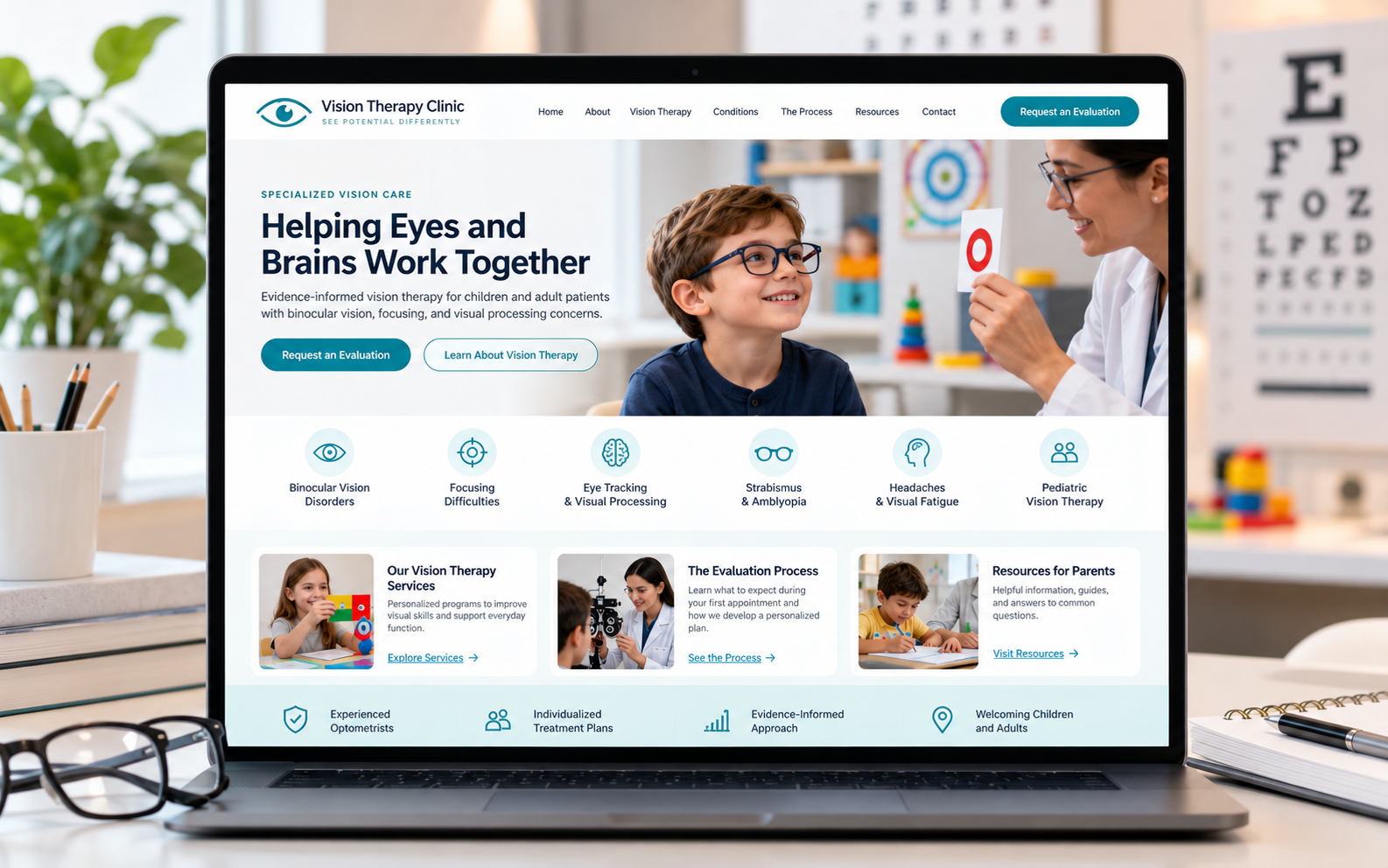
One issue worth examining during a clinic website review is whether the site’s structure reflects the practice’s actual specialty. A general optometry template may work for routine eye exams and eyewear, but it can leave important questions unanswered for patients researching specialized evaluations. Our vision therapy clinic website design guide explains how to assess specialist service pages, clinical information, provider credentials, and inquiry pathways before deciding whether a targeted improvement or a complete redesign is appropriate.

Are Patients Leaving Your Eye Clinic Website Without Booking?
If your website isn’t converting visitors into appointments, the problem is usually trust, clarity, and booking flow. Discover how a conversion-focused optometrist website can increase patient enquiries.
Buyer Intent Layer
Buyer Stage
Consideration → Decision
Questions Clinic Owners Commonly Ask
- Is my website losing patient bookings?
- Should I redesign my existing website?
- Will a better website generate more appointments?
- What separates a healthcare web design specialist from a general agency?
- How can my clinic remain competitive in AI-powered search?
Common Buyer Concerns
- Investing without measurable ROI
- Losing existing Google rankings
- Working with a designer unfamiliar with healthcare
- Project delays and poor communication
- Choosing technology that won’t scale
What Builds Buyer Confidence
Healthcare organizations typically evaluate:
- Industry experience
- Healthcare-specific UX expertise
- Technical SEO capabilities
- Conversion-focused strategy
- Transparent project process
- Long-term support
- Understanding of regional healthcare compliance requirements such as HIPAA (US), NHS/GOC guidance (UK), AHPRA and Medicare expectations (Australia), and local privacy regulations where applicable.
International clinic owners want confidence that their website partner understands both patient experience and regional healthcare requirements, not simply visual design.
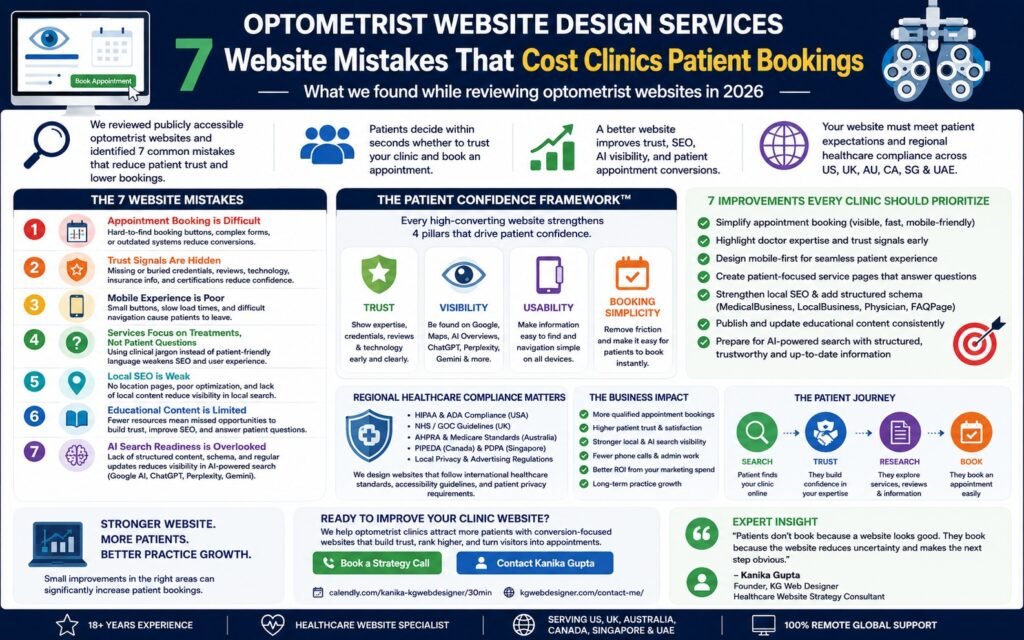
The Patient Confidence Framework
Through our healthcare website reviews, one principle consistently stands out.
Patients don’t book appointments because a website looks attractive.
They book because the website removes uncertainty.
At KG Web Designer, we evaluate healthcare websites using what we call the Patient Confidence Framework.
Every successful clinic website strengthens four essential areas:
Trust
Patients quickly verify doctor expertise, technology, reviews, insurance information, and clinic credibility.
Visibility
Your clinic should be discoverable through Google Search, Google AI Overviews, ChatGPT, Perplexity, Gemini, and other AI-powered search experiences.
Usability
Patients should immediately understand where to go, what to do next, and how to schedule an appointment.
Booking Simplicity
Every page should naturally move visitors closer to booking without unnecessary friction.
When one of these pillars is weak, patient confidence declines.
When all four work together, appointment requests become significantly easier to generate.
Why Do So Many Optometrist Websites Lose Patient Bookings?
Most optometrist websites lose bookings because they increase patient uncertainty instead of reducing it.
Patients don’t arrive looking for beautiful design.
They arrive looking for reassurance.
They want quick answers to practical questions.
- Can I trust this clinic?
- Who will examine my eyes?
- Can I book online?
- Do they accept my insurance?
- What technology do they use?
- How soon can I get an appointment?
If those answers aren’t immediately visible, patients often continue comparing clinics.
The website hasn’t failed technically.
It has failed psychologically.
Original Industry Observation
One pattern appears repeatedly.
Many clinics invest heavily in paid advertising while overlooking what happens after someone arrives on the website.
The result is increased traffic without a corresponding increase in booked appointments.
Improving trust, navigation, and booking usability frequently produces a stronger long-term return than increasing advertising spend alone.
Expert Insight From Kanika Gupta
Founder, KG Web Designer | Healthcare Website Strategy Consultant
“Patients don’t expect your website to convince them you’re the best clinic. They expect it to help them feel confident enough to book the first appointment. Every design decision should reduce uncertainty, answer questions, and make the next step obvious.”
Why Is AI Search Changing How Patients Find Eye Clinics?
Patients are no longer discovering healthcare providers exclusively through traditional search engines.
Today’s patients increasingly interact with AI-powered search experiences that summarize information before they ever visit your website.
Platforms such as ChatGPT, Google AI Overviews, Gemini, Claude, and Perplexity evaluate far more than keywords.
They increasingly assess:
- Educational content
- Structured information
- Doctor expertise
- Service completeness
- Website freshness
- Trust signals
- Semantic organization
- Structured Data Markup
As AI systems continuously revisit publicly available website information, clinics should ensure their websites remain accurate, regularly updated, and technically structured using standards such as MedicalBusiness, LocalBusiness, Physician, and FAQPage schema wherever appropriate.
Preparing for AI-powered discovery is no longer optional.
It has become part of modern healthcare website strategy.
Many clinic owners also struggle to choose the right platform before investing in a redesign. If you’re comparing website builders with professionally developed healthcare websites, our guide Wix vs Squarespace vs Custom Websites for Optometrist Website Design: An Honest Comparison (2026) explains the SEO, scalability, patient experience, and long-term business differences that clinics should evaluate before making a decision.
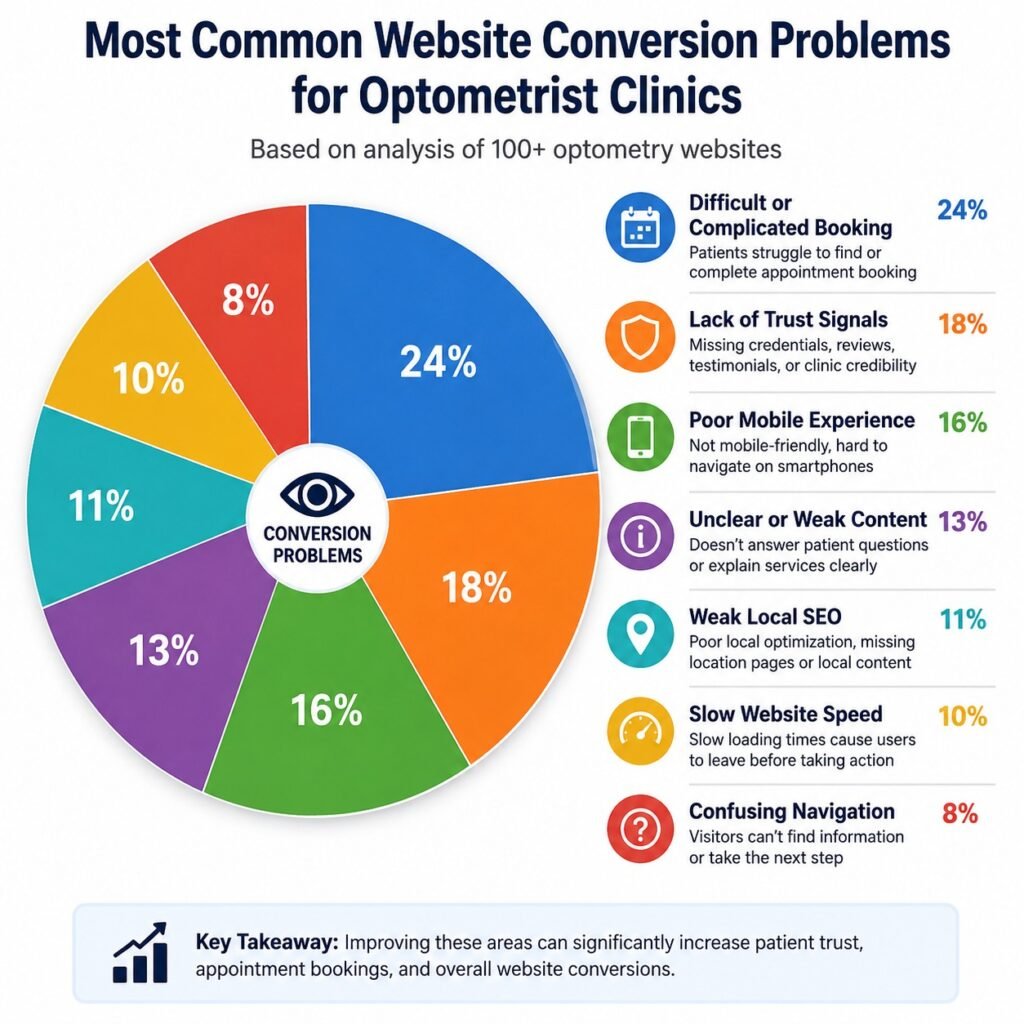
What Are the 7 Website Mistakes Costing Optometrist Clinics Patient Bookings?
The biggest booking losses usually come from patient experience problems rather than medical expertise. Most clinics provide excellent eye care, but their websites create unnecessary friction during the patient’s decision-making journey. Below are the seven issues we most frequently identify when reviewing healthcare websites.
1. Appointment Booking Creates Friction Instead of Convenience
Patients are far more likely to book when scheduling feels effortless.
The most common problem we encounter isn’t the absence of online booking-it’s making patients work too hard to find it.
Many clinics:
- Hide appointment buttons inside menus
- Use outdated third-party booking portals
- Require multiple clicks before patients can schedule
- Ask for excessive information before confirming an appointment
- Display inconsistent booking experiences between desktop and mobile
Healthcare websites should remove friction at every step.
A visitor who decides to book an appointment has already overcome the biggest hurdle: trust.
Don’t lose them because of poor usability.
A booking system should include:
- Sticky “Book Appointment” button
- Online scheduling available on every major page
- Mobile-friendly appointment forms
- Calendar integration
- Confirmation messaging
- Emergency contact information
The easier it is to book, the more appointments your website is likely to generate.
One important lesson from our website reviews is that patients rarely abandon an appointment because they suddenly lose interest in treatment. They usually leave because confidence gradually disappears during the booking journey. We explore the psychology behind this behavior in our guide on Why Patients Leave Eye Clinic Websites Without Booking, where we explain how trust signals, mobile usability, treatment content, and booking friction influence patient decisions before they ever contact your clinic.
Industry Observation
One common mistake we notice is that clinics treat appointment booking as the final step on the website instead of making it part of every patient’s journey.
The highest-performing healthcare websites present booking opportunities naturally throughout the content instead of waiting until visitors reach the contact page.
2. Trust Signals Appear Too Late
Patients decide whether they trust your clinic long before they compare treatment options.
Healthcare decisions involve uncertainty.
Patients want reassurance before taking action.
Yet many optometrist websites bury the information that builds confidence.
The strongest trust signals include:
- Doctor credentials
- Professional memberships
- Board certifications
- Advanced diagnostic technology
- Patient testimonials
- Insurance information
- Awards
- Years of experience
- Before-and-after educational examples where appropriate
- Community involvement
Visitors shouldn’t have to search for this information.
It should be visible throughout the website.
Expert Insight
Patients rarely think:
“This website looks beautiful.”
Instead they think:
“Can I trust these people with my eyesight?”
Every section should answer another question that reduces anxiety.
3. Mobile Experience Still Isn’t Designed for Patients
Most patients discover eye clinics on mobile devices, so mobile usability directly affects appointment bookings.
A surprising number of healthcare websites continue to prioritize desktop layouts even though mobile traffic dominates local healthcare searches.
Common mobile issues include:
- Tiny tap targets
- Difficult navigation
- Slow-loading images
- Long booking forms
- Poor font sizing
- Hidden contact information
Older patients appreciate simplicity.
Younger patients expect it.
A patient-focused eye clinic website design should be built mobile-first, not merely resized for smaller screens.
Example Scenario
A patient searches “eye exam near me” while leaving work.
They compare two clinics.
Clinic A loads quickly.
The booking button remains visible while scrolling.
Insurance information is easy to find.
Doctor credentials appear immediately.
Clinic B loads slowly.
Navigation requires several taps.
Booking opens a third-party portal that looks outdated.
Although both clinics provide excellent care, the patient books with Clinic A because the experience inspires more confidence.
The website-not the clinical expertise-made the difference.
Turn Patient Trust Into More Appointments
Patients don’t just compare clinics — they compare clarity, professionalism, and ease of booking. A well-designed eye clinic website builds confidence before they even call.
4. Service Pages Focus on Treatments Instead of Patient Questions
Patients search for solutions, not clinical terminology.
Many clinic websites organize content around internal service names instead of answering the questions patients actually ask.
Patients search for:
- Why is my vision blurry?
- Dry eye treatment
- Children’s eye exam
- Contact lens fitting
- Cataract consultation
- Digital eye strain
They rarely begin with medical terminology.
A custom optometrist website design organizes services around patient intent while maintaining clinical accuracy.
Educational content also improves AI search visibility because it directly answers common healthcare questions.
The Reality Check
Patients don’t care how your internal departments are organized.
They care about whether your clinic understands their concerns.
The websites generating the strongest engagement simplify complex medical information without oversimplifying clinical accuracy.
5. Local SEO Stops at the Homepage
Local visibility depends on much more than having a Google Business Profile.
Many clinics rely entirely on a single homepage for local rankings.
Instead, successful healthcare websites create location-focused experiences.
Examples include:
- Eye Exams in Brooklyn
- Pediatric Optometrist in Manchester
- Dry Eye Treatment Sydney
- Contact Lens Specialist Toronto
Dedicated local content improves relevance for both traditional search engines and AI-powered search experiences.
Professional eye clinic website design services combine local SEO, educational content, structured data, and patient-focused UX to create stronger visibility across multiple search channels.
Original Data Observation
Across the healthcare websites we review, location pages are frequently either missing or contain duplicated content with only the city name changed.
Search engines and increasingly AI systems reward genuinely helpful local information rather than repetitive location templates.
Wondering Whether Your Website Is Losing Patient Bookings?
Our healthcare website strategy sessions identify the friction points preventing more visitors from becoming patients.
We review:
- Patient journey
- Mobile usability
- Technical SEO
- Local SEO
- Booking experience
- Accessibility
- AI search readiness
- Website trust signals
Rather than recommending unnecessary redesigns, we focus on improvements that generate measurable business impact.
Book Your Website Strategy Consultation
6. Educational Content Doesn’t Answer Enough Patient Questions
Helpful educational content builds trust before patients contact your clinic.
Today’s patients research extensively before scheduling appointments.
Common questions include:
- How often should adults have eye exams?
- Are children’s eye exams different?
- What causes dry eyes?
- How do glaucoma screenings work?
- Should I choose glasses or contact lenses?
Educational content serves three purposes simultaneously.
It helps patients.
It improves search visibility.
It gives AI platforms trustworthy information to reference when recommending healthcare providers.
Clinics investing in ophthalmology website design services should treat educational resources as a long-term business asset rather than an occasional marketing activity.
Clinics that want to improve visibility beyond traditional Google Search should also understand how AI-powered platforms evaluate healthcare websites. Our guide How ChatGPT, Perplexity & Google AI Recommend Eye Clinics in 2026 (And How to Get Cited) explains how structured content, authority, topical expertise, and semantic organization influence AI-generated recommendations.
7. AI Search Readiness Is Still Being Ignored
Modern clinic websites must be optimized for AI systems as well as human visitors.
Search behavior has changed dramatically.
Patients increasingly receive summarized answers before clicking through to individual websites.
AI-powered search systems continuously evaluate publicly available websites for:
- Accurate information
- Structured content
- Educational depth
- Updated pages
- Author expertise
- Technical quality
- Semantic relationships
- Structured Data Markup
Google’s evolving AI-powered search experiences increasingly reward websites that demonstrate expertise, freshness, and technical clarity rather than relying solely on keywords.
Preparing your clinic website for AI visibility means implementing standards such as:
MedicalBusinessLocalBusinessPhysicianFAQPageBreadcrumbList
while keeping content regularly updated and medically accurate.
Clinics investing in optometry website development services should ensure their websites are prepared for both today’s search engines and tomorrow’s AI-driven discovery experiences.
Example From Our Experience
Challenge
A multi-location optometry practice had invested heavily in branding, yet appointment requests remained inconsistent despite healthy website traffic.
Patients frequently called the clinic to ask questions already answered elsewhere on the site, indicating that important information wasn’t easy to find.
Solution
Rather than recommending a complete redesign immediately, we focused on reducing patient friction.
Our recommendations included:
- Simplifying navigation
- Moving appointment CTAs higher
- Improving doctor profile pages
- Expanding educational resources
- Strengthening local landing pages
- Adding structured FAQ content
- Implementing healthcare-focused schema markup
- Improving internal linking
Outcome
The website became significantly easier for prospective patients to navigate and understand.
Instead of simply looking more modern, it became better equipped to build trust, support SEO, improve AI visibility, and convert visitors into appointment requests.
Why Most Optometrist Websites Fail to Generate Consistent Patient Bookings
Most clinics don’t have a traffic problem. They have a patient confidence problem.
Many practice owners believe a new website alone will increase bookings.
In reality, redesigning a website without improving patient trust, booking usability, technical SEO, and content strategy rarely produces meaningful business growth.
Through our healthcare website reviews, we’ve found that clinics often focus on aesthetics while overlooking the factors that actually influence patient decisions.
These include:
- Clear appointment pathways
- Immediate trust signals
- Educational content
- Local relevance
- Technical performance
- AI search readiness
Patients don’t evaluate websites like designers do.
They evaluate them like healthcare consumers looking for reassurance.
The Reality Check
An attractive homepage cannot compensate for a confusing booking process.
Likewise, excellent doctors cannot overcome a website that creates unnecessary friction.
The clinics generating the strongest online growth continuously improve both patient experience and website performance-not just visual appearance.
What This Means for Your Clinic
Your website should function as your highest-performing patient acquisition system, not simply an online brochure.
Every improvement you make influences multiple business outcomes simultaneously.
A better website helps:
- Increase qualified appointment requests
- Improve patient trust before the first consultation
- Strengthen local SEO visibility
- Increase visibility in AI-powered search
- Reduce unnecessary phone inquiries
- Improve staff efficiency
- Support long-term practice growth
One of the biggest opportunities we see is that many clinics already have enough website visitors.
The challenge is converting more of those visitors into booked appointments.
That’s where conversion-focused healthcare website strategy creates measurable business value.
7 Improvements Every Optometrist Website Should Prioritize
1. Simplify Appointment Booking
Patients should never have to search for your booking button.
Make scheduling visible throughout the website.
Recommended improvements include:
- Sticky appointment CTA
- Mobile-friendly booking
- Simple online forms
- Multiple booking opportunities throughout service pages
- Confirmation messaging
Reducing booking friction almost always improves conversion rates.
2. Highlight Trust Earlier
Patients trust doctors before they trust services.
Move important credibility elements higher on the page.
Include:
- Doctor profiles
- Professional credentials
- Clinic technology
- Awards
- Patient testimonials
- Insurance information
- Years of experience
Healthcare websites that establish trust early typically produce stronger engagement.
3. Design Mobile First
Most local healthcare searches now begin on mobile devices.
Prioritize:
- Large tap targets
- Fast page speed
- Readable typography
- Click-to-call buttons
- Easy navigation
- Mobile appointment forms
A high-converting optometrist website treats mobile usability as the primary experience rather than adapting desktop layouts afterward.
4. Answer Patient Questions Before They Ask
Educational content reduces uncertainty and improves SEO simultaneously.
Build service pages around patient concerns rather than internal clinic terminology.
Examples include:
- Dry eye treatment
- Children’s vision care
- Contact lenses
- Cataracts
- Digital eye strain
- Myopia management
Patients appreciate clear explanations.
AI-powered search engines also reward them.
5. Strengthen Local SEO and Structured Data
Local visibility depends on both content and technical optimization.
Every clinic should implement:
- Location-specific landing pages
- Google Business Profile optimization
- Local citations
- Consistent NAP information
- MedicalBusiness Schema
- LocalBusiness Schema
- Physician Schema
- FAQPage Schema
Professional eye clinic website design services combine technical SEO with patient-focused UX to strengthen visibility across Google Search, Maps, and AI-powered search platforms.
6. Keep Educational Content Updated
Healthcare information must remain current.
Publish and refresh articles covering:
- Eye health
- Preventive care
- Technology
- Insurance
- Treatments
- Frequently asked questions
Regular updates signal expertise to both search engines and prospective patients.
7. Prepare for AI-Powered Search
Websites are increasingly evaluated by AI systems, not just human visitors.
Modern healthcare websites should demonstrate:
- Accurate medical information
- Updated content
- Clear authorship
- Structured data
- Semantic organization
- Helpful FAQs
- Strong internal linking
- Consistent clinic information
Preparing for AI-powered discovery helps clinics remain visible as search experiences continue evolving.
Expert Insight From Kanika Gupta
Founder, KG Web Designer | Healthcare Website Strategy Consultant
“The highest-performing healthcare websites don’t persuade patients through clever marketing. They reduce uncertainty at every stage of the patient journey. When visitors quickly understand who you are, what you offer, and how to book, appointments become the natural outcome rather than the objective.”
Example From Our Experience
Challenge
A multi-location optometry practice had invested in a modern website but wasn’t seeing a corresponding increase in appointment requests.
Website analytics showed healthy traffic, yet visitors frequently abandoned service pages before reaching the booking process.
Solution
Rather than rebuilding the entire website immediately, we focused on improving the patient journey.
Our recommendations included:
- Simplifying navigation
- Expanding doctor profile pages
- Moving booking CTAs above the fold
- Creating educational treatment pages
- Improving local landing pages
- Adding healthcare-focused schema markup
- Strengthening internal linking
- Improving accessibility for older users
Outcome
Patients could find information more quickly, understand the clinic’s expertise more easily, and navigate toward appointment booking with fewer obstacles.
The website evolved from a digital brochure into a stronger patient acquisition platform while also improving long-term SEO and AI search readiness.
Final Thoughts
Your website is no longer just a marketing asset.
It has become one of the most important drivers of patient acquisition, trust, and long-term practice growth.
The clinics that consistently outperform competitors are not necessarily those with the largest advertising budgets.
They’re the ones whose websites make it easy for patients to understand their expertise, trust their care, and confidently schedule an appointment.
Investing in professional optometrist website design services helps practices create websites that improve patient experience, strengthen search visibility, support AI-powered discovery, and generate more qualified appointment inquiries.
As patient expectations continue evolving, clinics that prioritize usability, trust, education, accessibility, and technical excellence will remain well positioned for future growth.
Ready to Transform Your Clinic Website?
If you’re wondering whether your website is helping or hurting patient acquisition, we’d be happy to review it.
Our healthcare website strategy sessions include:
- Patient journey analysis
- UX and CRO review
- Technical SEO assessment
- AI search readiness evaluation
- Accessibility review
- Local SEO recommendations
- Performance optimization
- Conversion improvement roadmap
Ready to Get More Patient Bookings From Your Website?
If your current website is not converting visitors into appointments, it’s time to fix the experience. I help optometrists and eye clinics build websites that drive real patient enquiries.
Available across US, UK, Australia, Canada, Singapore, and UAE time zones. Fully remote. No obligation.
Frequently Asked Questions
Why is professional website design important for optometrists?
Professional website design improves patient trust, booking conversions, and online visibility. A well-structured healthcare website helps prospective patients quickly understand your expertise, find important information, and schedule appointments with confidence.
How often should an optometrist website be updated?
Most clinics should review and update their website at least once a year. Regular improvements keep content accurate, strengthen SEO, improve security, support AI search visibility, and maintain a positive patient experience.
What features should every optometrist website include?
Every clinic website should include online appointment booking, doctor profiles, educational resources, patient reviews, insurance information, location pages, clear calls-to-action, and healthcare-focused structured data. Together, these elements improve trust and conversion rates.
Can a better website increase patient bookings?
Yes, when it improves the patient journey. Simplifying booking, strengthening trust signals, improving mobile usability, and answering patient questions make it easier for visitors to become patients.
How does AI search affect optometrist websites?
AI-powered search increasingly recommends clinics with trustworthy, structured, and regularly updated content. Educational resources, schema markup, semantic organization, and clear authorship improve the likelihood of appearing in AI-generated search experiences.
Should I choose a template website or a custom website?
Growing practices usually benefit from a custom website designed around patient acquisition rather than a generic template. Custom solutions provide greater flexibility for SEO, accessibility, AI optimization, and long-term business growth.