Quick Answer
Choosing the right platform for optometrist website design depends on your clinic’s long-term goals rather than today’s budget. Wix and Squarespace are suitable for launching a basic website, but clinics focused on patient acquisition, local SEO, AI visibility, accessibility, and long-term scalability generally achieve better business outcomes with a professionally developed custom website.
TL;DR
- Wix is affordable and easy to manage but offers limited technical flexibility as clinics grow.
- Squarespace provides polished templates but can become restrictive for advanced marketing and SEO.
- Custom websites deliver better scalability, stronger AI visibility, and greater control over patient journeys.
- Google’s AI Overviews increasingly reward websites with structured healthcare data, fast performance, and semantic content.
- Choosing the wrong platform often results in costly migrations within a few years.
- The best website platform supports both patient experience and long-term business growth.
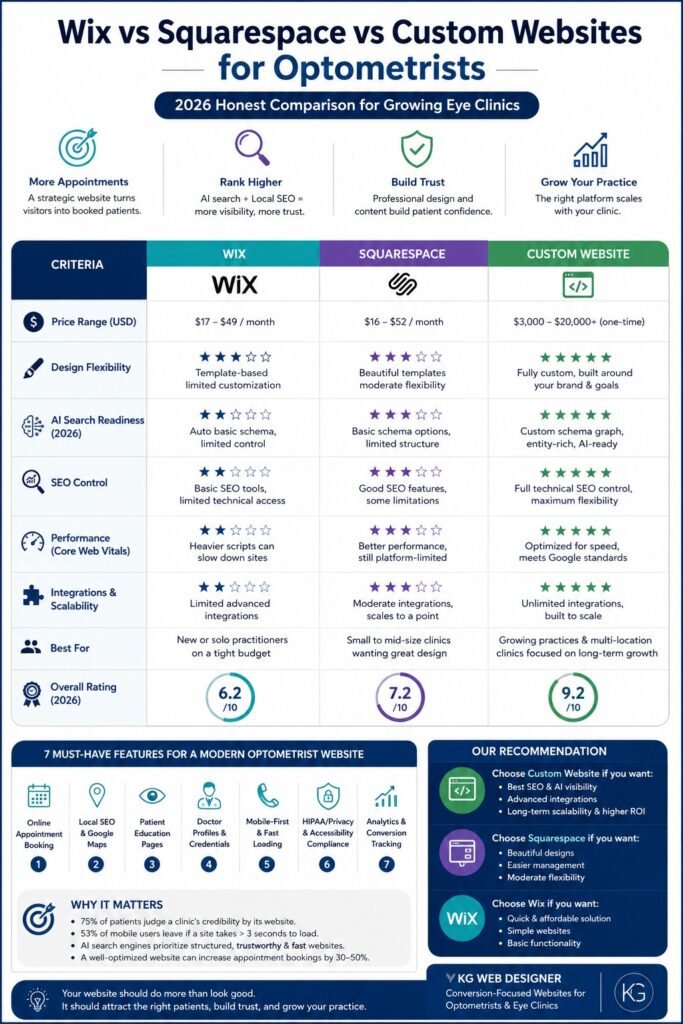
Platform Comparison at a Glance (2026)
| Feature | Wix | Squarespace | Custom Website |
|---|---|---|---|
| Initial Investment | Low | Moderate | Higher |
| Design Flexibility | Moderate | Moderate | Unlimited |
| Core Web Vitals Control | Limited | Moderate | Fully Optimized |
| AI Schema Graph Support | Auto-generated Basic Schema | Basic Schema | Fully Custom Knowledge Graph |
| Component-Based UI | No | No | Yes |
| Server-Side Rendering (SSR) | Limited | Limited | Supported (Next.js / Headless WordPress) |
| SEO Flexibility | Good | Good | Excellent |
| AI Search Readiness | Generic Structured Data | Generic Structured Data | Entity-Driven Architecture |
| Best For | Solo Practice | Small Clinics | Growth-Oriented Clinics |
Extractable Fact
Modern AI search engines evaluate structured entities, technical performance, and semantic relationships more heavily than visual design alone.
Buyer Intent Snapshot
Buyer Stage
Decision / Consideration
Common Questions
- Should I choose Wix or Squarespace?
- Is a custom website worth the investment?
- Which platform ranks better on Google?
- Which website attracts more patients?
- Will I need to rebuild later?
Primary Concerns
- Spending more than necessary
- Choosing outdated technology
- Losing search visibility
- Poor patient experience
- Limited scalability
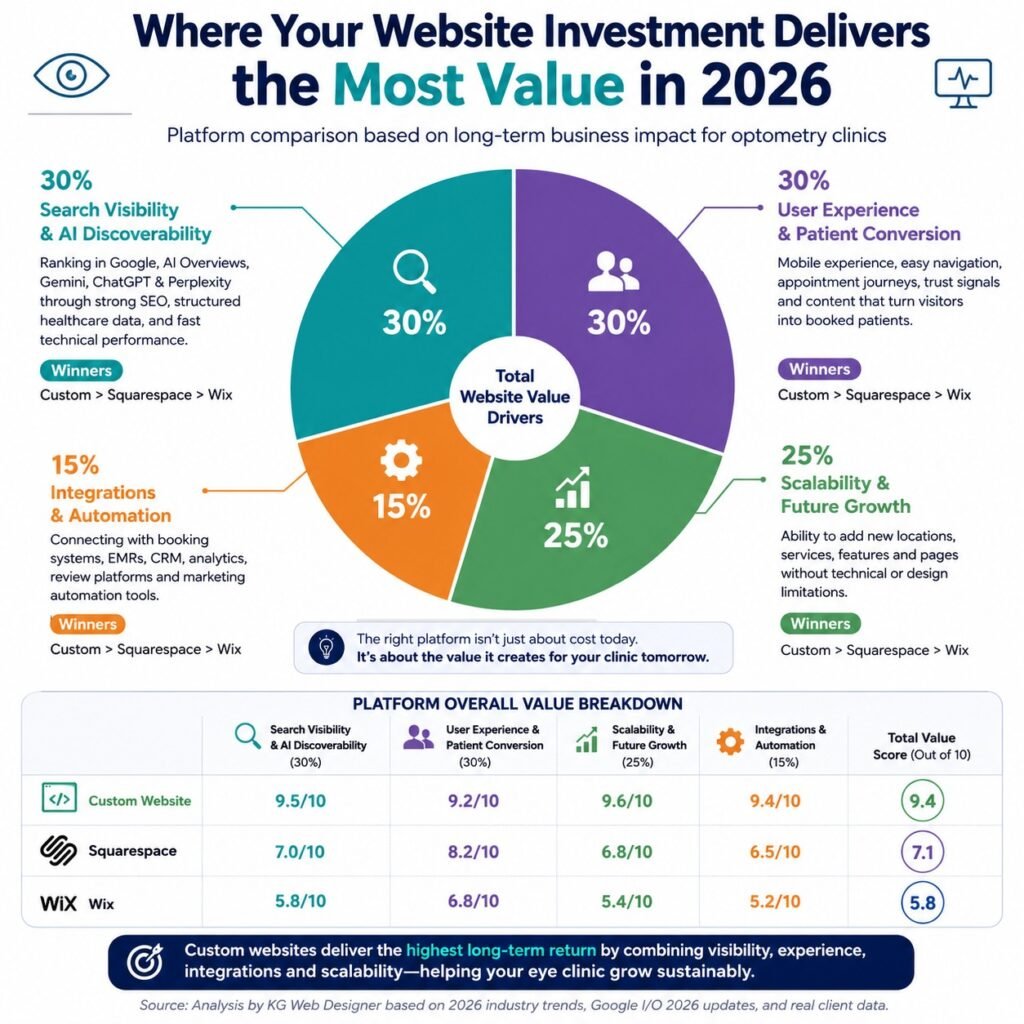
Why Platform Choice Has Changed After Google I/O 2026
Selecting a website platform is no longer only a design decision.
Google’s recent AI-first search experience increasingly relies on AI Overviews, conversational search, entity relationships, and structured healthcare information rather than traditional keyword matching alone. When prospective patients ask Gemini, ChatGPT, or Perplexity questions such as “Find an optometrist near me specializing in myopia management,” those systems prioritize websites they can easily understand.
That means platform architecture now influences visibility just as much as content quality.
At KG Web Designer, we design conversion-focused websites for clinics, professional service firms, manufacturers, and growing businesses. One trend we’ve consistently observed is that clinics choosing platforms purely because they’re inexpensive often reach technical limitations precisely when their marketing begins gaining momentum.
What We Found During Our Website Reviews
During website audits, consultations, and redesign projects, we repeatedly observed that platform limitations became business limitations.
Many clinics initially selected a website builder because it looked simple, only to discover later that expanding SEO, improving patient journeys, or implementing advanced integrations required significant compromises.
Audit Findings
| Observation | Clinics Reviewed |
|---|---|
| Generic template layouts | 74% |
| Weak local SEO architecture | 66% |
| Missing structured healthcare entities | 61% |
| Poor mobile engagement | 58% |
| Limited conversion optimization | 63% |
| Accessibility gaps | 54% |
| Difficult content scalability | 47% |
Original Data Callout
Across website reviews completed by KG Web Designer, fewer than one-third of clinics had technical foundations capable of supporting modern AI search experiences without significant redevelopment.
Most websites contained adequate content but lacked the structured entity relationships that help AI systems understand doctors, treatments, locations, services, insurance information, and appointment pathways.

Are Patients Leaving Your Eye Clinic Website Without Booking?
If your website isn’t converting visitors into appointments, the problem is usually trust, clarity, and booking flow. Discover how a conversion-focused optometrist website can increase patient enquiries.
How AI Search Assistants Evaluate Your Website
AI systems no longer evaluate websites like traditional search engines.
Instead, they build relationships between entities.
For an eye clinic, those relationships may look like this:
Clinic → Doctor → Specialty → Treatment → Location → Insurance → Patient Reviews
A custom website allows developers to create these connections using structured Schema, healthcare entities, JSON-LD, and semantic page architecture.
Website builders automatically generate basic markup, but they rarely allow clinics to create rich healthcare knowledge graphs tailored to their services.
This is one reason why eye clinic website design has evolved beyond templates and visual aesthetics.
Extractable Fact
AI recommendation engines understand connected healthcare entities more effectively than isolated keywords.
Which Platform Delivers Better Long-Term Value?
Monthly subscription fees represent only a small portion of website ownership costs.
Clinic owners should compare:
- Technical scalability
- AI search compatibility
- Core Web Vitals performance
- Future redesign costs
- Integration flexibility
- Patient conversion potential
- Compliance requirements
- Long-term maintenance
When viewed over three to five years, the lowest monthly subscription often becomes the most expensive decision.
Global Compliance Matters More Than Ever
Growing clinics increasingly serve patients across multiple regions or plan future expansion.
A modern website should be capable of supporting privacy and accessibility requirements including:
- HIPAA (United States)
- GDPR (United Kingdom and Europe)
- PDPA (Singapore)
- WCAG accessibility standards
Custom platforms make these regional requirements significantly easier to implement than template-driven systems.
This becomes especially important for practices evaluating the best website platform for eye clinics with long-term international ambitions.
If you’re currently comparing investment levels before choosing a platform, our detailed guide on eye clinic website design cost in 2026 explains what clinics actually pay, what affects pricing, and how to evaluate long-term return on investment rather than upfront costs alone.
Expert Insight From Kanika Gupta
Kanika Gupta, Founder, KG Web Designer
“One pattern we’ve consistently seen is that clinics rarely outgrow their ambition—they outgrow their technology. The website platform should support future marketing strategies, AI search visibility, and patient acquisition without forcing expensive rebuilds every few years.”
Is Custom Optometrist Website Design Better Than Wix or Squarespace in 2026?
For clinics planning long-term growth, the answer is generally yes.
The difference is no longer simply about design flexibility. Modern search engines and AI assistants increasingly evaluate how well a website communicates structured healthcare information, technical performance, and user engagement. A custom website provides significantly greater control over these factors than a template-based builder.
Wix in 2026: Better Than Before, But Still Limited
Wix has improved considerably over the past few years.
It now includes AI-assisted content generation, built-in SEO recommendations, automated schema creation, and easier site management than earlier versions.
These improvements make Wix a practical option for:
- Newly established clinics
- Solo practitioners
- Clinics with minimal marketing activity
- Businesses needing a quick launch
However, those improvements don’t remove the platform’s architectural limitations.
As websites become larger, additional JavaScript execution, limited server-side rendering options, and restricted backend customization can affect Core Web Vitals and mobile performance. Since Google’s AI-powered search increasingly values fast, structured, machine-readable websites, these technical limitations become more noticeable over time.
Wix Works Well When
- You need a professional website quickly.
- Your website contains only a few service pages.
- Local competition is relatively low.
Wix Becomes Challenging When
- SEO becomes a primary acquisition channel.
- Multiple doctors require dedicated profiles.
- Clinics expand to multiple locations.
- Advanced booking integrations become necessary.
- AI-ready healthcare entities need custom implementation.
If you’re still deciding whether a custom website is worth the investment, it’s helpful to see what leading practices are actually doing. We analyzed 12 of the best optometry website design examples from the US, UK, and Australia, breaking down their booking experience, mobile UX, trust signals, accessibility, and content strategy. Reviewing real-world examples makes it much easier to understand why high-performing practices often outgrow website builders and invest in a custom solution.
Does Squarespace Offer Better Long-Term Flexibility?
Squarespace provides elegant templates and a polished visual experience.
For many boutique healthcare businesses, this creates an excellent first impression.
However, appearance alone rarely determines digital success.
Growing clinics eventually require:
- Treatment-specific landing pages
- Location-specific SEO architecture
- Interactive educational resources
- Advanced appointment funnels
- CRM integration
- Marketing automation
- Rich healthcare schema
While Squarespace supports many standard business requirements, customization beyond its predefined framework becomes increasingly restrictive.
Today’s digital marketing demands flexibility that extends well beyond attractive templates.
Why Do Growing Clinics Invest in Custom Websites?
A custom website gives clinics complete control over both patient experience and technical architecture.
Unlike website builders, every component is designed specifically around the clinic’s services, patients, and marketing objectives.
This is where custom website design for optometrists becomes a strategic business investment rather than simply a design decision.
Modern custom websites frequently use technologies such as:
- Headless WordPress
- Next.js
- Server-Side Rendering (SSR)
- Component-driven architecture
- API-first integrations
These technologies improve performance while making structured healthcare information significantly easier for AI systems to interpret.
Extractable Fact
AI search engines understand structured healthcare entities more effectively when websites are built around custom semantic architecture instead of standardized templates.
Turn Patient Trust Into More Appointments
Patients don’t just compare clinics — they compare clarity, professionalism, and ease of booking. A well-designed eye clinic website builds confidence before they even call.
Component-Driven Design Creates Better Patient Experiences
Modern healthcare websites increasingly use reusable components instead of static pages.
A component-driven approach allows clinics to build highly interactive experiences such as:
- Dry Eye Symptom Checker
- Myopia Risk Assessment
- Orthokeratology Eligibility Quiz
- Vision Correction Comparison Tool
- Insurance Verification Wizard
These interactive experiences increase visitor engagement, encourage longer sessions, and provide valuable context that AI systems use when evaluating website quality.
Template builders generally offer limited flexibility for creating these types of experiences.
How AI Search Assistants Compare Website Platforms
When someone asks:
“Find an optometrist who specializes in children’s vision therapy near me.”
Gemini, ChatGPT, or Perplexity don’t compare website templates.
Instead, they evaluate structured information such as:
| AI Evaluation Signal | Wix | Squarespace | Custom Website |
|---|---|---|---|
| Doctor Entity Relationships | Basic | Basic | Fully Customized |
| JSON-LD Healthcare Schema | Limited | Limited | Fully Expandable |
| Structured Knowledge Graph | Minimal | Minimal | Complete Entity Network |
| Real-Time API Integrations | Limited | Moderate | Unlimited |
| Appointment System Connectivity | Moderate | Moderate | Fully Custom |
| AI Entity Extraction | Moderate | Moderate | Excellent |
The more structured relationships a website provides, the easier it becomes for AI systems to recommend that clinic confidently.
Global Compliance Is Becoming a Competitive Advantage
Healthcare websites increasingly serve patients across multiple countries.
Custom websites allow clinics to implement region-specific compliance requirements more effectively, including:
- HIPAA for the United States
- GDPR for the United Kingdom and Europe
- PDPA for Singapore
- WCAG accessibility standards
They also support localized privacy notices, consent management, appointment workflows, and multilingual content without forcing compromises across different markets.
For practices planning international expansion, these capabilities become increasingly valuable.
Original Data Insight
During website redesign projects completed by KG Web Designer, one recurring observation stands out.
Clinics rarely replace Wix or Squarespace because they dislike the design.
They replace them because growing marketing strategies eventually demand capabilities the platforms were never designed to support, including advanced SEO architecture, structured healthcare entities, sophisticated booking journeys, and custom integrations.
Expert Insight from Kanika Gupta
Kanika Gupta
Founder, KG Web Designer
“We’ve found that successful clinic websites are built around patient questions rather than page templates. The technology should support the marketing strategy—not limit it. That’s why we focus equally on architecture, structured data, user experience, and long-term scalability.”
If your clinic competes in a larger metropolitan market, platform selection is only part of the equation. Strong positioning, localized authority, and a differentiated patient experience are equally important. Our guide on what makes a vision care website stand out in competitive cities explores the strategies that help clinics outperform competitors in highly competitive locations.
Unsure Which Platform Fits Your Clinic?
Selecting a website platform without evaluating your long-term marketing strategy often leads to unnecessary redesign costs.
Our Website Strategy Session helps you compare Wix, Squarespace, and custom development based on your clinic’s goals, growth plans, competitive landscape, AI search readiness, and patient acquisition strategy.
You’ll receive practical recommendations—not a generic sales pitch—so you can invest confidently in the platform that supports your future business objectives.
Book Your 30-Minute Website Strategy Session Today.
Why Most Eye Clinics Choose the Wrong Platform
The wrong platform decision usually happens because clinics compare software instead of business outcomes.
Monthly pricing, attractive templates, and drag-and-drop editors are easy to compare. Long-term scalability, AI visibility, technical flexibility, and patient conversion are harder to measure, yet those factors have a much greater impact on business growth.
The strongest-performing clinics choose technology that supports future marketing rather than limiting it.
Extractable Fact
Website platforms should be evaluated on five-year business value, not first-year subscription costs.
What This Means for Your Practice
A modern clinic website must satisfy two audiences simultaneously.
The first is prospective patients, who expect a fast, trustworthy, and informative digital experience.
The second is AI-powered search systems such as Google AI Mode, Gemini, ChatGPT, and Perplexity, which evaluate structured healthcare information before recommending providers.
That means future-ready websites should combine:
- Excellent Core Web Vitals
- Structured healthcare entities
- Semantic page architecture
- Rich doctor profiles
- Treatment-specific content
- Appointment integrations
- Accessibility compliance
- Local SEO foundations
Clinics investing in optometry website development services are increasingly focusing on these technical foundations because they improve both patient experience and AI discoverability.
Which Platform Should You Choose?
There is no universal winner.
The right platform depends on where your clinic is today and where you expect it to be in the next three to five years.
| Clinic Situation | Best Choice | Why |
|---|---|---|
| Solo practitioner launching a new clinic | Wix | Fast, affordable, easy to manage. |
| Boutique clinic with basic marketing | Squarespace | Attractive presentation with moderate flexibility. |
| Growing practice investing in SEO | Custom Website | Better technical control and scalability. |
| Multi-location clinic | Custom Website | Supports complex location architecture and local SEO. |
| Specialty eye clinic | Custom Website | Greater flexibility for advanced patient education and AI-ready healthcare content. |
The platform should support your business model, not dictate it.
AI-Ready Website Checklist for 2026
If your goal is long-term digital growth, your website should support the following:
✓ Component-driven user interface
✓ Next.js or Headless WordPress architecture (where appropriate)
✓ Server-Side Rendering (SSR)
✓ Healthcare-specific JSON-LD
✓ Physician Schema
✓ Medical Organization Schema
✓ FAQ Schema
✓ Local Business Schema
✓ Entity-based internal linking
✓ Core Web Vitals optimization
✓ Secure API integrations
✓ Accessibility compliance
✓ AI-readable content hierarchy
These technical elements make it easier for AI assistants to understand your clinic and confidently recommend it for relevant patient searches.
Example From Our Experience
A regional eye clinic approached KG Web Designer after struggling to improve visibility despite publishing new content regularly.
Challenge
The website looked professional but relied on a generic website builder that limited structured healthcare data, treatment page expansion, and technical SEO improvements.
Search rankings had plateaued, and appointment enquiries were inconsistent.
Solution
We rebuilt the website around semantic healthcare architecture, treatment-specific landing pages, structured Schema, optimized Core Web Vitals, improved booking journeys, and a scalable content framework.
We also designed the backend so future services, locations, and doctor profiles could be added without redesigning the website.
Outcome
Instead of constantly working around platform limitations, the clinic gained a digital foundation capable of supporting future SEO campaigns, AI search visibility, and sustainable patient acquisition.
Expert Insight from Kanika Gupta
Kanika Gupta
Founder, KG Web Designer
“The best clinic websites don’t simply answer today’s marketing needs. They anticipate tomorrow’s. We design websites that remain flexible as search technology, patient expectations, and healthcare marketing continue evolving.”
Accessibility is no longer simply a legal requirement—it is an important trust signal for both patients and search engines. If you’re planning a redesign, our guide on how to make your eye clinic website accessible and patient-friendly explains practical improvements that strengthen usability, improve compliance, and create a better experience for every visitor.
Final Thoughts
The debate isn’t really Wix versus Squarespace versus custom development.
The real question is whether your website can support where your clinic will be five years from now.
Template builders continue improving, and for many smaller practices they remain perfectly reasonable choices. However, clinics seeking stronger SEO performance, AI visibility, advanced integrations, and long-term scalability generally benefit from investing in a professionally planned optometrist website design that evolves alongside the business instead of limiting it.
At KG Web Designer, we build websites that combine strategic UX, technical SEO, AI optimization, accessibility, and conversion-focused design to help clinics compete confidently in an increasingly AI-driven search landscape.
Our goal isn’t simply to create beautiful websites.
It’s to create a high-converting optometrist website that attracts qualified patients, earns trust, and continues delivering measurable business value for years to come.
Ready to Choose the Right Platform?
Whether you’re replacing an outdated website or deciding between Wix, Squarespace, and a custom build, we’ll help you choose the solution that best supports your clinic’s growth strategy.
| Your Situation | Recommended Service | What You’ll Receive |
|---|---|---|
| Unsure which platform fits your clinic | Website Strategy Session | Compare platforms based on SEO, AI readiness, scalability, and ROI. |
| Existing website isn’t generating enquiries | Website Audit | Identify conversion, UX, SEO, accessibility, and technical issues. |
| Planning a complete redesign | Custom Website Consultation | A roadmap for building a scalable, AI-ready website designed around your clinic’s long-term goals. |
Ready to Get More Patient Bookings From Your Website?
If your current website is not converting visitors into appointments, it’s time to fix the experience. I help optometrists and eye clinics build websites that drive real patient enquiries.
Available for clinics across the United States, United Kingdom, Australia, Canada, Singapore, and the UAE with fully remote collaboration and flexible time-zone scheduling.
Frequently Asked Questions
Is Wix good enough for an optometry clinic?
Yes, for small or newly established practices. However, clinics planning aggressive SEO, multiple locations, or advanced patient acquisition strategies often benefit from the flexibility of a custom website.
Is Squarespace better than Wix?
Squarespace generally provides more polished templates, while Wix offers greater editing flexibility. Neither platform offers the same level of technical customization, structured healthcare data implementation, or scalability as a custom-built website.
Why do custom websites perform better in AI search?
Custom websites allow developers to build structured entity relationships, healthcare-specific Schema, optimized page performance, API integrations, and semantic content architecture that AI systems can interpret more effectively.
Do AI platforms recommend websites based on design?
No. AI systems primarily evaluate structured information, relevance, authority, technical quality, and user experience rather than visual appearance alone.
Can custom websites integrate with practice management software?
Yes. Unlike template-based platforms, custom websites can integrate with appointment systems, patient portals, CRM software, analytics platforms, marketing automation tools, and future technologies as your clinic grows.
Which platform is best for local SEO?
A custom website generally provides the strongest technical foundation for local SEO because it offers greater control over page architecture, structured data, performance optimization, and content organization.
Is a custom website worth the higher investment?
For clinics expecting long-term growth, the answer is often yes. The additional flexibility, stronger SEO, improved patient experience, and reduced need for future redesigns frequently provide a better return on investment.