Quick Answer
After reviewing 40 mid-market ecommerce stores across fashion, beauty, wellness, home goods, and DTC electronics sectors, we found that the most successful brands invest in strategic ecommerce website design services that prioritize trust architecture, mobile-first UX, checkout simplicity, customer retention systems, and AI-readable commerce infrastructure. The biggest differentiator is not visual design. It is how effectively the store helps both human shoppers and AI shopping agents understand products, evaluate trust, and complete purchases.
TL;DR / Key Takeaways
- High-converting ecommerce stores remove friction throughout the customer journey.
- Mobile-first design continues to influence conversion performance more than desktop design.
- Product page trust signals directly impact purchase decisions.
- AI shopping agents now influence product visibility and transaction pathways.
- Simplified checkout experiences consistently reduce abandonment.
- Customer retention systems generate greater long-term profitability than acquisition-only strategies.
Ecommerce Store Benchmark Report: What We Found After Reviewing 40 Stores
Between January and May 2026, KG Web Designer reviewed 40 mid-market ecommerce stores operating across New York, London, Sydney, Toronto, Singapore, and Dubai.
The review included brands in:
- Fashion
- Beauty
- Wellness
- Home Goods
- DTC Electronics
Each store was evaluated against 35 conversion, UX, trust-building, mobile commerce, checkout, retention, and AI-readiness criteria.
The objective was simple:
Identify what separates high-converting ecommerce brands from stores that struggle to turn traffic into revenue.
Ecommerce Conversion Findings
| Finding | Stores Showing This Issue |
|---|---|
| Weak product page trust signals | 67% |
| Poor mobile purchase experience | 61% |
| Overcomplicated navigation | 58% |
| Confusing checkout process | 55% |
| Weak product differentiation | 52% |
| No customer retention strategy | 71% |
| Slow page loading speeds | 49% |
What High-Converting Stores Consistently Had
| Success Factor | High-Converting Stores |
|---|---|
| Strong trust architecture | 89% |
| Mobile-first UX | 92% |
| Simplified navigation | 86% |
| Optimized checkout experience | 84% |
| Customer retention systems | 81% |
| Clear product positioning | 87% |
KG Web Designer Ecommerce Benchmark Observation
Across the 40 stores reviewed, the strongest-performing brands were not necessarily those with the most sophisticated visual design.
The highest-performing stores consistently communicated value faster, established trust earlier, and reduced friction throughout the buying journey.
Customers purchased more frequently when confidence was created quickly.
Buyer Intent Analysis
Buyer Stage
Most ecommerce founders searching for website design guidance are already beyond awareness.
They understand website performance matters.
They are actively evaluating why competitors convert more effectively and whether their own store is limiting growth.
Most readers fall into either the Consideration or Decision stage.
Common Buyer Questions
- Why is my traffic increasing but sales remain flat?
- Should I redesign my ecommerce website?
- How much revenue am I losing because of UX issues?
- What improvements generate the highest ROI?
- How do successful ecommerce brands convert more visitors?
Common Buyer Concerns
Many ecommerce businesses worry about:
- Investing in a redesign without improving sales
- Losing organic rankings
- Choosing the wrong agency
- Increasing complexity instead of conversions
- Wasting marketing spend on low-converting traffic
Proof Buyers Want Before Investing
Before committing to a redesign, decision-makers typically look for:
- Ecommerce expertise
- Conversion strategy
- Industry-specific experience
- Measurable business outcomes
- Clear process frameworks
- Long-term scalability
The most successful ecommerce projects address these concerns before they become objections.
Ready to Build a High-Converting Ecommerce Website?
👉 Get your top 3 conversion leaks identified.
Why Are Some Ecommerce Stores Growing Faster Than Others?
Many ecommerce brands believe they have a traffic problem.
Most actually have a conversion problem.
Increasing advertising budgets rarely solves weak conversion architecture. It simply sends more visitors into an experience that is already underperforming.
At KG Web Designer, we construct high-performance, conversion-focused ecommerce ecosystems for scaling DTC brands, luxury retailers, and global online businesses. Our approach combines customer psychology, conversion architecture, SEO visibility, and AI-ready commerce infrastructure to help brands compete in both human and machine-driven shopping environments.
In our experience, many ecommerce stores already receive enough traffic to scale.
What they lack is a buying experience that turns visitors into customers consistently.
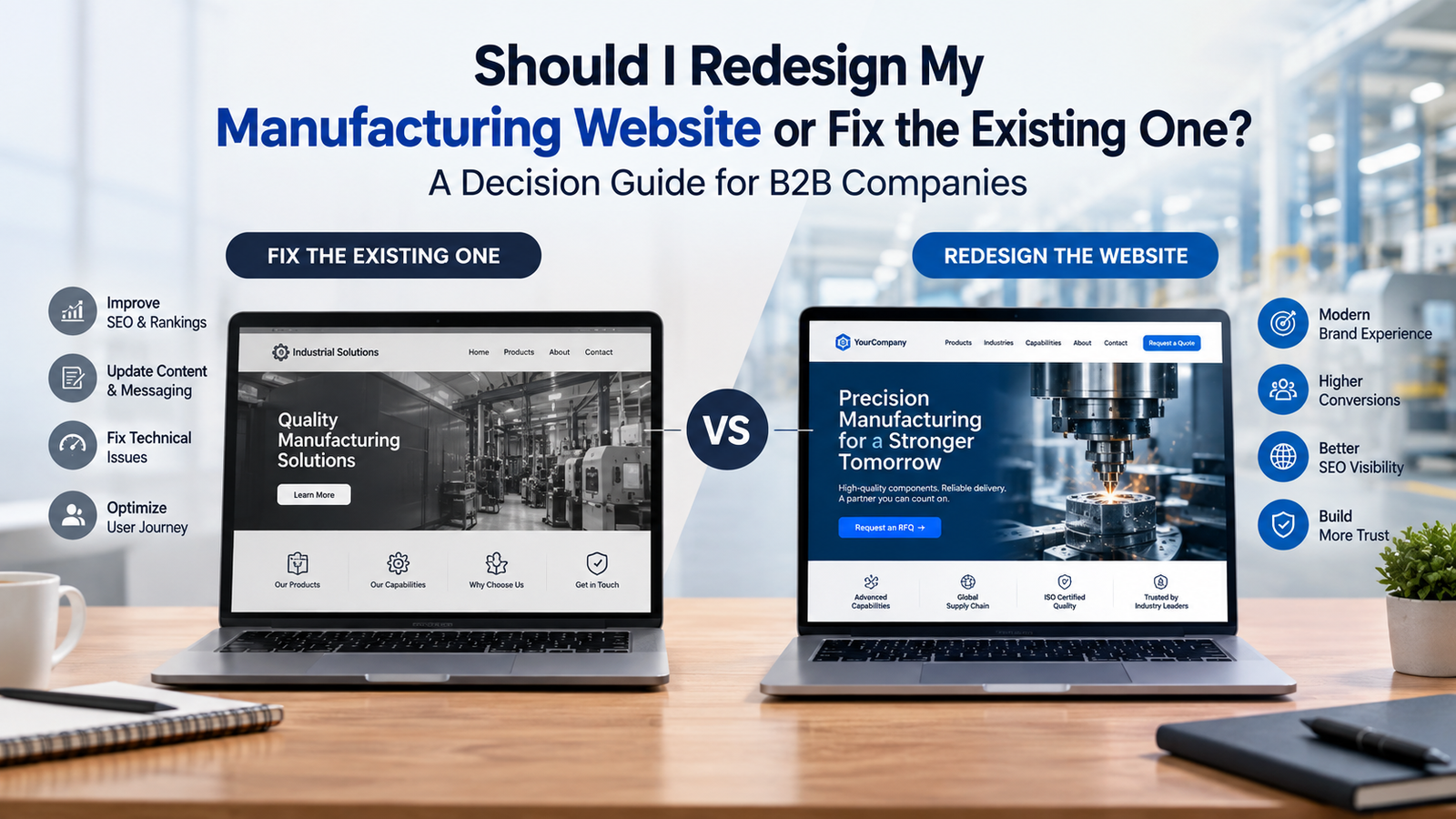
One pattern became clear during our review: many businesses assume improving conversions starts with a visual redesign. In reality, a poorly planned redesign can erase years of SEO progress if technical migration isn’t handled correctly. If you’re considering rebuilding your online store, our guide on Why Most Ecommerce Redesigns Fail (And the SEO-Safe Migration Framework We Use) explains how to protect rankings, preserve organic traffic, and migrate your ecommerce website without sacrificing the visibility you’ve already earned.
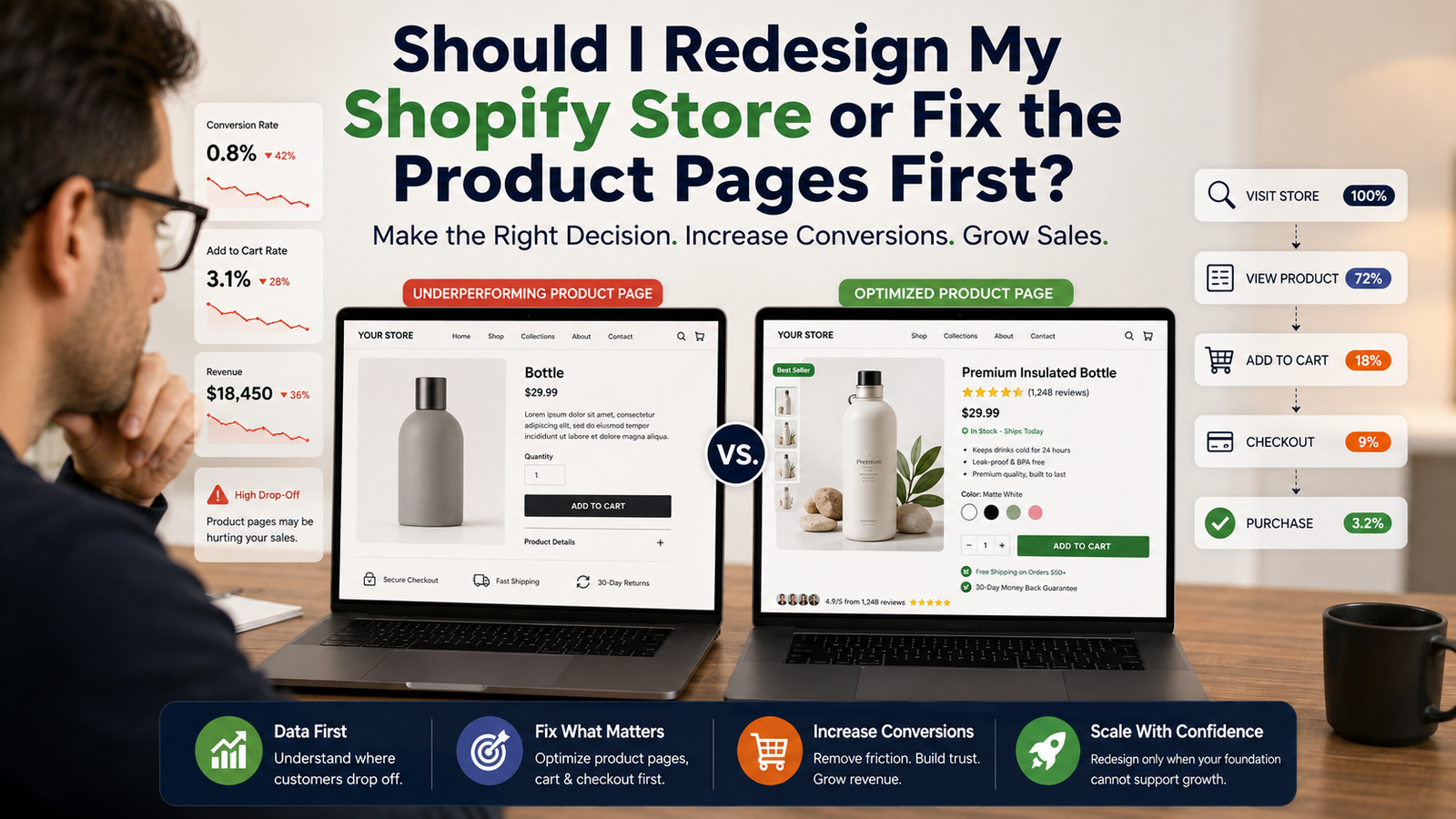
That distinction becomes especially important for Shopify brands deciding whether they actually need a full rebuild. Before committing to a new store, it is worth separating structural problems from isolated product-page and conversion issues. Our guide, Should I Redesign My Shopify Store or Fix the Product Pages First?, explains how to assess store architecture, product-page performance, mobile UX, cart friction, and checkout issues before spending on a complete redesign.
Expert Insight From Kanika Gupta
Kanika Gupta, Founder, KG Web Designer
After reviewing ecommerce brands across multiple industries, one pattern repeatedly appears.
Businesses often invest heavily in acquisition before fixing conversion bottlenecks.
Traffic is becoming more expensive every year.
The brands growing fastest in 2026 are not always the brands spending the most. They are the brands making it easier to buy.
What Do High-Converting Ecommerce Brands Do Differently?
High-converting brands reduce uncertainty at every stage of the buying journey.
Customers purchase when trust outweighs perceived risk.
The strongest ecommerce experiences intentionally build confidence from the first interaction through post-purchase engagement.
This is where ecommerce website design services create measurable business value.
The highest-performing stores consistently focus on:
- Product clarity
- Trust architecture
- Mobile usability
- Checkout simplicity
- Retention systems
- Conversion psychology
- AI commerce visibility
These elements work together to influence revenue growth.
While this article summarizes patterns across 40 ecommerce stores, we’ve also published an in-depth review of the 15 Best Ecommerce Website Designs in 2026, breaking down what individual fashion, beauty, electronics, and D2C brands do exceptionally well.
Industry Observation #1: Product Pages Influence More Revenue Than Homepages
Most purchasing decisions happen on product pages.
Yet many brands spend disproportionate time optimizing their homepage while neglecting product detail experiences.
The strongest ecommerce stores invest heavily in:
- Product education
- Customer reviews
- Comparison content
- Trust indicators
- Guarantees
- Shipping transparency
Product pages frequently determine whether a visitor becomes a customer.
Industry Observation #2: Mobile Commerce Has Become the Default Experience
Mobile shoppers now represent the majority of ecommerce traffic in most industries.
Customers expect speed, simplicity, and clarity.
Stores following ecommerce UX design best practices consistently reduce friction by making navigation, filtering, and checkout effortless on smaller screens.
Mobile-first design is no longer a competitive advantage.
It is a baseline requirement.
Industry Observation #3: Retention Is Still the Most Underutilized Revenue Driver
Many ecommerce businesses remain focused on first-time acquisition.
The strongest brands design for lifetime customer value.
Retention systems frequently include:
- Loyalty programs
- Subscription models
- Personalized recommendations
- Replenishment reminders
- Customer accounts
Brands investing in ecommerce store design for higher sales often outperform competitors because they generate more revenue from existing customers rather than relying exclusively on new customer acquisition.
Example Scenario
Imagine a beauty brand in London generating 50,000 monthly visitors.
The company has invested heavily in paid advertising, influencer campaigns, and email marketing.
Traffic continues to grow.
Revenue does not.
After reviewing the store, the underlying issues become obvious:
- Product pages lack trust indicators.
- Shipping costs are unclear.
- Mobile navigation creates friction.
- Checkout requires excessive effort.
- Customer retention systems are almost nonexistent.
The problem is not traffic.
The problem is conversion architecture.
Even a modest increase from a 1.2% conversion rate to 2.4% could potentially double online revenue without increasing advertising spend.
Why Most Ecommerce Stores Get This Wrong
Most ecommerce brands optimize for aesthetics before optimizing for buying behavior.
Customers do not purchase because a website looks impressive.
Customers purchase because the experience reduces uncertainty and makes decision-making easier.
One common mistake we notice is that brands obsess over homepage visuals while neglecting the pages where purchasing decisions actually occur.
The highest-performing stores prioritize:
- Product page clarity
- Trust architecture
- Mobile usability
- Checkout efficiency
- Customer retention
These areas typically produce greater financial impact than visual redesigns alone.
What Are the 8 Conversion Elements Found in High-Converting Stores?
The strongest ecommerce brands consistently demonstrated eight recurring conversion characteristics.
1. Immediate Product Clarity
Visitors should understand what a product does within seconds.
Confusion delays decisions.
Delayed decisions reduce conversions.
2. Trust Signals Near Purchase Decisions
Reviews, testimonials, guarantees, security indicators, and customer-generated content reduce perceived risk.
Trust should appear where buying decisions occur.
3. Strong Product Differentiation
Customers need a reason to choose one brand over another.
High-performing stores communicate outcomes, benefits, and positioning clearly.
4. Mobile-First User Experience
Mobile commerce continues to dominate ecommerce growth.
Stores optimized for mobile purchasing consistently outperform desktop-first experiences.
5. Clear Shipping Transparency
Unexpected costs remain one of the most common reasons customers abandon purchases.
Successful stores eliminate surprises.
6. Simplified Navigation
Customers should find products quickly.
Complex navigation structures increase friction and create decision fatigue.
7. Checkout Efficiency
The fewer barriers between cart and purchase, the better.
Every unnecessary step introduces risk.
8. Customer Retention Infrastructure
Brands implementing high-converting ecommerce website design frequently prioritize repeat purchases through loyalty programs, subscriptions, account systems, and personalized experiences.
Retention compounds profitability over time.
These eight conversion elements should ideally be validated before launch, when corrections are less disruptive and paid traffic has not yet exposed the gaps. Our Shopify launch checklist from waitlist to first order turns these priorities into a practical quality-assurance process covering storefront UX, checkout, email flows, analytics, SEO and launch-day monitoring.
The 2026 Search Reality: Designing for AI Shopping Agents
Google’s ecommerce ecosystem is changing rapidly.
Following the rollout of AI-powered shopping experiences, Universal Cart functionality, and persistent shopping agents, ecommerce stores must now serve two audiences simultaneously:
- Human shoppers
- AI shopping systems
This represents one of the biggest shifts in ecommerce design since mobile commerce.
Why This Matters
AI shopping agents increasingly evaluate:
- Product information
- Structured data
- Pricing transparency
- Shipping details
- Product comparisons
- Availability signals
before a customer even visits a website.
Stores that make product information easy to understand and access are becoming easier for AI-powered shopping experiences to recommend.
Expert Observation
High-performing ecommerce brands now optimize for both customer psychology and machine readability.
Stores with stronger semantic structure, clearer product architecture, and cleaner data organization are increasingly positioned to benefit from AI-assisted commerce experiences.
Many businesses recognize that their ecommerce store needs improvement, but immediately jump into a complete redesign without considering the SEO impact. A poorly planned migration can result in lost rankings, reduced organic traffic, broken URLs, and lower revenue, even if the new website looks significantly better. If you’re planning to rebuild or replatform your store, our guide, Why Most Ecommerce Redesigns Fail (And the SEO-Safe Migration Framework We Use in 2026), explains the migration framework we use to protect search visibility while improving user experience and conversions. It’s an essential next read before starting any ecommerce redesign project.
What Is WebMCP and Why Does It Matter?
WebMCP (Model Context Protocol) is becoming increasingly important in the agentic search era.
In simple terms, it helps AI systems understand website content more effectively.
Modern ecommerce architecture increasingly relies on:
- Structured data
- Product schema
- Clear content relationships
- AI-readable information pathways
Stores relying heavily on fragmented interfaces often create unnecessary barriers for AI discovery systems.
This is becoming a competitive issue.
As AI-powered shopping experiences expand, product visibility will increasingly depend on how effectively stores expose information to machine-readable systems.
Brands investing in custom ecommerce website design services should evaluate whether their ecommerce architecture supports both human users and AI-driven commerce environments.
Why Am I Losing Sales at Checkout? Common Friction Points Causing International Cart Abandonment
Checkout remains one of the largest revenue leak points in ecommerce.
Many stores successfully guide customers to the cart but fail to complete the transaction.
Common friction points include:
- Forced account creation
- Unexpected shipping costs
- Currency confusion
- Limited payment options
- Excessive form fields
- Mobile usability issues
- Tax uncertainty
Every friction point increases abandonment risk.

18+ Years. 500+ Websites. Zero Cookie-Cutter Stores.
I design ecommerce websites for founders in the US, UK, and Australia who are serious about revenue — not just a pretty storefront. Custom-built, conversion-focused, and delivered on time.
Why Do International Customers Abandon Ecommerce Stores?
Cross-border ecommerce introduces additional complexity.
International shoppers often evaluate risk differently than domestic buyers.
Common concerns include:
Duties & Tariffs
Customers increasingly want landed costs before checkout.
Unexpected import charges create abandonment.
Currency Uncertainty
Customers are more comfortable purchasing when prices appear in local currencies.
Local Payment Preferences
Different regions prefer different payment methods.
Examples include:
- Klarna
- Afterpay
- Apple Pay
- Google Pay
- GrabPay
- Shop Pay
Shipping Transparency
International customers want realistic delivery expectations.
Trust declines when shipping timelines are unclear.
Regional Trust Signals
European customers often respond positively to GDPR transparency and Trusted Shops certifications.
North American customers frequently look for secure payment indicators and customer reviews.
High-performing international stores adapt trust mechanisms to local expectations.
How Are Leading Brands Reducing Global Ecommerce Friction?
The strongest international ecommerce stores implement:
- Dynamic currency switching
- Localized payment methods
- Geo-targeted content experiences
- Region-specific trust indicators
- Landed-cost transparency
- International shipping clarity
These improvements help reduce purchase anxiety and improve conversion performance across global markets.
For brands focused on customer retention, our guide on designing an ecommerce store for repeat customers instead of only first-time sales explores how loyalty-focused UX influences long-term profitability.
Original Data Callout
KG Web Designer Ecommerce Conversion Observation
Across the 40 ecommerce stores reviewed, brands with visible trust indicators on product pages consistently demonstrated stronger conversion architecture than brands relying primarily on promotional messaging.
The strongest stores helped customers feel confident before asking them to purchase.
Trust was consistently positioned before conversion.
Mid-Article Strategy
Many ecommerce brands believe conversion improvements require complete redesigns.
In reality, the largest opportunities often come from identifying specific friction points.
A professional ecommerce audit can uncover:
- Revenue leaks
- Checkout barriers
- UX bottlenecks
- Trust deficiencies
- Mobile experience issues
- Retention opportunities
Small improvements frequently produce outsized business results.
Example From Our Experience
A supply-chain-focused DTC electronics brand serving North America and Europe approached KG Web Designer after experiencing stagnant ecommerce growth.
The business had invested heavily in advertising for nearly three consecutive quarters.
Traffic increased steadily.
Revenue did not.
Problem
The store looked modern but lacked conversion structure.
Product pages were generic.
Trust signals were difficult to find.
The checkout process created unnecessary friction.
Customers were leaving despite strong product-market fit.
Solution
After auditing the business, we stripped away generic marketing language and rebuilt the product experience around customer decision-making.
We improved:
- Product differentiation
- Trust positioning
- Mobile usability
- Checkout simplicity
- Information hierarchy
We also introduced stronger retention pathways and customer lifecycle touchpoints.
Outcome
The store became significantly easier to navigate, evaluate, and purchase from.
Most importantly, the website evolved from a digital catalog into a conversion-focused sales platform.
This is where ecommerce website conversion optimization produces measurable business value.
For brands evaluating product-page performance, our article on visual hierarchy in ecommerce design and guiding users to purchase faster explains how information structure directly influences buying behavior.
What Does This Mean for Your Ecommerce Business?
The biggest lesson from reviewing 40 ecommerce stores is simple.
Most brands do not have a traffic problem.
They have a conversion architecture problem.
Increasing ad spend without improving the buying experience often produces diminishing returns.
The stores generating the strongest results consistently invested in:
- Customer trust
- Product clarity
- Mobile usability
- Checkout simplicity
- Retention systems
- AI-ready commerce infrastructure
Revenue growth becomes easier when the website helps customers make decisions faster.
How Are High-Converting Ecommerce Brands Adapting to AI Shopping Agents in 2026?
The ecommerce landscape is changing rapidly.
Customers are no longer the only audience interacting with online stores.
AI shopping assistants, product recommendation engines, and conversational search systems increasingly influence product discovery.
The strongest brands are adapting accordingly.
AI-Powered Product Discovery
AI search systems increasingly analyze:
- Product data
- Reviews
- Shipping information
- Product availability
- Structured content
before recommending products.
Stores exposing clean product information gain visibility advantages.
Conversational Commerce
Customers increasingly ask questions such as:
- Which running shoes are best for flat feet?
- Which skincare product works for sensitive skin?
- Which office chair is best for remote work?
AI systems answer these questions directly.
Product information must therefore be structured clearly enough for AI systems to understand and reference.
Persistent Shopping Agents
Shopping assistants can now track products, compare offers, monitor pricing, and assist customers throughout the buying process.
Stores with stronger technical architecture become easier for these systems to understand.
Universal Cart Experiences
Google’s evolving shopping ecosystem increasingly prioritizes seamless product discovery and purchasing pathways.
Brands that simplify product data, pricing transparency, shipping information, and checkout experiences position themselves more effectively within these environments.
Why Is International Ecommerce UX Becoming a Competitive Advantage?
International customers often evaluate risk differently than domestic buyers.
The strongest global ecommerce brands actively reduce that uncertainty.
What Leading Brands Do
High-performing international stores increasingly implement:
- Dynamic currency display
- Local payment methods
- Region-specific trust signals
- Localized messaging
- Duty and tariff transparency
- Accurate delivery estimates
These improvements help customers feel confident purchasing across borders.
Regional Trust Expectations
Different regions often prioritize different trust indicators.
United States
- Secure checkout indicators
- Customer reviews
- Return policies
United Kingdom & Europe
- GDPR compliance
- Privacy transparency
- Trusted Shops verification
Australia
- Shipping reliability
- Local delivery expectations
- Mobile-first experiences
Singapore & UAE
- Mobile payments
- Speed
- Purchase convenience
The strongest ecommerce brands adapt trust experiences accordingly.
Future Ecommerce Infrastructure: What Are Smart Brands Investing In?
Forward-thinking ecommerce businesses are investing beyond traditional design.
Key investment areas include:
Product Information Management (PIM)
As product catalogs grow, centralized product management becomes increasingly important.
PIM systems help maintain consistency across channels.
Headless Commerce Architecture
Larger ecommerce brands increasingly adopt headless systems for flexibility, speed, and omnichannel experiences.
This approach supports future scalability.
AI Personalization
Personalized recommendations continue improving customer experience and average order value.
Customer Retention Systems
Retention remains one of the highest-ROI investments available to ecommerce brands.
AI-Readable Commerce Infrastructure
Structured product data and machine-readable architecture increasingly influence discoverability in AI-powered search environments.
This is becoming an important strategic advantage.
For brands focused on reducing revenue leakage, our guide on checkout page optimization and where most ecommerce revenue is lost explores how small checkout improvements can create measurable business impact.
Final Thoughts
High-performing ecommerce brands do not win simply because they attract more traffic.
They win because they convert more of the traffic they already have.
The review of 40 ecommerce stores revealed consistent patterns.
The strongest stores focus on trust, clarity, usability, retention, and increasingly, AI-ready commerce infrastructure.
Investing in ecommerce website design services is no longer just about improving visual appearance.
It is about building a revenue-generating platform capable of serving human customers and AI-driven commerce ecosystems simultaneously.
Based on our experience at KG Web Designer, brands that combine conversion-focused UX, retention strategy, search visibility, trust architecture, and scalable commerce infrastructure consistently outperform competitors focused solely on acquisition.
The goal is not simply to increase traffic.
The goal is to transform traffic into predictable, scalable revenue.
Ready to Identify the Revenue Leaks in Your Ecommerce Store?
Whether you operate in New York, London, Sydney, Toronto, Singapore, or Dubai, conversion opportunities often exist long before additional advertising spend becomes necessary.
A strategic ecommerce review can uncover:
- UX friction
- Checkout abandonment issues
- Trust gaps
- Mobile experience weaknesses
- Retention opportunities
- AI commerce readiness issues
Global Ecommerce Consultation Options
| Region | Engagement Model | Direct Access |
|---|---|---|
| US, UK, AU, CA, SG, UAE Brands | 20-Minute Conversion & Ecommerce Strategy Session | https://calendly.com/kanika-kgwebdesigner/20min |
| Ecommerce Growth Projects | Direct Consultation With Kanika Gupta | https://kgwebdesigner.com/contact-me/ |
Ready to Improve Your Ecommerce Conversions?
You now know what the right investment looks like. The next step is a quick call — no pitch, no pressure. Just clarity on what your store needs and what it’ll cost to build it right.

FAQs
Why do some ecommerce stores convert significantly better than others?
The biggest difference is usually customer experience. High-converting stores reduce friction, improve trust, simplify navigation, strengthen product communication, and make checkout easier. Small improvements across these areas often create meaningful increases in revenue.
How important is ecommerce UX in 2026?
Ecommerce UX directly influences conversion performance. Customers expect fast-loading, intuitive, mobile-friendly shopping experiences. Poor UX increases abandonment and reduces customer confidence throughout the buying journey.
What role do AI shopping agents play in ecommerce today?
AI shopping systems increasingly help customers discover products, compare options, evaluate reviews, and make purchasing decisions. Stores with stronger structured data and clearer product information become easier for these systems to understand and recommend.
How can ecommerce brands improve international conversions?
International conversion rates often improve when stores provide localized currencies, payment methods, trust indicators, shipping transparency, and duty information. Reducing uncertainty helps customers feel more comfortable purchasing across borders.
What is the biggest ecommerce conversion mistake?
One of the most common mistakes is focusing entirely on traffic acquisition while neglecting conversion optimization. Increasing visitors without improving customer experience often increases costs without generating proportional revenue growth.
Should ecommerce businesses redesign their websites in 2026?
Businesses should evaluate whether their websites support current customer expectations, mobile commerce behavior, retention systems, and AI-driven discovery environments. Redesign decisions should be based on performance opportunities rather than aesthetics alone.
What should brands look for in an ecommerce website design partner?
The best ecommerce partners understand conversion strategy, customer psychology, UX, SEO, retention systems, international ecommerce requirements, and emerging AI commerce trends. Design alone is rarely enough to drive sustainable growth.