
Quick Answer
Consultants lose high-value clients when their websites focus on credentials instead of buyer confidence. The highest-converting consulting websites clearly communicate expertise, demonstrate measurable outcomes, build trust through strategic proof, and guide prospects toward the next step. A website should pre-qualify ideal clients before the first conversation.
TL;DR
- High-value consulting clients evaluate trust before expertise.
- Generic messaging makes consultants appear interchangeable with competitors.
- Strong case studies and measurable outcomes build credibility faster than lengthy biographies.
- AI-ready content and clear website structure improve visibility in Google AI Overviews and AI search platforms.
- Every page should answer buyer questions while guiding visitors toward a consultation.
- Conversion-focused websites reduce sales friction and attract better-qualified enquiries.
High-value consulting clients don’t reject consultants openly. They rarely say, “Your website didn’t convince me.” Instead, they pause, hesitate, compare and quietly move on to someone who feels safer to trust.
In 2026, most consulting decisions begin long before a discovery call. Prospects evaluate consultants based on how clearly they communicate value, how confidently they position themselves, and how professionally their expertise is presented online. This is where consultant website design plays a decisive role.
Many consultants are skilled, experienced, and respected yet their websites sabotage their credibility in subtle ways. The result isn’t fewer visitors. It’s lower-quality inquiries and lost high-value opportunities.
This article breaks down the five most common website mistakes consultants make, explains why these mistakes repel high-value clients specifically, and shows how a smarter approach to consultant website design can reverse the damage.
Many consultants also underestimate how AI search is changing the way prospects discover professional services. Our guide on how clients find consultants through ChatGPT and AI search explains why modern consulting websites must be optimized not only for Google, but also for AI-driven recommendation engines that increasingly influence buying decisions.
Why Consultant Website Design Matters in 2026
In 2026, consultant website design is no longer a supporting asset. It has become a core credibility layer in the consulting decision process.
For many high-value prospects, your website is not the first interaction but it is often the most influential one.
Referrals, LinkedIn conversations, conference introductions, and AI-generated summaries may create awareness. The website is where those signals are validated. If the website feels unclear, generic, or misaligned, confidence erodes quietly and irreversibly.
This is why consultant website design matters more now than it did even a few years ago.
Consulting Decisions Are More Risk-Aware Than Ever
High-value consulting clients in 2026 operate under greater scrutiny.
They are accountable not just for results, but for:
- Budget justification
- Strategic alignment
- Internal stakeholder approval
Choosing the wrong consultant can have reputational consequences, not just financial ones.
As a result, buyers lean heavily on signals that reduce perceived risk. Your website is one of the few places where they can evaluate those signals without pressure.
A poorly structured or generic website increases uncertainty even if your expertise is strong.
Many firms believe generating more leads requires additional advertising, when the real challenge is earning trust quickly enough for visitors to take action. Our guide What CA Firms Must Include on Their Website to Win Trust in 2026 explains the website elements that reduce uncertainty, answer common buyer questions, and increase confidence before prospects submit an inquiry.
The Website Is a Silent Participant in Every Evaluation
Consultant website design influences decisions in ways that are rarely spoken aloud.
Prospects don’t say:
- “Your positioning felt too broad”
- “Your messaging didn’t show depth”
- “I couldn’t understand your thinking clearly”
They simply delay, disengage, or choose a consultant who feels easier to trust.
In 2026, websites act as silent evaluators, shaping impressions while consultants are not in the room to explain themselves.
This makes clarity, structure, and tone far more important than surface aesthetics.
Buyers Compare Consultants Differently Now
High-value clients no longer evaluate consultants in isolation.
They compare:
- Positioning clarity
- Depth of insight
- Confidence of communication
- Professional discipline
Often across multiple tabs, over multiple visits.
A consultant website must stand up to comparative scrutiny. If it looks similar to ten others, speaks in generic language, or avoids specificity, it becomes easy to dismiss even if the consultant behind it is exceptional.
Bespoke consultant website design helps a prospect articulate why you feel different.
Consultants who want to attract higher-value engagements need to communicate more than a broad list of capabilities. Understanding how boutique consulting firms differentiate their websites can help clarify which clients the firm serves, what specialist problems it solves, and how its experience supports a stronger case for choosing it over a larger consultancy.
AI and Indirect Discovery Raise the Bar
In 2026, consultants are increasingly discovered through:
- AI-generated recommendations
- Shared links in internal discussions
- Peer-curated resources
This means prospects may arrive at your website with:
- Partial context
- Fragmented understanding
- Pre-formed expectations
Your website must perform under indirect evaluation when you’re not present to clarify or reposition.
In this environment, vague messaging or weak structure becomes a liability.
Consultant Websites Must Reflect Thinking, Not Just Services
Generic service descriptions are no longer sufficient.
High-value consulting decisions are driven by:
- How problems are framed
- How trade-offs are explained
- How complexity is handled
Consultant website design in 2026 must prioritise thinking visibility not thought leadership for attention, but insight for reassurance.
Websites that communicate how a consultant approaches decisions feel safer than those that only describe what they offer.
The Cost of a Weak Website Is Invisible but Real
One of the reasons consultant website design is undervalued is because failure is quiet.
There are no error messages.
No dramatic drops in traffic.
No obvious complaints.
Instead, the cost appears as:
- Fewer high-quality inquiries
- Longer sales cycles
- Increased price resistance
- Missed opportunities that are never named
A strong consultant website doesn’t create urgency.
It removes hesitation.
Why This Matters More Than Visibility or SEO
Traffic alone doesn’t solve consulting growth challenges.
In fact, more traffic to a weak website often worsens outcomes by increasing low-quality inquiries while still losing high-value prospects.
In 2026, the consultants who perform best online are not the loudest or most visible they are the clearest.
Consultant website design matters because it determines who feels confident enough to engage.
Avoiding common website mistakes is only part of building a high-performing consulting website. The next step is understanding what successful consulting firms consistently do differently to earn executive trust and generate premium enquiries. In Corporate Website Design for Consulting Firms: What High-Trust Brands Do Differently (And How They Turn Visitors into Clients), we break down the messaging, authority signals, user journey, and conversion strategy that transform a professional website into a long-term business development asset rather than a digital brochure.
Expert Insight from Kanika Gupta
Kanika Gupta
Founder, KG Web Designer
“Consultants often believe clients hire expertise alone. In reality, buyers hire certainty. Your website should remove doubt at every stage by demonstrating authority, explaining your process, and proving that you’ve solved similar challenges before. The easier you make it for prospects to trust you, the easier it becomes for them to contact you.”
The High-Value Client Mindset (Why Small Mistakes Matter)
Low-value leads look for speed and price.
High-value clients look for safety and clarity.
They ask different questions:
- “Will this consultant understand our situation?”
- “Can I justify this decision internally?”
- “Does their thinking hold up under scrutiny?”
Your business consultant website must answer these questions without sounding defensive or promotional.
Mistake #1: Positioning Yourself as a Generalist
This is the most widespread mistake in consultant website design.
Common phrasing includes:
- “Helping businesses grow”
- “Consulting for all industries”
- “Strategy, operations, leadership, and growth solutions”
While this seems flexible, it creates doubt.
Why This Loses High-Value Clients
High-value clients associate generalist positioning with:
- Shallow expertise
- High uncertainty
- Increased decision risk
Specialists feel safer. Clear positioning makes decisions easier especially when clients must defend their choice to stakeholders.
How to Fix It
A professional consultant website should:
- Name a clear audience
- Specify the kind of problem you solve
- Exclude who it’s not for
Clarity does not reduce opportunities it raises perceived value.
Mistake #2: Turning the Website into an Online Resume
Many consultants treat their website like a biography:
- Long career timelines
- Degree lists
- Certifications stacked end-to-end
While credibility matters, resumes don’t convert consulting clients.
Why Resume-Style Websites Fail
High-value clients don’t hire you for your past.
They hire you for how you think today.
Resume-heavy websites:
- Shift focus away from client outcomes
- Feel self-centred instead of client-centred
- Delay relevance
What Works Better
A strong business consultant website translates experience into:
- Decision frameworks
- Problem-solving approach
- Real-world perspective
Your background should support your value not dominate it.
Mistake #3: No Clear Trust-Building Journey
Many consultants jump straight to:
“Book a call”
Without first building comfort, context, or confidence.
Why This Backfires
High-value clients rarely convert impulsively. They prefer:
- Time to evaluate
- Space to understand
- Proof of thinking
Aggressive CTAs signal desperation, not confidence.
Better Consultant Website Design Approach
Design a progression:
- Relevance (Is this for me?)
- Insight (Do they understand the problem?)
- Trust (Can I rely on them?)
- Action (Is it safe to engage?)
A professional consultant website guides it does not pressure.
This is where most consulting websites fail they look generic and fail to build credibility. In contrast, high-trust consulting websites are designed to showcase expertise, results, and authority from the first interaction.
You can see how top firms structure their websites in this detailed guide on consulting website design strategies used by high-trust brands.
Mistake #4: Polished Websites That Say Nothing
Many consultants invest in modern design but fill it with vague language:
- “Tailored solutions”
- “Driving transformation”
- “Partnering for success”
Why Vagueness Repels High-Value Clients
Experienced buyers have seen this language everywhere.
They associate it with:
- Marketing noise
- Lack of depth
- Avoidance of accountability
Silence creates suspicion.
What Strong Consultant Websites Do Instead
A professional consultant website:
- Uses specific language
- Takes clear positions
- Explains how value is created
Clarity feels confident. Vagueness feels risky.
Mistake #5: Treating the Website as Static
Many consultants build a site once and abandon it.
Outdated language, stale examples, and irrelevant framing quietly erode credibility.
Why This Costs High-Value Clients
High-value clients equate relevance with competence.
A static website suggests:
- Stagnant thinking
- Reduced market awareness
- Lower urgency
The Fix
In 2026, consultant websites must evolve:
- Messaging reflects current client challenges
- Positioning sharpens over time
- Content aligns with real work
A living website communicates ongoing expertise.
One of the biggest hidden issues is poor website structure this detailed guide explains why 80% of consulting firms lose leads due to weak website structure and how to fix it.
Comparison: Impact of Website Mistakes on Lead Quality
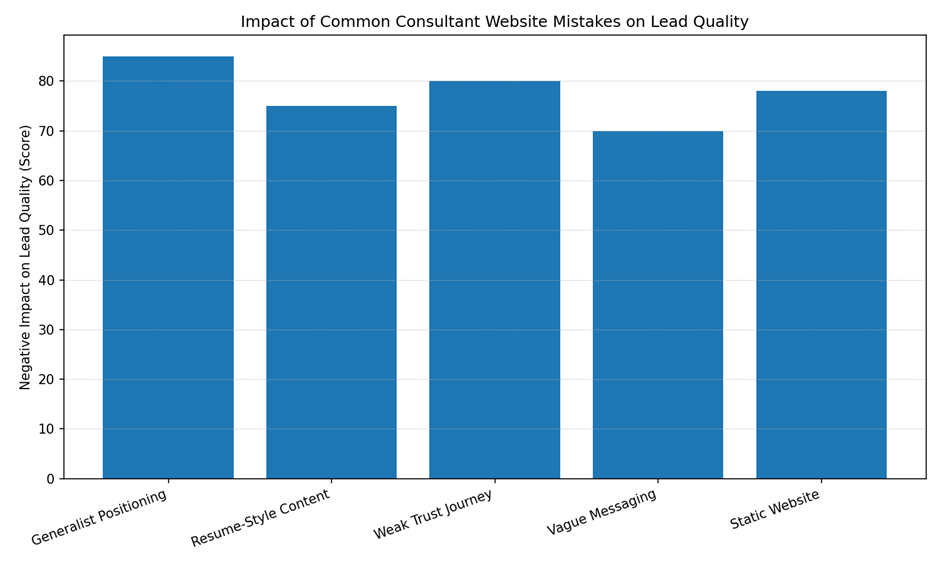
This visual shows why even subtle website issues disproportionately affect high-value leads.
Mistakes vs Fixes (Quick Reference)
| Website Element | Weak Signal | Strong Signal |
| Positioning | Broad & generic | Clear niche |
| Content | Resume-driven | Insight-led |
| CTA Style | Pushy | Guided |
| Messaging | Abstract | Specific |
| Maintenance | Static | Evolving |
How a High-Converting Consultant Website Should Work
A high-performing consultant website design does not “sell”.
It reduces risk step by step.
A high-converting consultant website does not behave like a salesperson.
It behaves like a risk-reduction system.
In 2026, high-value consulting clients are not looking to be persuaded quickly. They are looking to feel confident enough to move forward. The role of a consultant website is to quietly support that confidence without urgency, pressure, or noise.
This requires a fundamentally different approach from generic lead-generation websites.
A Consultant Website Should Guide, Not Push
High-performing consultant websites do not start with aggressive calls-to-action. They recognise that consulting decisions involve uncertainty, internal scrutiny, and personal accountability.
Instead of pushing visitors to “Book a Call,” the website should first help them answer three internal questions:
- Is this relevant to my situation?
- Does this consultant truly understand the problem I’m facing?
- Would it feel safe to engage them?
Only after these questions are addressed does action feel natural.
A website that asks for commitment before resolving uncertainty will always struggle to attract high-value clients.
Step 1: Establish Relevance Immediately
The first job of a high-converting consultant website is relevance.
Within seconds, a visitor should understand:
- Who this consulting work is for
- What kind of problem it addresses
- Whether they should keep reading
This is achieved through:
- Clear positioning language
- Audience-specific framing
- Problem-oriented headlines
Relevance reduces mental effort. When prospects recognise themselves quickly, they stay longer and engage deeper.
Step 2: Demonstrate Insight, Not Just Expertise
Once relevance is established, the website must show insight.
High-value clients are rarely convinced by credentials alone. They look for evidence of thinking:
- How does this consultant frame the problem?
- What assumptions do they challenge?
- Do they understand the nuances, constraints, and trade-offs?
A high-converting consultant website includes:
- Insight-driven explanations
- Clear articulation of approach
- Thoughtful language that reflects real-world complexity
This is where many websites fail by relying on generic claims instead of meaningful perspective.
Step 3: Build Trust Where Doubt Naturally Arises
Trust is not a single section on a website. It is built incrementally.
High-converting consultant websites place credibility signals at decision points, not in isolation.
Examples include:
- Explaining how results are achieved, not just that they are
- Using contextual examples instead of exaggerated testimonials
- Showing process clarity without revealing proprietary detail
Trust is strongest when it feels earned rather than advertised.
Step 4: Support Non-Linear Exploration
Consulting buyers do not move through websites in a straight line.
They often:
- Scan instead of read
- Open multiple pages at once
- Revisit sections over time
- Share links internally
A high-converting consultant website supports this behaviour by:
- Making pages self-contained and understandable on their own
- Maintaining consistency across messaging
- Avoiding dependencies on a single “funnel” path
This flexibility reduces friction and supports thoughtful decision-making.
Step 5: Introduce Action Calmly and Contextually
Only after relevance, insight, and trust are established should action appear and even then, it should feel optional, not urgent.
High-converting consultant websites use:
- Calm, contextual calls-to-action
- Language that respects the buyer’s pace
- Clear expectations about what happens next
This might look like:
- Inviting a conversation rather than pushing a booking
- Explaining the purpose of the first interaction
- Reducing ambiguity around engagement
When action feels safe, high-value clients move forward willingly.
Fixing common website mistakes is only the first step. To consistently attract premium consulting engagements, your website should also be structured to qualify prospects before they ever contact you. Our guide on how to build a consulting website that pre-qualifies clients before they contact you explores the messaging, content strategy, and conversion framework that helps consultants attract higher-value opportunities.
Why This Approach Converts Better in 2026
In 2026, consultants compete less on visibility and more on decision confidence.
A consultant website that:
- Reduces uncertainty
- Clarifies thinking
- Respects the buyer’s process
Will attract fewer but far better inquiries.
This is why high-converting consultant websites often do not look aggressive or flashy. They feel composed, thoughtful, and precise qualities that mirror strong consulting itself.
The Hidden Advantage of Doing This Well
When a consultant website works this way:
- Sales conversations start warmer
- Prospects arrive pre-qualified
- Price resistance decreases
- Internal buy-in becomes easier
The website doesn’t replace the consultant. It supports their credibility before they speak.
FAQs
Why does consultant website design matter more for high-value clients?
Because high-value clients are risk-aware and evaluate trust, clarity, and thinking online before engaging.
Can consultants use templates for their websites?
Templates can work visually, but without consultant-specific strategy they often fail to convert high-value clients.
How often should a consultant update their website?
Positioning should be reviewed quarterly; messaging should evolve with client challenges.
Do consultants need aggressive CTAs?
No. High-value clients respond better to calm, contextual guidance.
Is redesign always necessary?
Not always. Often, repositioning and content strategy fixes conversion issues faster.
Final Thought
Most consultants don’t lose high-value clients because of pricing, competition, or ability.
They lose them because their website creates just enough uncertainty to slow decisions and hesitation favors safer-looking alternatives.
A well-designed consultant website doesn’t shout expertise.
It quietly proves it.