Quick Answer
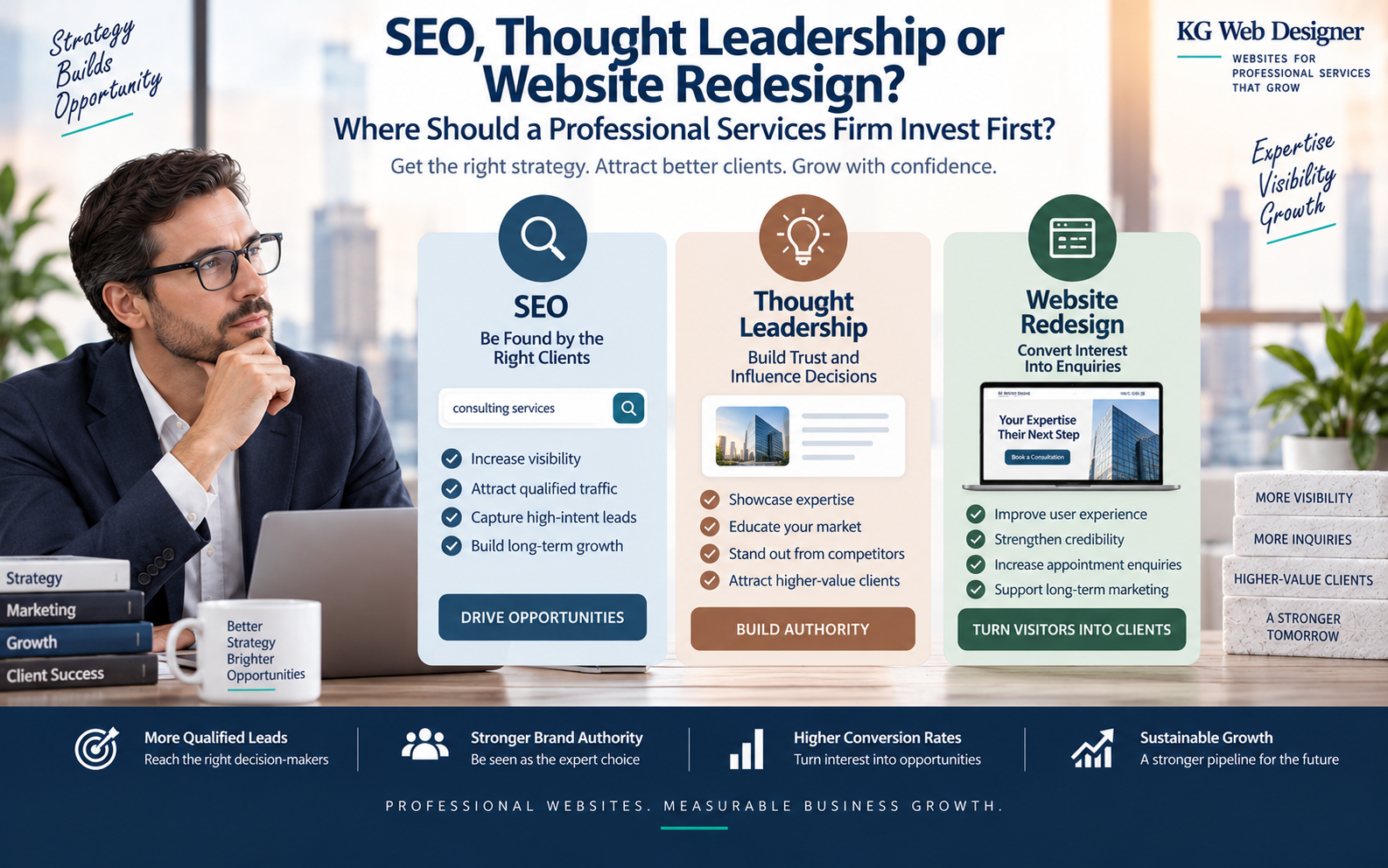
A professional services firm should invest first in the part of its marketing system creating the biggest commercial bottleneck. If qualified buyers cannot find you, prioritize SEO. If buyers find you but cannot understand or trust your expertise, improve thought leadership and website conversion. If the website itself creates friction, redesign it before scaling traffic. The right sequence depends on evidence, not whichever marketing channel is currently popular.
TL;DR: What Should You Fix First?
- Professional Services Marketing Strategy should begin with identifying whether the firm’s primary problem is visibility, authority, or conversion.
- SEO is most useful when qualified prospects are searching for services the firm provides but the firm has weak organic visibility.
- Thought leadership becomes particularly valuable when buyers need evidence of expertise before entering a serious sales conversation.
- A website redesign deserves priority when positioning, credibility, information architecture, mobile experience, or conversion paths are limiting otherwise qualified demand.
- Professional services firms should measure qualified inquiries, opportunity quality, sales acceptance, and revenue contribution rather than treating traffic or impressions as the final objective.
- Hinge’s 2026 High Growth Study found that high-growth firms grow substantially faster than the average firm and are more likely to invest in marketing, activate subject-matter experts, and build digital maturity.
Which Marketing Investment Should Come First?
The first investment should address the earliest identifiable constraint in the buyer journey. A firm with almost no qualified visibility has a different problem from a firm receiving hundreds of relevant visitors but very few serious inquiries.
This distinction matters financially because professional services firms sell expertise, not standardized products. A potential client may spend days researching a firm, reviewing its service pages, reading expert content, checking credentials, looking at case studies, and discussing the provider internally before anyone completes a form.
Hinge’s 2026 research found that median professional-services growth had cooled to 9.9%, while its High Growth firms were growing 4X faster and reported average profitability of 39.5%. The study also found that high-growth firms allocated 12% of revenue to marketing versus a much lower allocation among other firms. These figures describe Hinge’s research sample, not a universal budget recommendation, but they reinforce the importance of treating marketing as a strategic growth function rather than an isolated expense.
| Business problem | First area to investigate | Primary objective | Useful measurement |
|---|---|---|---|
| Qualified buyers cannot find the firm | SEO | Increase relevant visibility | Qualified organic inquiries |
| Buyers find the firm but do not trust it | Thought leadership | Demonstrate expertise | Engagement, assisted opportunities, sales influence |
| Website traffic exists but inquiries are weak | Website conversion | Remove buyer friction | Conversion rate, qualified inquiries |
| Positioning is unclear across services | Website strategy | Improve relevance and differentiation | Engagement by service and audience |
| Referrals arrive but prospects do not convert | Website + authority | Reinforce referral confidence | Referral-to-inquiry rate |
| Firm enters a new market | SEO + thought leadership + website | Establish visibility and credibility | Market-specific qualified opportunities |
KG Web Designer audit observation: One recurring pattern is that firms often describe a marketing problem as a traffic problem when the deeper issue is that the website does not make the firm’s expertise, differentiation, proof, or next step obvious enough for a high-value buyer.
Is SEO the Right First Investment for a Professional Services Firm?
SEO should come first when there is demonstrable search demand for the firm’s services and the website is not capturing enough of that demand. The strongest opportunity is usually not simply ranking for broad terms, but becoming visible for commercially relevant searches connected to specific services, industries, problems, and buyer needs.
This is where Professional Services SEO differs from publishing a large volume of generic articles. A consulting firm, engineering practice, accounting firm, technology provider, or specialist advisory business needs search visibility around the problems it is qualified to solve.
Google’s current guidance emphasizes helpful, reliable, people-first content that demonstrates first-hand expertise and provides original value rather than content created primarily to manipulate rankings.
A useful SEO priority list is:
- Identify commercially valuable services.
- Map those services to actual buyer search intent.
- Strengthen service pages before producing large amounts of supporting content.
- Build topical authority around the problems those services solve.
- Create evidence-led content that demonstrates expertise.
- Improve internal linking between educational and commercial pages.
- Measure qualified inquiries rather than traffic alone.
SEO becomes a weaker first investment when the firm’s website already receives relevant traffic but visitors cannot determine why they should choose the firm.
That is an important distinction. Increasing traffic to a weak conversion environment can increase the number of people experiencing the same problem rather than solving it.
Don’t Ask Which Marketing Channel Is Best. Ask What’s Holding Growth Back.
SEO, thought leadership and website redesign solve different problems. Start by identifying where prospects are dropping out of your firm’s journey.
Not sure where the real bottleneck is? Start with a review of the complete prospect journey.
Request a Website Review →Can Thought Leadership Generate Better B2B Opportunities?
Thought leadership can influence B2B buying decisions when it gives prospects a useful way to understand a problem, challenge an assumption, or evaluate a complex decision. It is particularly relevant for professional services because the buyer often needs confidence in the people behind the service before committing to a conversation.
Professional Services Thought Leadership should therefore not be confused with publishing frequent opinion posts. Strong thought leadership connects a firm’s expertise to a specific commercial problem and gives the reader something they can use to make a better decision.
The 2025 Edelman-LinkedIn B2B Thought Leadership Impact Report surveyed nearly 2,000 global professionals and emphasized the influence of “hidden buyers” inside B2B buying groups. Its findings show that thought leadership is consumed by people who may not be the obvious decision-maker but can influence whether a deal progresses.
Earlier Edelman-LinkedIn research also found that 75% of B2B decision-makers and C-suite executives said thought leadership had led them to research a product or service they were not previously considering.
For a professional services firm, useful thought leadership might include:
- Original research.
- Industry-specific analysis.
- Executive commentary.
- Detailed frameworks.
- Practical buyer guides.
- Case-based lessons.
- Strong opinions supported by evidence.
- Analysis of emerging regulatory or technology changes.
- Detailed explanations of difficult client problems.
The commercial value is not always a direct last-click conversion. A buyer may discover an expert article, share it internally, revisit the firm’s website later, and eventually request a consultation.
That is why thought leadership should be measured as part of the buying journey rather than judged solely by immediate form submissions.
When Does a Website Redesign Deserve Priority?
A redesign deserves priority when the existing website is preventing qualified visitors from understanding, trusting, or engaging with the firm’s offer. If the website has unclear positioning, outdated service architecture, weak proof, poor mobile UX, confusing navigation, or difficult conversion paths, increasing traffic may not solve the underlying problem.
Professional Services Website Redesign should therefore be treated as a business intervention, not simply a visual refresh.
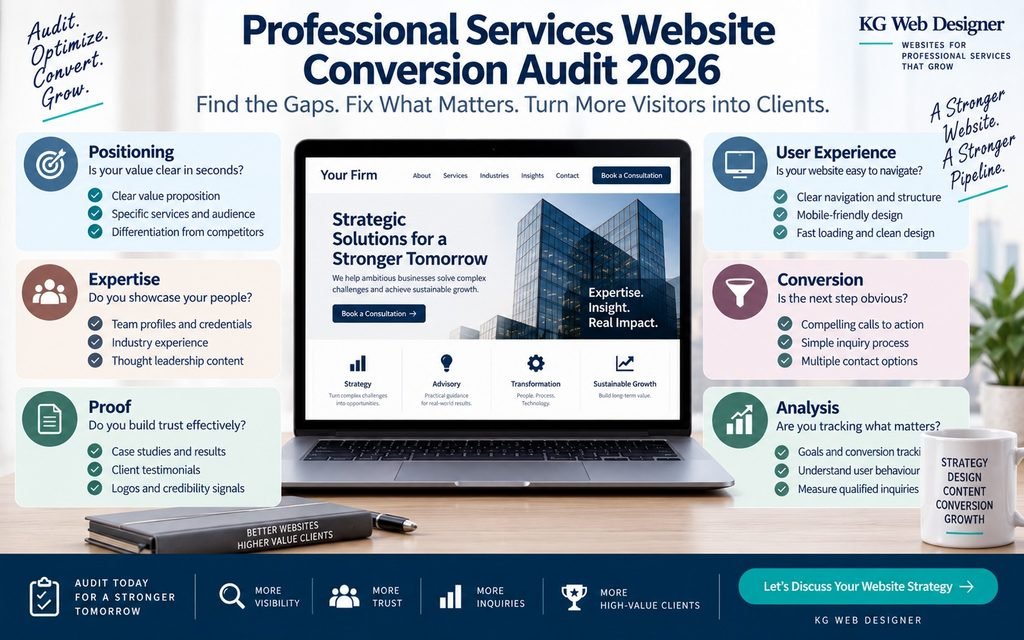
Before recommending a redesign, I would audit:
- Homepage positioning.
- Service-page structure.
- Industry and audience segmentation.
- Case-study visibility.
- Practitioner or expert credibility.
- Mobile usability.
- Page speed and technical quality.
- Calls to action.
- Consultation pathways.
- Contact forms.
- Referral traffic behavior.
- Organic landing pages.
- Analytics and conversion tracking.
- Content that has commercial value but is difficult to discover.
A redesign becomes especially important when several of these problems occur together.
For example, imagine a consulting firm receiving traffic from Google for a high-value service. The visitor reaches the relevant page but sees vague claims, no clear evidence of expertise, no relevant case example, and a generic “Contact Us” button. More SEO traffic is unlikely to fix the fundamental issue.
What should happen before approving a redesign?
The firm should be able to explain what business problem the redesign will solve.
If the answer is simply “the website looks old,” the business case is incomplete.
If the answer is “qualified prospects are reaching the website, but the current structure does not communicate our specialization, evidence, process, or next step clearly,” the redesign has a stronger strategic rationale.
At KG Web Designer, this is one of the distinctions we make before discussing design direction. The question is not whether a website could look better. The question is whether the existing digital experience is restricting business development.
If your firm is unsure whether the problem is visibility, positioning, or conversion, a website and marketing audit can provide a more useful starting point than immediately committing to a full redesign.
Explore KG Web Designer’s website strategy and consultation options
How Can You Tell Whether the Problem Is Visibility, Authority, or Conversion?
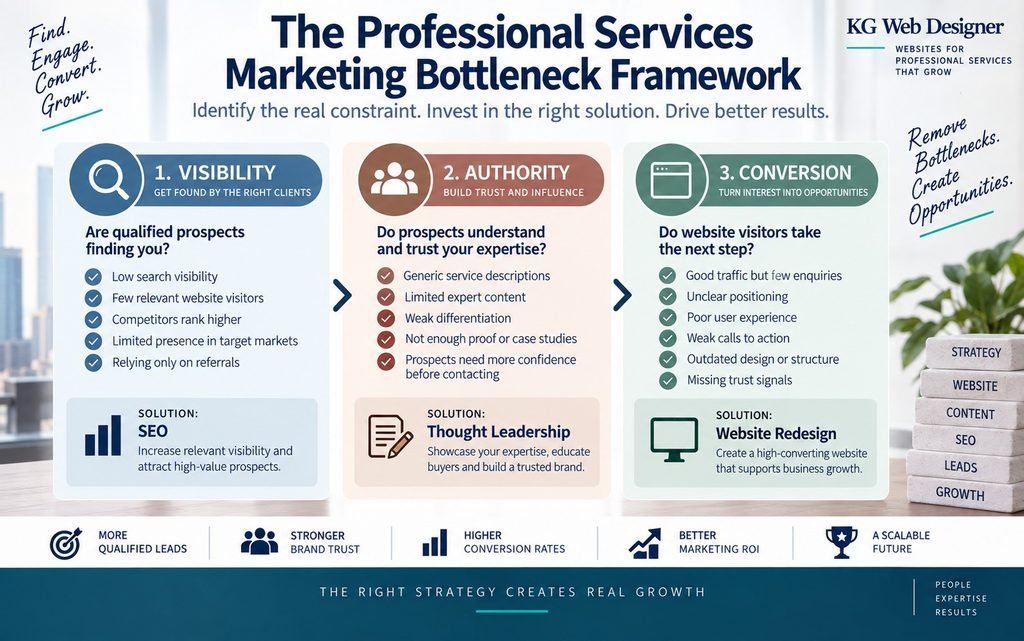
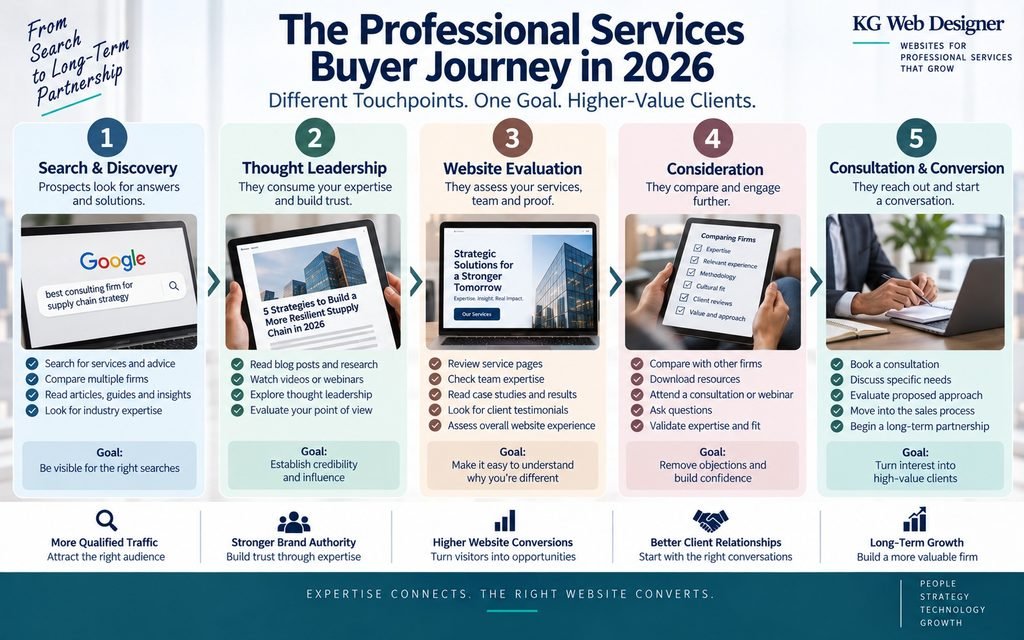
The easiest way to diagnose the problem is to separate the buyer journey into three stages: discovery, evaluation, and action. Each stage produces different evidence, and the evidence should determine where the next investment goes.
1. Discovery problem
You have strong services but weak qualified visibility.
Typical symptoms include:
- Low visibility for commercial service searches.
- Few organic landing pages producing inquiries.
- Competitors appearing for important buyer questions.
- Weak service-specific search coverage.
- Little visibility outside branded searches.
Likely priority: SEO.
2. Authority problem
People discover the firm but cannot establish why its expertise is credible.
Typical symptoms include:
- Weak differentiation.
- Generic service descriptions.
- Limited expert commentary.
- Few substantive case studies.
- Minimal evidence of specialized knowledge.
- Thought leadership disconnected from commercial services.
Likely priority: thought leadership and authority building.
3. Conversion problem
Qualified prospects reach the website but do not take the next step.
Typical symptoms include:
- High engagement with service pages but few inquiries.
- Confusing navigation.
- Weak calls to action.
- Long or unnecessary forms.
- Poor mobile experience.
- Lack of relevant proof.
- Unclear consultation process.
Likely priority: website conversion work or redesign.
This diagnostic approach is more useful than deciding that one channel is always superior.
The phrase professional services website redesign vs SEO should therefore be treated as a diagnostic question rather than a permanent either-or choice.
What Does a Strong Professional Services Marketing Strategy Look Like in 2026?
A strong Professional Services Marketing Strategy connects visibility, expertise, website experience, and business development instead of managing each activity as a separate marketing project.
Hinge’s 2026 High Growth Study identified four broad advantages among high-growth firms: marketing, talent, strategy, and technology. It also reported that high-growth firms were 2.5X more likely to activate subject-matter experts to build trust in a content-saturated environment.
That matters because professional services buyers are evaluating people and expertise, not just product features.
A modern strategy should connect these elements:
Search visibility → Expert content → Service pages → Proof → Consultation → Sales qualification
For example, a potential client might discover a firm’s article through search. That article should lead naturally to a relevant service page. The service page should explain the firm’s approach and demonstrate expertise. A case study or client example can reduce perceived risk. The consultation page should then make the next step straightforward.
This is also where Professional Services Website Design becomes strategic. Design should help the buyer understand the firm’s value rather than merely make the website look polished.
Hinge’s 2026 research specifically identifies digital maturity as a differentiator and reports that digitally mature firms are more likely to outperform their peers.
What Should a Firm Fix Before Spending More on Marketing?
A firm should fix the foundational conversion and positioning problems before scaling traffic if those problems are already visible. Otherwise, the firm risks spending more to bring qualified people into an experience that has not been designed to move them forward.
Before increasing marketing spend, check these eight areas:
- Positioning: Can a buyer understand who you serve and what problem you solve within seconds?
- Service architecture: Are important services easy to find and clearly differentiated?
- Proof: Can prospects see evidence of relevant experience?
- Expertise: Are your specialists visible?
- Content: Does the firm demonstrate knowledge beyond promotional claims?
- Conversion: Is the next step obvious?
- Measurement: Can you distinguish qualified inquiries from low-value contacts?
- Technical foundation: Does the site provide a reliable experience across devices?
One of the most expensive mistakes is solving these issues in the wrong order.
A firm might spend heavily on SEO while its service pages remain unclear. Another might commission a redesign without fixing its positioning. A third might publish thought leadership without creating a path from that content to a relevant commercial service.
The investment is not necessarily wrong. The sequence is.
Example Scenario: A Consulting Firm With Traffic but Few Enquiries
A consulting firm with strong referral relationships may already have enough credibility to generate website visits, but still lose opportunities because its digital experience does not reinforce the referral. In this situation, SEO may not be the immediate priority.
Imagine that a prospective client receives the firm’s name from a colleague and searches for it. The visitor finds the website but sees a broad list of services, generic messaging, limited evidence, and no clear explanation of which team specializes in the client’s problem.
The firm has a visibility advantage because the visitor already knows its name. The missing component is confidence.
A better sequence would be:
Clarify positioning → Rebuild priority service pages → Add relevant proof → Strengthen expert visibility → Improve consultation path → Then scale SEO and thought leadership
This approach protects marketing spend because each additional visitor has a stronger path toward becoming a qualified opportunity.
Example From Our Experience
A recurring anonymized audit pattern we see at KG Web Designer involves firms that assume their website needs “more traffic” when the more immediate problem is information architecture.
Problem: The firm’s services exist, but they are grouped under broad navigation labels that force prospects to work too hard to understand the firm’s specialization.
Solution: Reorganize the website around buyer problems, priority services, industries, expertise, proof, and clear conversion paths.
Outcome: The immediate objective is not to promise a specific percentage increase in leads. It is to create a website where qualified visitors can understand relevance faster and where analytics can more accurately reveal which services and content are generating commercially useful engagement.
That distinction matters because a credible agency should not manufacture a result before measurement exists.
At KG Web Designer, we treat the website as part of the firm’s business-development system. The design, content, SEO structure, authority signals, and conversion journey need to support the same commercial objective.
Referral-driven firms should also consider what happens after someone recommends them. A strong referral can create initial trust, but the website still needs to validate expertise, relevance, proof, and fit before the prospect decides to inquire. Read our guide on professional services referral website strategy to understand more.
Where Does Website Authority Fit Into the Buying Journey?
Website authority sits between visibility and conversion because buyers need a reason to believe the firm is capable of solving their problem. Search can introduce the firm, but authority helps determine whether the buyer continues evaluating it.
Hinge’s research into professional services buyers has consistently emphasized expertise, reputation, visibility, and specialization as important parts of the buying process. Its current research program continues to study how buyers search for and evaluate professional services firms.
This is particularly important for high-value engagements.
A buyer considering a $50,000, $100,000, or substantially larger engagement is unlikely to make the decision based on a homepage headline alone. They may examine the firm’s team, expertise, case studies, industry experience, publications, search presence, and external reputation before agreeing to a conversation.
A strong authority system therefore includes:
- Named experts.
- Relevant credentials.
- Original insights.
- Case studies.
- Client evidence where permission exists.
- Industry-specific service pages.
- Clear methodology.
- Useful educational content.
- Consistent executive visibility.
- Strong third-party reputation.
The website should make these signals easy to verify rather than forcing the buyer to hunt for them.
For firms that depend heavily on referrals, this is especially important. A referral may create the initial introduction, but the website can influence whether that introduction becomes an inquiry.
Your Website Should Turn Visibility and Expertise Into Conversations
SEO can introduce your firm. Thought leadership can establish authority. Your website needs to connect both to a credible client journey.
Positioning + Proof + Trust
Helping prospects understand your expertise and why it is relevant to their situation.
How Should a Firm Decide What to Invest in Next?
A firm should rank potential investments by commercial bottleneck, evidence, implementation dependency, and expected time horizon rather than choosing the channel with the loudest marketing claims.
A practical decision sequence is:
First: Fix the foundation
Address positioning, service architecture, proof, conversion paths, analytics, and major UX problems.
Second: Build authority
Make subject-matter experts visible and develop useful thought leadership around the problems the firm is qualified to solve.
Third: Expand qualified visibility
Build SEO around commercial services, industry needs, buyer questions, and supporting authority content.
Fourth: Measure business outcomes
Track:
- Qualified inquiries.
- Sales-accepted opportunities.
- Opportunity value.
- Source-assisted opportunities.
- Consultation-to-opportunity rate.
- Revenue contribution.
- Service-level performance.
- Cost per qualified opportunity.
Fifth: Reallocate
If SEO produces visibility but poor opportunities, investigate the landing experience. If thought leadership generates engagement but no commercial movement, examine the connection between content and services. If the website converts existing traffic well but demand is limited, expand acquisition.
This is how Professional Services Marketing Strategy becomes an operating system rather than a list of disconnected tactics.
Professional services firms that depend on transparent communication can also benefit from understanding how pricing information influences buyer confidence and qualification. This connects naturally with the broader discussion about reducing uncertainty before a prospect reaches a consultation.
Why Most Businesses Get This Wrong
Most firms get this wrong because they choose a marketing channel before diagnosing the buyer journey. SEO is attractive because rankings are measurable. Redesigns are attractive because the result is visible. Thought leadership is attractive because it signals expertise. None of those facts establishes which one should come first.
Another mistake is treating marketing as a collection of departments instead of one commercial system.
For example:
- SEO produces traffic but does not influence the website structure.
- Content produces articles but does not connect them to services.
- The website communicates services but does not showcase experts.
- Sales receives leads but does not feed qualification data back into marketing.
- Leadership publishes opinions but does not build a recognizable point of view.
The result is activity without alignment.
Google’s guidance reinforces the importance of original information, first-hand expertise, and satisfying the user’s goal rather than producing search-engine-first content.
The firms that avoid this problem tend to start with the buyer and work backward.
What This Means For Your Business
The financial implication is simple: the right marketing investment is the one that removes the constraint closest to qualified revenue.
If qualified buyers cannot find you, visibility matters. If they find you but cannot establish expertise, authority matters. If they trust you but struggle to understand the offer or take the next step, the website becomes the priority.
This also changes how a firm should evaluate agencies.
A credible partner should be able to explain:
- Why a specific investment is recommended.
- What evidence supports the recommendation.
- Which problem it is expected to solve.
- What should happen before implementation.
- How success will be measured.
- What risks exist.
- What should not be changed.
- What happens if the proposed investment does not produce the expected signal.
If this were my website, I would not begin by asking, “Should I spend more on SEO, thought leadership, or a redesign?” I would first ask, “Where are qualified buyers falling out of my journey?”
That answer should determine the investment sequence.
Expert Insight from Kanika Gupta
“If this were my website, I would resist the temptation to buy more traffic until I knew the website could convert the right visitor. A professional services website should make the buyer feel that the firm understands the problem before the buyer ever speaks to sales.”
That is the distinction I believe many firms miss. A website is not simply the place where marketing traffic arrives. For a professional services business, it is often the place where a prospect validates the decision to continue.
When the buyer is evaluating expertise, credibility, specialization, and risk, the website has to carry more responsibility than a conventional brochure.
How Can Professional Help Make Sense?
Professional help makes sense when the firm has enough complexity that internal teams cannot confidently determine which problem is restricting growth. This is common when SEO, content, website UX, analytics, sales feedback, and positioning are being managed separately.
A strategic website engagement can be particularly valuable when:
- The firm has multiple high-value services.
- Several audiences influence buying decisions.
- The website has accumulated years of content.
- Organic traffic exists but conversion is inconsistent.
- The firm is entering a new market.
- The brand has evolved but the website has not.
- Leadership cannot agree on positioning.
- Marketing reports traffic without meaningful pipeline context.
- The existing CMS limits important changes.
- The firm is considering a major redesign and wants to protect SEO equity.
The goal should not be to sell the largest project.
The goal should be to identify the smallest strategically sound intervention that can remove the biggest constraint.
KG Web Designer is a conversion-focused website design studio specializing in custom websites for clinics, professional services, manufacturers, and growing businesses. Our approach is centered on connecting positioning, website structure, user experience, search visibility, authority, and conversion rather than treating website design as an isolated visual exercise.

SEO, Thought Leadership or Website Redesign — Where Should Your Firm Focus First?
Let’s look at how prospects currently discover your firm, evaluate your expertise and decide whether to start a conversation — then identify where the biggest gap sits.
Final Thoughts
The right Professional Services Marketing Strategy is rarely about choosing one channel and ignoring the others. SEO, thought leadership, and website redesign solve different problems, and the sequence should follow the firm’s actual buyer journey.
Start with diagnosis. Fix the foundation. Build authority. Expand qualified visibility. Then measure which activities are creating commercially useful opportunities.
Hinge’s 2026 research shows that high-growth professional services firms are treating marketing, expertise, strategy, and technology as interconnected growth capabilities rather than isolated activities.
At KG Web Designer, we believe the website should sit at the center of that system because it is where search visibility, thought leadership, referrals, reputation, expertise, and conversion ultimately meet.
If your firm is deciding whether the next investment should be SEO, thought leadership, or a website redesign, start with the evidence rather than the channel.
Discuss your professional services website strategy with KG Web Designer
Frequently Asked Questions
How do I know whether my professional services firm has a marketing problem or a website problem?
Start by separating visibility from conversion. If qualified prospects rarely reach the website, investigate acquisition and search visibility. If relevant prospects reach the site but do not engage with services or inquire, investigate positioning, proof, UX, and conversion paths. Analytics should be reviewed alongside lead quality and sales feedback rather than traffic alone.
Should a professional services firm invest in SEO before thought leadership?
Not necessarily. SEO can create visibility for existing demand, while thought leadership can build demand and authority among buyers who are researching complex problems. If the firm’s expertise is difficult to differentiate, strong expert content may need to develop alongside search optimization rather than being treated as a later activity.
How should a professional services firm measure marketing ROI?
Measure marketing against qualified commercial outcomes rather than impressions alone. Useful metrics include qualified inquiries, sales-accepted opportunities, opportunity value, consultation-to-opportunity rate, source-assisted opportunities, customer acquisition cost, and revenue contribution. The appropriate measurement model depends on the firm’s sales cycle and service economics.
Can a professional services firm grow through referrals without investing heavily in SEO?
Yes, but the website still plays an important validation role. A referred prospect may search the firm, review its expertise, examine its services, and look for evidence before making contact. Search visibility therefore does not need to replace referrals, but the digital presence should support the credibility created by them.
How much thought leadership does a professional services firm need?
There is no useful universal publishing frequency. A smaller number of substantive pieces can be more valuable than frequent generic posts when the content demonstrates genuine expertise, addresses important buyer problems, and connects naturally to the firm’s services. Quality, relevance, expert participation, and commercial context matter more than simply increasing publishing volume.
When is a complete website redesign unnecessary?
A complete redesign may be unnecessary when the underlying structure, positioning, CMS, content, and conversion journey are fundamentally sound and the problems are limited to specific templates or pages. Targeted UX, content, technical, or conversion improvements may be more appropriate. The decision should follow an audit rather than a predetermined project scope.