
August 21, 2026

My Consulting Website Is 5 Years Old: When Does a Redesign Become a Business Decision, Not a Design Decision?

Quick Answer

A five-year-old consulting website does not automatically need a redesign. Consulting website redesign becomes a business decision when the current site is weakening positioning, losing qualified opportunities, creating technical limitations, or failing to support how buyers research your firm. If the structure, content, SEO equity, and conversion journey still work, targeted optimization may produce a better return than rebuilding everything.

TL;DR: What Should You Do With a Five-Year-Old Consulting Website?

When Does a Five-Year-Old Website Actually Become a Business Problem?

A five-year-old website becomes a business problem when its limitations affect revenue, lead quality, positioning, search visibility, or buyer confidence rather than simply because its design looks dated.

This distinction matters because a website can be visually old but commercially healthy. Conversely, a website launched only two years ago can already be damaging the sales process if its messaging is vague, its service architecture is confusing, or prospects cannot find convincing evidence of expertise.

Google’s current guidance emphasizes people-first content, first-hand expertise, and overall page experience rather than treating a particular visual style or website age as a ranking requirement.

Stanford’s web credibility research also found that credibility is influenced by professional design, usability, expertise, contact accessibility, updated information, and the presence of a real organization behind the site.

That makes the business question much more useful:

Is my website helping the right buyer become more confident, or is it creating reasons to hesitate?

The diagnostic summary

If your website still has strong organic visibility, logical architecture, useful service pages, manageable technical infrastructure, and a working conversion journey, you likely need optimization rather than a full rebuild.

If your website has broken information architecture, outdated positioning, poor mobile UX, obsolete technology, weak proof, difficult navigation, and a disconnected sales journey, a redesign is more likely to be commercially justified.

Age alone is not the reason to redesign a consulting website. The stronger signal is whether the site still communicates your expertise clearly, supports the executive buying journey, and converts qualified visitors into meaningful conversations. In our review of consultant websites, we found that many lead-generation problems were caused by positioning, proof, trust architecture, and consultation friction rather than visual age alone. Our broader review of consultant website lead-generation mistakes explores these patterns in greater detail.

What Are Consulting Firm Owners Actually Saying When a Website Has Become Outdated?

The most useful warning signs are often business complaints rather than design complaints.

I would pay attention if you or your sales team are saying things like:

These symptoms point to different problems.

For example, poor mobile usability can often be fixed without rebuilding the entire website. But if the entire information architecture reflects the firm’s old business model, repeatedly patching individual pages may simply make the underlying problem worse.

How I Diagnose an Aging Consulting Website Before Recommending a Redesign

I would inspect the business logic of the website before touching the visual design.

At KG Web Designer, the first questions I would ask are:

  1. Has the business changed since the website was launched?
  2. Has the target client changed?
  3. Have the highest-value services changed?
  4. Does the homepage communicate the current commercial positioning?
  5. Can buyers quickly identify relevant expertise?
  6. Are service pages structured around buyer problems and outcomes?
  7. Are case studies visible at decision points?
  8. Is the website technically limiting growth?
  9. Is mobile UX creating friction?
  10. Are important pages receiving search visibility and qualified traffic?
  11. Can analytics identify where visitors disengage?
  12. Does the website support the sales team’s current objections?

Google recommends looking at Core Web Vitals alongside broader page experience rather than treating one score as the entire diagnosis. For example, Google recommends aiming for an LCP of 2.5 seconds or less, INP below 200 milliseconds, and good visual stability, while also emphasizing that page experience involves more than Core Web Vitals.

If this were my website, I would not approve a redesign until I could identify the business problem the redesign is supposed to solve.

That is the difference between spending money on a new website and investing in a commercial asset.

Should You Optimize the Existing Website or Rebuild It?

The correct choice depends on the severity and concentration of the problems.

SituationBest First MoveWhy
Outdated visual styling onlyOptimizeAppearance alone does not justify destroying useful infrastructure
Weak homepage messagingOptimizePositioning can often be rewritten without rebuilding
Poor service-page structureOptimize or partial rebuildDepends on how deeply the architecture is affected
Strong SEO equityPreserveAvoid unnecessary URL and content disruption
Poor mobile UX across the siteRedesign or substantial rebuildSystemic UX problems are difficult to patch efficiently
Business model has changedRedesignThe architecture may no longer support the offer
New target marketsRedesign or restructureInformation architecture may need to support different buyer journeys
Outdated CMS or technical limitationsRedesignTechnology can become a growth constraint
Broken navigationRedesign or structural rebuildThe problem affects the entire buyer journey
Low conversion but strong trafficCRO firstDiagnose the conversion problem before replacing the website
Poor SEO caused by technical debtTechnical redesignInfrastructure may be holding back organic growth
Everything works and only looks datedOptimizeA visual refresh may be sufficient

The commercial principle is simple: fix the smallest problem capable of producing the desired business improvement.

That protects your existing SEO equity, content investment, analytics history, and internal knowledge.

Website Strategy

Does Your Website Reflect the Level of Expertise You Sell?

Your website is often the first step in a potential client’s evaluation. If your positioning, expertise, proof, and services are difficult to understand, even highly qualified prospects may move on. A strategically structured consultant website can turn that first impression into a stronger reason to start a conversation.

Get practical recommendations for improving your website and lead quality.

Book a Free 30-Minute Strategy Call →

What Does the Data Say About How Professional Services Buyers Research Firms?

Professional services buyers do substantial research before contacting providers, which makes the website an important part of the pre-sales process.

Hinge’s professional services buyer research has examined more than 1,400 decision-making buyers and more than 3,000 professional services sellers, specifically studying how buyers evaluate professional services firms.

Research cited by Consultancy.uk found that 65% of surveyed professionals used consulting firms’ websites when evaluating providers, while 54% said they used search engines to research consulting firms.

More recent B2B research points in the same direction. Responsive reported in its 2025 buyer research that 90% of buyers conduct research before first contact, with nearly two-thirds using generative AI tools as much as or more than traditional search.

This does not mean every consulting firm needs a completely new website.

It means the website has a job to perform before the sales call.

It needs to answer:

That is where consulting website leads become a website strategy issue rather than simply a traffic issue.

Decision matrix for choosing consulting website optimization or redesign

What Does a Modern Consulting Website Need to Communicate?

A modern consulting website needs to make expertise easier to recognize, validate, and trust.

The strongest structure usually connects five elements:

  1. Positioning: Who do you help and what problem do you solve?
  2. Expertise: Why are you qualified to solve it?
  3. Proof: What evidence demonstrates that capability?
  4. Decision support: What questions and objections can the website answer?
  5. Conversion: What is the logical next step for a qualified prospect?

This is particularly important because consulting is a high-trust purchase. Buyers are not simply evaluating a service menu. They are evaluating whether your firm is capable of handling a problem that may carry significant financial, operational, reputational, or strategic consequences.

Stanford’s credibility guidelines specifically recommend making expertise visible, showing that a real organization exists behind the website, making contact information easy to find, maintaining professional design, keeping content current, and making the site easy to use.

That is a much stronger redesign brief than “make the website look more modern.”

An important industry observation

Consulting firms often have more expertise than their websites communicate.

The problem is usually not a lack of knowledge. It is a translation problem.

The firm’s experts understand the client’s situation in sophisticated terms, while the website presents that expertise as generic service descriptions.

That gap can reduce perceived value even when the underlying consulting capability is excellent.

Your website should reflect the level of expertise you bring to every client engagement. Before investing in a redesign, review our 2026 guide to consultant website design costs to see how investment varies between solo consultants, boutique firms, and established consultancies—and what those budgets can deliver.

What Should You Fix Before Spending Money on a Full Redesign?

The first fixes should usually target messaging, information architecture, trust, and conversion before aesthetics.

I recommend auditing these areas in this order:

1. Positioning

Can a prospect identify your specialization and commercial value within seconds?

Replace vague statements such as “strategic solutions for business growth” with specific language around clients, problems, expertise, and outcomes.

2. Service architecture

Your highest-value services should have clear, dedicated paths.

A prospect should not have to decode an internal organizational structure to understand what you offer.

3. Proof

Move relevant case studies, outcomes, credentials, client evidence, methodologies, and expertise closer to the claims they support.

Trust works better as a layer across the website than as one isolated testimonials page.

4. Conversion paths

Every major page should have an appropriate next step.

A service page may lead to a consultation. A thought-leadership article may lead to another relevant resource. A case study may lead to a strategic conversation.

5. Mobile experience

Do not assume a desktop website automatically translates well to smaller screens.

Check navigation, typography, forms, menus, sticky elements, spacing, buttons, and content hierarchy on actual mobile journeys.

Google explicitly recommends mobile-friendly pages as part of good page experience.

Why Does a Five-Year-Old Website Sometimes Need a Redesign Even If It Still Looks Fine?

A website can look perfectly acceptable while its underlying business logic has become obsolete.

This happens frequently when a consulting firm has evolved over five years.

Perhaps the firm originally served small businesses and now works primarily with enterprise clients. Perhaps it started with general management consulting and developed a strong specialization. Perhaps new partners, sectors, methodologies, or geographic markets have become important.

The website may still visually represent the old business.

That is when consulting website redesign becomes a strategic repositioning exercise rather than a cosmetic project.

The professional services website redesign should then change the architecture around the firm’s current commercial priorities.

For example:

Old structure

Home → About → Services → Industries → Blog → Contact

Potential strategic structure

Home → Expertise → Problems We Solve → Industries → Services → Case Studies → Insights → About → Consultation

The exact structure will depend on the firm, but the principle remains: navigation should reflect how buyers evaluate the firm, not how the internal organization is structured.

Expert Insight From Kanika Gupta

Kanika Gupta, Founder, KG Web Designer

“The strongest consulting websites never attempt to look bigger than they are. Instead, they make expertise impossible to ignore. When executives immediately understand your specialization, your thinking, and your track record, sales conversations begin with trust instead of skepticism. That single shift changes the quality of every inquiry.”

A successful consulting website is an investment in positioning, credibility, and lead generation. Before you begin your redesign, explore our consultant website design cost guide for 2026 to understand what different types of consulting firms should budget for a website that supports long-term growth.

Example Scenario

Consider a consulting firm that has operated for five years and has grown substantially.

Its original website was designed around three broad services. The firm now has two highly profitable specialties, a stronger international client base, several substantial case studies, and a more sophisticated methodology.

Traffic has remained stable.

The problem is that visitors still enter through the old service pages. The homepage talks about the original positioning. The best case studies are difficult to find. The consultation CTA is generic. Mobile navigation is cumbersome.

The firm does not necessarily have a traffic problem.

It has a commercial architecture problem.

In this scenario, simply changing colors and typography would create a newer-looking version of the same business problem.

A strategic redesign would instead reorganize the site around current positioning, high-value services, proof, buyer questions, and a clearer consultation journey.

Consulting buyer journey from search and expertise validation to consultation

What Is the Difference Between a Website Refresh and a True Redesign?

A website refresh changes presentation; a true redesign changes how the website supports the business.

Website RefreshStrategic Redesign
TypographyPositioning
ColorsInformation architecture
SpacingService hierarchy
ImagesBuyer journey
Button stylingConversion strategy
Visual polishTrust architecture
Minor UX fixesMobile experience
Content editsContent strategy
Cosmetic improvementsBusiness alignment

A refresh is appropriate when the foundation is healthy.

A redesign becomes appropriate when the foundation itself is preventing growth.

This distinction can save a consulting firm considerable money because rebuilding a healthy website simply because it looks five years old can destroy useful assets without solving the underlying problem.

Why Most Consulting Firms Get This Wrong

Most firms get this wrong because they evaluate their website from the owner’s perspective rather than from the buyer’s decision process.

The owner knows the firm is credible.

The partners know the methodology.

The sales team knows the case studies.

Existing clients already understand the value.

A first-time visitor knows none of this.

That visitor sees the website without the context the business has internally.

This is why polished design cannot compensate for weak positioning.

Stanford’s research supports the broader credibility principle: visual design, usability, expertise, contact accessibility, accuracy, and signs of a legitimate organization all contribute to perceived website credibility.

Another mistake is treating SEO and redesign as separate projects.

They are connected.

A redesign can affect URLs, internal linking, page hierarchy, metadata, content depth, redirects, crawlability, and organic visibility. A careless rebuild can therefore create unnecessary search risk.

Google also emphasizes helpful, reliable, people-first content and first-hand expertise rather than content created primarily to manipulate search rankings.

What Should Your Redesign Action Plan Look Like?

The safest approach is measure → diagnose → prioritize → redesign only where justified.

Phase 1: Measure

Review:

Phase 2: Diagnose

Separate problems into:

Phase 3: Prioritize

Classify each issue:

High impact + easy to fix: do immediately.

High impact + difficult to fix: plan strategically.

Low impact + easy to fix: batch into routine improvements.

Low impact + difficult to fix: usually defer.

Phase 4: Rebuild Only If Necessary

If the diagnosis shows that the current structure, technology, positioning, or user experience cannot efficiently support the business, then a redesign becomes the rational next step.

This is how you turn a website project into a business decision.

What Does This Mean for Your Business?

A strategically managed consulting lead generation website can influence more than appearance because the website sits between marketing activity and sales conversations.

The commercial impact can include:

But the opposite is also true.

A badly planned redesign can create unnecessary URL changes, lose useful content, weaken established search visibility, introduce new UX problems, and consume internal resources without improving lead quality.

That is why the objective should never be “launch a new website.”

The objective should be remove the business constraints created by the current website.

Does Your Website Reflect the Expertise You Sell?

Consulting buyers look for relevant expertise, credible proof, and a clear reason to choose you before they ever book a conversation. If your website feels generic or fails to communicate your value, it may be costing you qualified opportunities. Explore how professional services website design can turn your expertise into a stronger digital presence and more qualified enquiries.

Explore Professional Services Website Design →

Example From Our Experience

At KG Web Designer, our approach is to diagnose the commercial problem before recommending a build.

Our own 2026 review of more than 250 consultant and boutique consulting firm websites identified recurring weaknesses around positioning, proof, consultation pathways, founder authority, and AI-readable expertise. The benchmark was built around a Consultant Trust Framework covering positioning, proof, authority, conversion, and AI visibility.

Problem: Many consulting websites had substantial expertise but communicated it through broad service descriptions and weak proof architecture.

Solution: The stronger approach was to connect specialization, business outcomes, case studies, authority signals, and consultation pathways rather than treating design as the primary problem.

Outcome: The practical result is a website that can do more of the trust-building work before a prospect enters the sales conversation.

One important qualification: benchmark observations are not the same as controlled conversion experiments. They should be used to identify patterns and audit priorities, not to promise a specific percentage increase in leads.

For a broader look at how corporate websites lose opportunities through positioning, structure, trust, and conversion problems, this corporate website lead-generation analysis provides a useful companion framework.

When Does Professional Help Make Sense?

Professional help makes sense when the website problem crosses multiple disciplines and the cost of getting the diagnosis wrong is higher than the cost of an audit or strategy engagement.

That usually happens when:

At that point, hiring someone purely for visual design is often the wrong first step.

You need someone who can connect business positioning, buyer behavior, SEO, UX, content, architecture, and conversion strategy.

If the real requirement is a website built specifically around how consulting buyers evaluate expertise, consultant website design services is the relevant service path.

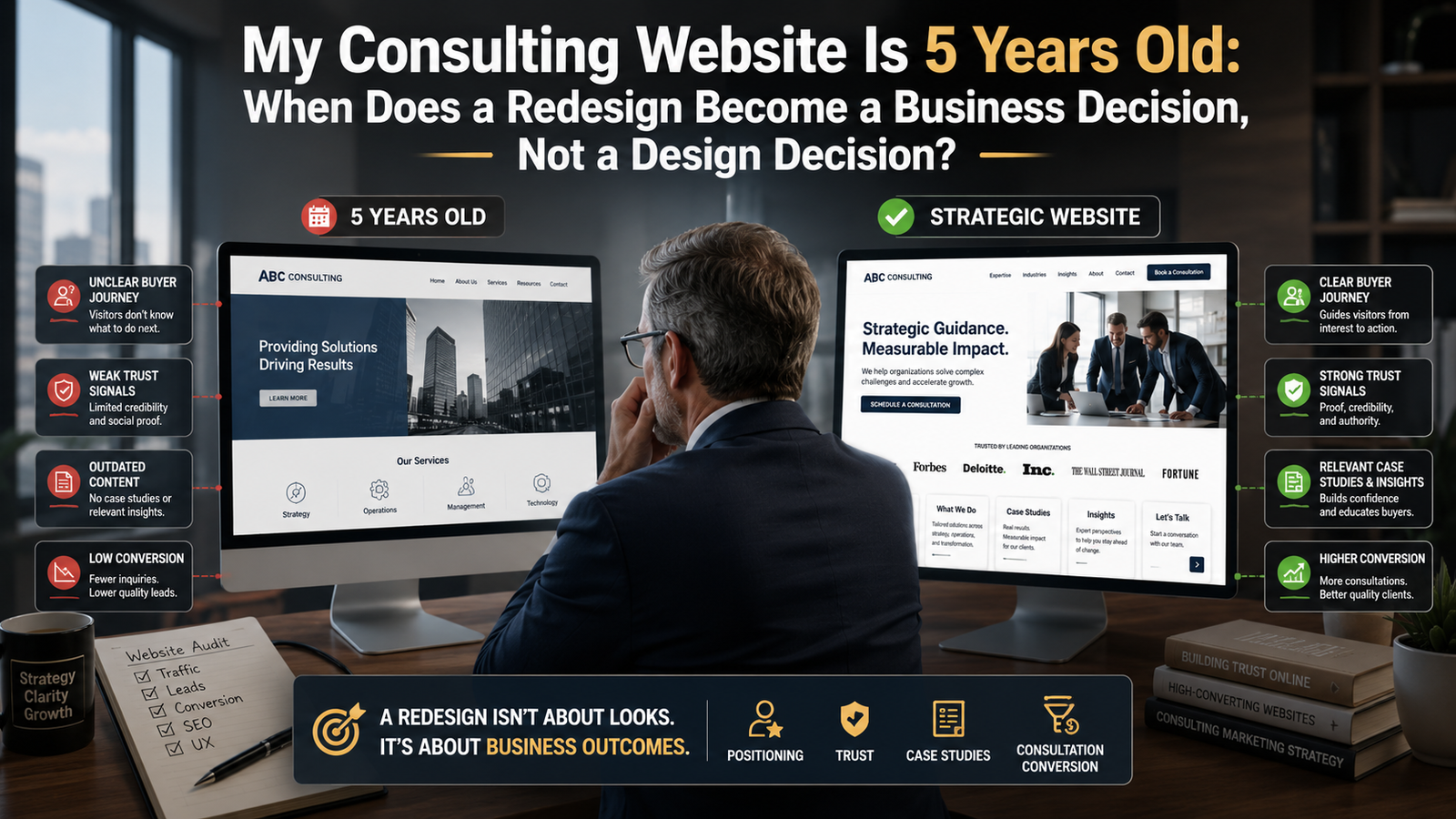
Before and after comparison of an outdated and business-focused consulting website

Expert Insight from Kanika Gupta

Kanika Gupta, Founder, KG Web Designer

My strongest judgment is this: do not redesign a five-year-old consulting website because you are embarrassed by how old it looks. Redesign it because the business has outgrown what the website is capable of communicating.

I frequently see firms spend significant effort modernizing the visual layer while leaving the old positioning, old service structure, weak proof, and unclear conversion path untouched.

That is an expensive way to preserve the same problem.

The better question is not, “Does our website look five years old?”

It is:

“Does our website accurately represent the firm we want to sell today?”

If the answer is no, then the redesign discussion becomes much more commercially meaningful.

What Other Consulting Website Problems Should You Audit?

A redesign decision should also be connected to the wider acquisition system.

For example, our review of consultant websites identified generic positioning, weak differentiation, limited case studies, poor consultation pathways, weak founder authority, and limited AI-readable expertise as recurring weaknesses.

If your website is receiving visitors but failing to turn the right visitors into conversations, the problem may therefore sit somewhere between discovery and decision rather than at the traffic level.

That is also why the broader AI Overview traffic and citation framework is relevant when reviewing a consulting website that already receives search visibility but is not generating enough qualified inquiries.

How Can You Tell Whether the Website Is Ready for a Business-Led Redesign?

Your website is probably ready for a strategic redesign when several of these conditions are true at the same time:

If only one or two of these apply, start with optimization.

If most apply, rebuilding may be the more economical long-term decision.

For another perspective on how consulting firms can strengthen trust and convert visitors, this high-trust consulting website analysis is worth reviewing alongside your audit.

What Should You Avoid During a Consulting Website Redesign?

Avoid starting with visual design, changing every URL unnecessarily, or assuming a new theme will solve a strategic problem.

Also avoid these common mistakes:

  1. Redesigning without baseline metrics.
  2. Deleting high-performing content because it looks old.
  3. Changing URLs without a migration strategy.
  4. Replacing specific positioning with generic corporate language.
  5. Moving case studies farther away from conversion points.
  6. Designing only for desktop presentations.
  7. Adding more services instead of clarifying priorities.
  8. Using “Contact Us” as the only conversion strategy.
  9. Treating SEO as something to fix after launch.
  10. Assuming a prettier website automatically produces more leads.

The most expensive mistake is usually not choosing the wrong color palette.

It is spending heavily on a redesign without first identifying what the existing website is failing to accomplish.

Ready for a Consulting Website That Wins Better-Fit Clients?

Your website should do more than explain what you offer. It should communicate your expertise, establish credibility, and help the right prospects feel confident about contacting you. I help consultants build strategic websites designed to strengthen positioning and generate more qualified enquiries.

Final Thoughts

A five-year-old website is not automatically obsolete. Consulting website redesign becomes a business decision when the current website no longer represents the firm’s positioning, expertise, buyer journey, technical requirements, or commercial ambitions.

The smartest approach is to protect what is working, identify what is creating friction, and rebuild only the parts that genuinely need to change.

At KG Web Designer, I would start with an audit of positioning, architecture, SEO equity, trust signals, mobile UX, conversion paths, and business goals before recommending a rebuild.

If the website has become a constraint on the firm you are trying to build, request a website strategy discussion with KG Web Designer and make the redesign decision from evidence rather than aesthetics.

Action plan for deciding whether to optimize or redesign a consulting website

FAQs

Should I redesign my consulting website after five years?

Not necessarily. Five years is a useful trigger for an audit, not an automatic redesign deadline. Review positioning, SEO performance, technology, mobile UX, information architecture, conversion paths, and buyer trust first. If the foundation still supports the business, targeted improvements may provide better ROI than a complete rebuild.

How do I know if my consulting website is actually losing leads?

Look for evidence such as strong traffic with weak inquiries, poor engagement on high-value service pages, repeated prospect questions, weak conversion paths, low mobile engagement, or prospects failing to understand your specialization. Analytics should be combined with sales feedback and a qualitative review of messaging and buyer journeys.

Will a website redesign improve consulting leads?

A redesign can improve lead quality when it solves genuine problems with positioning, trust, UX, architecture, and conversion. It should not be treated as a guaranteed lead-generation tactic. The strongest redesigns improve the website’s ability to qualify and reassure prospects who are already researching the firm.

Should I redesign my consulting website or improve SEO first?

The answer depends on the diagnosis. If the site has strong architecture and useful content but lacks search visibility, SEO may come first. If the website ranks well but visitors are not progressing toward inquiries, conversion and messaging work may have higher priority. A redesign is justified when structural or technical limitations prevent those improvements.

Can I redesign without losing my Google rankings?

Yes, but the migration needs to be planned carefully. Preserve valuable content and URLs where appropriate, map changed URLs, implement relevant redirects, maintain internal links, review metadata, test crawlability, and monitor performance after launch. Google emphasizes helpful content and overall page experience, so SEO preservation should be part of the redesign process rather than an afterthought.

What should I fix first on an old consulting website?

Start with positioning, high-value service architecture, trust signals, conversion paths, mobile UX, and technical performance. Do not begin with colors or animations. The first goal is to identify which problems are actually preventing qualified visitors from understanding, trusting, and contacting the firm.

Is a modern-looking website enough to build trust?

No. Visual quality contributes to credibility, but buyers also need evidence of expertise, clear information, accessible contact details, current information, useful content, and a coherent user experience. Stanford’s credibility research specifically identifies expertise, usability, professional presentation, contact accessibility, accuracy, and signs of a real organization as important credibility factors.

How often should a consulting website be reviewed?

A consulting website should be reviewed continuously rather than treated as a five-year asset. A deeper strategic review at least annually is sensible, while analytics, search performance, content, conversion paths, and sales feedback can be reviewed more frequently. The goal is to identify business changes before the website becomes a constraint.