
August 17, 2026

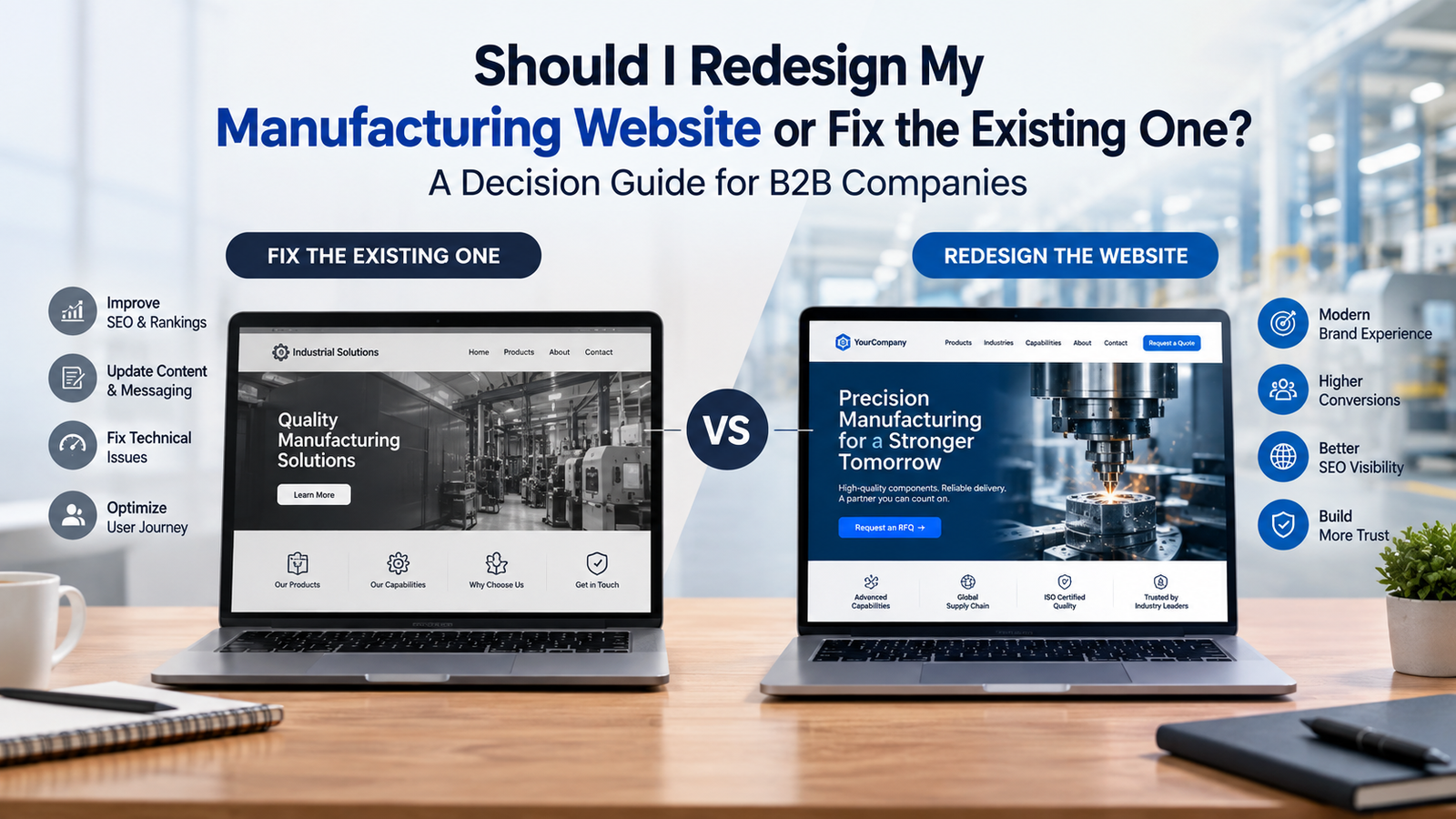
Should I Redesign My Manufacturing Website or Fix the Existing One? A Decision Guide for B2B Companies

Quick Answer

You do not need a new manufacturing website simply because the current one looks dated. If your rankings, content, URLs, and buyer journey are still fundamentally sound, targeted manufacturing website design services may deliver a better return than a complete rebuild. If buyers cannot understand your capabilities, validate your credentials, find technical information, or request an RFQ easily, the underlying structure may need to change. The right decision is based on evidence, buyer friction, SEO equity, and commercial performance, not how old the design looks.

TL;DR / Key Takeaways

What Does the Current B2B Buying Evidence Tell Us?

The evidence strongly suggests that manufacturing websites now play a more important role in supplier evaluation than many manufacturers assume. Gartner reported in July 2025 that 76% of B2B buyers said they would avoid doing business with suppliers that provide a bad website experience.

That matters because a procurement buyer may be evaluating several suppliers before anyone from your sales team knows the opportunity exists.

Gartner’s 2026 research found that B2B buyers used an average of seven information sources during a recent purchase, while 45% reported using generative AI, primarily to research vendors and products. The same research found that 67% preferred a rep-free experience and 70% preferred a completely digital self-service buying experience.

For a manufacturer, this changes what the website needs to accomplish.

The website has to answer questions that previously might have been handled by a salesperson:

A website that fails these questions may be creating sales friction long before the sales team gets involved.

Is Your Manufacturing Website Turning Buyers Into Enquiries?

Your website should clearly communicate your capabilities, build confidence with potential buyers, and make it easy for the right prospects to enquire. Let’s identify where your current website may be losing opportunities.

Book a Free 30-Minute Website Audit

👉 Get your top 3 website conversion leaks identified.

Should You Fix the Existing Website Before Redesigning It?

Usually, you should diagnose the existing website before deciding to replace it. An older website can contain valuable rankings, backlinks, indexed pages, technical resources, customer-facing content, and established URLs that should not be discarded simply because the visual design is dated.

I would first examine organic landing pages, Search Console data, analytics, conversion paths, technical content, internal linking, mobile usability, page performance, and the pages closest to commercial intent.

The question is not:

“Does this website look old?”

The better question is:

“Is the current website preventing qualified buyers from understanding, trusting, and contacting the company?”

Those are very different questions.

A manufacturer can have an outdated-looking website that still ranks for valuable searches and generates qualified enquiries. Rebuilding it without understanding that existing equity can create unnecessary risk.

The opposite can also happen. A modern-looking website may have beautiful animations and polished photography while making it extremely difficult for a procurement manager to find the relevant manufacturing capability.

If this were my website, I would first identify which pages already attract valuable buyers and which parts of the buyer journey are failing before approving a redesign.

That is the starting point for an evidence-based decision.

If your website is attracting visitors but those visitors are not becoming enquiries, the problem may be deeper than traffic volume. Our guide on why a website gets traffic but no enquiries provides a useful framework for separating visibility problems from conversion problems.

When Does a Manufacturing Website Actually Need a Redesign?

A redesign becomes justified when the problems are structural rather than cosmetic. If the site’s architecture, messaging, navigation, mobile experience, technical foundation, and conversion paths are all working against the buyer journey, repeatedly patching individual pages can become less efficient than rebuilding the system properly.

I would seriously consider a redesign when several of these conditions exist:

  1. The navigation reflects company departments instead of buyer needs.
  2. Important capabilities are hidden behind generic product categories.
  3. Technical specifications are difficult to locate.
  4. Certifications and quality information are buried.
  5. Industry-specific applications are missing.
  6. The RFQ path is difficult to discover.
  7. The website performs poorly on mobile devices.
  8. The CMS makes meaningful improvements difficult.
  9. The homepage does not explain who the company serves and what it does quickly.
  10. The visual presentation makes a sophisticated manufacturer appear less credible than its actual operation.

Google recommends strong Core Web Vitals as part of delivering a good page experience. Its current guidance identifies good targets of LCP within 2.5 seconds, INP below 200 milliseconds, and CLS below 0.1.

Performance alone does not mean a site needs a rebuild. But when poor performance appears alongside weak architecture, poor mobile usability, outdated templates, and conversion friction, a redesign becomes much easier to justify.

The financial question is therefore not whether the website looks modern.

It is whether the existing system is making qualified buyers work too hard.

Decision matrix for fixing or redesigning a manufacturing website

What Symptoms Tell You That the Website Is Losing Manufacturing Buyers?

The strongest symptoms are usually expressed as buyer questions rather than design complaints. Procurement managers rarely tell a manufacturer, “Your information architecture is poor.” They say, “I couldn’t find what I needed.”

Common symptoms include:

These statements reveal procurement buyer intent more clearly than traffic numbers do.

There is another important issue. Gartner’s recent research shows that buyers increasingly use AI and digital channels for vendor and product research, while still relying on sellers for validation at important decision points.

Your website therefore needs to make the supplier easier to validate before the sales conversation begins.

The RFQ problem can begin even earlier than the form itself. Navigation, capability pages, technical proof, certifications, industry relevance, and trust signals can determine whether a buyer ever reaches the quotation stage.

Our guide to preventing lost RFQs before the sales conversation starts examines that problem in greater detail.

Expert Insight From Kanika Gupta

Founder, KG Web Designer | B2B Manufacturing Website Strategist

“Manufacturing buyers are looking for evidence before they start a conversation. A high-performing B2B website should make it easy to understand what you manufacture, which industries you serve, what capabilities you offer, and why buyers can trust your processes. When that information is clear and easy to verify, your website becomes a sales tool rather than simply an online company profile.”

What Would I Inspect First During a Manufacturing Website Audit?

I would inspect the buyer journey before the homepage design. The first objective is to understand what a qualified procurement visitor is trying to accomplish and whether the current website allows that person to accomplish it without unnecessary friction.

At KG Web Designer, one recurring issue we see is a gap between what the manufacturer knows internally and what the buyer can verify online.

The manufacturer may have:

But the website may communicate only:

“Quality manufacturing solutions for a range of industries.”

That sentence does very little to reduce procurement risk.

I would inspect six areas first

1. Organic visibility

Which pages already attract search traffic?

Are they attracting people looking for actual manufacturing capabilities or only general information?

2. Capability architecture

Can a buyer quickly reach a relevant process, material, product, application, or industry page?

3. Technical proof

Are specifications, tolerances, equipment, materials, certifications, inspection capabilities, and quality systems clearly documented?

4. RFQ journey

Is the quotation path obvious?

Can the buyer understand what information to provide and what happens after submission?

5. Mobile experience

Can a buyer review technical information and take action from a phone without fighting the interface?

6. SEO preservation

Which existing URLs, rankings, backlinks, internal links, and content assets need protection?

The answer to those six questions will usually tell me whether I am looking at a repair project, CRO project, content project, partial redesign, or full rebuild.

What Is the Right Choice: SEO, Redesign, CRO, PPC, or Do Nothing?

The right solution depends on where the commercial bottleneck actually exists. More traffic is useful only when the website can convert relevant visitors into meaningful next steps, while a redesign is unnecessary if the existing structure already supports strong buyer journeys.

What you are seeingLikely issueBest first movePriority
Strong rankings, weak enquiriesConversion frictionCRO auditVery high
Strong traffic, poor lead qualityPositioning or qualificationMessaging + CROHigh
Low organic visibilitySearch visibilitySEO + contentHigh
Broken navigationInformation architectureRedesignVery high
Weak RFQ processConversion frictionRFQ optimizationVery high
Good website, weak rankingsSEOSEO improvementHigh
Poor mobile experienceUXUX redesignHigh
Major technical debtPlatformRebuildHigh
Strong rankings and qualified RFQsNo major problemDo not redesignProtect
New market needs immediate visibilityAcquisitionSEO + PPCStrategic

This is where B2B website conversion needs to be separated from traffic generation.

If 10,000 relevant visitors arrive and cannot determine whether you are capable of handling their project, doubling traffic does not solve the underlying commercial problem.

It simply increases the number of people encountering the same friction.

Why Is RFQ Optimization More Important Than Many Manufacturers Realize?

RFQ performance matters because it sits at the point where buyer research becomes a commercial opportunity. A procurement visitor who has reached the quotation stage has already demonstrated substantially more intent than someone casually reading a general manufacturing article.

That does not mean the answer is always a shorter form.

Manufacturing RFQs often legitimately require information such as:

The objective is to collect what sales and engineering genuinely need without asking for unnecessary information.

W3C guidance specifically recommends keeping forms simple and asking only for information required to complete the transaction or process because excessive or irrelevant requests can increase abandonment.

That makes RFQ form optimization a commercial discipline rather than a cosmetic UX exercise.

A useful RFQ page should also explain what happens after submission.

For example:

Submit RFQ → Engineering review → Clarification if needed → Quote → Next-step discussion

That small amount of information can reduce uncertainty and make the buyer more comfortable submitting project details.

How Can a Redesign Affect SEO?

A redesign can improve SEO, but it can also create unnecessary search volatility if the migration is treated as a purely visual project. The safest approach is to treat existing organic visibility, URLs, content, internal links, and backlinks as assets that must be audited before the new architecture is finalized.

Google’s current site-migration guidance recommends preparing and testing the new site, creating URL mappings, implementing server-side permanent redirects, updating internal links, submitting the new sitemap, and monitoring Search Console after launch. Google also notes that temporary ranking fluctuations can occur while pages are recrawled and reindexed.

This is why I would never recommend:

“Let’s launch the new design first and have SEO people fix it afterward.”

SEO needs to be considered during architecture planning.

If a valuable capability page currently ranks, the redesign team needs to know that before changing its URL.

If a technical article has earned backlinks, it should not casually disappear.

If several pages serve different search intents, they should not automatically be consolidated simply to make the navigation cleaner.

A redesign should preserve valuable search equity while improving the experience.

Google also states that permanent redirects do not cause a loss of PageRank, but the implementation still needs to be accurate and relevant.

What Does Manufacturing SEO Look Like in a Modern Website?

Effective manufacturing SEO is increasingly about building a clear information system around the company’s actual expertise. The goal is not to create dozens of generic pages containing variations of “manufacturing company” keywords.

The stronger approach is to create useful, specific destinations around:

Google’s current guidance for generative AI features reinforces this principle. Google says existing SEO fundamentals remain relevant for AI Overviews and AI Mode, including crawlability, indexing, internal linking, textual content, page experience, and helpful people-first content.

Google also published dedicated guidance in 2026 emphasizing valuable, unique, non-commodity content for generative AI experiences.

For manufacturers, this creates an important opportunity.

Your most valuable content may not be a generic blog post.

It may be a detailed page explaining a manufacturing process, a technical limitation, a material choice, an application, a certification, or an engineering consideration that demonstrates real expertise.

That kind of content can serve buyers, traditional search, and AI-assisted research simultaneously.

Kanika Gupta

18+ Years. 500+ Websites. Manufacturing Websites Built to Convert.

I help manufacturing companies in the US, UK, and Australia turn their websites into credible sales tools — clearly communicating capabilities, building buyer confidence, and generating qualified enquiries. Every website is custom-built, conversion-focused, and designed around your business goals.

What Should Manufacturing Website Design Services Actually Include?

Manufacturing website design services should include much more than page layouts because the website has to function as a digital sales and procurement resource.

At minimum, I would expect the strategy to address:

  1. Buyer-focused information architecture
  2. Capability and process pages
  3. Industry and application pathways
  4. Technical content structure
  5. Certification and trust presentation
  6. RFQ journey design
  7. Mobile UX
  8. SEO migration planning
  9. Internal linking
  10. Conversion measurement
  11. CMS and technical scalability
  12. Analytics and Search Console integration

The important point is that these elements need to work together.

A beautiful capability page is not particularly useful if the buyer cannot reach it.

A strong SEO page is not commercially effective if it does not communicate supplier credibility.

A sophisticated RFQ form is not helpful if the website has failed to establish trust before asking the buyer to upload a drawing.

A manufacturing website is therefore a connected system.

The homepage, capability pages, technical resources, trust signals, navigation, search visibility, and RFQ experience should reinforce one another.

What Should a Manufacturing Website Communicate Above the Fold?

The top portion of the website should quickly establish who the manufacturer serves, what it does, and why a qualified buyer should continue. It does not need to explain the entire company in the first screen, but it should give the buyer enough orientation to know they are in the right place.

A useful manufacturing homepage usually communicates:

Who you serve

For example, OEMs, industrial buyers, medical device manufacturers, aerospace companies, automotive suppliers, or other defined markets.

What you manufacture

Make the core capability immediately understandable.

Why buyers should trust you

Use relevant certifications, experience, quality systems, equipment, or customer-industry evidence.

What to do next

Provide a clear path to capabilities, technical information, or an RFQ.

The biggest mistake is using the hero section for vague statements such as:

“Engineering Excellence Since 1987.”

That may be true, but it does not answer the buyer’s immediate question:

“Can you manufacture what I need?”

The website should earn the right to tell the company story by first helping the buyer solve the procurement problem.

Example Scenario: What If Your Website Gets Traffic but Few RFQs?

Imagine a contract manufacturer receives consistent organic traffic from searches related to its manufacturing capabilities. The leadership team sees the traffic and concludes that the website is working.

But procurement visitors arrive on broad pages.

They cannot quickly determine whether the company supports their material.

The relevant certification is buried in an unrelated section.

The industry application they care about has no dedicated page.

The RFQ button is difficult to find.

The form does not explain whether drawings can be uploaded.

The sales team then reports:

“We get enquiries, but many are not qualified.”

This is not necessarily a traffic problem.

It is a buyer-journey problem.

I would first improve the information architecture, technical evidence, qualification messaging, and RFQ pathway before increasing paid acquisition.

The financial opportunity is in making the existing qualified attention more productive.

Before and after comparison of a manufacturing website redesign

Example From Our Experience

One recurring pattern across manufacturing website audits and projects at KG Web Designer is a mismatch between operational capability and digital presentation.

The manufacturer may have advanced equipment, strong quality procedures, experienced engineers, and a clear understanding of its ideal customers.

Yet the website may organize the information around internal company departments rather than the questions a buyer needs answered.

In an anonymized project pattern, a manufacturer had substantial technical information available internally, but procurement visitors had to move through several unrelated pages before finding relevant process and quality information. The recommendation was not to rewrite everything. It was to reorganize the information around buyer questions and make the existing evidence easier to discover.

The important lesson was not that a particular redesign generated a particular percentage increase.

The lesson was that the company already possessed the expertise required to build buyer confidence.

The website simply was not exposing that expertise at the right points in the journey.

That is a common distinction between a manufacturer’s real-world capability and its digital capability presentation.

What Are the Most Important Improvements to Make First?

The first improvements should be the ones closest to revenue and buyer confidence. A manufacturer should not begin by redesigning every page or commissioning a new visual identity if the biggest commercial problem is simply that buyers cannot find the information they need.

I would prioritize the work in this order:

1. Clarify the positioning

Make the ideal buyer and core capabilities obvious.

2. Fix capability architecture

Create clear paths for products, processes, materials, industries, and applications.

3. Strengthen proof

Make certifications, quality systems, equipment, engineering expertise, and relevant experience easy to verify.

4. Improve RFQ access

Give high-intent visitors a clear next step.

5. Improve technical content

Answer questions buyers would otherwise need to send to sales.

6. Improve mobile UX

Make technical information usable across devices.

7. Protect search equity

Map URLs and preserve valuable content before launching structural changes.

8. Measure qualified outcomes

Track meaningful RFQs, not just form submissions or pageviews.

This order matters because it prioritizes commercial friction before decorative improvements.

Expert Insight From Kanika Gupta

Founder, KG Web Designer | Manufacturing Website Strategist

“Manufacturing buyers need confidence before they make contact. Your website should answer the practical questions procurement teams have about capabilities, specifications, quality standards, certifications, lead times, and industry experience. When buyers can find that information easily, your website helps shorten the path from research to a qualified enquiry.”

Why Most Businesses Get This Wrong

Most manufacturers get the redesign decision wrong because different departments evaluate the same website through completely different lenses. The owner sees a dated design. Marketing sees declining visibility. Sales sees weak enquiries. Engineering sees incomplete RFQs. The web team sees technical limitations.

All of these observations can be true simultaneously.

The mistake is selecting a solution before identifying the shared problem.

Another common mistake is assuming that a new website automatically means more leads. It does not.

A new website can reproduce the same vague messaging, poor navigation, thin technical content, weak trust signals, and difficult RFQ journey inside a more attractive interface.

A third mistake is treating the website as a brochure while expecting it to perform like a sales tool.

Modern B2B buyers increasingly prefer self-service research, and Gartner’s recent findings show that digital and AI-assisted research are now embedded in the buying process.

Successful manufacturers therefore give buyers enough information to make progress independently while making sales available when validation or human expertise becomes valuable.

That is a fundamentally different website strategy.

Manufacturing procurement buyer journey from website discovery to RFQ

Why Should Manufacturers Own Their Digital Buyer Journey?

Manufacturers often depend on directories, marketplaces, distributors, and industry platforms for discovery, but those channels should not become substitutes for a strong owned website. Your own website is where you control the technical depth, positioning, trust signals, buyer journey, and path from research to RFQ.

A marketplace profile can help someone discover you.

Your website should help them decide whether they should trust you.

That distinction becomes particularly important when buyers are comparing several suppliers.

Your own website can explain:

Our comparison of your own website versus IndiaMART, Alibaba, and Thomasnet explores why an owned website should be treated as more than another company profile.

The objective is not necessarily to abandon third-party platforms.

It is to ensure that when a serious buyer researches your company independently, your own digital presence provides the evidence needed to move the conversation forward.

What Does Strong Industrial Website Design Look Like?

Strong industrial website design makes complex information easier to understand without making the manufacturing operation look simplistic. The goal is not to remove technical detail. The goal is to structure technical detail so that the right buyer can find and interpret it quickly.

That usually means combining:

The visual design should support credibility.

It should not compete with the information.

A manufacturer serving aerospace or medical-device customers may need a very different visual hierarchy from a company selling commodity industrial components.

The right design reflects the buyer’s risk level, technical complexity, purchasing process, and expectations.

For practical examples of how this can work, our collection of manufacturing website design examples that build trust and generate more RFQs provides useful reference points.

What Does This Mean For Your Business?

The commercial implication is straightforward: every unnecessary question a buyer has to ask your sales team can create friction, and every important question your website answers clearly can reduce friction.

That does not mean websites should replace sales.

Gartner’s 2026 research actually points to a more nuanced model: buyers increasingly want digital self-service, but sellers remain important for validation, confidence, and decision support.

Your website should therefore handle the information that can be self-served while making the sales team’s human contribution more valuable.

That can improve several areas at once:

This is the real business case for improving the website.

It is not simply about making the company look modern.

It is about making the company’s existing expertise easier to buy.

When Does Professional Help Make Sense?

Professional help makes sense when the cost of making the wrong decision is greater than the cost of getting the diagnosis right. That is particularly true when the website has meaningful organic visibility, hundreds of URLs, valuable backlinks, multiple manufacturing capabilities, international buyers, complex product structures, or a significant amount of technical content.

For manufacturers evaluating manufacturing website design services, I would expect the engagement to begin with a diagnosis rather than a homepage mockup.

The right specialist should be able to answer:

A good provider should also be willing to tell you when a full redesign is unnecessary.

That is an important commercial trust signal.

If the correct answer is “repair the existing website first,” a specialist should be comfortable saying so.

At KG Web Designer, the objective is not to sell a new website for the sake of replacing an old one. The objective is to determine what digital intervention gives the manufacturer the strongest commercial outcome.

What Should You Do Before Approving a Redesign?

Before approving a full rebuild, ask for a structured website diagnosis covering SEO equity, buyer journey, information architecture, technical content, mobile UX, RFQ conversion, and migration risk. If the proposed solution starts with design concepts without first identifying these issues, you may be buying a new interface without solving the underlying commercial problem.

If you are evaluating whether your existing website needs targeted improvements or a full strategic rebuild, manufacturing website design services can be evaluated around your actual procurement journey, technical requirements, search visibility, and RFQ goals rather than visual preference alone.

What Should You Fix First, Second, and Third?

The most sensible action plan is to move from evidence to diagnosis and then to implementation. Starting with development before completing those steps makes it harder to distinguish genuine business requirements from design preferences.

First: Audit

Review:

Second: Classify

Determine whether the primary problem is:

Third: Implement the smallest effective solution

That may mean:

If URLs are changing, create the migration map before development is finished. Google specifically recommends URL mapping, permanent redirects, internal-link updates, sitemap submission, and Search Console monitoring during site moves.

The goal is not to create the newest website.

The goal is to create the most commercially useful website.

Manufacturing action plan for manufacturing website redesign

Expert Insight from Kanika Gupta

A manufacturing website should not be redesigned because the owner is tired of looking at it.

It should be redesigned when the current digital experience makes it harder for a qualified buyer to verify capability, understand supplier fit, assess risk, or request a quotation.

That is the distinction I use when reviewing manufacturing websites.

I have found that manufacturers often underestimate how much expertise they already possess and overestimate how much of that expertise their website communicates.

The factory may be impressive.

The engineering team may be exceptional.

The quality system may be rigorous.

The website may still communicate almost none of it.

My recommendation is therefore simple: preserve what has commercial value, expose what buyers cannot currently find, and rebuild only what genuinely needs rebuilding.

Kanika Gupta, Founder, KG Web Designer

Manufacturing Website Insights

What Manufacturing Websites Often Get Wrong

After reviewing manufacturing websites across different industries and business sizes, one issue consistently stood out: manufacturers often have strong capabilities, but their websites make buyers work too hard to understand them.

1. Capabilities Were Not Clearly Presented

Important information about machinery, processes, materials, production capacity, and technical capabilities was often scattered across multiple pages instead of being presented in a clear, buyer-friendly structure.

2. Buyers Had No Clear Next Step

Websites often explained products and services without giving buyers an obvious way to request a quote, discuss a project, submit specifications, or contact the right team.

3. Trust Signals Were Underused

Certifications, industries served, client experience, quality standards, case studies, and production expertise were frequently missing or difficult to find—leaving buyers with unanswered questions.

Key Takeaway: A manufacturing website should make it easy for buyers to understand your capabilities, verify your credibility, and take the next step. Clear structure and technical evidence often matter more than simply having a modern-looking website.

Author Insight

My strongest judgment is that manufacturers should stop treating “website redesign” as a visual procurement exercise.

The first deliverable should not be a homepage design.

It should be a diagnosis.

I want to know which buyer questions are currently unanswered, which pages already have search value, where procurement visitors encounter friction, which trust signals are missing, and whether the RFQ journey supports the sales process.

Only then should visual design begin.

That approach may sometimes result in a complete redesign.

It may also result in the recommendation not to redesign.

Being willing to make either recommendation is part of doing the job properly.

Final Thoughts

You should redesign your manufacturing website when the existing structure prevents qualified buyers from understanding your capabilities, validating your credibility, finding technical information, or moving toward an RFQ. You should fix the existing website when its underlying architecture, search equity, content, and buyer journey are still sound and the problems can be solved without rebuilding everything.

The key distinction is between a website that looks old and a website that is commercially broken.

Those are not the same thing.

The strongest manufacturers treat their website as part of the procurement experience. It should help buyers research independently, validate supplier fit, understand technical capability, reduce perceived risk, and reach the sales team with better-informed questions.

That is also why manufacturing website design services should be judged by the quality of the diagnosis and buyer journey, not simply by the appearance of the final design.

If you are unsure whether your current website needs a redesign, targeted conversion work, SEO improvements, or a complete rebuild, the most sensible next step is a structured website assessment rather than immediately commissioning a new site.

Request a Manufacturing Website Strategy Discussion

FAQs

Should I redesign my manufacturing website if it looks outdated?

Not necessarily. An outdated visual style does not automatically mean the underlying website is failing. If the site has valuable rankings, useful technical content, good backlinks, and a workable buyer journey, targeted improvements may be more sensible. A redesign becomes more justified when the architecture, messaging, mobile experience, technical foundation, or conversion paths prevent meaningful improvement.

How do I know if my manufacturing website is losing RFQs?

Look for a combination of qualified organic traffic and weak enquiries, poor engagement with capability pages, low RFQ completion, difficult navigation, weak trust signals, and repeated sales questions that should already be answered online. Review analytics and Search Console alongside actual feedback from sales and engineering teams. The strongest diagnosis combines behavioral data with real buyer objections.

Will redesigning my manufacturing website hurt Google rankings?

A redesign can cause temporary ranking fluctuations, particularly when URLs, content, internal links, or technical structures change. Google recommends preparing the new site carefully, mapping old URLs, implementing permanent redirects, updating internal links, submitting the new sitemap, and monitoring Search Console.

Should I spend money on SEO or redesign my website first?

Start by identifying the constraint. If qualified buyers cannot find your company, SEO may deserve priority. If they find you but cannot understand your capabilities or request a quotation, conversion work may come first. If the architecture itself prevents both search visibility and buyer navigation, a redesign may be justified. More traffic will not solve a website that cannot convert relevant visitors.

What should I fix first on a manufacturing website?

Start with the pages and journeys closest to commercial intent. Review homepage positioning, core capability pages, industry pathways, certifications, technical resources, RFQ access, mobile UX, and trust signals. Then protect SEO assets before structural changes. The objective is to help a procurement buyer answer two questions quickly: “Can this supplier solve my problem?” and “Can I trust them with the project?”

Is a new manufacturing website better than improving the existing one?

A new website is not automatically better. Improving the existing site is often preferable when its URLs, rankings, backlinks, content, and architecture still have value. A new build becomes more appropriate when the CMS, information architecture, technical foundation, mobile experience, or conversion journey prevents meaningful improvement. The decision should be based on evidence rather than the age of the design.

How important is the RFQ form on a manufacturing website?

The RFQ form is one of the most commercially important conversion points because it connects demonstrated buyer intent with the sales process. It should collect enough information to help sales and engineering evaluate the opportunity without creating unnecessary friction. Depending on the manufacturer, useful fields may include quantity, material, drawings, application, certifications, tolerances, and delivery requirements.

Do manufacturing websites need to be optimized for AI search?

They should be built around the same fundamentals that make content useful for traditional search: clear technical structure, crawlability, indexability, strong internal linking, useful text, original expertise, and helpful content. Google states that there are no separate technical requirements specifically for AI Overviews or AI Mode. Existing SEO fundamentals remain foundational.