
August 14, 2026

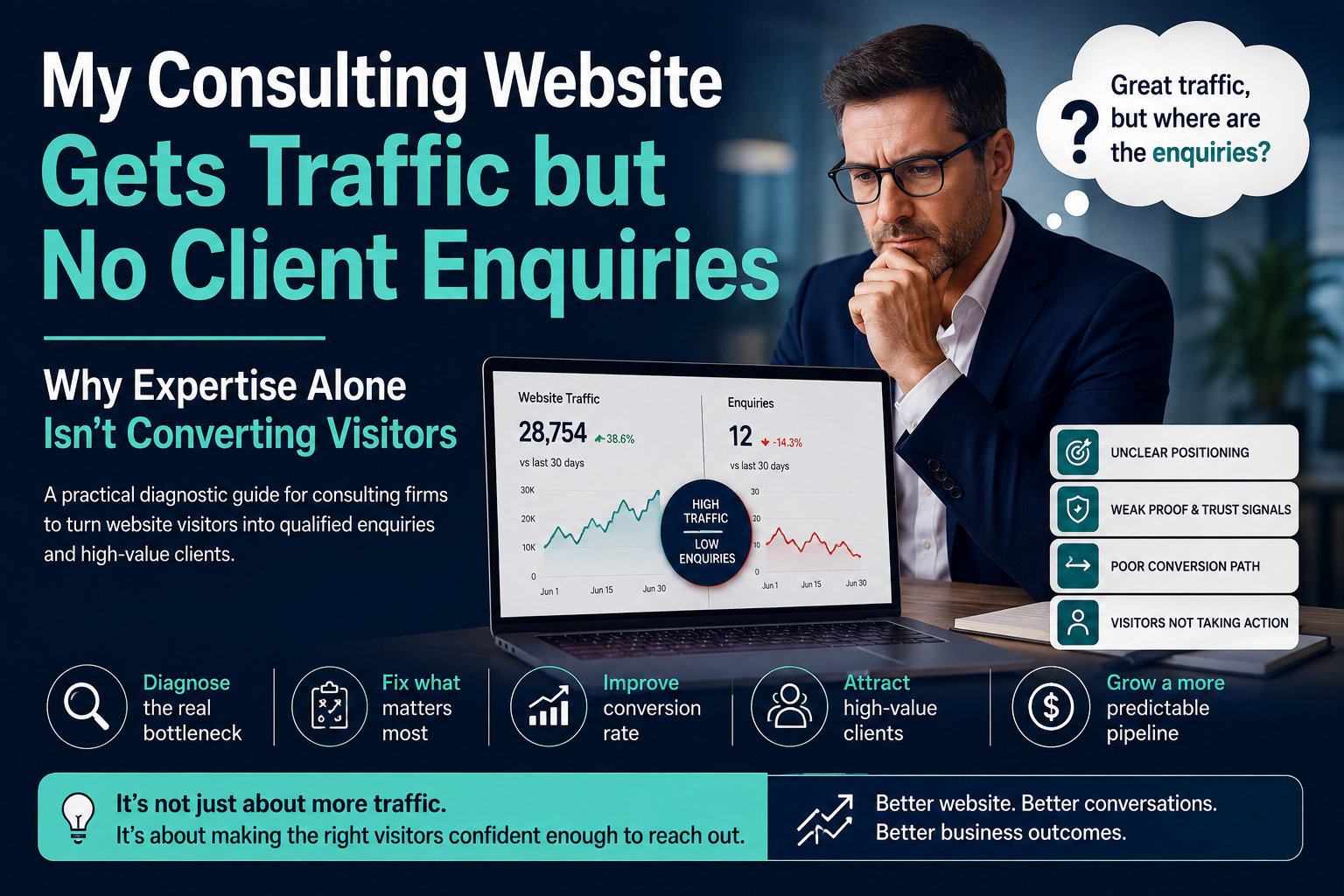
My Consulting Website Gets Traffic but No Client Enquiries: Why Expertise Alone Isn’t Converting Visitors

Quick Answer

If your consulting website gets visitors but very few client enquiries, I would not automatically spend more on SEO or paid traffic. I would first check whether the website makes your expertise, ideal client, business outcomes, proof, and next step obvious. Consultant website design services should turn existing attention into buyer confidence. If qualified visitors are reaching the site but leaving without engaging, the problem is often positioning, trust, conversion friction, or unclear buyer intent rather than traffic volume alone.

TL;DR: What I Would Check First

Is Your Consulting Website Actually Converting Expertise Into Buyer Confidence?

A consulting website can receive relevant traffic and still fail to generate enquiries when the visitor understands that you are experienced but does not understand why your firm is the right choice for their particular problem.

That distinction is important. A prospect may read your biography, review your credentials, look at your services, and still leave without contacting you because the website has not reduced enough uncertainty around fit, outcomes, credibility, process, or investment.

Hinge’s research into professional-services buyers reinforces why this matters: buyers actively search for and evaluate professional-services firms before making decisions. Its research covers consulting alongside other professional-services categories and examines buyer behavior, evaluation criteria, and selection factors.

So when a consulting website gets traffic but few enquiries, I would not start with the question, “How do we get more visitors?”

I would start with:

“What happens between the moment a qualified buyer lands on the website and the moment they decide whether this firm is worth contacting?”

That is where the commercial diagnosis begins.

If your traffic is relevant but you are not generating enough consulting website leads, the problem may be happening after the visitor arrives.

What Does the Traffic-to-Enquiry Problem Usually Look Like?

The most useful way to diagnose the problem is to separate traffic quality, positioning, trust, engagement, and conversion rather than treating every low-enquiry website as an SEO problem.

What you are seeingWhat it may indicateWhat I would investigate first
Very little relevant trafficVisibility or targeting problemSEO, search intent, content and positioning
Good traffic but immediate exitsMessaging or relevance problemHomepage positioning and landing-page clarity
Visitors read service pages but do not enquireTrust or offer problemProof, outcomes, differentiation and CTA
Strong engagement but few enquiriesConversion frictionEnquiry path, forms, CTAs and next-step clarity
Many enquiries but poor-fit prospectsPositioning problemAudience definition and qualification
Traffic and engagement are healthy but sales remain weakSales/process issue may existLead handling, offer and sales journey

The key point is simple: traffic and enquiries are different problems. More visitors can increase exposure, but they cannot compensate for a website that leaves qualified buyers uncertain about your relevance or credibility.

This is also why I would resist recommending a complete redesign immediately. If the underlying issue is positioning or conversion architecture, rebuilding every page before identifying the actual problem can increase cost without solving the commercial constraint.

Does Your Consulting Website Reflect Your Expertise?

Your website should do more than explain what you do. It should establish authority, communicate your value, and help potential clients understand why you’re the right choice. A strategic consultant website design can turn your expertise into a stronger digital presence and better-quality enquiries.

Explore Consultant Website Design →

What Are Consulting Business Owners Usually Saying When This Happens?

The symptoms are often more revealing than the analytics dashboard.

You may hear statements such as:

These are not necessarily traffic problems.

They are often decision-confidence problems.

A professional-services buyer may already have enough information to find your website. What they may not have is enough evidence to confidently move from research to conversation.

How I Would Diagnose the Website Before Recommending a Redesign

I would inspect the website in the same order that a serious prospect is likely to experience it: relevance first, credibility second, evidence third, action fourth.

The first thing I would inspect is the homepage message.

Can a prospective client understand within a few seconds:

  1. Who you help?
  2. What problem you solve?
  3. What kind of outcome you create?
  4. Why your firm is qualified?
  5. What should the visitor do next?

If those answers are unclear, I would not blame the traffic.

Next, I would inspect the service pages. A consulting service page should not merely describe what the firm offers. It should help the prospective buyer understand the business problem, the consulting approach, the likely engagement, relevant expertise, evidence, and next step.

Then I would examine the proof.

Credentials are useful, but credentials alone do not necessarily answer the buyer’s most important question:

“Have you successfully dealt with a problem like mine?”

That is why relevant case studies, outcomes, client context, methodologies, publications, speaking experience, original thinking, and useful insights can be more persuasive than another paragraph about professional experience.

At KG Web Designer, this is one of the distinctions I would make before recommending a redesign: is the website failing because it looks outdated, or because it fails to communicate commercial relevance?

Those are very different problems.

Consultant / Corporate diagnostic framework for consulting website traffic no leads

A KG Web Designer Audit Observation

Across the consultant websites we review, one recurring pattern is that firms often put substantial effort into demonstrating that they are experienced, but less effort into demonstrating why that experience matters to the buyer’s current problem.

That creates an unusual gap.

The consultant sees a website full of expertise.

The prospective client sees a website that still requires them to figure out whether that expertise applies to them.

My judgment: the strongest consulting websites do not merely prove that the consultant is knowledgeable. They make the buyer feel that the consultant understands the problem before the first conversation takes place.

That is the difference between an expertise website and a decision-support website.

What Does a Strong Consulting Website Need to Prove?

A strong consulting website should prove four things before asking a high-value visitor to enquire.

1. Relevance

The visitor should quickly recognize that the firm works with businesses like theirs or solves problems like theirs.

2. Expertise

The website should demonstrate knowledge through useful analysis, frameworks, case studies, methodologies, publications, insights, or other credible evidence.

3. Commercial value

The buyer needs to understand what changes as a result of hiring the consultant. “Strategy consulting” is a service description. “Helping multi-location businesses identify operational bottlenecks before expansion” communicates a problem and a business context.

4. Low-risk next step

The visitor should understand what happens after clicking the CTA.

A vague “Contact Us” button creates more uncertainty than a specific invitation such as “Discuss Your Consulting Challenge” or “Request a Strategic Website Review.”

This is especially important for premium consulting engagements where the first enquiry is not an impulse purchase. The website needs to make the next conversation feel appropriate, credible, and worthwhile.

Why Does Expertise Alone Fail to Generate Consulting Leads?

Expertise alone fails when it remains difficult for the buyer to translate that expertise into a reason to engage.

A consultant may have twenty years of experience, impressive credentials, a strong network, and deep industry knowledge. But if the website communicates all of that through a long biography without connecting it to buyer problems and outcomes, the visitor still has to do the interpretation.

That interpretation creates friction.

This is particularly important because professional-services buyers do not evaluate firms using a single signal. Hinge’s buyer research has examined how buyers search for providers, evaluate firms, and determine which providers they ultimately select.

Extractable Insight

A consulting website should translate expertise into buyer-relevant evidence rather than simply display credentials.

If your site says:

“20 years of consulting experience.”

the buyer may think:

“That’s impressive, but can you solve my problem?”

If the site instead explains the type of problem you have solved, the context, your approach, and the resulting business impact, the buyer has much more information with which to assess fit.

That is where consulting lead generation becomes a website strategy problem rather than simply a traffic problem.

If a consultant is already seeing traffic but cannot determine whether the underlying issue is visibility, relevance, or conversion, the broader diagnostic framework on website gets traffic but no enquiries is a useful next step because it separates traffic problems from website conversion problems.

How Can a Consulting Website Demonstrate Expertise Without Sounding Self-Promotional?

A consulting website demonstrates expertise most effectively when it shows how the consultant thinks rather than repeatedly telling visitors how experienced the consultant is.

For example, instead of writing three paragraphs about being a “trusted strategic partner,” demonstrate the thinking behind a difficult client problem. Explain what was assessed, what alternatives were considered, why one approach was selected, and what changed afterward.

Useful evidence can include anonymized project situations, decision frameworks, diagnostic checklists, original observations, detailed case studies, published research, conference contributions, or practical explanations of complex business problems.

If you want to benchmark this approach further, our guide on how clients find consultants through ChatGPT and AI search explores how expertise and evidence can make a consulting firm easier to discover and evaluate in AI-assisted search.

Demonstrating expertise does not require filling your website with self-congratulatory claims. A stronger approach is to show expertise through useful evidence: original insights, specific examples, clear methodologies, relevant case studies, and content that helps a prospective client make a better decision.

If you want to go deeper into how messaging can attract higher-value decision-makers, our guide to website content strategy for corporate firms explains how strategic content, positioning, and trust-focused messaging can make a corporate website feel more authoritative without becoming overly promotional.

1. Is the Problem Actually Poor Traffic Quality?

Poor traffic quality is the first thing I would rule out because a website cannot convert visitors who were never potential buyers in the first place.

A consulting firm can rank for broad informational searches, attract students, competitors, job seekers, or people looking for free advice, and still conclude that “the website doesn’t generate leads.” The better question is whether the people arriving on the site have a realistic reason to consider hiring the firm.

I would compare the traffic sources against the services you actually want to sell.

For example, a strategy consultant targeting mid-market companies may receive substantial organic traffic for general strategy questions. That traffic can look impressive in analytics while contributing very little commercial value if those visitors are not decision-makers looking for consulting support.

What I Would Check

If traffic is low-quality, improve targeting before redesigning the entire website.

If traffic is relevant and visitors are reaching service pages but still not enquiring, I would move down the funnel and investigate positioning, proof and conversion.

2. Does the Homepage Make Your Expertise Relevant Within Seconds?

A consulting homepage should make the firm’s relevance obvious before asking the visitor to explore deeper.

This is where many experienced consultants unintentionally create friction. The homepage often begins with a broad statement about expertise, followed by a list of services, a biography, and generic claims about delivering value.

The problem is not necessarily that those statements are wrong.

The problem is that they make the visitor work too hard to answer:

“Is this firm relevant to the problem I am trying to solve?”

A stronger homepage connects audience + problem + expertise + outcome.

Instead of:

“We provide strategic consulting solutions for organizations seeking sustainable growth.”

a more useful positioning structure might communicate:

“We help growing professional-services firms redesign their operating model before expansion creates unnecessary complexity.”

The second statement gives the buyer something to recognize.

A Simple Homepage Test

Ask someone who does not know your business to look at the homepage for 10 seconds.

Then ask:

  1. Who does this firm help?
  2. What problem does it solve?
  3. What makes it credible?
  4. What should I do next?

If they cannot answer most of those questions, more traffic is unlikely to solve the underlying problem.

Your homepage should reduce buyer uncertainty before it asks for buyer commitment.

Is Your Website Helping You Win the Right Consulting Clients?

Potential clients are looking for expertise, relevance, proof, and a clear reason to trust you. A strategic professional services website can communicate your value more effectively and turn website visitors into stronger, better-qualified enquiries.

Explore Professional Services Website Design →

3. Does Your Website Demonstrate Expertise Without Sounding Self-Promotional?

Expertise is more persuasive when the website demonstrates it through useful evidence rather than repeatedly claiming that the consultant is an expert.

This is particularly important for consultants because the buyer is purchasing judgment, experience and problem-solving ability. A page full of adjectives such as “trusted,” “leading,” “innovative,” and “results-driven” does not necessarily provide enough evidence to support those claims.

Instead, demonstrate expertise through:

At KG Web Designer, we frequently see a difference between credential-heavy websites and evidence-led websites.

Credential-heavy websites say:

“We have extensive experience.”

Evidence-led websites show the type of problems that experience allows the consultant to identify and solve.

That distinction can materially affect how a prospective buyer evaluates the firm.

Extractable Insight

A consulting website builds stronger authority when it demonstrates expertise through useful evidence instead of relying primarily on self-promotional claims.

If you are building that evidence into the site’s content strategy, our guide on how clients find consultants through ChatGPT and AI search explores how consulting firms can structure their online presence for AI-assisted discovery.

The objective is not to make the website sound more impressive.

It is to make the firm’s expertise easier for a prospective client to verify.

4. Are Your Service Pages Built for Buyers or Written Like Brochures?

Your service pages should help a prospective client understand whether the engagement is relevant, valuable and credible before they contact you.

A common consulting website mistake is treating the service page as a description of what the consultant does.

For example:

“Our strategic advisory service provides organizations with comprehensive strategic planning and implementation support.”

That explains very little from the buyer’s perspective.

A stronger service page answers:

The buyer should not have to schedule a call simply to discover what the service actually involves.

That is especially important for international buyers who may be evaluating several firms without an existing relationship.

A Useful Service-Page Structure

Problem → Who It Is For → Approach → Evidence → Expected Engagement → Next Step

This structure also supports consultant website conversion because it moves the visitor logically from recognition of a problem toward a credible next action.

Consultant / Corporate buyer journey for consulting website traffic no leads

5. Is Your Website Showing Proof at the Exact Moment Buyers Need It?

Proof works best when it appears alongside the claim or decision it is intended to support.

A case study buried three clicks away from a service page has less practical value than relevant evidence placed directly beside the service proposition.

For example, if you claim expertise in organizational transformation, the supporting page should ideally make it easy to find evidence related to transformation work.

That evidence could include a case study, methodology, client context, measurable business outcome where legitimately available, or a detailed explanation of the problem-solving process.

What Strong Proof Can Include

  1. Relevant case studies
  2. Client outcomes that can be substantiated
  3. Industry experience
  4. Named methodologies
  5. Original research or analysis
  6. Publications and speaking credentials
  7. Testimonials where permission exists
  8. Recognized certifications or affiliations
  9. Detailed examples of previous work

The important point is relevance.

A collection of impressive logos does not automatically prove that your firm can solve the specific problem a buyer is researching.

The best proof answers the buyer’s next objection before the buyer has to ask it.

If the website needs a broader messaging overhaul, the article on the consulting website design formula for messaging that converts decision-makers is particularly relevant because the issue is often not a lack of expertise but how that expertise is presented to a prospective buyer.

6. Is the Website Making the Buyer Work Too Hard to Take the Next Step?

A high-value consulting website should make the next step obvious without making it feel aggressive.

This is where many otherwise strong websites lose potential enquiries.

The site may have excellent content, strong credentials and relevant case studies, but the visitor reaches the bottom of the page and finds a generic “Contact Us” button.

That leaves unanswered questions:

For premium professional services, reducing uncertainty around the enquiry process can be as important as improving the button itself.

Better CTA Examples

Instead of:

Contact Us

consider context-specific options such as:

The CTA should match the visitor’s stage of decision-making.

A visitor reading an educational article may not be ready to “Hire a Consultant.”

A visitor reviewing a detailed service page may be ready to discuss an engagement.

The CTA should tell the buyer what happens next, not simply tell them to click.

7. Are You Confusing Website Trust With Visual Polish?

A visually polished website can create a good first impression, but visual quality alone does not establish consulting credibility.

For a consulting firm, website trust comes from the combination of clarity, evidence, consistency, professionalism, relevance and transparency.

A premium-looking website with vague claims can actually create more skepticism because the presentation promises a level of professionalism that the content does not substantiate.

I would therefore assess trust across five areas:

Trust factorWhat the buyer needs to see
ExpertiseRelevant knowledge and experience
EvidenceCase studies, examples, research or outcomes
RelevanceClear understanding of the buyer’s situation
TransparencyClear services, process and expectations
ProfessionalismConsistent design, content and communication

This is also why a website should not try to look “premium” by simply adding animations, oversized typography or expensive-looking photography.

The buyer is ultimately asking:

“Can I trust this firm with a problem that matters to my business?”

The design should support the answer.

8. Should You Redesign the Website, Improve CRO, Fix SEO, or Increase PPC?

The right investment depends on where the funnel is breaking.

SituationPriorityWhy
Not enough relevant visitorsSEO / targetingThe acquisition problem comes first
Relevant traffic but weak engagementMessaging / UXVisitors are not recognizing enough relevance
Strong engagement but few enquiriesCROThe website is failing at the conversion stage
Weak proof and outdated positioningWebsite strategy / redesignThe buyer lacks confidence
Good website but insufficient qualified trafficSEO / content / PPCAcquisition may be the constraint
Plenty of enquiries but poor-fit leadsPositioningThe website is attracting the wrong buyer
Strong website and qualified traffic but weak salesSales processThe problem may be beyond the website

The Decision Rule I Would Use

If the right people are not arriving, fix acquisition. If the right people arrive but do not trust the offer, fix positioning and proof. If they trust the offer but do not act, fix conversion.

That distinction prevents a common mistake: spending more money on traffic when the existing traffic is already exposing a website problem.

Improving consultant website conversion is not simply about adding more buttons; it is about reducing uncertainty at the point where a prospective client is deciding whether to engage.

Does Your Consulting Website Attract the Clients You Actually Want?

Your website should establish your expertise before the first conversation. Strengthen your positioning, communicate your value clearly, and create a digital experience that encourages serious prospects to take the next step.

9. What Should You Fix First If Your Consulting Website Gets Traffic but No Enquiries?

If the traffic is relevant, I would fix the conversion path before increasing acquisition spend.

My priority would be:

First: Clarify the positioning

Make the target client, problem and value proposition immediately understandable.

Second: Strengthen the commercial service pages

Explain the problem, engagement, approach, evidence and next step.

Third: Improve proof

Put relevant case studies, expertise, research, outcomes and evidence where buyers need them.

Fourth: Remove conversion friction

Simplify CTAs, enquiry forms and next-step expectations.

Fifth: Review acquisition

Only after the conversion foundation is working would I increase SEO or paid acquisition.

If this were my website, I would not increase the advertising or SEO budget until I knew that qualified visitors had a clear reason to trust the firm and take the next step.

That is one of the strongest diagnostic decisions I would make before recommending a rebuild.

When Does a Full Website Redesign Actually Make Sense?

A full redesign makes sense when the problems are structural rather than cosmetic.

I would consider a rebuild when several of the following are true:

However, traffic alone is not a reason to rebuild a website.

A business can have strong organic visibility and still have a poor conversion experience. Destroying a functioning search foundation when a targeted restructuring would solve the commercial problem can create unnecessary risk.

At KG Web Designer, I would rather identify the actual constraint first and then recommend the smallest intervention capable of solving it.

That is better for the buyer and better for the long-term performance of the website.

If your consulting website is already attracting relevant visitors but those visitors are not turning into serious conversations, the first step should be diagnosis rather than another round of traffic acquisition.

KG Web Designer can review the positioning, service-page structure, trust signals and conversion path to identify where qualified visitors are being lost.

Request a consulting website review

Consultant / Corporate trust and conversion factors for consulting website traffic no leads

Why Most Consulting Firms Get This Wrong

Most consulting firms get this wrong because they evaluate their website from the perspective of the person who built the business rather than the person considering hiring it.

The owner knows the firm’s history.

They know what the services mean.

They know which clients they have helped.

They understand the credentials.

They know why their methodology is different.

The prospective client does not.

That creates an information asymmetry that the website has to solve.

The Most Common Mistakes I See

The strongest firms do something different.

They make the website useful before asking the visitor to become a lead.

What This Means For Your Business

A consulting website that converts well does more than generate enquiries. It helps prospects self-qualify, understand the firm’s expertise, evaluate relevance, and arrive at the first conversation with better expectations.

That can improve the quality of the sales pipeline even when total website traffic stays the same.

The commercial opportunity is therefore not simply “more leads.”

It is:

More relevant visitors → greater confidence → better-qualified enquiries → more productive sales conversations.

This is where authority positioning becomes commercially important.

Your website should position you as an expert without forcing the visitor to take your expertise on faith.

It should give them enough evidence to reach that conclusion themselves.

A professional services website has a harder conversion job than a typical brochure site because buyers are often evaluating expertise before they are ready to discuss a project.

One More Diagnostic Question

Before spending another dollar on SEO, PPC, or a redesign, ask:

If my ideal client landed on my website today, would they understand within one minute why they should continue evaluating my firm?

If the answer is no, more traffic is probably not the first problem to solve.

At KG Web Designer, we frequently see consulting firms put their credentials, years of experience, and service descriptions ahead of the information a prospective client actually needs to evaluate their thinking.

A stronger consulting website makes the expertise observable.

If you want to go deeper into the messaging structure behind this approach, our guide to the consulting website design formula for messaging that converts decision-makers explains how the first few seconds of a website visit can establish relevance before a visitor evaluates credentials.

More importantly, expertise should not live only on an “About” page. It should appear throughout the website in the way problems are explained, services are structured, examples are presented, and decisions are simplified.

This is one of the strongest differences between an informational consulting website and a commercially effective one.

What Should a Consulting Website Say About Its Services?

A consulting website should explain what problem each service solves, who it is for, what changes after the engagement, and why the firm’s approach is appropriate.

A common mistake is creating service pages that simply list capabilities:

These labels may describe the firm’s internal structure, but they do not necessarily help a prospective client decide whether the service is relevant.

A stronger service page answers questions such as:

  1. What situation usually triggers this need?
  2. Who inside the organization typically owns the problem?
  3. What is likely to happen if the problem remains unresolved?
  4. What does the consulting process involve?
  5. What decisions will the client be able to make more confidently?
  6. What evidence demonstrates relevant experience?
  7. What should the buyer do next?

That structure moves the page from a service catalog to a decision-making resource.

It also makes the website more useful to buyers who are still comparing firms.

Build a Consulting Website That Sells Your Expertise

A premium consulting business needs a website that does more than look professional. Turn your expertise into clear positioning, stronger trust, and a smoother path from first visit to qualified consultation.

How Does Buyer Intent Change the Way a Consulting Website Should Be Structured?

Buyer intent should influence website structure because someone researching a consulting problem is not necessarily ready to request a proposal.

A visitor may be trying to understand:

A website that treats every visitor as ready to “Book a Call” skips several important stages of the buying process.

A better structure supports the progression:

Problem recognition → expertise evaluation → approach comparison → evidence review → commercial qualification → enquiry

That progression is particularly important for high-value consulting because the buyer may need internal approval before engaging a firm.

The website therefore has a job beyond generating a form submission. It needs to help the visitor build the internal case for contacting you.

What Does a High-Converting Consulting Website Need Above the Fold?

A high-converting consulting website should communicate relevance, credibility, differentiation, and a clear next step without requiring the visitor to decode the positioning.

The first screen should make four things reasonably obvious:

Buyer questionWhat the website should communicate
Is this relevant to me?The type of client, problem, or situation served
Can I trust this firm?Evidence of experience and credibility
Why this consultant?A clear point of differentiation
What should I do next?A specific, low-friction next step

This does not mean filling the hero section with badges, awards, logos, or oversized claims.

In many cases, a precise statement of the problem is more persuasive than another generic credibility statement.

For example:

Weak:
“We Deliver World-Class Strategic Consulting Solutions.”

Stronger:
“We help growing professional-services firms clarify their positioning, strengthen their commercial strategy, and turn expertise into a more predictable pipeline.”

The second version gives the visitor something to evaluate.

That is what a strong consulting website should do.

Why Do Some Consulting Websites Attract Traffic but Still Generate Weak Enquiries?

The most common reason is that traffic and commercial relevance are being treated as the same thing.

A consulting website can attract visitors through articles, branded searches, referrals, or broad informational queries while failing to communicate enough commercial relevance to turn those visitors into qualified opportunities.

For example, a visitor may read an excellent article about organizational strategy and leave because the website never clearly explains:

This creates an important distinction:

Traffic answers the question “Can people find you?” Conversion answers the question “Do the right people understand why they should contact you?”

Those are different website problems.

If your analytics show healthy traffic but weak enquiries, I would not automatically recommend publishing more content or increasing paid acquisition. I would first examine the transition between interest and commercial confidence. Effective consulting lead generation requires the website, content, search visibility, and enquiry path to work as one system.

Expert Insight from Kanika Gupta

Kanika Gupta, Founder, KG Web Designer

My strongest recommendation for consulting firms is to stop treating the website as an online brochure.

A consulting website should do some of the thinking that normally happens during the first sales conversation.

If a prospective client can arrive on the website with a business problem, understand how you approach it, see evidence that you have handled related situations, and recognize the logical next step, the eventual sales conversation starts at a much higher level.

If this were my website, I would remove anything that exists primarily to say “we are good” and replace it with evidence that lets the buyer reach that conclusion themselves.

That distinction is easy to overlook because consulting firms naturally want to showcase credentials.

But credentials establish credibility. Useful thinking establishes authority.

What Should I Fix First If My Consulting Website Gets Traffic but Few Enquiries?

Start with the conversion path, not the traffic source.

I would audit these areas in this order:

1. Positioning

Can a prospective client immediately understand who you help and what problem you solve?

2. Service relevance

Do your service pages describe business problems and outcomes, or do they simply list capabilities?

3. Proof

Can visitors find specific evidence supporting your expertise?

4. Buyer journey

Does the website help someone move from researching a problem to considering an engagement?

5. Conversion path

Is there an obvious next step for someone who is interested but not yet ready for a full sales conversation?

6. Content quality

Does your content demonstrate original thinking, or does it mainly repeat information already available elsewhere?

7. Technical experience

Is the website fast, mobile-friendly, accessible, easy to navigate, and technically reliable?

This sequence matters financially because fixing the wrong problem can result in spending more money without improving the underlying conversion rate.

What Should a Consulting Website Do Differently From a Generic Professional Services Website?

A consulting website should make expertise and decision-making capability visible, rather than relying primarily on service descriptions and credentials.

Consulting is unusually dependent on perceived expertise because buyers are often purchasing judgment before they can see a tangible deliverable.

That means the website should provide evidence through:

This is where content strategy becomes part of conversion strategy.

A useful article can attract a prospective buyer, demonstrate how the consultant thinks, answer an initial question, and create a logical reason to explore a relevant service.

That is significantly more valuable than publishing content simply because a keyword has search volume.

Is Your Website Bringing You the Right Clients?

A professional website should do more than generate traffic. It should communicate your value, build trust, and help qualified prospects understand why they should choose your firm.

Let’s identify what may be stopping your website from converting.

Available across US, UK & AU time zones · Fully remote · No commitment required

Book a Free 30-Minute Strategy Call →

What This Means For Your Business

If your consulting website receives visitors but produces few enquiries, the problem may not be a lack of expertise. The problem may be that your expertise is not being translated into evidence that buyers can quickly understand and trust.

The commercial implications are significant.

A stronger website can help you:

The goal is not to make every visitor contact you.

The goal is to make the right visitor understand why contacting you makes sense.

Example From Our Experience

Problem

One recurring pattern we see during website reviews is a consulting firm with substantial expertise but a website that communicates that expertise primarily through credentials, service lists, and broad positioning statements.

The firm may be highly capable, but the visitor still has to work too hard to understand the commercial relevance.

Solution

The stronger approach is to restructure the website around the buyer’s questions.

Instead of beginning with “Here are all the things we do,” the website explains the problems the firm solves, the situations in which clients typically need help, the firm’s perspective, supporting evidence, and the logical next step.

Outcome

The immediate benefit is not simply more form submissions.

A better outcome is a more informed enquiry, where the prospect already understands the firm’s positioning and has enough context to discuss a meaningful business problem.

That can make the website a more effective part of the sales process rather than a passive destination for referrals.

When Does Professional Website Help Make Sense?

Professional help makes sense when the website has become a commercial bottleneck rather than simply a design problem.

I would consider an external website strategy or redesign when:

At this point, hiring a designer purely to “make the website look better” can be the wrong brief.

The better brief is to improve the website’s ability to explain, qualify, differentiate, and convert.

Consultant / Corporate decision matrix for consulting website traffic no leads

A Better Way to Think About Consulting Website Investment

The right question is not simply, “How much does a consulting website cost?”

The better question is:

What does the website need to accomplish before a prospective client agrees to a conversation?

That determines the required level of strategy, messaging, content, UX, proof, technical implementation, and ongoing optimization.

If you are evaluating a broader website project, your investment should reflect the commercial role the website is expected to play, not just the number of pages being designed.

If your website is generating attention but the enquiries are weak, KG Web Designer can review the journey from positioning to conversion and identify where prospective clients are losing confidence or failing to see the next step.

The useful starting point is not automatically a redesign. It is understanding where the commercial journey breaks down and what should be fixed first.

Final Thoughts

A consulting website does not need to sound louder to convert better.

It needs to make the firm’s expertise easier to understand, easier to verify, and easier to act on.

If your website already attracts the right audience but few of those visitors become meaningful enquiries, I would investigate positioning, proof, service messaging, buyer intent, and the conversion path before spending more aggressively on traffic acquisition.

The strongest consulting websites do not simply tell prospects that the firm is credible. They give prospects enough evidence to reach that conclusion themselves.

For firms that need a website capable of supporting that level of commercial positioning, consultant website design services should be approached as a strategic business asset rather than a visual redesign exercise.

If your consulting website is attracting visitors but producing too few qualified enquiries, the next step is not necessarily a redesign. It is identifying where prospects lose relevance, trust, or confidence. Request a website strategy discussion with KG Web Designer and we can start with the commercial problem rather than the visual redesign.

FAQs

Why does my consulting website get traffic but no enquiries?

A consulting website can receive traffic without generating enquiries when visitors understand the topic but do not understand why they should hire the firm. Common causes include unclear positioning, weak service pages, insufficient proof, generic messaging, poor conversion paths, or content that attracts informational visitors without connecting them to a commercial problem.

Should I redesign my consulting website if traffic is already good?

Not necessarily. If traffic is relevant and growing, a complete redesign may not be the first step. Audit the positioning, service pages, proof, UX, conversion path, and enquiry quality first. A targeted CRO or messaging improvement may solve the problem without replacing the entire website.

How can I make my consulting website look more credible?

Credibility comes from evidence rather than visual polish alone. Use relevant case studies, specific client problems, original insights, credentials where they matter, clear methodologies, useful resources, and precise service descriptions. The design should then present that evidence in a professional and easy-to-evaluate format.

What should a consulting website say above the fold?

The opening section should quickly communicate who the firm helps, what problem it solves, why the visitor should care, and what action they can take next. Avoid filling the hero area with generic claims such as “trusted experts” unless those claims are supported by immediately accessible evidence.

How long does it take to improve a consulting website’s conversion rate?

The timeline depends on whether the problem is messaging, UX, technical performance, content, positioning, or the entire website structure. Some improvements can be made through targeted page and messaging changes, while a strategic redesign takes longer. The first step should be identifying the highest-impact bottleneck rather than assuming the entire site needs rebuilding.

What makes consulting website design different from ordinary business website design?

Consulting websites have to sell expertise, judgment, and relevance before the buyer has experienced the consulting service. That makes positioning, evidence, thought leadership, service architecture, case studies, and buyer education particularly important. The website often functions as an extension of the firm’s business-development process.