
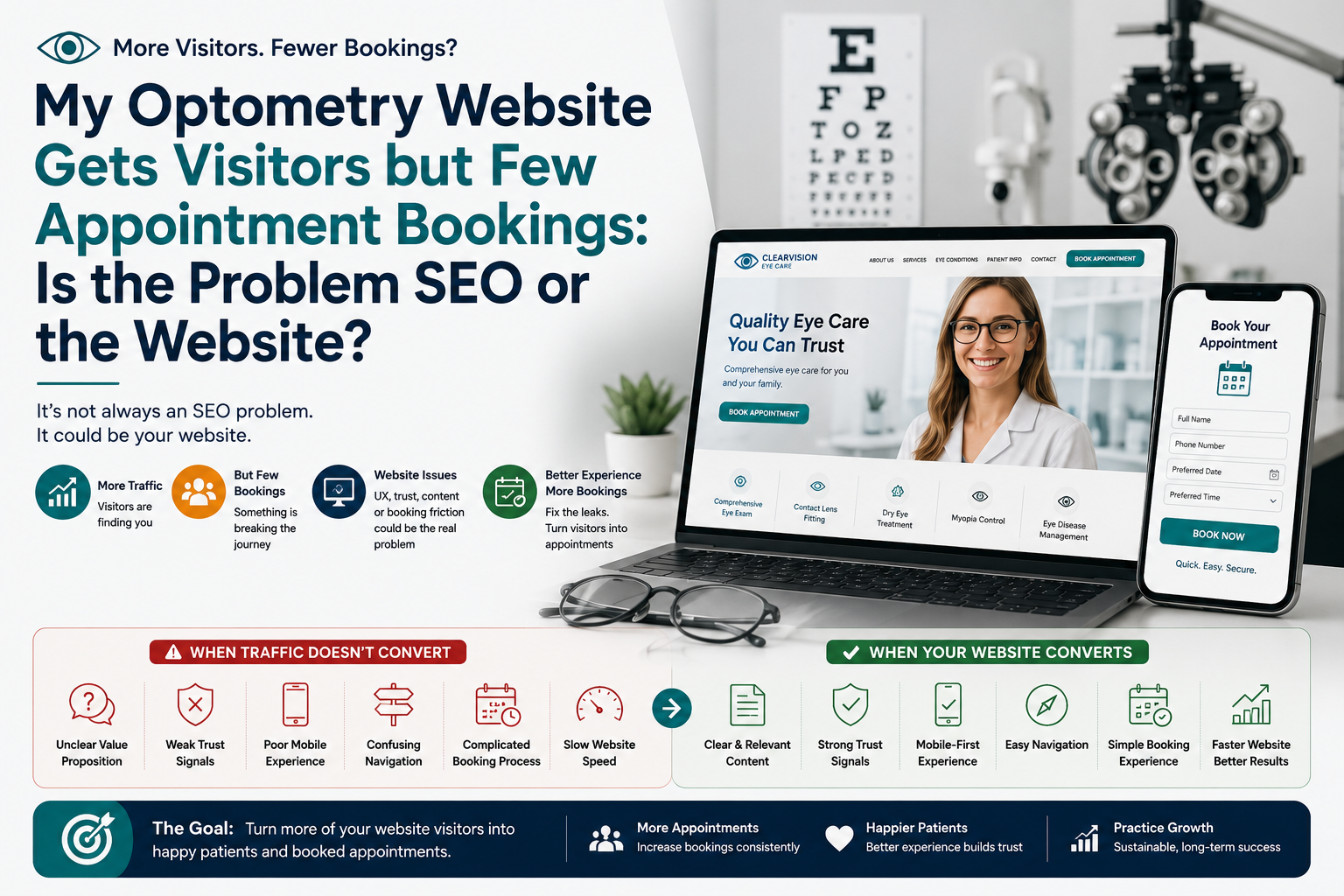
If your optometry website traffic no bookings problem is happening despite relevant visitors reaching the site, do not automatically increase SEO spending. Before investing in optometry website design services, first identify where patients are dropping out: search visibility, service-page relevance, patient trust, booking calls to action, or the scheduling process itself. If traffic is weak, investigate SEO and local search. If qualified visitors are reaching the right pages but not booking, prioritize conversion optimization, UX improvements, or a strategic website redesign before buying more traffic.
The fastest way to diagnose the problem is to separate visibility, intent, trust, action, and completion rather than treating “website traffic” as one metric.
| What you see | Likely problem | What to investigate first | Recommended priority |
|---|---|---|---|
| Very little relevant search traffic | SEO / local visibility | Search Console, rankings, local presence, service targeting | SEO |
| Traffic is increasing but mostly informational | Search intent mismatch | Queries, landing pages, content intent | SEO + content |
| Relevant visitors reach service pages but leave | Relevance / UX | Page messaging, service clarity, mobile experience | CRO |
| Visitors engage but rarely click booking | Trust / CTA problem | CTA visibility, reviews, provider credibility, page structure | CRO |
| Booking clicks are strong but completed bookings are weak | Booking friction | Scheduling platform, fields, availability, errors | Booking UX |
| Problems exist throughout the site | Structural website problem | Navigation, CMS, mobile UX, architecture, templates | Redesign |
| Traffic, engagement and booking flow are healthy | Marketing may need scaling | Conversion data, economics, acquisition channels | SEO / PPC |
This distinction matters financially. If the problem is conversion, increasing traffic can increase your marketing expense without proportionately increasing appointments.
Google’s own guidance also makes an important distinction for local search: local results are primarily influenced by relevance, distance, and prominence. Complete and accurate Business Profile information helps Google understand what a practice offers and match it with relevant searches.
So the first question should not be:
“Should I spend more on SEO?”
It should be:
“Where exactly is the patient journey breaking?”
Website traffic only tells you that people are arriving. It does not tell you whether they are the right patients, whether they found the information they needed, whether they trusted the practice, or whether the booking process was easy enough to complete.
For an optometry practice, a visitor might arrive after searching for an eye exam, contact lens services, pediatric eye care, urgent eye care, specialty lenses, or a specific provider. Those visitors have different needs and different levels of appointment intent.
A visitor searching for “eye exam near me” is already closer to an appointment decision than someone reading a general article about eye health. Your website needs to recognize that difference.
Traffic is an acquisition metric. Appointments are a business outcome.
That sounds obvious, but it changes how a practice should evaluate marketing.
Suppose a practice receives 1,000 monthly visitors. That number alone tells you very little. You need to know:
That is why I would not recommend making a redesign decision from Google Analytics traffic alone.
A useful model is:
Search → Service Page → Relevance → Trust → Booking CTA → Scheduling → Completed Appointment
If the first stage is weak, you may have an SEO problem.
If the middle stages are weak, you may have a website or CRO problem.
If the final stage is weak, the scheduling experience may be the problem.
That distinction is critical because each problem requires a different investment.

A professional eye clinic website should do more than look good. It should build trust, explain your services clearly, and make booking an appointment effortless.
SEO is more likely to be the problem when the practice is not receiving enough relevant, local, appointment-oriented search visibility in the first place.
Google says local ranking is primarily based on relevance, distance, and prominence, while complete business information helps Google understand and match a business to searches.
For an optometry practice, I would investigate:
A practice can have growing organic traffic while still having weak appointment potential if the traffic is poorly aligned with its commercial services.
Ask:
“Are enough people with appointment intent finding the right page?”
If the answer is no, SEO deserves attention.
If the answer is yes, continuing to buy more traffic before fixing the website can be the wrong sequence.
The website becomes the more likely problem when qualified visitors are already reaching relevant pages but are not taking the next logical action.
This is where I would look beyond rankings and inspect the patient journey itself.
A visitor should be able to understand, with very little effort:
This is particularly important because online scheduling is not merely a technical feature. Research published in Frontiers in Digital Health in 2025 examined online appointment scheduling in an ophthalmology practice and university hospital. In the practice studied, online bookings accounted for an average 22.8% of appointments during the observation period, and online-booked appointments had a lower median no-show rate than offline appointments in that practice.
The study does not prove that every optometry practice will achieve the same result. What it does demonstrate is that the appointment journey itself can have measurable operational consequences.
There is also a useful patient-experience signal from Healthgrades’ 2025 research: its published summary reports that 80% of respondents used online appointment scheduling at least some of the time, while 55% said they would consider changing doctors for a provider offering the feature.
That makes the booking experience a business consideration, not simply a web-design preference.


Before recommending a complete redesign, I would inspect the highest-intent patient journey rather than judging the homepage aesthetically.
If this were my website, I would start with the page most likely to generate an appointment, not the page that looks most important internally.
I would inspect five stages.
Does the page match what the visitor expected to find?
If someone searches for a specific optometry service and lands on a generic homepage, the website has already introduced unnecessary friction.
Can the visitor quickly understand the service, who it is for, and why this practice is relevant?
A vague headline such as “Comprehensive Eye Care for Your Family” may sound polished, but it does not necessarily answer the patient’s immediate question.
Patients need enough information to feel comfortable taking the next step.
That can include:
The booking action should be obvious without becoming aggressive.
The patient should not have to search through the navigation, scroll through several sections, or decipher an ambiguous button.
This is frequently overlooked.
A website can have an excellent “Book Now” button and still lose patients if the scheduling system:
That is why patient booking UX should be evaluated as part of the website conversion system, not as a separate afterthought.


Patients often decide whether to contact a clinic before making a call. Build credibility with a website that clearly communicates your expertise, services, patient experience, and next steps.
At KG Web Designer, we look at a website as part of a larger business journey rather than as an isolated design asset.
A visually attractive website with weak search intent, unclear service information, poor trust signals, or a difficult booking journey can still underperform.
KG Web Designer is a conversion-focused website design studio specializing in custom websites for clinics, professional services, manufacturers, and growing businesses.
And that distinction matters when deciding whether the next investment should be SEO, CRO, PPC, or a redesign.
The right marketing decision depends on where the patient journey is failing, not on how attractive the website looks or how much traffic Google Analytics reports. I recommend separating the problem into five stages: visibility, relevance, trust, action, and completion. This prevents a practice from paying for more traffic when the real issue is a weak service page, unclear positioning, poor mobile experience, or friction inside the appointment process.
Visibility → Relevance → Trust → Action → Completion
| Stage | Question to ask | Warning sign | Likely solution |
|---|---|---|---|
| Visibility | Are the right local patients finding us? | Weak qualified search traffic | SEO / local SEO |
| Relevance | Does the landing page answer their search? | High exits from service pages | Content / landing-page optimization |
| Trust | Does the practice feel credible? | Visitors view services but do not act | Trust and UX improvements |
| Action | Is booking the obvious next step? | Few booking CTA clicks | CRO |
| Completion | Can patients finish booking easily? | Many clicks but few completed bookings | Booking UX / scheduling improvements |
This framework is useful because it changes the conversation from “SEO versus redesign” to evidence versus assumption.
Google’s current guidance for AI features also reinforces the importance of fundamental SEO rather than a separate optimization system. Google says its AI features use the same underlying Search fundamentals and that there are no additional technical requirements specifically for appearing in AI Overviews or AI Mode.
For a practice owner, the practical implication is simple: fix the actual patient journey first, then decide which marketing channel deserves additional investment.
You should invest in the channel that addresses the bottleneck shown by your data, because each option solves a different business problem. SEO is primarily an acquisition strategy, PPC can create faster visibility for targeted searches, CRO improves the percentage of existing visitors who take action, and redesign becomes appropriate when the underlying website structure prevents those improvements from working properly.
| Situation | SEO | CRO | PPC | Redesign | Priority |
|---|---|---|---|---|---|
| Very low qualified organic traffic | High | Low | Medium | Low | SEO |
| Good traffic but poor service-page engagement | Medium | High | Low | Medium | CRO / UX |
| Strong traffic but weak booking CTA engagement | Low | High | Low | Medium | CRO |
| Strong booking clicks but weak completion | Low | High | Low | Low | Booking UX |
| Poor mobile experience across the site | Low | High | Low | High | Redesign |
| Confusing navigation and service structure | Low | High | Low | High | Redesign |
| New location needs immediate visibility | Medium | Low | High | Low | PPC + local SEO |
| Website works well but needs more qualified demand | High | Medium | High | Low | SEO / PPC |
| Website is outdated across multiple templates | Low | Medium | Low | High | Redesign |
This table should be used as a decision aid, not a replacement for analytics. Before spending, compare Search Console data, analytics, landing-page behavior, booking CTA interactions, and the actual scheduling journey.
Do not use SEO to solve a website conversion problem.
If qualified patients are already reaching the right pages but failing to book, more traffic may simply produce more non-booking visitors.
Likewise, do not redesign a website to solve an SEO visibility problem if the current website already provides a technically sound, useful experience and simply lacks search visibility.
The expensive mistake is choosing the wrong solution because it is easier to sell or easier to explain internally.
“One trend we repeatedly observe is that AI search engines reward clarity over promotion. Clinics often invest significant resources into visual design while underinvesting in expertise communication. AI systems are not impressed by claims. They respond to evidence. Physician credentials, treatment authority, educational content, patient trust signals, and structured information consistently outperform marketing language when it comes to earning citations.”
Patients are usually trying to reduce uncertainty before they commit to an appointment, so the website needs to answer practical questions before asking for the booking. This is where patient trust becomes a conversion factor rather than a decorative design element.
A prospective patient may want to know:
These questions become particularly important on service pages.
A generic page that says “We provide comprehensive eye care” forces patients to interpret what that means. A stronger page makes the service, provider, process, location, practical information, and next action obvious.
First, service specificity matters. A practice may offer many services, but a prospective patient typically arrives with one immediate problem or need. The page should make that service easy to identify.
Second, provider credibility should not be buried. Patients considering an appointment with an unfamiliar practice often need reassurance before they are ready to act. Provider information, qualifications, experience, reviews, and real practice details can contribute to that confidence.
Third, the booking CTA should follow the decision rather than interrupt it. A “Book Appointment” button is useful, but its effectiveness depends on whether the surrounding page has answered enough questions for the patient to feel ready.
These observations are more useful than simply saying “make your website user-friendly.”


Mobile booking deserves separate attention because a patient may discover a practice, evaluate its services, and attempt to schedule an appointment from the same device and session. A website that looks acceptable on a phone but makes navigation, reading, or scheduling difficult can create friction at exactly the point where commercial intent is highest.
I would test the complete journey on an actual phone:
Google search → landing page → service information → provider/trust information → location → booking CTA → scheduling system → confirmation.
Do not test only the homepage.
The real question is:
Can someone who has never used this practice understand what to do next without thinking about the website itself?
If the answer is no, the problem is probably not a lack of traffic.
Google’s current AI Search documentation also emphasizes that websites should continue following fundamental SEO and usability practices rather than attempting to create a separate “AI-only” optimization layer.
That matters here because the same clear structure that helps a human visitor understand a page also gives search systems clearer information about the page’s purpose.
Kanika Gupta, Founder, KG Web Designer
If this were my website, I would not approve a redesign simply because appointment numbers are disappointing. I would first follow one high-intent patient journey from search to completed booking and identify the exact point where confidence or momentum disappears.
In my experience, the most useful website diagnosis often happens before any design work begins.
I would want to know whether the practice has a traffic problem, an intent problem, a trust problem, an action problem, or a completion problem. Those sound similar when viewed from a monthly appointment report, but they require very different solutions.
For example, if a practice ranks well for relevant services and visitors are reaching those pages, I would be reluctant to recommend spending heavily on additional SEO until the website’s conversion path has been examined.
On the other hand, if the practice has a strong website experience but lacks visibility for commercially relevant local searches, redesigning the website may have little effect on the underlying acquisition problem.
That is why I prefer diagnosis before prescription.
At KG Web Designer, the objective is not simply to make a practice website look newer. The objective is to create a clearer path between patient intent and business action.
The first fix should be the highest-friction point that affects visitors who already demonstrate meaningful appointment intent. In practical terms, that usually means reviewing the service landing pages and booking journey before commissioning a complete redesign or increasing acquisition spend. For practices concerned about eye clinic website bookings, the first step is to identify whether patients are leaving because of weak information, insufficient trust, or friction in the booking journey.
I would prioritize the work in this order:
Check whether the booking action is:
Every important service should have a page that clearly explains:
Review:
Do not assume that responsive design automatically means good mobile UX.
Test:
Once the website can convert relevant visitors more effectively, additional SEO or PPC investment becomes easier to evaluate.
This sequence protects the practice from paying to amplify a broken journey.
A specialized website strategy becomes commercially justified when the practice’s problems are structural rather than isolated. If several templates have unclear messaging, navigation is confusing, service information is poorly organized, mobile UX is weak, trust signals are buried, and booking pathways are inconsistent, individual page edits may only treat symptoms.
That is when optometry website design services should be evaluated as a broader conversion project rather than as a cosmetic redesign.
The goal should be to rebuild the relationship between:
Search intent → service architecture → patient trust → appointment action.
A good project should also preserve what is already working. Existing rankings, useful content, URLs, analytics data, and successful landing pages should be reviewed before major structural changes are made.
This reduces one of the biggest fears practice owners have when considering a redesign: losing something that already works.
If the current site has valuable organic visibility, the redesign process should therefore include an SEO migration plan rather than treating search performance as something to deal with after launch.
Before committing to another marketing campaign, identify where prospective patients are leaving the journey. KG Web Designer can review your service-page structure, mobile experience, trust signals, calls to action, and appointment pathway to identify the highest-priority conversion problems.
Request an Optometry Website Conversion Review
Patients don’t just compare clinics — they compare clarity, professionalism, and ease of booking. A well-designed eye clinic website builds confidence before they even call.
Continuing to increase traffic before understanding the conversion problem can waste marketing budget because every new visitor enters the same patient journey. If the website is losing qualified visitors because of weak service pages, buried trust information, poor mobile UX, or booking friction, more traffic simply increases the number of people exposed to the same problem.
This is why I would diagnose the website before recommending a larger acquisition budget.
A useful rule is:
If qualified visitors are reaching the right pages but are not moving toward an appointment, investigate conversion before increasing acquisition.
That does not mean SEO is unimportant. It means the sequence matters.
Google’s current guidance says AI Overviews and AI Mode continue to rely on foundational SEO practices, including crawlability, internal linking, useful textual content, page experience, and accurate structured data. Google also emphasizes original, people-first content rather than content created primarily to manipulate rankings. A local SEO optometrist strategy can increase visibility for geographically relevant searches, but additional visibility will not solve a website that fails to convert qualified visitors.
For a practice owner, that translates into a simple business question:
Is the next dollar better spent bringing another visitor to the website, or making the existing visitor more likely to book?
Most practices get this wrong because “more traffic” is an easier problem to understand than “where are patients losing confidence?” Traffic appears as a clear number in a report, while conversion problems require examining search intent, page content, mobile behavior, trust signals, calls to action, and the scheduling experience together. A useful distinction is whether your optometrist website leads are low because too few qualified visitors arrive or because existing visitors fail to take the next step.
Three mistakes appear repeatedly in this type of diagnosis.
More relevant visitors can create more opportunities, but traffic does not guarantee conversion.
A practice may rank for informational searches that generate visibility without producing strong appointment intent. That is why traffic should be evaluated alongside landing pages, search queries, engagement, booking actions, and completed appointments.
An outdated visual style can be a legitimate problem, but aesthetics alone do not prove that redesign is the correct investment.
If the existing site has strong rankings, useful content, clear navigation, and a functional booking journey, a full rebuild may create unnecessary risk. The better approach may be targeted CRO and UX improvements.
A booking button cannot compensate for unclear service information.
Patients may need to understand the provider, service, location, appointment expectations, insurance or payment considerations, and credibility of the practice before they are ready to act.
The booking CTA is the action point, not the entire persuasion system.


A strong conversion journey reduces uncertainty at every meaningful step, moving the visitor from a specific need toward an easy appointment action. The website should not make prospective patients work out how the practice can help them. Effective eye clinic conversion depends on connecting search intent, relevant service information, patient trust, clear calls to action, and a frictionless scheduling process.
A practical journey looks like this:
Relevant Search
↓
Relevant Service Page
↓
Clear Service Information
↓
Provider + Practice Trust
↓
Location + Practical Information
↓
Clear Booking CTA
↓
Simple Scheduling
↓
Appointment Confirmation
The important point is that every stage has a different job.
SEO gets the right person to the website.
The landing page confirms relevance.
The content builds understanding.
Trust signals reduce hesitation.
The CTA creates action.
The scheduling system completes the conversion.
That is why blaming SEO for every appointment problem is too simplistic.
Imagine an optometry practice that receives a steady stream of visitors from searches related to eye exams and contact lenses. The practice owner sees traffic increasing but notices that appointment volume has not increased at the same pace.
The first reaction might be to hire an SEO agency and target more keywords.
I would take a different approach.
I would first compare the highest-intent landing pages with appointment behavior. If visitors are reaching the right service pages but rarely interacting with booking CTAs, I would inspect messaging, trust, page hierarchy, mobile UX, and the booking journey before recommending more traffic.
If visitors frequently click “Book Appointment” but fail to complete the process, I would investigate the scheduling system instead.
The same symptom, “few appointments,” can therefore have completely different causes.
The first priority should be the point where qualified patients experience the greatest friction, followed by the pages and trust elements supporting that journey. Only after those fundamentals are working should a practice decide whether additional SEO or PPC investment is justified.
Review:
Prioritize pages that already receive qualified traffic.
Improve:
Test the complete booking process. Improving patient booking UX means removing unnecessary steps between a patient’s decision to schedule and the completed appointment request.
Ask:
Online scheduling deserves attention because there is evidence that its operational impact can extend beyond convenience. A 2025 ophthalmology study involving more than 16,000 practice appointments found that online scheduling accounted for 22.8% of appointments in the studied practice and was associated there with lower no-show rates and fewer unused appointment slots. The researchers also found different results in a university hospital setting, which is an important reminder that outcomes depend on the specific healthcare environment.
The lesson is not that every optometry practice will achieve those numbers. The useful lesson is that the scheduling system is part of the patient experience and should be measured rather than ignored.
If your current website is not converting visitors into appointments, it’s time to fix the experience. I help optometrists and eye clinics build websites that drive real patient enquiries.
You probably need a redesign when the conversion problems are structural across the website rather than isolated to one page or one CTA. If the problems can be fixed through targeted content, UX, CTA, or booking improvements, a complete redesign may be unnecessary. Good optometry website design should make the patient journey easier to understand and complete, rather than simply making the practice look more modern.
| Problem | Targeted improvement | Full redesign |
|---|---|---|
| One weak service page | Yes | Usually no |
| CTA is difficult to find | Yes | Usually no |
| Provider information is buried | Yes | Usually no |
| One broken booking link | Yes | No |
| Poor mobile experience across the site | Sometimes | Often |
| Confusing navigation | Sometimes | Often |
| Weak service-page architecture | Sometimes | Often |
| Multiple inconsistent templates | Rarely | Often |
| Outdated technical infrastructure | Rarely | Often |
| Major content and UX problems across the site | Limited | Yes |
| SEO migration risk from major URL changes | Manage carefully | Yes, if rebuilding |
The distinction is important because a redesign should solve a business problem, not simply produce a newer-looking homepage.
If the problem is isolated, optimize.
If the problem is repeated across templates, restructure.
If the problem affects the entire patient journey, redesign.
That is a much safer decision than redesigning because competitors have newer-looking websites.
I would not attach an invented conversion percentage to a client project simply to make this article sound more authoritative. Instead, one of the diagnostic patterns we look for during website reviews is the gap between what a practice wants patients to do and what the website actually makes easy to do.
A common pattern is a practice with good services and credible providers but a website where those strengths are difficult to discover. Service information may be too generic, provider credibility may appear several clicks away, and the booking action may compete with too many other navigation choices.
The solution in that situation is not automatically “more SEO.”
The practical response is to reorganize the patient journey so the website makes the existing value easier to understand and act upon.
That is also why I recommend measuring the journey before and after changes rather than claiming that a redesign automatically produces a particular percentage increase.


From showcasing your services to building patient confidence and encouraging bookings, your website should support your clinic’s growth at every step.
The financial opportunity is not simply about increasing the number of website visitors. It is about improving the percentage of qualified visitors who move from interest to an appointment while protecting the acquisition investment already being made.
If your practice has strong visibility but weak conversion, fixing the website can make existing marketing spend more productive.
If the website already converts well but does not receive enough qualified visitors, SEO or PPC may deserve more attention.
If both acquisition and conversion are weak, the answer may require a coordinated strategy rather than a single-channel fix.
And if the website is structurally preventing improvements in both areas, a strategic redesign may be the most sensible long-term investment.
This is where optometry website design services become valuable when they are approached as a business and conversion project rather than a visual refresh.
Before hiring anyone for an optometry website project, ask them to explain what they believe is broken and why before they explain what they want to build.
A strong provider should be able to discuss:
Be cautious if the entire proposal focuses on colors, animations, homepage visuals, or generic promises about “more leads.”
A professional website project should connect design decisions to business outcomes.
If your practice is specifically struggling with visitors who are not turning into appointments, you can review KG Web Designer’s broader framework for diagnosing a website gets traffic but no enquiries problem before deciding whether a redesign is necessary.
Professional help makes sense when you have enough evidence that the problem is larger than a few isolated edits, or when you cannot confidently identify where qualified visitors are dropping out. The value of an experienced website strategist is not simply in building pages, but in connecting search intent, information architecture, trust, UX, conversion, and technical implementation.
I would consider outside help when:
For practices specifically facing an optometry website traffic no bookings problem, the right project should begin with diagnosis rather than immediately prescribing a new website. Optometry and Eye Clinic Website Design
Patient trust and mobile usability work together because a prospective patient must both believe the practice is credible and be able to act without unnecessary friction. A polished website is not enough if the patient cannot quickly understand the service, evaluate the provider, locate the practice, or schedule an appointment.
For a deeper examination of the reasons prospective patients abandon eye-clinic websites, this guide on why patients leave eye clinic websites without booking expands on the trust, messaging, navigation, and booking issues that can interrupt the patient journey.
The broader principle is simple:
Trust creates willingness. UX creates momentum. Booking creates action.
A mobile-first experience should make the highest-intent actions easier rather than simply shrinking the desktop layout. For an optometry practice, that means testing service pages, provider information, location details, calls to action, forms, and appointment scheduling on the devices patients actually use.
Mobile UX should therefore be treated as part of conversion strategy.
If your practice wants to investigate the relationship between mobile usability, patient confidence, and appointment behavior in greater depth, the article on eye clinic website design and why mobile UX impacts patient trust and bookings provides a useful supporting resource.


A redesign is justified when the current website’s structure prevents meaningful improvement, but a targeted optimization project is usually preferable when the problems are isolated. The decision should be based on evidence from the patient journey rather than the age of the website or whether the design looks fashionable.
If the practice has:
then a full redesign may not be the first priority.
If the practice has:
then a strategic redesign may make more sense.
For practices considering what changes before committing to a rebuild, the before-and-after optometry website redesign strategy can be used as a supporting resource when evaluating structural versus cosmetic improvements.
My strongest recommendation is simple: do not confuse a traffic problem with a website problem, and do not confuse a website problem with a design problem.
When I evaluate a practice website, I want to know what the prospective patient is trying to accomplish and whether the website makes that decision easier.
If the right patients cannot find the practice, improve visibility.
If they find the practice but cannot understand the service, improve relevance.
If they understand the service but hesitate, improve trust.
If they trust the practice but cannot easily book, improve conversion and scheduling.
And if these problems are structural across the website, then consider a redesign.
That sequence protects the practice from spending money on the wrong problem.
The question is not simply whether your optometry website needs more traffic or a new design. The better question is where qualified prospective patients are being lost between search and appointment.
If relevant traffic is weak, SEO and local search deserve attention. If relevant visitors are already reaching the right pages but failing to act, focus on service-page relevance, trust, mobile UX, CRO, and booking friction before increasing acquisition.
Google’s current guidance supports this people-first approach: successful search and AI visibility still depend on useful, original content, strong page experience, accessible content, and sound technical SEO fundamentals.
At KG Web Designer, I approach optometry website design services as part of that larger conversion system rather than as a cosmetic redesign exercise.
If you already have visitors but are not getting enough appointments, the next step should be diagnosis.
Do not buy more traffic until you know what happens to the traffic you already have.
If your practice is receiving visitors but appointment growth is not keeping pace, request a focused website conversion review. The goal is to identify whether your biggest opportunity is SEO, CRO, UX, booking optimization, or a broader website redesign.
Not automatically. First determine whether the existing visitors are relevant and whether they reach high-intent service pages. If qualified visitors are already arriving but appointment actions remain weak, CRO, UX, trust, or booking improvements may produce a better return than simply increasing traffic.
A redesign is more appropriate when problems affect the site’s overall structure, navigation, mobile experience, service architecture, trust presentation, and booking journey. If only one or two pages have problems, targeted optimization may be more efficient. Review the complete patient journey before committing to a full rebuild.
Yes, if the website is already receiving relevant visitors but losing them before they book. Improving service-page clarity, trust signals, calls to action, mobile UX, and scheduling friction can make existing traffic more valuable. However, website improvements cannot compensate for a fundamental lack of qualified search visibility.
Start with the highest-intent patient journey. Review the search query, landing page, service information, trust signals, booking CTA, mobile experience, and scheduling process. Fix the earliest major point of friction before investing in lower-priority visual changes or additional acquisition.
PPC can be useful when a practice needs targeted visibility quickly, but it should not be used to bypass a poor conversion experience. If paid visitors reach a website with weak service pages or a difficult booking journey, the practice can spend more without solving the underlying conversion problem.
Online scheduling can be commercially and operationally important, but the exact impact varies by practice. A 2025 ophthalmology study found meaningful differences in online scheduling usage and appointment utilization across two healthcare settings, demonstrating that scheduling behavior should be measured rather than assumed.
Ask them to identify the business and conversion problems they believe need solving before discussing visual design. They should be able to explain their approach to patient intent, service architecture, mobile UX, trust, booking flow, analytics, SEO preservation, and post-launch measurement.