
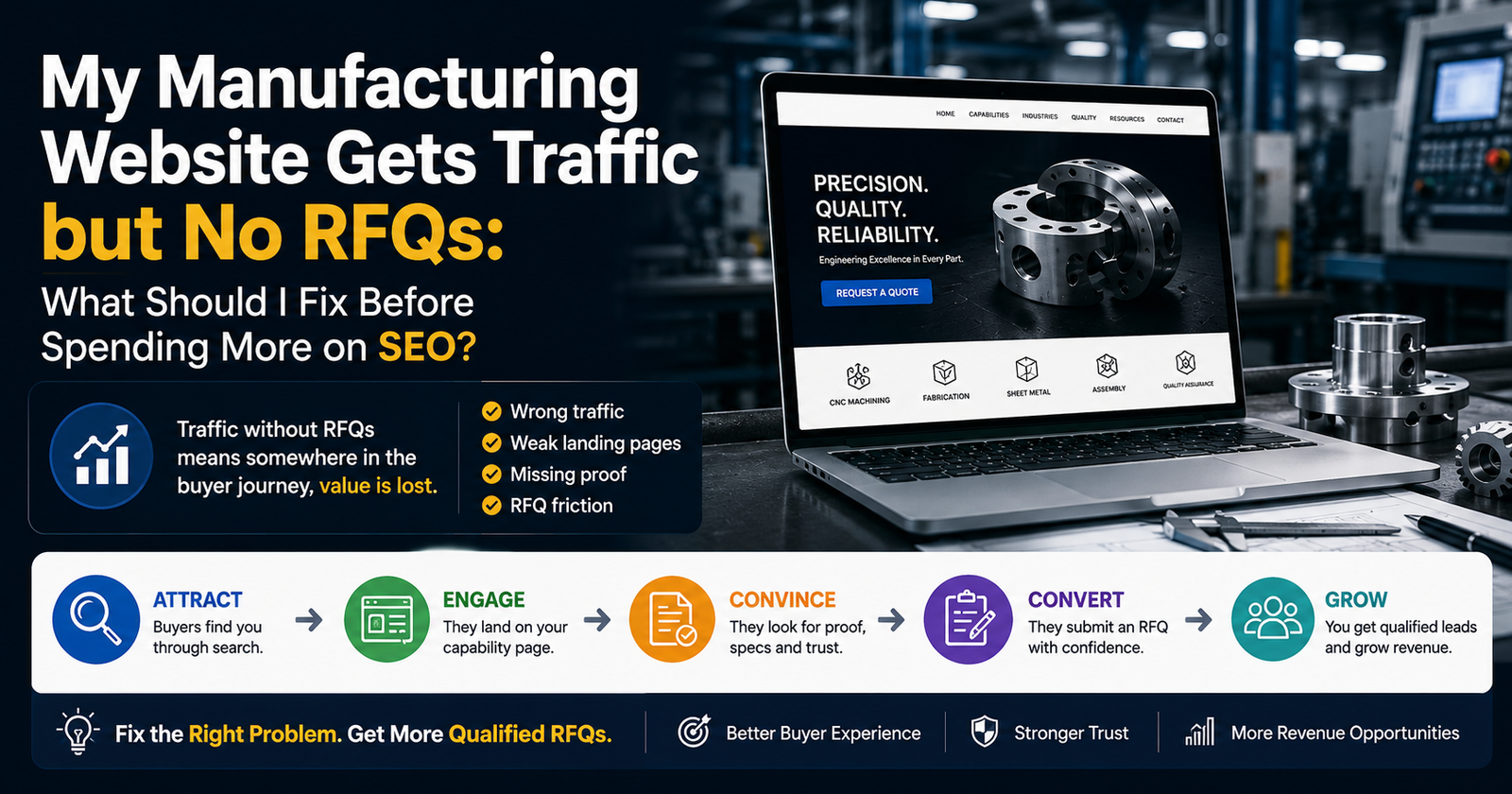
Effective manufacturing website design should turn relevant website traffic into qualified RFQs, not simply generate visits. If you are facing the manufacturing website traffic no RFQs problem despite attracting relevant buyers, do not automatically invest more in SEO. First determine whether visitors can quickly verify your capabilities, technical fit, certifications, applications, proof, and quotation process. If qualified visitors are arriving but not taking action, fix the buyer journey, landing pages, trust signals, and RFQ process before increasing traffic.
A manufacturing website can attract substantial traffic without producing RFQs when the visitors, landing pages, technical information, trust signals, or conversion path do not align with procurement intent.
This distinction matters because website traffic is an activity metric, while an RFQ is a commercial action.
A manufacturer may rank for terms related to materials, processes, products, applications, technical questions, or general industry information. Those visitors can be useful for long-term visibility, but they are not necessarily ready to evaluate a supplier.
The more important question is:
Are the people reaching your website actually capable of becoming customers, and does the website help them take the next step?
At KG Web Designer, we approach this as a conversion diagnosis rather than assuming every traffic problem requires more SEO. KG Web Designer is a conversion-focused website design studio specializing in custom websites for clinics, professional services, manufacturers, and growing businesses.
For manufacturers, this distinction is particularly important because a procurement buyer may not need a sales conversation at the beginning of the journey. They may first need to determine whether your company can manufacture the required component, meet the specification, support the application, satisfy quality requirements, and deliver within the required timeframe.
Only after those questions are answered does an RFQ become a logical next step.
Current industrial buyer research shows that supplier websites increasingly influence supplier selection before a buyer ever speaks with sales, which means a manufacturer’s website has to perform part of the qualification process.
Kula Partners’ Q1 2026 Industrial Buyer Pulse surveyed 303 North American decision-makers involved in industrial purchasing. It found that 76% had placed at least one supplier on a shortlist before speaking with them live. The same study reported that 55% said the level of proof required to approve a major 2026 investment was higher than the previous year.
The Q3 2025 study provides another useful signal: 82% of respondents had shortlisted suppliers before speaking with them, while supplier websites were the first information source for 31% of respondents’ most recent significant purchases.
Gartner’s March 2026 research points in the same direction. Its survey of 646 B2B buyers found that 67% preferred a rep-free experience and 45% had used AI during a recent purchase.
Gartner’s May 2026 research adds an important nuance: buyers still want human validation at important moments. Sixty-nine percent said they prefer to validate AI-generated insights with sales representatives, while 67% preferred a rep-free experience and 70% preferred a completely digital, self-service buying experience.
The practical implication is simple: your website should answer routine qualification questions independently, while your sales and engineering teams should become more valuable when human validation is actually needed.
👉 Discover the top 3 things holding your website back.
Before increasing SEO investment, measure whether the existing traffic is relevant, whether visitors reach commercially important pages, and whether those pages provide a clear path toward an RFQ.
A useful diagnostic table is:
| What you see | What it may indicate | First action |
|---|---|---|
| High traffic, low commercial relevance | SEO targeting problem | Review search intent |
| Relevant traffic, low engagement | Landing-page mismatch | Improve page relevance |
| Capability-page traffic, few RFQs | Conversion problem | Review CTA and proof |
| Buyers repeatedly ask basic questions | Content gap | Improve technical information |
| Strong technical content, weak trust | Proof problem | Improve certifications, evidence and case studies |
| Many low-quality inquiries | Qualification problem | Improve RFQ questions |
| Strong RFQs but weak sales outcomes | Sales/process issue | Review qualification and follow-up |
| Almost no qualified traffic | Visibility problem | SEO and information architecture |
This prevents an expensive mistake: treating every weak lead-generation result as an SEO problem.
For example, suppose a manufacturer receives 8,000 monthly organic visits. If most visitors arrive through informational searches unrelated to the company’s actual capabilities, doubling that traffic may produce very little commercial value.
Conversely, a manufacturer receiving only 1,000 monthly visitors may already have an attractive opportunity if 200 of those visitors are arriving on high-intent capability or application pages.
That is why manufacturing website leads should be evaluated by relevance and commercial intent, not simply by volume.

The KG Manufacturing RFQ Readiness Framework evaluates whether a website gives a qualified procurement buyer enough information and confidence to move from research to quotation.
The framework uses five stages:
| Stage | Buyer question | Website responsibility |
|---|---|---|
| 1. Intent | Did I find the right supplier? | Match search and landing-page intent |
| 2. Capability | Can they make what I need? | Explain processes, materials and capabilities |
| 3. Evidence | Can they prove it? | Show certifications, specifications and technical proof |
| 4. Confidence | Can I trust this supplier? | Demonstrate quality, experience and reliability |
| 5. Action | How do I request a quote? | Provide a clear, low-friction RFQ path |
This framework is deliberately different from a conventional website checklist.
The objective is not simply to determine whether a website “looks professional.” It is to determine whether the site supports the sequence a procurement buyer follows when evaluating supplier risk.
A manufacturer can have excellent equipment and experienced engineers but still lose opportunities if the website does not communicate those strengths clearly.
You can also score each area out of 20:
| Area | Maximum |
|---|---|
| Search intent alignment | 20 |
| Capability clarity | 20 |
| Technical evidence | 20 |
| Buyer confidence | 20 |
| RFQ conversion path | 20 |
| Total | 100 |
A score below 40 suggests that increasing traffic may not solve the underlying problem.
A score between 40 and 60 indicates significant buyer friction.
A score between 61 and 80 suggests a workable foundation with meaningful conversion opportunities.
A score above 80 indicates that the website is structurally prepared to convert qualified procurement traffic, although SEO, sales processes, and market conditions can still affect results.
This is also where industrial website design becomes more than visual presentation. The architecture should help buyers move through these five stages without forcing them to search through unrelated corporate pages, PDFs, or generic product descriptions.
After working with manufacturers and industrial organizations, I’ve found that buyers rarely contact suppliers because of attractive design alone.
They reach out when a website reduces uncertainty and gives them confidence in the supplier.
The strongest manufacturing websites clearly communicate capabilities, technical expertise, quality standards, certifications, and industry experience within the first few minutes of a visit.
A procurement buyer should be able to determine technical fit, quality capability, application relevance, supplier credibility, and the next commercial step without having to request basic information from sales.
At minimum, a strong manufacturing website should make these areas easy to locate:
A procurement buyer does not necessarily need every detail on one page. The important point is that the information architecture should make these answers easy to discover.

Manufacturing websites often lose qualified buyers because technical knowledge exists inside the company but is not organized around the questions buyers use to evaluate suppliers.
This is one of the recurring patterns we see when reviewing industrial websites.
A manufacturer may have:
Yet the website may present these assets as disconnected information.
The result is a gap between what the manufacturer knows and what the buyer can verify.
That gap is commercially important.
A buyer comparing several suppliers does not have unlimited time to reconstruct your capabilities from scattered pages. If Supplier A explains its capabilities, applications, quality controls and RFQ process clearly while Supplier B requires several clicks and a sales conversation just to establish basic fit, Supplier A has reduced the buyer’s evaluation effort.
That is a website advantage, even when both manufacturers are technically capable.
Kanika Gupta, Founder, KG Web Designer, observes that manufacturers often diagnose an RFQ problem as an SEO problem too early.
In her experience, the first question should be whether a qualified visitor can verify technical capability, quality, application fit, and the next commercial step without needing to contact sales for basic information.
That distinction changes the project brief.
Instead of asking:
“How can we get more visitors?”
the better question becomes:
“What is preventing the right visitors from becoming qualified inquiries?”
That is a much more useful starting point for deciding whether the next investment should go into SEO, content, conversion optimization, or a broader website redesign.
👉 Get 3 actionable recommendations for your website.
A recurring observation from manufacturing website reviews is that companies often have more technical expertise than their websites successfully communicate.
The problem is frequently not a lack of content.
It is fragmentation.
Technical capabilities may exist in brochures. Certifications may live on a separate quality page. Applications may only appear in sales presentations. Equipment information may be hidden inside an “About” section. RFQ instructions may consist of nothing more than a generic contact form.
From a buyer’s perspective, those are not separate content problems. They are one supplier evaluation problem.
Google’s current people-first guidance specifically encourages original information, first-hand expertise, and analysis that provides value beyond simply rewriting information already available elsewhere.
For this article, that means the useful insight is not simply “manufacturing websites need better SEO.”
It is that the website should convert the manufacturer’s existing technical knowledge into an evaluation system that buyers can actually use.
If a manufacturer wants to understand the broader reasons industrial websites struggle to generate qualified opportunities, our analysis of why most manufacturing company websites fail to generate B2B leads provides useful context around buyer intent, website structure, technical content and conversion paths.
If your website already attracts relevant procurement visitors, fix the highest-friction point in the buyer journey before increasing SEO spend.
The priority should usually be:
Intent → Landing Page → Capability → Proof → Trust → RFQ
not:
Traffic → More Traffic → More Traffic
A manufacturer can have strong organic visibility and still lose opportunities because the visitor lands on a generic homepage, cannot find the relevant capability, cannot verify technical fit, or encounters a weak RFQ process.
The right intervention depends on where the journey breaks.
| Problem | Likely priority | Why |
|---|---|---|
| Wrong visitors | SEO strategy | Traffic is not commercially relevant |
| Right visitors, wrong landing page | Content/UX | Search intent is not being satisfied |
| Capability difficult to understand | Information architecture | Buyer cannot establish fit |
| Technical proof missing | Content strategy | Buyer cannot validate capability |
| Strong information, weak trust | CRO/proof | Buyer still perceives supplier risk |
| Strong pages, weak RFQs | Conversion optimization | Interest is not becoming action |
| Fundamentally outdated structure | Website redesign | Existing architecture limits improvement |
This diagnostic approach reduces the risk of spending more money on the wrong channel.
You should usually pause additional SEO investment when qualified visitors are already reaching commercially important pages but the website is failing to convert that existing demand.
Look at your highest-intent organic landing pages first.
For example, if a page targeting a specific manufacturing capability receives relevant visitors but produces almost no inquiries, ask:
If several answers are “no,” more traffic may simply increase the number of people encountering the same problems.
This is where B2B website conversion strategy becomes more valuable than blindly increasing sessions.
Do not increase SEO spend yet if your website has unresolved conversion or buyer-information problems that prevent qualified visitors from evaluating your company.
Look for these warning signs:
These problems should be addressed before assuming the website simply needs more visitors.
A useful rule is:
If the website cannot convert the right traffic, increasing the volume of the same traffic is not a complete growth strategy.
You should increase SEO investment after the website has a credible conversion foundation and search visibility is the remaining constraint.
SEO becomes a stronger investment when:
At that point, SEO can expand the number of qualified buyers entering an already-functional conversion system.
That distinction matters.
A well-designed capability page can benefit from more visibility. A poorly structured capability page may simply create more traffic without solving the underlying commercial problem.
I build high-performance manufacturing websites for founders across the US, UK, and Australia—designed to communicate your capabilities, build trust, and turn more visitors into qualified enquiries.
A manufacturing capability page should answer whether the company can perform the required work before asking the visitor to request a quotation.
A strong capability page can include:
Explain precisely what the company provides.
Avoid vague claims such as “world-class manufacturing solutions” when the buyer actually needs to know whether you perform CNC machining, metal stamping, injection molding, fabrication, casting, finishing, assembly, or another specific process.
Depending on the capability, explain relevant:
Only publish information that the manufacturer can substantiate.
Show where the capability is used.
This helps buyers determine whether the manufacturer understands their type of requirement.
Connect the capability to the industries the manufacturer genuinely serves.
Make relevant certifications, inspection procedures and quality controls visible.
Use appropriate:
Explain what information the buyer should provide and what happens next.
This structure helps turn a capability page into a procurement resource rather than an SEO landing page.
An effective RFQ form collects enough information to qualify a project without creating unnecessary friction for a technically sophisticated buyer.
The correct fields depend on the manufacturing business, but useful information can include:
The form should not become a questionnaire simply because more information sounds useful.
Instead, ask:
What information does our engineering or estimating team genuinely need to determine whether this is a viable opportunity?
For many manufacturers, file upload capability can be particularly important because drawings, CAD files, specifications and technical documentation may contain information that cannot reasonably be communicated through a short text field.
The RFQ page should also tell the buyer what happens next.
For example:
Submit your drawings and project requirements. Our team will review the information and contact you regarding technical feasibility, quotation requirements, and next steps.
The exact promise should reflect the manufacturer’s actual process.
Overseas buyers need enough information to assess not only technical capability but also whether the manufacturer appears prepared to support an international procurement relationship.
A manufacturer targeting buyers in the United States, United Kingdom, Australia, Canada, Singapore, or UAE should consider clearly communicating relevant information such as:
| Buyer concern | Website information |
|---|---|
| Where are you located? | Manufacturing and operating locations |
| Can you serve international customers? | Export/service markets, if applicable |
| Can you meet our requirements? | Capabilities and technical specifications |
| Can you prove quality? | Current certifications and quality systems |
| Can you support documentation? | Relevant technical and quality documentation |
| What happens after an RFQ? | Clear quotation process |
| How quickly will someone respond? | Accurate response expectations |
| How do we provide technical information? | Drawing/CAD/file upload options |
| Who should we contact? | Appropriate sales or technical contact |
| Can we understand the supplier before speaking with them? | Comprehensive supplier information |
Do not add export claims simply because they sound persuasive.
If a company serves only specific countries or has particular shipping limitations, the website should communicate that accurately.
For an overseas procurement buyer, clarity itself is a trust signal.
👉 Identify 3 opportunities to turn more visitors into customers.
Consider a precision manufacturer receiving organic traffic from searches related to CNC machining, but the majority of visitors land on a generic services page with limited information about materials, tolerances, applications, equipment, or quality controls.
The company might conclude that it needs more SEO because the website receives only a small number of inquiries.
But the diagnostic sequence tells a different story.
Suppose analytics show that relevant visitors are already reaching the CNC-related page.
The first intervention should be to improve the page:
Search intent → CNC capability → Materials → Tolerances → Applications → Quality → Proof → RFQ
Only after that pathway is functioning should the company determine whether additional SEO is needed to expand visibility.
The opportunity is not simply to increase sessions.
It is to make the existing commercial intent easier to convert.

Most businesses get this wrong because traffic is easier to measure and report than buyer intent, conversion friction, or supplier evaluation quality.
A monthly SEO report might show:
Those numbers can look positive while the sales pipeline remains unchanged.
The manufacturer then increases SEO investment.
The cycle continues.
A better measurement system connects marketing activity to commercial behavior:
Search query → Landing page → Engagement → Capability evaluation → RFQ → Qualified opportunity
That does not mean every website visitor should become a lead.
It means the business should understand whether the right visitors are moving toward the right commercial action.
This is particularly important in manufacturing because purchasing decisions can involve engineering, procurement, quality, operations and management.
A single visitor may not be the final decision-maker.
The website therefore needs to support the broader evaluation process rather than optimize solely for a form submission.
Purchasing managers should be able to find the information they need to compare supplier capability, quality, responsiveness, and fit without navigating through a generic corporate brochure.
That includes information such as:
We explore this buyer perspective in greater detail in our guide to what purchasing managers actually look for on a manufacturing company website, particularly how technical content and trust signals influence supplier evaluation.
The important principle is that your website should not force a procurement professional to behave like a marketer.
They should be able to arrive with a specific business requirement and quickly determine whether your company deserves further consideration.
Choose SEO when visibility is the main constraint, CRO when qualified visitors are failing to act, and redesign when the existing architecture prevents either strategy from working effectively.
| Primary problem | Recommended priority |
|---|---|
| Not enough relevant search visibility | SEO |
| Relevant visitors leave quickly | UX/content |
| Visitors reach capability pages but do not inquire | CRO |
| Buyers cannot find technical information | Content architecture |
| Website structure is fundamentally outdated | Redesign |
| Mobile experience creates friction | UX/technical optimization |
| RFQ process is confusing | Conversion optimization |
| Multiple capabilities are poorly organized | Information architecture |
| Existing website cannot support future SEO/content | Strategic redesign |
This is why a website project should begin with diagnosis rather than a predetermined deliverable.
A company that needs CRO should not automatically buy a complete redesign.
A company whose architecture is fundamentally broken should not spend another year patching individual pages.
A manufacturing website needs a redesign when structural problems prevent qualified buyers from understanding, trusting, and contacting the company, even when the underlying business has strong capabilities.
A redesign becomes more justified when:
A redesign should not begin with colors, animations, fonts, or homepage graphics.
It should begin with:
Buyer intent → Information architecture → Content → Proof → Conversion → Technology
That sequence reduces the risk of producing a visually impressive website that still fails to generate qualified opportunities.
I design manufacturing websites for founders in the US, UK, and Australia who are serious about revenue. Custom-built, conversion-focused, and delivered on time.
A stronger conversion path connects the buyer’s search intent directly to a relevant capability, supporting evidence, and a clear RFQ action.
A typical pathway can look like:
Search
↓
Capability / Application Page
↓
Technical Information
↓
Industries / Applications
↓
Quality & Certifications
↓
Relevant Proof
↓
Request a Quote
↓
Technical Qualification
This architecture benefits both SEO and conversion.
Search engines receive clearer relationships between topics and entities.
Procurement buyers receive a logical evaluation path.
Sales teams receive better-qualified inquiries.
The website becomes part of the sales process rather than simply a digital company brochure.
A focused 30-day diagnosis can reveal whether your next investment should go toward SEO, conversion optimization, content, or a larger website project.
Review:
Separate commercial traffic from general informational traffic.
Prioritize the pages most likely to influence supplier evaluation.
Improve:
Do not create content simply to increase page count.
Review:
The objective is to reduce unnecessary friction while preserving the information required to qualify an opportunity.
Build a keyword-to-page map:
Keyword → Intent → Page → Buyer question → Evidence → CTA
Then identify the gaps.
For example, if you have strong visibility for a manufacturing process but no dedicated page explaining its applications and technical capabilities, that may be a better SEO investment than publishing another general industry article.
Measure qualified commercial behavior rather than relying only on traffic growth.
Track:
Where possible, connect website submissions to actual sales outcomes.
A manufacturer should ultimately want to know:
Which pages and search journeys are producing opportunities worth pursuing?
That is a much stronger question than:
“How many visitors did SEO generate?”
If the question has moved from diagnosis to budgeting, the next consideration is the scale of the website intervention. Our manufacturing website design cost guide for 2026 explains how project scope changes depending on architecture, functionality, content, integrations, and business requirements.
That distinction matters because a manufacturer should not budget for a full website rebuild before establishing whether the underlying problem actually requires one.
In our experience, one of the most useful manufacturing website interventions is often not adding more pages, but reorganizing existing technical knowledge around the questions a buyer needs answered before requesting a quotation.
At KG Web Designer, we frequently see manufacturers with strong capabilities but websites that present those capabilities as disconnected corporate information. The company may have the right equipment, engineering expertise, certifications and application experience, but a prospective buyer has to work too hard to connect those pieces.
A typical audit pattern looks like this:
Problem: A manufacturer receives relevant organic visitors, but its capability information is spread across generic service pages, PDFs and company-profile sections. The RFQ CTA is primarily placed on the contact page.
Solution: Reorganize the relevant capability into a dedicated buyer-focused page covering process, materials, applications, technical parameters, quality, proof and the quotation pathway.
Outcome: The website becomes easier to evaluate because the buyer can establish technical fit before contacting sales. We would not attach a fabricated percentage improvement to this pattern, because conversion outcomes depend on traffic quality, market, sales process and implementation.
That last point matters.
A credible website strategy should distinguish between what the website change is designed to improve and what can actually be proven through measurement after launch.
The manufacturing website traffic no RFQs problem means your website may have a disconnect between visibility and commercial intent, and that disconnect should be diagnosed before additional traffic is purchased.
If the website attracts the wrong audience, SEO needs attention.
If it attracts the right audience but provides insufficient information, content and information architecture need attention.
This distinction is important because a traffic problem and a conversion problem require very different solutions. If you want to understand the broader diagnosis process, our guide on website gets traffic but no enquiries explains how to identify whether the real issue is visibility, relevance, trust, UX, or the customer journey before investing in more marketing.
Instead of treating SEO, website design and CRO as competing services, consider them as different interventions for different problems.
| Your current situation | Most likely priority | Investment question |
|---|---|---|
| Very little relevant organic visibility | SEO | Which commercial searches should we own? |
| Good visibility but irrelevant visitors | SEO strategy | Are we targeting the right intent? |
| Relevant visitors but weak engagement | UX/content | Does the landing page answer the search? |
| Strong capability-page traffic but few RFQs | CRO | What prevents action? |
| Buyers cannot establish technical fit | Content architecture | What information is missing? |
| Buyers cannot verify quality | Trust/proof | What evidence should be surfaced? |
| RFQs are low quality | Qualification | Are we asking the right questions? |
| Website is outdated across every stage | Redesign | Can the existing platform support the strategy? |
This framework is especially useful for leadership teams because it changes the conversation from “Do we need more SEO?” to “Where is the commercial bottleneck?”
The financial impact of poor conversion depends on traffic quality, average deal value, close rate and sales cycle, but even a small number of missed qualified opportunities can matter substantially for a high-value manufacturer.
Consider a simple scenario.
Suppose a manufacturer receives 1,500 relevant monthly organic visitors.
If 2% become meaningful inquiries, that represents 30 inquiries.
If the website’s current experience results in only 0.5% becoming inquiries, that is approximately 8 inquiries.
The difference is 22 potential inquiries per month.
That does not mean all 22 would become customers. Some would be unqualified, some would select another supplier, and some would not fit production requirements.
But the calculation demonstrates why conversion deserves attention before traffic volume.
For high-value industrial products, the economics can be particularly significant because one additional qualified opportunity can be worth more than hundreds of low-intent visitors.
This is also why the objective should not be to maximize the number of form submissions.
The objective is to increase the number of appropriate commercial conversations generated by the website.


Procurement buyer intent becomes visible when a visitor moves beyond general information and starts evaluating whether your company can satisfy a specific purchasing requirement.
A useful distinction is:
A visitor may be researching:
A visitor may be:
This is why procurement buyer intent should influence SEO and website architecture.
A page attracting 10,000 informational visitors is not automatically more valuable than a page attracting 500 procurement-focused visitors.
The commercial context matters.
If most of your traffic is informational, do not assume that all of it should be converted into RFQs; instead, build a clear path from educational content toward commercially relevant capability pages.
For example:
Educational Search
↓
Technical Article
↓
Related Manufacturing Capability
↓
Application
↓
Technical Proof
↓
RFQ
This creates a useful relationship between SEO and conversion.
A technical article can answer a research question without aggressively selling.
The article can then help an interested reader discover a relevant capability page.
The capability page can provide technical and commercial evidence.
Only then does an RFQ become a natural next step.
This approach is usually stronger than placing a generic “Contact Us” button at the end of every article.
RFQ form optimization should reduce unnecessary friction while collecting enough technical information to determine whether the opportunity deserves engineering or sales attention.
A useful RFQ form optimization review should examine five areas.
Can a qualified visitor find the RFQ option without returning to the navigation?
Does the CTA match the page?
A capability page should ideally lead toward an action relevant to that capability rather than forcing the buyer through a generic contact route.
Does the form request information that the sales or engineering team actually needs?
Can buyers provide drawings, CAD files, specifications or other relevant documentation when appropriate?
Does the confirmation experience explain what happens next?
A buyer who submits a technical request should not necessarily receive a vague “Thank you, your message has been received.”
The confirmation should reflect the actual business process.
For example, if the company genuinely reviews drawings before responding, the confirmation can explain that the submission has been received for technical review.
Never promise a response time unless the company can consistently meet it.
An overseas buyer needs enough evidence to reduce the perceived risk of starting a supplier relationship across geographic boundaries.
For a buyer in New York, London, Sydney, Toronto, Singapore or Dubai, the website may be one of the earliest ways to assess a supplier.
Relevant trust signals can include:
Avoid using generic statements such as “trusted worldwide” unless the company can substantiate them.
A stronger approach is evidence.
Instead of:
“We are a globally trusted manufacturer.”
show the information that allows the buyer to reach that conclusion independently.
That is stronger EEAT and stronger commercial communication.


You now know what the right investment looks like. The next step is a quick call — no pitch, no pressure. Just clarity on what your website needs and what it’ll cost to build it right.
Manufacturing SEO remains important because a conversion-ready website still needs qualified buyers to discover it, but SEO should amplify a functioning commercial experience rather than compensate for a broken one.
Once the core website is prepared, manufacturing SEO can expand visibility around:
The key is mapping search intent to the right page.
For example:
“What is CNC machining?”
may deserve an educational article.
“CNC machining manufacturer”
may deserve a commercial capability page.
“CNC machining supplier for aerospace components”
may require a highly specific capability or application page if the manufacturer genuinely serves that market.
The pages should not all compete for the same intent.
That is where keyword strategy, information architecture and conversion strategy need to work together.
For your business, the biggest opportunity may not be generating more website traffic but increasing the commercial value of the traffic you already have.
That can produce advantages across several areas.
A better conversion pathway gives qualified buyers a clearer route toward requesting a quotation.
Better qualification information can help sales teams distinguish serious opportunities from general inquiries.
Technical evidence and certifications reduce uncertainty during supplier evaluation.
A manufacturer that communicates its capabilities more clearly can make the buyer’s comparison process easier.
A well-structured website provides a foundation for future SEO, content, AI visibility and international market expansion.
This is why the website should be treated as part of the commercial infrastructure of the business.
It is not merely a marketing brochure.
You should consider a specialist when the website problem involves multiple connected areas such as SEO, information architecture, technical content, CRO, analytics and a broader redesign rather than a few isolated page edits. For manufacturers dealing with these interconnected issues, manufacturing website design services can provide a structured way to address the website architecture, buyer journey, technical content and RFQ experience together.
Internal teams often know the business extremely well.
That is a major advantage.
But familiarity can also make it difficult to recognize what an external buyer cannot understand.
A specialist can provide an independent perspective on:
The right specialist should not begin by selling a redesign.
They should first determine whether the business actually needs one.
A useful discovery process should answer:
That diagnostic process is more valuable than simply receiving a proposal for “a new website.”
If your website already attracts relevant procurement traffic, audit the conversion journey before committing additional SEO budget.
A practical next step is to review your top commercial landing pages against five questions:
If the answer is “no” to several of these questions, there is likely a website-side opportunity worth addressing first.
If the answers are consistently “yes” but relevant search visibility remains weak, SEO becomes a more logical next investment.
If you want a website diagnosis rather than another generic SEO report, request a website strategy consultation with KG Web Designer.
The simplest decision is to compare qualified traffic with qualified action: if the right buyers are arriving but not progressing, prioritize conversion; if the right buyers are not arriving, prioritize search visibility.
Use this final decision tree:
Are relevant buyers finding your website?
│
No ───────→ Improve SEO / search intent
│
Yes
↓
Are they reaching relevant capability pages?
│
No ───────→ Improve architecture / content
│
Yes
↓
Can they verify technical fit?
│
No ───────→ Improve technical content
│
Yes
↓
Can they verify trust and quality?
│
No ───────→ Improve proof / authority
│
Yes
↓
Can they request an RFQ easily?
│
No ───────→ Improve conversion path
│
Yes
↓
Is qualified traffic still insufficient?
│
Yes ───────→ Increase SEO investment
This is the core diagnosis behind the manufacturing website traffic no RFQs problem.
Traffic is only one part of the system.
The commercial outcome depends on what happens after the visitor arrives.
If your manufacturing website design attracts traffic but produces few RFQs, the first step is diagnosis, not automatically more SEO.
Start by separating relevant procurement traffic from general informational traffic.
Then evaluate the pages receiving commercial visitors.
Can buyers understand your capabilities? Can they verify technical fit? Can they see quality evidence? Can they understand your applications and experience? Can they request a quote without unnecessary friction?
If the answer is no, fixing the website may create more commercial value than simply increasing traffic.
If the website already performs well for qualified visitors but lacks sufficient visibility, then SEO becomes the logical growth lever.
The strongest strategy is therefore not SEO versus website design.
It is:
Relevant traffic → useful information → technical proof → buyer confidence → qualified RFQ.
That is the system your website should support.
KG Web Designer approaches manufacturing websites from that commercial perspective, combining website strategy, conversion thinking, SEO structure and buyer-focused information architecture rather than treating website design as a purely visual exercise.
If you want to identify where your website is losing qualified buyers before investing further in SEO, contact KG Web Designer for a website strategy consultation.


Your manufacturing website should do more than look professional. It should communicate your capabilities, build buyer confidence, and make it easy for prospects to take the next step.


No, but you should diagnose the traffic and conversion problem before increasing SEO spending. If relevant buyers are already reaching capability pages but are not requesting quotes, website content, trust signals, UX or the RFQ journey may need attention first. If traffic is largely irrelevant, the SEO strategy itself may need to be corrected.
Look at the behavior of qualified visitors rather than total traffic. If relevant visitors reach capability, product or application pages but rarely engage with RFQ actions, the website may have a conversion problem. Review CTA visibility, technical information, proof, page relevance, mobile usability, forms and the path from capability information to quotation.
A manufacturing website should establish capability and supplier fit before asking the buyer to submit a quotation request. Depending on the business, this can include processes, materials, specifications, tolerances, applications, industries, quality systems, certifications, equipment, relevant experience and instructions for submitting drawings or technical requirements.
Neither is automatically better because they solve different problems. SEO increases relevant discovery, while website strategy and conversion optimization improve what happens after the visitor arrives. A redesign becomes appropriate when the existing architecture, technology or user experience prevents the business from effectively supporting search visibility and buyer conversion.
Start with the highest-value commercial pages and improve their conversion path. Make the capability clear, add relevant technical evidence, strengthen trust signals, clarify applications, improve CTA placement, simplify unnecessary form fields and provide appropriate file-upload functionality. Testing these changes can reveal whether a full redesign is actually necessary.
International buyers generally need clear information that reduces uncertainty about supplier capability and the purchasing relationship. Location, certifications, technical documentation, relevant experience, communication expectations and the RFQ process can all influence confidence. Claims about international service should be accurate and supported by the company’s actual operations.
There is no universal amount because the required investment depends on the website’s existing architecture, content, technology and conversion problems. The better approach is to identify the highest-value bottleneck first. A focused conversion and content improvement may be sufficient for one company, while another may require a complete information-architecture and website redesign.
Start with the pages receiving the most commercially relevant traffic. Determine whether those visitors can understand your capability, verify technical fit, see credible evidence, understand the next step and submit an RFQ without unnecessary friction. Fix the largest bottleneck first, then reassess whether additional SEO is justified.