
August 6, 2026

Why Most Consultant Websites Feel Generic: 5 Elements That Fix It in 2026

Quick Answer

Most consultant websites feel generic because they communicate the consulting category rather than the consultant’s distinctive expertise. They rely on interchangeable promises such as “strategic growth,” “tailored solutions,” and “measurable impact” without showing who the consultant is best suited to help, how they think, or why buyers should trust them. Effective consultant website design fixes this through five elements: positioning, point of view, evidence, decision architecture, and a clear conversion pathway.

TL;DR: Why Consultant Websites Blend Together

The 5-Element Consultant Authority Framework

What Makes a Consultant Website Feel Distinctive?

At KG Web Designer, we use a simple five-part framework to evaluate whether a consultant’s website is merely describing services or actually helping buyers recognize and trust expertise.

The 5-Element Consultant Authority Framework

ElementBuyer’s QuestionWebsite’s Job
1. PositioningIs this consultant relevant to my situation?Establish relevance
2. Point of ViewDo they understand this problem differently or more deeply?Create differentiation
3. EvidenceWhy should I believe them?Reduce perceived risk
4. Decision ArchitectureCan I evaluate whether they are right for us?Support independent research
5. Conversion PathwayWhat should I do next?Turn confidence into a qualified conversation

Definition: The 5-Element Consultant Authority Framework is KG Web Designer’s approach to structuring consulting websites around five buyer needs: positioning establishes relevance, point of view creates differentiation, evidence reduces risk, decision architecture supports evaluation, and conversion pathways create a clear next step.

These elements are deliberately sequential.

A CTA cannot compensate for weak authority.

A case study cannot completely fix vague positioning.

Thought leadership cannot produce the right inquiries if visitors do not understand what the consultant actually sells.

The website becomes commercially stronger when all five work together.

5-Element Consultant Authority Framework infographic

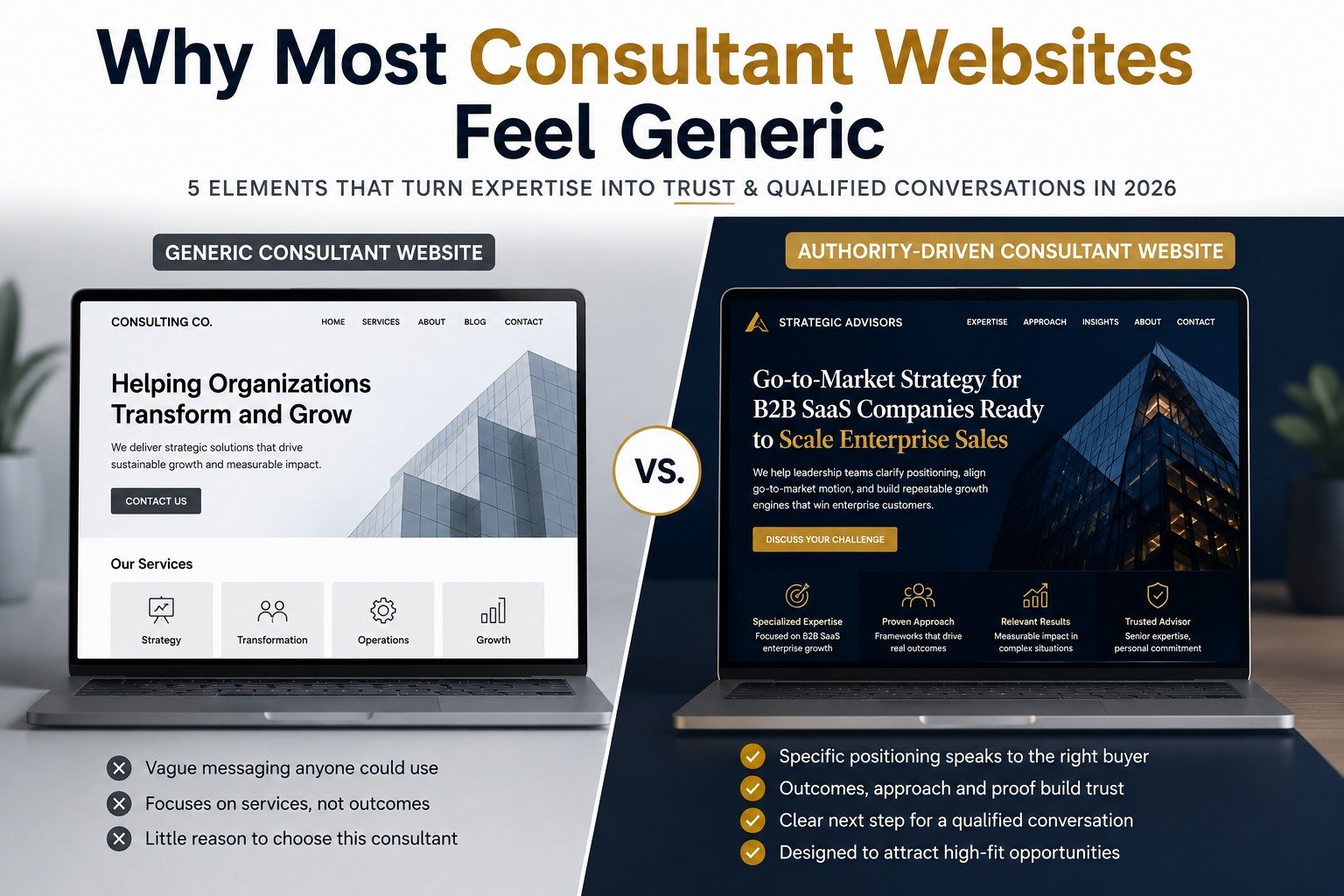
Generic Consultant Website vs. Authority-Driven Consultant Website

The difference is easier to see when we compare the complete buyer experience.

Website ElementGeneric Consultant WebsiteAuthority-Driven Consultant Website
Hero“Transform Your Business”Specific buyer + problem + relevance
PositioningBroad enough for almost anyoneDeliberately relevant to a defined buyer
ServicesStrategy, transformation, growthBusiness problems and decisions the consultant helps solve
Point of viewIndustry best practicesOriginal observations, frameworks and specialist opinions
Proof“20+ years of experience”Relevant engagement evidence and expertise
Case studiesClient logo + testimonialContext → problem → approach → evidence
InsightsGeneric trend articlesDecision guides, frameworks and original analysis
About pageCareer biographyCareer evidence connected to current expertise
CTAContact UsAppropriate next step for the buyer’s intent
International trust“We work globally”Explains how cross-border delivery actually works
Buyer experienceRequires a call to understand the offerSupports meaningful evaluation before contact

The distinction is not primarily aesthetic.

It is informational.

A generic website asks the buyer to believe that the consultant is different.

An authority-driven website gives the buyer enough information to discover the difference themselves.

Generic vs. Authority-Driven Consultant Website infographic

Why Do So Many Consultant Websites Feel the Same?

Most consultant websites feel the same because they use the language of consulting rather than the language of their own expertise.

Open several sites and you are likely to encounter variations of:

We help organizations navigate complexity.

We deliver tailored solutions for sustainable growth.

We partner with leaders to unlock potential.

We combine deep expertise with innovative thinking.

None of these statements is inherently wrong.

The problem is substitution.

A strategy consultant, HR adviser, operations consultancy, digital-transformation firm, and leadership consultant could often exchange these sentences without changing their meaning.

The website may look premium while remaining strategically anonymous.

A prospective client is asking much more specific questions:

If the website answers only “what services do we provide?”, most of the buying decision remains unresolved.

Is Your Consulting Website Attracting the Wrong Leads?

If your website looks polished but still brings low-quality enquiries, the problem is usually structure, clarity, and trust. See how a conversion-focused consultant website design can help you filter better-fit clients before the first call.

Explore Consultant Website Design →

Why Does Generic Messaging Matter More in 2026?

B2B buyers increasingly research providers before engaging directly with sales.

Gartner reported in March 2026 that 67% of surveyed B2B buyers preferred a rep-free experience. Gartner also reported that 45% of buyers had used generative AI during a recent B2B purchase.

That does not mean buyers no longer want human interaction.

In separate 2026 research, Gartner reported that 69% of B2B buyers preferred to validate AI-generated insights with sales representatives.

Taken together, the more useful interpretation is:

Independent Research

Website / Thought Leadership / AI-Assisted Research

Shortlisting

Human Validation

Commercial Conversation

For consultants, the website increasingly participates in the stages that happen before the conversation.

That makes generic messaging expensive.

If five consultants appear equally capable, the buyer has fewer reasons to keep one particular firm on the shortlist.

The KG Web Designer Competitor Swap Test

One of the simplest diagnostics we use when reviewing a professional-service homepage is what I call the Competitor Swap Test.

How the test works

Take the homepage.

Remove:

Now replace the brand name with a direct competitor.

Then read the page again.

If most of the messaging still makes sense, the website is probably communicating category-level claims rather than distinctive positioning.

For example:

Strategic solutions for sustainable growth.

Tailored expertise for complex challenges.

Helping ambitious businesses unlock their potential.

Trusted advice. Measurable impact.

Almost any competent consulting firm could claim these things.

The visual identity may be unique.

The commercial message is not.

What should survive the test?

A distinctive website should contain elements that become difficult to transfer to another consultant:

The Competitor Swap Test is not a statistical benchmark or search-engine metric.

It is a practical positioning diagnostic.

And it often reveals a problem that a visual redesign alone cannot fix.

Competitor Swap Test Infographic

Element 1: How Does Sharp Positioning Fix a Generic Consultant Website?

Sharp positioning helps the right prospect recognize relevance quickly while allowing unsuitable prospects to recognize that the consultant may not be for them.

That second part matters.

Many consulting businesses fear specificity because they assume broader messaging creates a larger market.

So they say:

Strategy for ambitious businesses.

Helping organizations transform and grow.

Solutions for today’s complex business environment.

The language avoids excluding anyone.

Unfortunately, it also gives high-value prospects little evidence that the consultant has particular expertise in their situation.

Compare these two messages.

Generic Positioning

Helping Organizations Navigate Change and Accelerate Growth

It sounds professional.

But who is it for?

What kind of change?

What type of growth?

Why this consultant?

Specific Positioning

Pricing Strategy for B2B SaaS Companies Moving From Founder-Led Sales to Enterprise Growth

Now the buyer can identify:

Expertise: Pricing strategy
Market: B2B SaaS
Business stage: Moving beyond founder-led sales
Commercial context: Enterprise growth

The second consultant may attract fewer irrelevant visitors.

That is not necessarily a disadvantage.

For a premium consulting firm website design, qualification is part of conversion.

The objective should not be:

Make everyone interested.

It should be:

Make the right buyers recognize themselves.

What Should Consultant Positioning Communicate Above the Fold?

A strong opening screen should help a qualified buyer understand four things without reading half the website.

1. Who Is This For?

Examples could include:

“Businesses” is rarely a useful audience definition.

2. What Problem Do You Understand?

Avoid:

Business transformation.

Prefer something closer to:

Integrating acquired business units after a PE-backed roll-up.

or:

Rebuilding pricing architecture as a SaaS company moves into enterprise sales.

Specific problems demonstrate familiarity with actual business situations.

3. What Strategic Direction Does the Work Support?

Consultants should avoid guaranteed outcome language when outcomes depend on factors beyond their control.

But the website can still communicate direction:

Build a repeatable enterprise sales model.

Clarify positioning before entering a new market.

Reduce decision complexity across newly acquired business units.

Develop a pricing structure appropriate for enterprise customers.

4. Why Should the Buyer Keep Reading?

The first screen does not need to contain the entire proof story.

But it should introduce a reason to continue.

That could be:

The hero’s job is not to close the engagement.

It is to earn the next section.

Expert Insight From Kanika Gupta

Kanika Gupta, Founder, KG Web Designer

“The strongest consulting websites never attempt to look bigger than they are. Instead, they make expertise impossible to ignore. When executives immediately understand your specialization, your thinking, and your track record, sales conversations begin with trust instead of skepticism. That single shift changes the quality of every inquiry.”

Before redesigning your consulting website, it’s worth understanding how investment levels influence positioning, functionality, and long-term lead generation. Our comprehensive pricing guide explains what solo consultants, boutique firms, and growing consultancies should realistically budget before starting a redesign.

What I Actually Look at Before Redesigning a Consultant Website

“When I first open a consultant’s website, I usually ignore the colors and animation. I read the hero, then the services, and then I look for proof. If I still cannot tell who the consultant is particularly good for, what they understand unusually well, and why I should believe them, I know the problem is deeper than visual design.”

Kanika Gupta, Founder, KG Web Designer

This is an important distinction.

A designer can improve hierarchy, typography, imagery, navigation, and interaction.

But design cannot manufacture business differentiation that has never been defined.

For a strong custom consultant website design, positioning has to become an input to the design process rather than something written after the homepage layout is finished.

Is Your Consulting Website Attracting the Wrong Leads?

If your website looks polished but still brings low-quality enquiries, the problem is usually structure, clarity, and trust. See how a conversion-focused consultant website design can help you filter better-fit clients before the first call.

Explore Consultant Website Design →

A Common Problem: The Consultant Sounds Better on the Sales Call Than on the Website

This is one of the clearest signals that the website is underrepresenting the business.

Ask a consultant:

Why do clients hire you instead of a larger firm?

and they may give a highly specific five-minute answer.

They explain:

Then open the website.

It says:

Bespoke strategies for sustainable business transformation.

The differentiation exists.

It simply never made it onto the page.

That is why the website strategy process should capture the expertise normally revealed during a strong discovery or sales conversation.

Example: Two Consultants Selling Similar Expertise

Imagine two independent consultants targeting mid-market technology companies.

Consultant A

Homepage:

Transform Your Business. Accelerate Your Growth.

Supporting copy:

We provide tailored strategic solutions that help ambitious organizations navigate change and achieve sustainable success.

Services:

Strategy | Growth | Transformation

CTA:

Contact Us

The website is polished.

But the buyer has to interpret almost everything.

Consultant B

Homepage:

Go-to-Market Strategy for B2B Technology Companies That Have Outgrown Founder-Led Sales

The next section says:

We Typically Get Involved When:

CTA:

Discuss Your Go-to-Market Challenge

Consultant B has not yet proven they are a better consultant.

But they have made it substantially easier for a particular buyer to recognize relevance.

That is the first job of positioning.

Element 2: Why Does a Consultant Website Need a Point of View?

A consultant needs a visible point of view because clients are purchasing judgment, not simply access to a list of services.

A services page might tell the buyer that the consultant provides:

Those labels describe capabilities.

They do not reveal how the consultant thinks.

A strong consultant personal branding website should therefore make the consultant’s intellectual position visible.

That could include:

This creates a much stronger distinction than adjectives such as “innovative,” “strategic,” or “bespoke.”

Why Does Thought Leadership Matter to Consulting Buyers?

Thought leadership gives prospective clients an opportunity to evaluate expertise before they have access to the consultant personally.

The 2025 Edelman-LinkedIn B2B Thought Leadership Impact Report examined how thought leadership affects B2B buying, including the role of “hidden buyers” who influence decisions even when they are not visible to the seller. The research found that strong thought leadership can help lesser-known providers gain attention and internal advocacy during the buying process.

Earlier Edelman-LinkedIn research also reported that 73% of decision-makers considered thought leadership a more trustworthy basis for assessing an organization’s capabilities than conventional marketing materials.

For consultants, that creates an important distinction:

Marketing says:
“We are experts.”

Thought leadership demonstrates:
“Here is how we think.”

The second is much harder to fake convincingly over time.

Expert Insight From Kanika Gupta

Founder, KG Web Designer | AI Search & Conversion-Focused Website Strategist

“One of the biggest misconceptions consultants have is believing they’re selling experience. They’re actually selling confidence. Before buyers invest in your expertise, they need confidence that you understand their challenges, have solved similar problems before, and can deliver predictable outcomes. Your website should build that confidence within minutes, not after multiple sales calls.”

From Generic Blog Content to Intellectual Property

A generic consulting blog might publish:

5 Ways to Improve Your Business Strategy

Why Digital Transformation Matters in 2026

10 Leadership Trends Every CEO Should Know

These articles can contain useful information.

But they rarely reveal why the consultant deserves to be hired.

A stronger authority strategy could include:

The goal is not simply to produce more content.

It is to create intellectual evidence.

Our guide to building a thought-leadership hub that builds AI authority and earns backlinks explains how these insights can be organized into an interconnected knowledge system rather than left as isolated blog posts.

For a consultant, that structure helps the website demonstrate depth around a defined area of expertise.

A Practical Point-of-View Test

Review your homepage, service pages, and five most important articles.

Ask:

Could a competent competitor publish essentially the same ideas without changing them?

If the answer is yes, the website may contain information without containing much intellectual differentiation.

Compare:

Generic

We take a holistic approach to business transformation.

with:

Point of View

Most post-merger integration programs focus too early on systems. We begin by mapping decision ownership because duplicated authority can create operational friction before technology becomes the main constraint.

The second statement tells the buyer something about how the consultant thinks.

The buyer may agree.

They may disagree.

But they can evaluate the thinking.

That is authority.

Why Does Point of View Matter for AI-Assisted Research?

AI-assisted buying makes generic expertise even easier to compare.

When a buyer asks an AI system to explain a business problem, summarize different approaches, or identify potential providers, generic statements contribute very little distinctive information.

A consultant who publishes:

creates a richer body of information around their expertise.

This does not guarantee citation or recommendation by ChatGPT, Google, Gemini, Perplexity, or another system.

There is no honest way to promise that.

But it gives both machines and human buyers more distinctive information to interpret than:

“We provide innovative solutions that unlock sustainable growth.”

What the First Two Elements Have Fixed

At this point, the website has answered two foundational questions.

Positioning

Is this consultant relevant to my situation?

Point of View

Is there something distinctive about how this consultant understands the problem?

But relevance and interesting ideas are not enough to justify a high-value consulting engagement.

The buyer still needs to know:

Why should I believe them?

That is where evidence becomes critical.

Element 3: How Does Evidence Turn Consulting Expertise Into Buyer Trust?

Evidence turns positioning and expertise into trust because a senior buyer needs more than an intelligent message. They need reasons to believe the consultant can apply that thinking to a real business problem.

This is where many consultant websites become noticeably weaker.

The homepage establishes an impressive position:

We advise leadership teams through complex transformation.

The service pages promise:

Deep expertise. Proven methodologies. Measurable impact.

The About page adds:

More than 20 years of experience.

Yet the buyer is still left asking:

What have you actually done that makes these claims credible?

For a high-converting consulting website, proof should not be treated as decoration. It should reduce specific uncertainties throughout the buyer’s evaluation.

Expert Insight From Kanika Gupta

Kanika Gupta, Founder, KG Web Designer

“The strongest consulting websites never attempt to look bigger than they are. Instead, they make expertise impossible to ignore. When executives immediately understand your specialization, your thinking, and your track record, sales conversations begin with trust instead of skepticism. That single shift changes the quality of every inquiry.”

Before redesigning your consulting website, it’s worth understanding how investment levels influence positioning, functionality, and long-term lead generation. Our comprehensive pricing guide explains what solo consultants, boutique firms, and growing consultancies should realistically budget before starting a redesign.

What Evidence Matters Most to a Consulting Buyer?

The strongest evidence is not necessarily the most prestigious evidence. It is the evidence most relevant to the risk the buyer is trying to resolve.

A CEO considering a pricing adviser may want to know whether that person has handled a similar commercial transition.

A PE operating partner evaluating an integration consultant may care more about complexity, scale, and executive experience.

A founder hiring a positioning consultant may want to see how that consultant actually diagnoses positioning problems.

That creates a useful principle:

Proof becomes more persuasive when it appears in the context of the claim it supports.

Compare:

Buyer QuestionGeneric ProofMore Useful Evidence
Have you solved this kind of problem?“20+ years of experience”Relevant engagement context
Do you understand our sector?“Deep industry expertise”Specific industry experience or analysis
How do you approach the problem?“Proven methodology”Visible framework or diagnostic process
Can you operate at our level?Logo wallRelevant project scope or executive experience
What changed?“Transformational impact”Verifiable outcome with context
Can I trust your judgment?“Trusted adviser”Detailed reasoning and original insight
What will working together involve?“Collaborative approach”Clear engagement process

This is why evidence should be designed as a system rather than a single “Trusted By” strip.

What Is a Consultant Website Proof System?

A consultant website proof system is the deliberate placement of relevant evidence across the pages where buyers need reassurance.

Instead of expecting one testimonials page to establish credibility, the website connects different kinds of proof to different buyer questions.

Homepage: Establish Initial Credibility

The homepage might include:

The purpose is not to prove everything immediately.

It is to give the positioning credibility.

Expert Insight From Kanika Gupta

Founder, KG Web Designer | AI Search & Conversion-Focused Website Strategist

“One of the biggest misconceptions consultants have is believing they’re selling experience. They’re actually selling confidence. Before buyers invest in your expertise, they need confidence that you understand their challenges, have solved similar problems before, and can deliver predictable outcomes. Your website should build that confidence within minutes, not after multiple sales calls.”

Service Pages: Prove Problem-Specific Expertise

If the page is about pricing strategy, show evidence relevant to pricing.

If it is about post-merger integration, use evidence relevant to integration.

Useful elements could include:

A generic company-wide testimonial may be less persuasive here than one highly relevant example.

Consultant Website Proof System infographic

About or Consultant Profile: Establish Personal Authority

This page should go beyond biography.

It can connect the consultant’s professional history to the expertise they now sell:

A buyer should understand not only where the consultant worked, but why that history matters to the engagement they are considering.

Insights Hub: Demonstrate Intellectual Authority

This is where the consultant can show thinking rather than claim it.

Useful content might include:

The strongest thought leadership becomes a form of evidence.

Case Studies: Demonstrate Applied Expertise

A useful case study should answer:

Context → Problem → Constraints → Diagnosis → Approach → Outcome → Lesson

This is much stronger than:

Client X approached us with a challenge. Using our proven methodology, we delivered transformational results.

That sounds impressive but tells the buyer almost nothing about the consultant’s judgment.

Why Is a Client Logo Wall Not Enough?

A recognizable logo can establish familiarity, but a logo alone rarely tells the buyer what the consultant actually did.

Imagine this section:

Microsoft | HSBC | Salesforce | Unilever | Deloitte

It looks impressive.

But the prospective client may reasonably ask:

Where confidentiality and permissions allow, contextual evidence is stronger.

Instead of:

Trusted by leading global organizations.

consider something more informative:

Advised the commercial leadership team of a global B2B technology company while it repositioned its enterprise offer following expansion into multiple markets.

The company can remain unnamed if required.

The buyer still learns something meaningful about the work.

A Pattern We Look for During Website Reviews: Hidden Proof

One of the most common credibility problems we see is not an absence of expertise.

It is an absence of visible expertise.

The consultant may have:

Then the website reduces all of that to:

Decades of experience. A personalized approach.

The problem is not that the consultant lacks proof.

The website has failed to convert their professional history and intellectual assets into buyer-relevant evidence.

Expert Insight From Kanika Gupta

Kanika Gupta, Founder, KG Web Designer

“The strongest consulting websites never attempt to look bigger than they are. Instead, they make expertise impossible to ignore. When executives immediately understand your specialization, your thinking, and your track record, sales conversations begin with trust instead of skepticism. That single shift changes the quality of every inquiry.”

Before redesigning your consulting website, it’s worth understanding how investment levels influence positioning, functionality, and long-term lead generation. Our comprehensive pricing guide explains what solo consultants, boutique firms, and growing consultancies should realistically budget before starting a redesign.

What I Ask When a Consultant Says, “We Don’t Have Enough Proof”

“I don’t start by asking whether you have enough testimonials. I ask what you have actually done. What problems have people trusted you with? What did you lead before starting the consultancy? What frameworks have you developed? What do clients repeatedly ask your advice about? Very often, the proof already exists. It just hasn’t been translated into website content.”

Kanika Gupta, Founder, KG Web Designer

This is particularly relevant to independent consultants.

Someone may have 15 years of relevant executive experience but only two years under their current consultancy brand.

The website should not pretend the consultancy has a 15-year client history.

But it also should not hide the founder’s relevant professional experience.

Accuracy and context matter.

How Should Consultants Use Case Studies Without Inventing Success Stories?

Case studies should explain real work clearly enough for another buyer to understand its relevance.

A useful structure is:

1. Client Context

What kind of organization was involved?

2. Business Problem

What triggered the engagement?

3. Constraints

What made the problem difficult?

4. Diagnosis

What did the consultant identify?

5. Approach

What work was performed?

6. Outcome

What changed?

7. Evidence

Which results can genuinely be substantiated?

8. Lesson

What should another executive learn from the engagement?

The final step is often overlooked.

A lesson turns the case study into useful thought leadership instead of pure self-promotion.

What If Confidentiality Prevents Naming the Client?

An anonymized case study can still be useful.

For example:

A UK-based professional-services company was preparing to reposition its offer following a merger. Its two legacy businesses used different service structures, messaging, and sales narratives, creating confusion around the combined proposition.

That gives the reader useful context without revealing the client.

But anonymization should never become a license to fabricate.

If an engagement did not happen, label the content as a hypothetical scenario rather than presenting it as a client case study.

That distinction matters for both buyer trust and EEAT.

What If a Consultant Has No Publishable Case Studies Yet?

Case studies are valuable, but they are not the only form of proof.

A consultant can also demonstrate authority through:

This is particularly useful for newly independent consultants whose strongest experience happened inside previous organizations and cannot be turned into conventional client case studies.

The principle is simple:

Do not manufacture proof. Surface the strongest proof you genuinely have.

Element 4: What Is Decision Architecture on a Consulting Website?

Decision architecture is the way a website organizes information around the questions a prospective client needs answered before deciding whether to begin a conversation.

This is different from traditional website architecture.

A conventional sitemap might contain:

Home → About → Services → Industries → Insights → Contact

There is nothing inherently wrong with those pages.

The problem begins when each page simply reflects how the consultancy describes itself internally.

The buyer does not arrive thinking:

I need to read the About page and then the Services page.

They arrive with questions.

For example:

  1. Is this firm relevant to my problem?
  2. Do they understand organizations like ours?
  3. What exactly do they help solve?
  4. How do they think about the problem?
  5. What would an engagement involve?
  6. What evidence supports their claims?
  7. Can they work at our level?
  8. What happens if I contact them?

Good decision architecture helps the buyer answer those questions without unnecessary hunting.

Consulting Buyer Decision Journey infographic

How Should Consulting Service Pages Be Structured?

A strong consulting service page should help a buyer recognize when the service is relevant, understand how the consultant approaches the problem, and determine whether further evaluation is worthwhile.

Compare these approaches.

Generic Service Page

Strategy Consulting

Our strategy consulting services help ambitious organizations navigate complexity, unlock opportunities, and achieve sustainable growth.

Services:

This tells the buyer what category of service is available.

But it does not help them diagnose whether they need it.

When Does a B2B SaaS Company Need a Pricing Strategy Review?

A pricing review becomes particularly important when a company has moved into enterprise sales, introduced multiple product tiers, expanded internationally, added substantial functionality, or discovered that discounting has become the default mechanism for closing deals.

Then:

When clients typically involve us

What we diagnose

How we approach the problem

What decisions the engagement addresses

Relevant experience

FAQs

Discuss your situation

Now the page supports evaluation.

That is decision architecture.

What Should Every Consulting Service Page Help the Buyer Understand?

Depending on the engagement, a useful page should answer most of these questions:

  1. What problem does this service solve?
  2. Who is it designed for?
  3. When is the service typically needed?
  4. What circumstances indicate that action may be necessary?
  5. What does the consultant evaluate?
  6. How does the engagement work?
  7. What decisions or deliverables are involved?
  8. What relevant evidence exists?
  9. What should the client expect to contribute?
  10. What happens next?

The page does not need to disclose confidential methodology or provide free consulting.

It needs to give a qualified buyer enough information to decide whether a conversation makes sense.

Why Should Consultant Websites Address Objections Before the Sales Call?

Because the prospect who never schedules the call never gives the consultant an opportunity to answer them personally.

Common questions can include:

Not every answer needs to be public.

Pricing, scope, and contractual details can depend heavily on the engagement.

But forcing the prospect to schedule a call simply to discover how the consultancy basically works creates avoidable uncertainty.

Is Your Consulting Website Attracting the Wrong Leads?

If your website looks polished but still brings low-quality enquiries, the problem is usually structure, clarity, and trust. See how a conversion-focused consultant website design can help you filter better-fit clients before the first call.

Explore Consultant Website Design →

The Buyer Decision Journey: From Generic Website to Qualified Conversation

The five elements are easier to understand when mapped against the buyer’s internal questions.

Stage 1: Recognition

“This sounds like our problem.”

Driven primarily by positioning.

Stage 2: Intellectual Fit

“They understand this in a way that makes sense to me.”

Driven by point of view.

Stage 3: Credibility

“There is enough evidence to take them seriously.”

Driven by proof.

Stage 4: Evaluation

“I understand what they do, how they work, and whether they may fit us.”

Driven by decision architecture.

Stage 5: Action

“I know what the appropriate next step is.”

Driven by the conversion pathway.

A generic website often jumps from Stage 1 directly to Stage 5:

We help businesses transform.

Book a call.

The buyer has been asked to act before the website has resolved enough uncertainty.

How Does Homepage Messaging Support Decision Architecture?

The homepage should not attempt to answer every question.

Its job is to help the buyer recognize relevance and route themselves toward the information they need next.

For example:

Specific Hero Positioning

Problems / Situations We Help Solve

Who We Work With

How We Think / Framework

Relevant Proof

Services

Insights / Case Evidence

Next Step

This is why homepage messaging cannot be separated from website architecture.

Our guide to the consulting website design formula for messaging that converts decision-makers in 10 seconds explores this first-screen problem in greater detail. The objective is not to close a complex consulting engagement in ten seconds. It is to communicate enough relevance and credibility to earn the buyer’s next thirty seconds.

Different Buyers Need Different Routes Through the Website

A strong website should not assume every visitor arrives with the same knowledge or intent.

Consider four common journeys.

1. Referral Buyer

A CEO has been given the consultant’s name by another executive.

Their journey might be:

Homepage → About → Relevant Work → Contact

They already have borrowed trust from the referral.

They are validating fit.

2. Search Buyer

A founder discovers a specialist service page through Google.

Their journey might be:

Service → Framework → Case Evidence → Consultant Profile → Contact

They are building trust from scratch.

3. LinkedIn Buyer

An executive has followed the consultant’s posts for six months.

Their journey might be:

Insight → About → Service → Case Study → Call

They may already trust the consultant’s thinking but need to understand the commercial offer.

4. AI-Assisted Research Buyer

A buyer encounters the consultant while researching a business problem or comparing approaches through an AI tool.

Their journey could be:

Specialist Content → Framework → Evidence → Firm → Contact

The precise journey will vary, and no website controls how an AI service presents or recommends information.

But the underlying requirement remains the same:

The website should contain enough connected information for the buyer to move from discovery to evaluation.

What Does a Strong Consulting Website Architecture Look Like?

There is no universal sitemap.

However, many independent consultants and specialist firms can benefit from an architecture such as:

Homepage

Positioning, problems, authority, proof, pathways.

Who We Help

Relevant client types, sectors, business stages, or situations.

Services

Individual problem-led service pages.

Approach

Methodology and engagement philosophy.

Case Studies / Client Work

Applied expertise and verifiable evidence.

Insights

Thought leadership organized around specialist themes.

About / Consultant Profile

Personal authority connected to the service proposition.

Contact / Strategy Conversation

Clear expectations and next step.

A solo executive adviser does not need the same architecture as a 40-person consulting firm with six practice areas.

Architecture should follow the buyer journey and business model.

Not a website template.

Expert Insight From Kanika Gupta

Kanika Gupta, Founder, KG Web Designer

“The strongest consulting websites never attempt to look bigger than they are. Instead, they make expertise impossible to ignore. When executives immediately understand your specialization, your thinking, and your track record, sales conversations begin with trust instead of skepticism. That single shift changes the quality of every inquiry.”

Before redesigning your consulting website, it’s worth understanding how investment levels influence positioning, functionality, and long-term lead generation. Our comprehensive pricing guide explains what solo consultants, boutique firms, and growing consultancies should realistically budget before starting a redesign.

Why Most Consulting Businesses Get Website Architecture Wrong

A common website project starts with:

We need Home, About, Services, Blog and Contact.

Then copy is written to fill those pages.

That reverses the strategic sequence.

The stronger starting question is:

What does a qualified prospect need to understand before they will trust this consultant enough to begin a commercial conversation?

The answers determine the content.

The content determines the architecture.

The architecture then informs the interface.

This also explains why redesign projects sometimes produce beautiful websites that still feel generic.

The project changed the presentation without changing the information available to the buyer.

Expert Insight From Kanika Gupta

Founder, KG Web Designer | AI Search & Conversion-Focused Website Strategist

“One of the biggest misconceptions consultants have is believing they’re selling experience. They’re actually selling confidence. Before buyers invest in your expertise, they need confidence that you understand their challenges, have solved similar problems before, and can deliver predictable outcomes. Your website should build that confidence within minutes, not after multiple sales calls.”

The Problem With “Premium-Sounding” Vagueness

Consultants sometimes remove specificity because they believe broad language sounds more senior.

The homepage becomes filled with:

Transformation.
Innovation.
Complexity.
Impact.
Acceleration.
Growth.

These words are not inherently bad.

The problem is that abstract language becomes difficult to evaluate when it is not connected to concrete situations.

Compare:

We help organizations navigate complex transformation.

with:

We help leadership teams integrate decision-making, operating structures, and commercial priorities after multi-business acquisitions.

The second statement is still strategic.

It is simply more informative.

Specificity does not reduce perceived sophistication.

Used correctly, it demonstrates familiarity with the problem.

What Does Better Decision Architecture Change Commercially?

A well-structured website can influence several parts of the commercial journey without making unsupported promises about conversion percentages.

Lead Relevance

Clear positioning helps high-fit buyers recognize themselves while giving unsuitable prospects more information to self-select.

Sales Conversations

If the website explains foundational questions, the first call can potentially begin at a more advanced level.

Buyer Confidence

Relevant evidence reduces dependence on broad credibility claims.

Referral Validation

A referral may trust the person who recommended the consultant but still use the website to determine whether the consultant fits the specific problem.

International Evaluation

An overseas buyer who cannot rely on geographic proximity needs clearer evidence, engagement information, and operational reassurance.

Long-Term Authority

Frameworks, specialist content, and case evidence remain useful beyond the lifespan of a visual trend.

That is why a consultant website for lead generation should not be evaluated only by the number of form submissions it produces.

The quality and readiness of those inquiries matter.

Element 5: How Should a Consultant Website Turn Authority Into Inquiries?

A consultant website should turn authority into inquiries by making the next step appropriate to the buyer’s level of intent.

This is where otherwise excellent consulting websites sometimes become unexpectedly generic.

The website spends ten pages establishing sophisticated expertise.

Then the CTA says:

CONTACT US

That creates an information gap.

The buyer may still wonder:

A premium conversion pathway reduces this uncertainty.

It does not need artificial urgency.

What CTAs Work Better for Consulting Services?

The CTA should reflect the decision being made.

High-Intent Buyer

Discuss Your Strategy Challenge

Useful when the visitor already understands the problem and service.

Fit-Oriented Buyer

Discuss Whether We’re the Right Fit

Acknowledges that both parties are evaluating the engagement.

Complex Advisory Service

Request an Initial Strategy Conversation

More appropriate than “Buy Now” or “Get Started.”

Lower-Intent Buyer

See How We Approach This Problem

This can route the visitor to a framework, methodology, or case study before asking for contact.

The CTA itself will not create trust.

It should appear after enough trust has been established.

What Should Happen After the Buyer Clicks?

The contact experience should feel consistent with the positioning.

If a website presents the consultant as a senior strategic adviser and then sends prospects to a generic form containing:

Name
Email
Message
Submit

the final stage of the experience suddenly feels interchangeable again.

Depending on the consulting business, useful fields could include:

But every additional field creates effort.

The purpose is not to collect every fact the consultant might eventually need.

It is to collect enough context to make the first conversation useful.

Does Your Website Communicate the Expertise Buyers Hear on a Sales Call?

A consultant can often explain their differentiation clearly in a conversation while their website reduces the same expertise to broad service labels.

If that gap exists, changing fonts or rebuilding the homepage may not be the first problem to solve.

KG Web Designer helps professional-service businesses examine the positioning, authority signals, information architecture, and conversion journey behind the interface so the website communicates more of the expertise buyers encounter when speaking with the business.

Book a 30-Minute Website Strategy Call with Kanika Gupta

Available across US, UK, and Australian time zones. Fully remote. No commitment required.

The Complete 5-Element Consultant Authority Framework

ElementBuyer QuestionCommercial Role
1. PositioningIs this relevant to us?Qualification
2. Point of ViewDo they understand the problem deeply?Differentiation
3. EvidenceWhy should we believe them?Risk reduction
4. Decision ArchitectureCan we evaluate them confidently?Buyer enablement
5. Conversion PathwayWhat should we do next?Qualified inquiry

The framework works as a system.

Positioning without evidence can sound like marketing.

Evidence without positioning may impress buyers who are not actually a fit.

Thought leadership without decision architecture can generate attention without helping the buyer understand the offer.

Decision architecture without a clear CTA can educate without creating an obvious next step.

A CTA without authority asks for commitment too early.

The objective is not to add five isolated website features.

It is to build a connected journey from:

Recognition → Intellectual Fit → Credibility → Evaluation → Qualified Conversation

Ready to Turn Your Consulting Website Into a Client-Filtering System?

If your website is attracting traffic but not the right enquiries, it is time to improve the messaging, trust signals, and conversion flow. I help consultants build websites that support premium positioning and better-fit leads.

Why Overseas Consulting Buyers Need a Different Trust Layer

For consultants targeting premium clients in the US, UK, Australia, Canada, Singapore, or UAE, international conversion requires more than adding “We work globally” to the footer.

An overseas prospect may already believe the consultant understands their business problem. They can still hesitate because they do not know whether working together across borders will be practical.

Questions may include:

These are operational questions, but they influence trust.

A consultant does not need to appear local to win an overseas client.

They need to make distance feel operationally manageable.

The Overseas Buyer Trust Checklist

Before an international prospect contacts you, can they determine the following?

1. Where You Actually Work With Clients

State the markets you genuinely serve.

Avoid vague claims such as:

Worldwide consulting solutions.

If your practice actively accommodates clients in the US, UK, and Australia, say so.

2. Whether Time-Zone Overlap Is Practical

You do not need to promise 24/7 availability.

A more credible statement might be:

Meeting windows are arranged to provide practical overlap with EST, GMT/BST, and AEST business hours where project requirements allow.

Only state this if it reflects how you actually operate.

3. Who Delivers the Engagement

If buyers hire the founder, make that clear.

If delivery involves a wider team, explain the structure accurately.

This is particularly important when a consultant’s personal authority is a major reason the buyer initiated contact.

4. How Remote Collaboration Works

Depending on the engagement, explain whether you use:

The platforms themselves are not the selling point.

The objective is to show that remote delivery has a process.

5. How Contracts and Billing Work

Where appropriate, clarify:

Do not advertise multi-currency billing unless you genuinely support it.

6. How Confidentiality Is Handled

If confidentiality matters to the service, explain the actual process.

Avoid using generic security icons as a substitute for meaningful information.

7. Whether Relevant International Experience Exists

If you have relevant overseas experience, make it visible and contextual.

If you do not, do not manufacture:

Remote is not inherently a weakness.

Misleading trust signals are.

8. What Happens After the Buyer Books a Call

Tell the prospect:

Reducing uncertainty at the final step can make the website feel substantially more professional.

Overseas Buyer Trust Checklist Infographic

US vs. UK vs. Australia: Should the Website Change by Market?

The fundamental principles of consulting trust remain similar across markets, but messaging and supporting information should reflect the actual buying environment.

Website ConsiderationUSUKAustralia
PositioningClear problem and business relevanceSpecialist expertise and credibilityPractical expertise and relevance
ProofRelevant experience and substantiated resultsMethodology, experience and professional credibilityRelevant work and practical evidence
Engagement clarityScope, process and valueFit, process and expectationsDelivery process and accessibility
Cross-border questionCan you operate effectively with our team?Will communication and delivery be straightforward?Will distance and time zones create friction?
Useful evidenceRelevant US experience, if genuineRelevant UK experience, if genuineRelevant Australian experience, if genuine
CTA approachStrategy/discovery conversationInitial consultation/fit conversationStrategy/discovery conversation

This table should not be interpreted as a rigid description of every buyer in those countries.

A US executive and another US executive can have very different expectations.

The more useful principle is:

Localize around the buying environment, not stereotypes about the buyer.

Terminology, currency, examples, industry context, regulatory considerations, and engagement expectations may all need adjustment depending on the market.

Original Observation: International Trust Is Often a Detail Problem

Large trust statements receive most of the attention during website projects:

20+ years of experience.

Trusted adviser.

Global expertise.

But an international buyer’s hesitation can come from much smaller unanswered questions.

They may like the consultant’s thinking and still wonder:

Are those prices in USD?

Am I going to have to join every meeting outside normal business hours?

Will I actually work with the person whose articles I have been reading?

How will our executive workshops work remotely?

How will we review recommendations?

What happens after I schedule the call?

None of these necessarily deserves prominent homepage space.

Collectively, however, they can influence whether working together feels straightforward.

That is why I would treat international conversion as an operational trust layer, not a “Global Clients” badge.

What Should an International Engagement Section Explain?

For consultants actively targeting overseas work, a concise “How We Work” section can resolve much of this uncertainty.

Communication

Explain how communication normally happens.

For example:

Strategic workshops are held by video, with written decisions and agreed actions documented after key sessions.

That is more informative than:

Seamless global communication.

Project Visibility

Explain how the client knows what is happening between meetings.

Depending on the consultancy, this might involve:

Working session → Written decisions → Action ownership → Progress update → Milestone review

The exact process should reflect reality.

Time Zones

If international delivery is established, communicate practical overlap rather than exaggerated availability.

Commercial Clarity

Where appropriate, explain the basics of contracts, billing, and payment expectations.

Not every consultancy needs to publish pricing.

But the buyer should not feel that working across borders introduces mysterious commercial complexity.

How Can Consultants Build International Trust Without Pretending to Be Local?

Be transparent about being remote.

Compare:

Global consulting expertise with local presence.

with:

We work remotely with leadership teams across multiple markets, using agreed meeting windows, documented milestones, and structured asynchronous communication between workshops.

The second statement may sound less grand.

It is also easier to believe.

Premium buyers are capable of hiring specialists outside their city or country.

The website’s job is to demonstrate that geography will not create unnecessary delivery friction.

How Should AI Search Change a Consultant Website Strategy?

AI-assisted discovery increases the importance of making expertise explicit, attributable, interconnected, and useful.

A consultant’s website may contain many relevant facts but still make those relationships difficult to understand.

For example:

Consultant

specializes in

Pricing Strategy

for

B2B SaaS Companies

using

Named Methodology

supported by

Professional Experience + Insights + Case Evidence

That relationship is more informative than repeating “B2B SaaS pricing consultant” throughout a page.

The same clarity helps human visitors.

A buyer can understand:

Who → Expertise → Audience → Method → Evidence

without reconstructing the relationship from several vague pages.

What Content Gives Consultants Stronger Information Gain?

Consultants should prioritize content that contributes something more useful than a summary of information already available across hundreds of competing websites.

Good formats include:

Original Frameworks

Turn expertise into a reusable model.

For example, the framework in this article connects:

Positioning → Point of View → Evidence → Decision Architecture → Conversion

Diagnostic Tools

The KG Web Designer Competitor Swap Test is an example.

It gives the reader a practical method for evaluating their own homepage.

Decision Guides

Answer questions such as:

When should a company hire a pricing consultant rather than a fractional CRO?

Detailed Comparisons

Explain differences that matter to an actual purchasing decision.

Experience-Based Observations

Describe recurring patterns you genuinely encounter.

Teardowns

Show what you would evaluate and why.

Research Interpretation

Do not simply repeat a statistic.

Explain what it means for the buyer.

Case Evidence

Connect expertise to a real situation where confidentiality allows.

The objective is not to create content that “sounds original.”

It is to contribute information that genuinely comes from expertise.

Ready to Turn Your Consulting Website Into a Client-Filtering System?

If your website is attracting traffic but not the right enquiries, it is time to improve the messaging, trust signals, and conversion flow. I help consultants build websites that support premium positioning and better-fit leads.

Should Consultants Optimize for Google, ChatGPT, Gemini, or Perplexity?

The priority should be making expertise unusually clear and useful to the prospective client.

A durable foundation includes:

Do not damage an article by inserting unnatural phrases simply because they appear “AI optimized.”

And do not promise:

Guaranteed ChatGPT citations.

Guaranteed AI Overview inclusion.

Guaranteed Perplexity recommendations.

No legitimate website strategy can guarantee those outcomes.

A better goal is to make the business and its expertise easier for both buyers and information systems to understand.

How Should Structured Data Support Consulting Authority?

Structured data should describe entities and information that genuinely exist on the website.

Depending on the site and individual page, relevant Schema.org types may include:

For example, a consultant profile can help establish relationships between:

Person → Organization → Role → Expertise → Published Content

Structured data should accurately represent visible information.

It should never be used to manufacture:

Schema makes existing information more explicit.

It does not turn unsupported marketing claims into evidence.

How Do You Know Whether a Consultant Website Is Working?

Do not evaluate the website only by traffic.

And do not evaluate it only by whether colleagues say:

It looks much more premium now.

The website should be measured against the buying journey it is supposed to support.

AreaUseful Question
HomepageAre relevant visitors progressing into services, expertise, or proof?
Service pagesAre visitors exploring approach, evidence, and next steps?
Thought leadershipDoes useful content lead readers into the consultant’s wider expertise?
Case studiesAre prospective clients using them during evaluation?
Consultant profileDoes personal authority contribute to further exploration?
CTAAre relevant visitors starting the inquiry process?
Contact journeyAre appropriate prospects completing it?
Lead qualityDo inquiries increasingly match the firm’s positioning?
Sales conversationsAre prospects arriving with a better understanding of the offer?

Some of the most valuable evidence will not appear in analytics.

Ask whoever handles sales conversations:

Which pages are prospects mentioning?

Do prospects understand what we specialize in?

Are they arriving with better questions?

Are we still receiving inquiries for work we do not want?

Which concerns repeatedly appear on calls?

Those answers can reveal gaps that traffic dashboards miss.

Expert Insight From Kanika Gupta

Founder, KG Web Designer | AI Search & Conversion-Focused Website Strategist

“One of the biggest misconceptions consultants have is believing they’re selling experience. They’re actually selling confidence. Before buyers invest in your expertise, they need confidence that you understand their challenges, have solved similar problems before, and can deliver predictable outcomes. Your website should build that confidence within minutes, not after multiple sales calls.”

The Consultant Website Audit Checklist

Before deciding that you need another redesign, audit the existing website against the five elements.

Positioning

Point of View

Evidence

Decision Architecture

Conversion Pathway

International Trust

Search and AI Discoverability

A poor result across several categories usually signals a strategic problem rather than a purely visual one.

When Should a Consultant Redesign Instead of Rewriting the Copy?

A copy update may be enough when the site’s underlying structure, technology, mobile experience, and conversion paths remain suitable.

A more substantial redesign may be justified when:

The recommendation should come from the audit.

Not from a designer’s desire to sell a larger project.

What This Means for Consultants Competing for Premium Clients

Premium consulting buyers do not need a website to convince them that consulting is valuable.

They need enough information to answer:

Why this consultant?

The answer develops across the complete experience.

Positioning says:

This is relevant to us.

Point of view says:

They understand the problem.

Evidence says:

There are reasons to believe them.

Decision architecture says:

We can evaluate whether they fit.

Conversion pathway says:

We know what to do next.

That is the difference between trying to look differentiated and making genuine differentiation visible.

Final Thoughts: Fix the Strategy Before You Fix the Style

Most consultant websites do not feel generic because they use the wrong font, too much white space, or the same visual trend as competitors.

They feel generic because the underlying expertise has been translated into category-level marketing language.

Effective consultant website design should therefore begin before the interface.

Start with:

Who are we unusually well positioned to help?

Then:

What do we understand unusually well?

Then:

What evidence gives a buyer a reason to believe that?

Then:

What does the buyer need to understand before contacting us?

Then:

What is the most appropriate next step?

Only after those questions have been answered should visual design turn the strategy into an experience.

A premium interface can amplify strong differentiation.

It cannot manufacture it.

Consultant Website Audit Checklist infographic

Ready to Make Your Consulting Website Harder to Compare?

If you already have a credible consulting business but your website does not communicate the same level of expertise prospects experience when speaking with you, the first step is identifying where that gap occurs.

KG Web Designer can review the positioning, messaging, proof, information architecture, authority content, and conversion journey behind the website before deciding whether the solution requires focused improvements or a broader redesign.

The objective is not to make the website different simply for the sake of being different.

It is to make genuine expertise easier for the right buyer to recognize, evaluate, and trust.

Ready to Turn Your Consulting Website Into a Client-Filtering System?

If your website is attracting traffic but not the right enquiries, it is time to improve the messaging, trust signals, and conversion flow. I help consultants build websites that support premium positioning and better-fit leads.

Available across US, UK, and Australian time zones. Fully remote. No commitment required.

Frequently Asked Questions

Why do most consultant websites look and sound the same?

Many consulting websites rely on category-level phrases such as “strategic solutions,” “sustainable growth,” “tailored approaches,” and “transformational impact.” These statements may be accurate, but they rarely reveal a distinctive audience, business problem, methodology, point of view, or body of evidence. Strong differentiation comes from making the consultant’s actual expertise visible.

What are the five elements of an authority-driven consultant website?

The 5-Element Consultant Authority Framework consists of positioning, point of view, evidence, decision architecture, and conversion pathway. Positioning establishes relevance, point of view creates intellectual differentiation, evidence reduces risk, decision architecture supports evaluation, and the conversion pathway gives the buyer an appropriate next step.

What should a consultant website include?

A strong consultant website should communicate specialist positioning, services, point of view, credible evidence, engagement approach, relevant insights, consultant authority, and a clear next step. The exact architecture should reflect the consultancy’s business model and how its clients evaluate expertise.

How can a consulting website generate better-quality leads?

A website can support better lead quality by making the target client and relevant problems explicit, explaining the consultant’s approach, presenting credible evidence, answering important buyer questions, and providing an appropriate inquiry pathway. More CTA buttons do not automatically create better leads.

How important are case studies for consultants?

Case studies can be valuable because they show how expertise was applied to an actual business situation. Strong case studies explain context, constraints, diagnosis, approach, and verifiable outcomes. If confidentiality prevents identifying the client, truthful anonymized examples can still provide useful evidence.

What if a consultant cannot name previous clients?

Client names are only one form of proof. Consultants can use anonymized engagement examples, relevant professional experience, methodologies, credentials, original frameworks, research, speaking experience, and thought leadership. Previous experience should be described accurately without implying that an earlier employer’s clients belong to the consultant’s current business.

Does a consultant need a blog?

Not necessarily a traditional blog. However, an insights or thought-leadership hub can help a consultant demonstrate expertise before a buyer makes contact. A small collection of original frameworks, decision guides, specialist analysis, and useful comparisons can be more valuable than publishing large volumes of generic articles.

How should a consultant website target overseas clients?

The website should make cross-border delivery easy to understand. Depending on the business, this can include markets genuinely served, time-zone overlap, communication methods, remote engagement processes, billing arrangements, relevant international experience, confidentiality practices, and clear expectations for the initial conversation.