
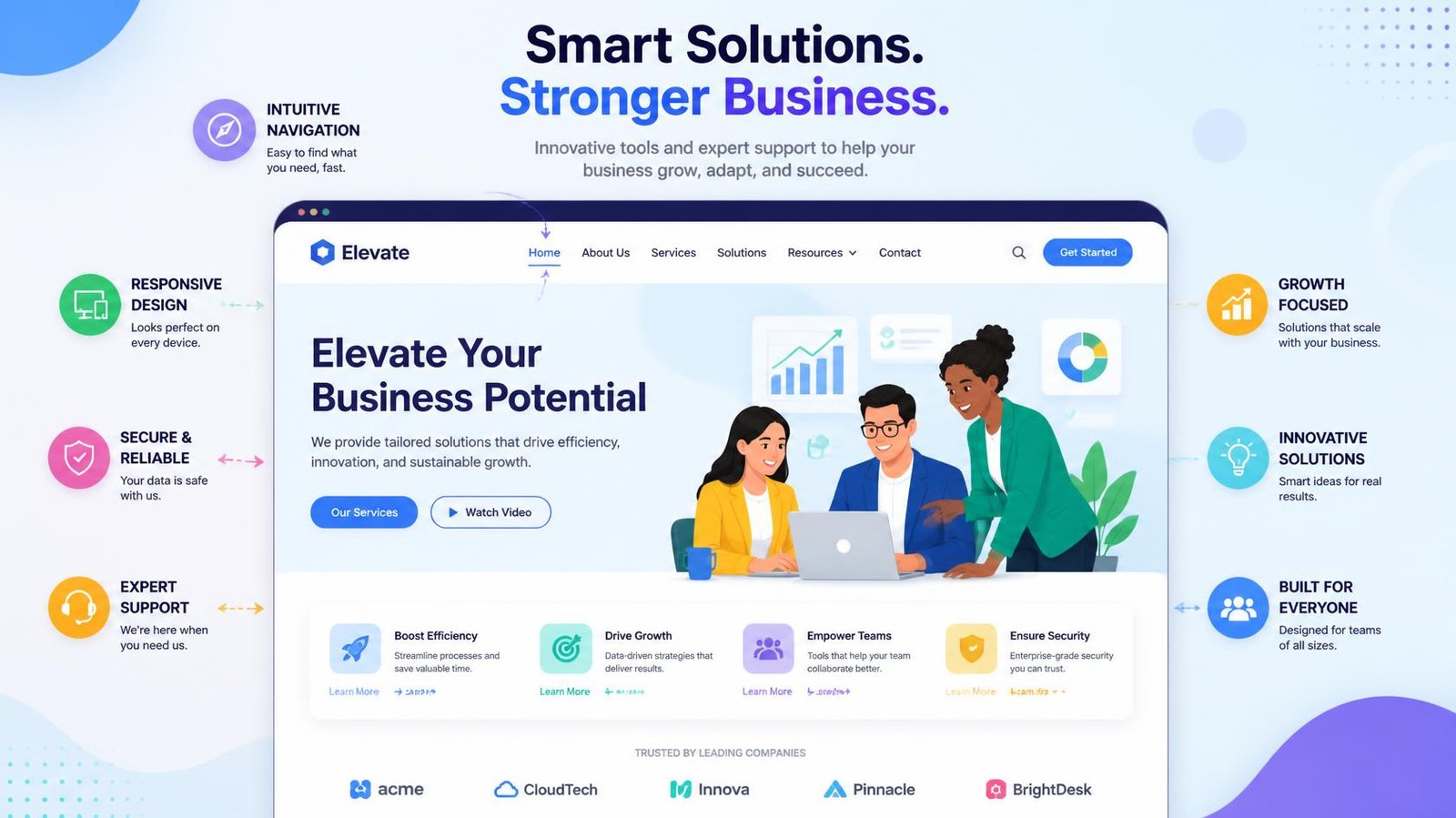
A thought-leadership hub is not simply a blog. It is a strategically organized Insights section that publishes original expertise, executive perspectives, practical frameworks, and industry analysis that help buyers make informed decisions. When integrated into corporate website design, it strengthens topical authority, improves search visibility, increases the likelihood of being referenced by AI-powered search experiences, and builds executive trust long before the first discovery call. Google’s guidance consistently emphasizes creating original, people-first content that demonstrates real experience and expertise over content written primarily to rank in search.
| Traditional Blog | Thought-Leadership Hub | AI-Ready Knowledge Hub |
|---|---|---|
| Published whenever time permits | Built around a documented content strategy | Organized into interconnected topic clusters |
| Focuses on individual keywords | Focuses on buyer education | Demonstrates experience, expertise, and authority |
| Minimal internal linking | Related articles reinforce each other | Strong semantic relationships improve discoverability |
| Generates temporary traffic spikes | Builds long-term authority | Supports SEO, AI search, and executive trust |
| Promotional tone | Educational and consultative | Includes original frameworks and practical insights |
| Rarely referenced externally | Greater opportunity to earn backlinks | Designed to become a trusted industry resource |
The answer is straightforward: modern decision-makers don’t reward businesses that publish the most content. They remember businesses that consistently help them solve meaningful problems.
Whether your ideal client is a healthcare executive in Boston, a consulting partner in London, or a manufacturing director in Sydney, their buying journey rarely begins with a contact form. It begins with research. Before speaking with any vendor, they compare ideas, evaluate expertise, and determine whether a company genuinely understands the challenges they face.
This behavior aligns with Google’s ongoing guidance around helpful, reliable, people-first content. Rather than rewarding content created primarily for rankings, Google’s documentation encourages businesses to publish original information, demonstrate first-hand expertise, and create resources readers would genuinely recommend to others.
At KG Web Designer, we’ve noticed a recurring pattern during website strategy sessions. Businesses often invest thousands of dollars in homepage redesigns, branding, and visual improvements, yet their Insights section contains only a handful of generic blog posts. As a result, prospects can see what the business does but struggle to understand how it thinks.
An effective Insights Hub changes that.
Instead of acting as a marketing archive, it becomes a business asset that:
As AI-powered search continues to evolve, businesses that consistently document their expertise are creating assets that remain valuable long after publication. Recent research also shows that AI-generated search experiences frequently retrieve and present information differently from traditional search results, increasing the importance of publishing comprehensive, well-structured resources rather than relying only on service pages.
If your website looks polished but still brings low-quality enquiries, the problem is usually structure, clarity, and trust. See how a conversion-focused consultant website design can help you filter better-fit clients before the first call.
Explore Consultant Website Design →A thought-leadership hub is a centralized library of educational content that answers the questions your ideal clients ask before making important business decisions.
Unlike a traditional corporate blog where articles are often published independently, every piece of content contributes to a broader knowledge architecture. Articles support one another through internal linking, shared themes, and consistent subject expertise, making it easier for readers and search engines to understand your authority.
A consulting firm’s Insights Hub, for example, may include:
This structure transforms content from isolated marketing assets into an interconnected knowledge library.
One of the most overlooked benefits is that buyers rarely consume a single article before contacting a business. Instead, they often explore several related resources, gradually building confidence in the company’s expertise. An organized Insights Hub supports that journey naturally while reinforcing your authority across multiple topics.

Across dozens of website strategy sessions, one pattern appears repeatedly. Companies already possess enough expertise to publish an exceptional Insights Hub. The problem isn’t a lack of knowledge-it’s that their knowledge never leaves internal meetings.
Sales teams answer sophisticated questions every week. Consultants explain implementation frameworks during workshops. Leadership teams discuss industry trends with clients. Yet almost none of those conversations become searchable content.
The businesses that consistently build authority aren’t necessarily creating more ideas. They’re documenting the expertise they already use every day.
“One misconception I hear regularly is, ‘We’ll publish articles after the website launches.’ In reality, the website and the Insights Hub should be planned together. Buyers don’t trust businesses because they have a beautiful homepage. They trust businesses because every page consistently demonstrates expertise. Your Insights Hub is often where that trust is earned.”
Kanika Gupta
Founder, KG Web Designer
Most companies don’t have a blogging problem.
They have a knowledge publishing problem.
During strategy workshops, we often ask leadership teams to list the questions prospects ask before signing a contract. Within fifteen minutes, they’ve identified twenty or thirty valuable topics that could become authoritative articles.
Yet those answers remain trapped inside sales presentations, Zoom meetings, proposal documents, and email conversations.
Every unanswered buyer question is a missed opportunity to build trust before the first conversation.
That’s why the most successful thought-leadership hubs don’t begin with keyword research. They begin with real customer conversations, genuine expertise, and a commitment to publishing information that executives can actually use to make better decisions.
A thought-leadership hub improves AI visibility by helping search engines and AI assistants understand not only what your business does, but how deeply it understands its industry. Instead of isolated blog posts competing for individual keywords, you’re creating an interconnected knowledge base that demonstrates expertise across an entire subject area.
Google’s Search Essentials continue to encourage businesses to publish original, helpful content that demonstrates Experience, Expertise, Authoritativeness, and Trustworthiness (E-E-A-T). At the same time, AI-powered search experiences increasingly favor comprehensive pages that answer multiple related questions rather than thin, keyword-focused articles.
At KG Web Designer, we approach content architecture the same way we approach website architecture. Every article should strengthen another page, answer the next logical buyer question, and move prospects one step closer to trusting your expertise.
One article rarely establishes authority.
A connected knowledge ecosystem does.
| Stage | Objective | Long-Term Business Value |
|---|---|---|
| Publish original expertise | Demonstrate real-world experience | Builds buyer confidence |
| Organize content into topic clusters | Strengthen topical authority | Improves semantic relevance |
| Connect related resources through internal linking | Guide users and search engines | Increases engagement and crawl efficiency |
| Earn references and backlinks | Build external authority | Improves long-term search visibility |
| Become a trusted industry resource | Strengthen executive trust | Generate qualified inquiries consistently |
Unlike traditional blogging, every new article increases the value of existing content. Over time, the entire Insights Hub becomes more authoritative because every page reinforces the others.

“The biggest shift we’ve seen isn’t in web design. It’s in buyer behavior. Five years ago, prospects judged a business primarily by its homepage. Today, they judge it by the quality of its thinking. If your website can’t answer executive-level questions before a meeting, someone else’s website will.”
Kanika Gupta
Founder, KG Web Designer
“Here’s something I tell consultants almost every week. Hide your logo for a minute. Ignore the colors. Forget the animations. Now read only the words on your homepage. If those words wouldn’t convince a skeptical CEO to trust you with a six-figure business challenge, changing the design won’t fix it. That’s like putting expensive paint on a house with weak foundations. Design amplifies authority. It doesn’t manufacture it.”
One pattern has become increasingly obvious during our strategy sessions.
Businesses often believe they need more traffic.
After reviewing their websites, we usually discover something different.
The traffic isn’t always the problem.
The problem is that visitors have very few opportunities to experience the company’s expertise.
Most websites contain:
What they don’t contain are the decision-making resources executives actually search for before choosing a partner.
The businesses generating premium inquiries usually educate first and sell second.
An effective Insights Hub answers buyer questions at every stage of the purchasing journey instead of publishing content simply to maintain a blogging schedule.
A successful corporate website design services strategy should include multiple content formats that demonstrate expertise from different perspectives.
Help prospects understand the problem.
Examples include:
Help buyers evaluate possible solutions.
Examples include:
Help prospects choose confidently.
Examples include:
Together, these resources become the foundation of a scalable corporate insights hub design that supports both organic visibility and executive trust.
Imagine two consulting firms offering nearly identical services.
The first website contains five service pages and a contact form.
The second website includes:
Both firms may have similar expertise.
However, the second firm consistently demonstrates that expertise before prospects ever schedule a discovery call.
By the time an executive contacts the business, much of the credibility-building has already happened.
That changes the entire sales conversation.
Authority isn’t built all at once.
It develops in predictable stages.
| Trust Level | Buyer Thinking | Website Objective |
|---|---|---|
| Visibility | “I’ve discovered this company.” | Be found through search and AI platforms |
| Credibility | “They understand my industry.” | Demonstrate expertise through educational content |
| Confidence | “I trust their recommendations.” | Share original frameworks and practical insights |
| Conversion | “I’d like to speak with them.” | Provide a clear, low-friction next step |
Every article published should help move readers upward through this pyramid.

During content planning workshops, we rarely begin by discussing keywords.
Instead, we ask leadership teams one simple question:
“What questions do prospects ask before signing a contract?”
Within thirty minutes, executives usually fill an entire whiteboard with topics.
Pricing.
Implementation.
Timelines.
Mistakes.
Vendor selection.
Technology choices.
Risk reduction.
Those conversations become the foundation of an Insights Hub.
Keyword research comes later.
This approach produces content that’s naturally aligned with buyer intent because it originates from genuine business conversations instead of search volume reports.
If your website already has valuable expertise hidden inside proposal documents, presentations, webinars, or sales conversations, you don’t need more ideas.
You need a better publishing strategy.
At KG Web Designer, we help businesses transform existing knowledge into structured authority hubs that support SEO, AI visibility, and conversion-focused high-converting corporate website design.
Book a strategy call to explore how your existing expertise can become one of your strongest long-term business assets.
Thought leadership converts because it reduces uncertainty before prospects ever contact your business.
Executive buyers rarely make important purchasing decisions based solely on attractive design or persuasive marketing copy. They want evidence that your business understands their industry, anticipates their challenges, and provides practical guidance before asking for a commitment.
One of the most effective ways to reinforce that expertise is through clear homepage messaging supported by educational content. In our article, The Consulting Website Design Formula: Messaging That Converts Decision-Makers in 10 Seconds (2026 Guide), we explain how positioning, buyer psychology, and homepage structure work together to create immediate credibility while encouraging executives to continue exploring your website rather than returning to the search results.
Most businesses don’t fail because they publish too little content.
They fail because every article is treated as a separate marketing campaign instead of part of a larger knowledge strategy.
A company might publish twenty blog posts over two years, but if those articles aren’t connected through topic clusters, buyer intent, and internal linking, they rarely establish meaningful authority.
At KG Web Designer, one of the first things we evaluate during a website audit is how knowledge is organized. We often discover excellent content hidden behind poor information architecture. Valuable articles become difficult for both visitors and search engines to find because they aren’t connected to related topics or service pages.
Another common mistake is assuming AI-generated content automatically creates authority.
AI can certainly accelerate research and drafting, but it cannot replace first-hand industry experience, practical frameworks, or professional judgment. Those are the elements that distinguish genuine thought leadership from content that simply summarizes information already available elsewhere.
Businesses that consistently earn trust publish content that only they could have written.
“The strongest consulting websites never attempt to look bigger than they are. Instead, they make expertise impossible to ignore. When executives immediately understand your specialization, your thinking, and your track record, sales conversations begin with trust instead of skepticism. That single shift changes the quality of every inquiry.”
Before redesigning your consulting website, it’s worth understanding how investment levels influence positioning, functionality, and long-term lead generation. Our comprehensive pricing guide explains what solo consultants, boutique firms, and growing consultancies should realistically budget before starting a redesign.
An organized AI-optimized corporate website doesn’t just attract visitors. It helps prospects make informed decisions before your sales team becomes involved.
Every educational article can answer objections, reduce uncertainty, and reinforce your expertise throughout the buying journey.
A strategic Insights Hub helps your business:
Instead of relying exclusively on advertising or outbound outreach, your website becomes a continuously growing business asset that compounds in value with every high-quality article you publish.

For executives in the United States, United Kingdom, Australia, Canada, Singapore, and the UAE, choosing a website partner isn’t simply about design quality.
They also want confidence that projects will be delivered professionally, communication will remain consistent, and expectations will be clear from day one.
At KG Web Designer, we’ve designed our collaboration process around those expectations.
For international businesses, trust is earned through predictable delivery, transparent communication, and consistent execution-not geographic proximity.
Situation
A professional services firm approached us with a modern-looking website that had received positive feedback for its design but generated very few meaningful inquiries.
What We Found
The website explained the company’s services well, yet it provided almost no educational content to help executives understand the firm’s expertise. Visitors could learn what the business offered but not how it solved complex business problems.
Our Recommendation
Instead of starting with another homepage redesign, we recommended building an Insights Hub around the questions prospects repeatedly asked during sales meetings. We reorganized content into topic clusters, strengthened internal linking, and aligned educational articles with the firm’s core services.
Business Impact
The website evolved from a digital brochure into a resource that educated buyers before they reached out. Sales conversations became more productive because prospects arrived with a clearer understanding of the firm’s thinking and approach.
The most successful authority websites don’t publish hundreds of articles overnight.
They publish consistently, strategically, and around clearly defined business themes.
A practical roadmap looks like this:
This structured publishing model transforms an Insights section into a long-term competitive advantage rather than a collection of unrelated blog posts.
If your website currently prioritizes aesthetics more than authority, our article Why Consultant Website Design Should Prioritize Authority Over Aesthetics in 2026: An Honest Opinion From a Designer explains why demonstrating expertise often has a greater impact on executive trust and lead generation than visual design alone.
Not every business needs to publish weekly content, but organizations that sell high-value products or services benefit significantly from documenting their expertise. A structured Insights Hub helps buyers research your business before making contact while strengthening long-term authority.
A traditional blog often consists of standalone articles published independently. An Insights Hub organizes content into connected topic clusters that reinforce expertise, improve internal linking, and guide buyers through their decision-making journey.
Consistency is more valuable than frequency. One comprehensive, experience-driven article each month generally creates more long-term business value than several generic posts focused primarily on keywords.
No. AI can support research, outlining, and editing, but genuine thought leadership comes from first-hand experience, strategic judgment, and original observations developed through real client work.
Authority develops gradually. As your Insights Hub grows with interconnected, high-quality resources, your website becomes more valuable for readers while strengthening topical authority for search engines and AI-powered search experiences.
Educational content supports lead generation by reducing buyer uncertainty and demonstrating expertise before prospects contact your business. While no content strategy guarantees inquiries, businesses that consistently educate buyers typically create stronger trust and more qualified opportunities over time.
In 2026, the most successful corporate websites won’t be remembered because they looked impressive.
They’ll be remembered because they consistently helped buyers make smarter decisions.
A strategically planned Insights Hub transforms corporate website design into a long-term authority platform that supports SEO, AI visibility, executive trust, and sustainable lead generation. Every article becomes another opportunity to educate prospects, answer critical questions, and demonstrate expertise before the first conversation begins.
At KG Web Designer, we help consulting firms, manufacturers, healthcare organizations, and professional service businesses build websites that combine strategic design, structured content architecture, and buyer psychology to attract premium clients across global markets.
Ready to build a website that becomes your industry’s most trusted knowledge resource?
If your website is attracting traffic but not the right enquiries, it is time to improve the messaging, trust signals, and conversion flow. I help consultants build websites that support premium positioning and better-fit leads.
Book a 30-minute Strategy Call (available across US, UK, Australia, Canada, Singapore, and UAE time zones with transparent project planning and milestone-based delivery).
Or contact Kanika Gupta to discuss your project.