
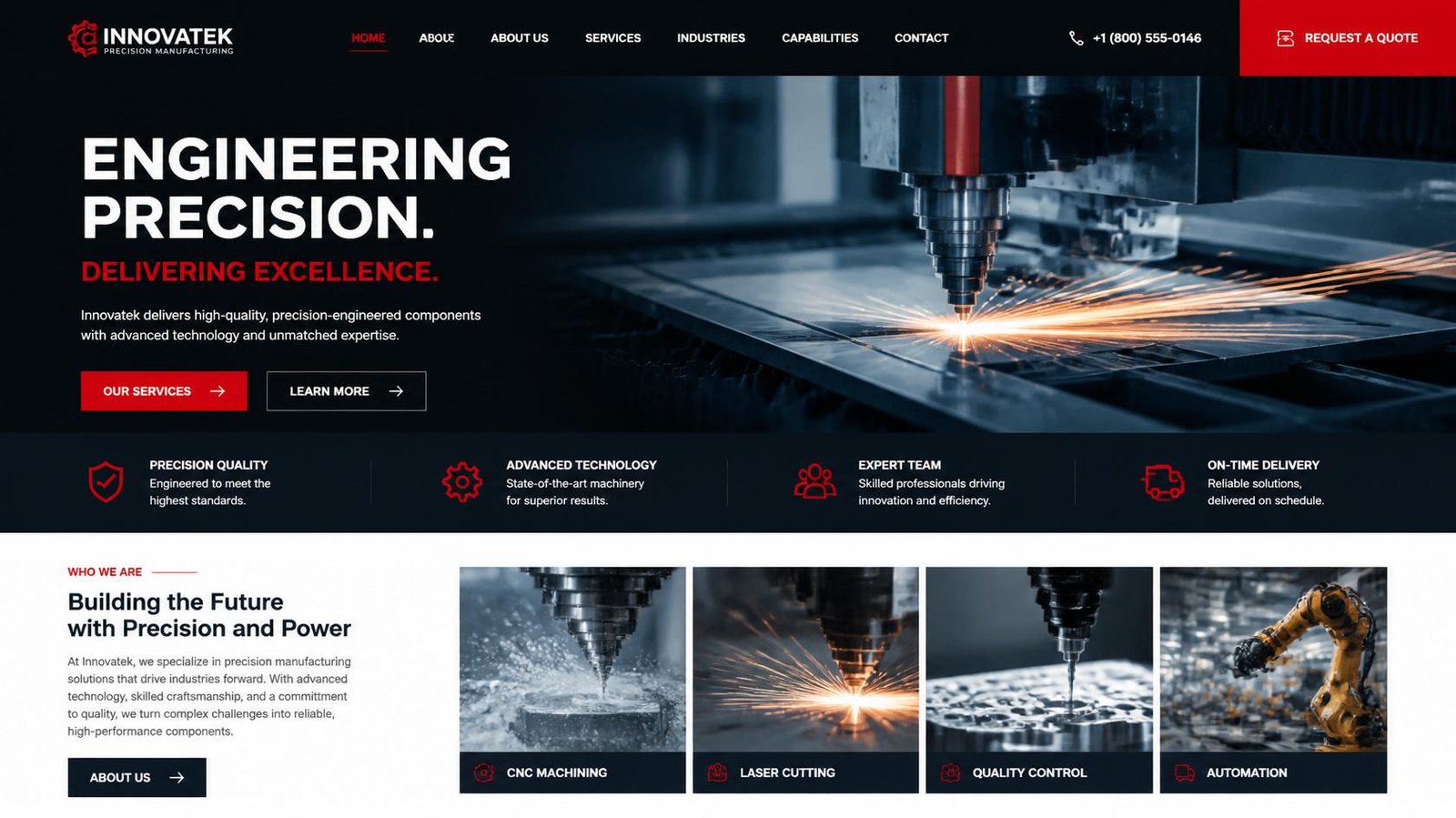
A brochure website introduces your manufacturing company. A lead generation website helps procurement teams evaluate your capabilities, trust your expertise, and confidently submit an RFQ. Modern manufacturing company website design focuses on buyer decision-making, AI search visibility, and conversion strategy rather than simply showcasing products or facilities.
| Traditional Brochure Website | Lead Generation Website |
|---|---|
| Focuses on the company | Focuses on the buyer |
| Company history | Buyer problems and solutions |
| Generic services page | Industry-specific capability pages |
| Contact Us form | RFQ workflow and consultation paths |
| Static product catalog | Educational buying resources |
| Few trust signals | Certifications, case studies, quality systems |
| Difficult for AI to summarize | Structured for AI search and Google AI Overviews |
| Supports branding | Supports revenue generation |
Imagine you’re the Procurement Director for an aerospace manufacturer in Texas.
Your team needs a new precision machining supplier capable of maintaining AS9100 quality standards while producing complex five-axis CNC components.
You search Google.
Within minutes you’ve narrowed your options to three manufacturers.
Every company has modern photography.
Every company claims exceptional quality.
Every company says they’re customer focused.
Yet only one website immediately answers the questions your engineering team actually cares about.
The decision isn’t made because one website looks prettier.
It’s made because one website reduces uncertainty.
That difference explains why some manufacturers consistently receive qualified enquiries while others struggle despite investing heavily in digital marketing.
Today’s manufacturing buyers rarely begin by contacting suppliers.
Instead, they conduct extensive online research, compare vendors, consult AI-powered search tools, evaluate technical capabilities, and create a shortlist before reaching out to sales. Gartner has found that many B2B buyers prefer self-service during much of the purchasing journey, while generative AI is increasingly being used to accelerate supplier research and validate purchasing decisions.
This changes the role of your website completely.
It is no longer an online brochure.
It has become your first salesperson, technical consultant, and trust builder.
At KG Web Designer, we specialize in conversion-focused website design for manufacturers, healthcare organizations, professional service firms, ecommerce brands, and growing businesses. Every website we create is designed to help decision-makers build credibility, support procurement research, and generate qualified enquiries rather than simply attract visitors.
👉 Get your top 3 conversion leaks identified.
Because procurement teams don’t visit manufacturer websites looking for marketing.
They visit looking for evidence.
Modern buyers want confidence before they initiate contact.
They want to know whether your company has solved problems similar to theirs, whether you understand their industry, whether your production capabilities meet their requirements, and whether your organization appears reliable enough to include on a supplier shortlist.
A traditional brochure website rarely answers those questions.
Instead, it typically contains:
While this information has value, it does very little to help buyers make purchasing decisions.
A lead generation website takes the opposite approach.
Rather than asking visitors to “Contact Us,” it systematically removes the doubts that prevent them from making contact in the first place.

One of the biggest shifts we’ve observed over the past few years is that supplier evaluation now happens long before the first sales conversation.
Instead of contacting multiple manufacturers immediately, procurement professionals build a shortlist through independent research.
The journey often looks like this:
Google Search
↓
Google AI Overview / ChatGPT / Gemini
↓
Manufacturer Website
↓
Capability Evaluation
↓
Engineering Review
↓
Internal Supplier Shortlist
↓
Request for Quote (RFQ)
↓
Sales Conversation
Notice something important.
Sales doesn’t enter the process until the very end.
Your website is responsible for every step before that.
If it fails to answer buyer questions, communicate technical expertise, or demonstrate credibility, your company may never reach the RFQ stage regardless of the quality of your products.
“When I review manufacturing websites, I rarely find problems with visual design. The real issue is that most websites are organized around the company instead of the buyer. Procurement teams don’t want another company profile. They want confidence that your business can solve their manufacturing challenge. The websites that consistently generate enquiries answer technical, commercial, and operational questions before a prospect ever contacts sales.”
Founder, KG Web Designer
Across manufacturing website reviews we’ve conducted, one pattern appears repeatedly.
Companies invest thousands of dollars in professional photography, drone videos, and product catalogs while dedicating very little content to the information procurement teams actually evaluate.
We frequently find websites that explain what a company manufactures but not why a buyer should trust them.
The strongest manufacturing websites don’t simply showcase equipment.
They explain:
These details reduce buyer uncertainty, which is often the deciding factor during supplier selection.
Before contacting a manufacturer, buyers usually want answers to several practical questions.
| Procurement Question | Your Website Should Answer |
|---|---|
| Can this manufacturer produce our parts? | Capabilities and equipment |
| Have they worked in our industry? | Industry-specific pages |
| Are they certified? | ISO, AS9100, IATF, ISO 13485, etc. |
| Can they meet our production volume? | Capacity and scalability |
| How do we submit drawings? | Secure RFQ workflow |
| Can we trust them? | Case studies, testimonials, quality systems |
A brochure website leaves buyers searching for these answers.
A lead generation website presents them before buyers even think to ask.
“The strongest manufacturing websites don’t try to impress buyers. They reduce uncertainty. When procurement teams can quickly verify capabilities, quality systems, certifications, engineering support, and production expertise, they move forward with confidence instead of hesitation.”
AI-powered search is fundamentally changing how manufacturers are discovered.
Increasingly, procurement teams use Google AI Overviews, ChatGPT, Gemini, and other AI tools to compare suppliers, summarize capabilities, and identify potential manufacturing partners before visiting individual websites.
That means your website is no longer competing only for Google rankings.
It’s competing to become the source AI systems trust when recommending manufacturers.
A modern manufacturing company website design should therefore include:
Manufacturers that publish authoritative, experience-driven content are significantly better positioned to appear during AI-assisted supplier research than companies relying solely on product catalogs or generic marketing copy.

A lead generation website performs better because it aligns with how procurement teams evaluate suppliers instead of how manufacturers describe themselves.
Traditional websites are often organized around internal departments:
That structure makes sense from the company’s perspective.
It doesn’t match the buyer’s decision-making process.
Modern procurement teams are asking different questions:
A conversion-focused website answers those questions before they’re asked.
Instead of functioning like an online brochure, it becomes a technical resource that supports engineers, procurement specialists, quality managers, and executives throughout the buying journey.
The highest-performing manufacturing websites combine technical credibility with conversion strategy.
Rather than overwhelming visitors with every capability on one page, they guide buyers through a logical evaluation process.
A modern manufacturing website design services strategy should include:
Every page should answer a buyer question while encouraging the next logical step.

Instead of thinking about individual pages, think about the website as a complete sales journey.
A high-converting manufacturing website typically follows this structure:
Each section builds confidence.
Confidence creates enquiries.
One mistake we frequently notice is manufacturers trying to impress visitors with everything they do.
The result is a homepage packed with dozens of services, certifications, industries, and product categories.
Buyers don’t interpret that as expertise.
They interpret it as complexity.
The highest-converting websites simplify decision-making by guiding buyers toward the information most relevant to their industry.

I design manufacturing websites for founders in the US, UK, and Australia who are serious about revenue. Custom-built, conversion-focused, and delivered on time.
Imagine a procurement engineer at a medical device manufacturer searching for a precision CNC machining partner.
Two suppliers appear equally qualified in search results.
Supplier A’s website lists:
Supplier B immediately answers questions such as:
Without making a phone call, the procurement engineer already has significantly greater confidence in Supplier B.
The difference isn’t better marketing.
It’s better buyer enablement.
For overseas buyers, your website often creates the first and only impression before an RFQ is submitted.
Trust therefore becomes one of your strongest competitive advantages.
The most effective manufacturing websites clearly communicate:
Display certifications such as:
Explain what they mean rather than simply displaying logos.
Buyers want to understand:
Specific information builds confidence.
International buyers often evaluate:
These details reduce purchasing risk.
Instead of asking buyers to complete a generic contact form, explain:
Clear expectations improve enquiry quality.
If you serve clients in the United States, United Kingdom, Australia, Canada, Singapore, or the UAE, communicate:
International buyers value responsiveness almost as much as technical capability.
One pattern appears consistently across manufacturing website projects.
Companies often spend considerable effort describing their machinery while providing very little information about how they solve customer problems.
Procurement teams aren’t buying CNC machines.
They’re buying predictable production outcomes.
The manufacturers generating the strongest enquiries explain:
That subtle shift transforms a website from an equipment catalog into a persuasive sales resource.
Procurement teams increasingly rely on AI-assisted research before they contact suppliers. Understanding how your website appears in ChatGPT, Google AI Overviews, and other AI platforms is becoming just as important as traditional SEO.
Our guide How Procurement Teams Use ChatGPT & AI Search to Shortlist Suppliers explains how manufacturers can structure their websites to improve visibility during AI-driven supplier research.
During one manufacturing website strategy project, the client’s website contained detailed product information but generated very few qualified enquiries.
The issue wasn’t traffic.
It was website structure.
Capabilities were buried, certifications were difficult to find, and procurement teams had no clear path for submitting technical requirements.
Rather than redesigning only the visuals, we reorganized the website around the buyer journey.
Dedicated industry pages, clearer capability content, stronger trust signals, and a streamlined RFQ process made it significantly easier for prospects to evaluate the business before contacting sales.
One noticeable outcome was that incoming enquiries became far more detailed. Buyers arrived with better-defined project requirements because the website had already answered many of their initial questions.
“Procurement teams appreciate clarity more than persuasion. When your website answers technical, operational, and compliance questions before the first conversation, buyers arrive with greater confidence and your sales process becomes significantly more efficient.”
Not every manufacturer is ready to schedule a consultation immediately.
Many simply want to understand whether their current website is helping or hurting sales.
That’s why we recommend starting with a Manufacturing Website Lead Generation Scorecard.
This checklist helps you evaluate your website against the same criteria procurement teams use when researching suppliers, including buyer messaging, trust signals, capability pages, RFQ workflow, AI visibility, and conversion strategy.
Once you’ve identified the gaps, you can decide whether incremental improvements or a complete redesign will deliver the greatest business impact.
The biggest misconception is that more website traffic automatically means more business.
It doesn’t.
Traffic only creates opportunity.
Conversion strategy creates enquiries.
Many manufacturers invest heavily in SEO, Google Ads, trade shows, LinkedIn campaigns, and email marketing, only to send prospective buyers to websites that don’t support technical evaluation or purchasing decisions.
Common mistakes include:
These issues increase buyer uncertainty and often encourage prospects to continue evaluating competing suppliers.
Manufacturers that want to remain competitive in 2026 and beyond must build websites that communicate effectively with both people and AI systems.
Today’s procurement professionals increasingly use Google AI Overviews, ChatGPT, Gemini, Perplexity, and other AI-powered tools to compare suppliers, summarize capabilities, and build vendor shortlists before visiting individual websites. Your website is no longer competing solely for Google rankings. It’s competing to become the most trusted source AI systems reference when answering buyer questions.
A modern B2B manufacturing website design strategy should include:
The goal isn’t simply to rank higher.
It’s to become the manufacturer buyers trust before they ever request a quote.
International buyers evaluate more than manufacturing capability.
They also assess whether your company appears reliable enough to become a long-term supplier.
A modern custom manufacturing website development strategy should reduce the uncertainty associated with overseas purchasing by addressing practical concerns early in the buying journey.
Quality Standards
Display internationally recognized certifications such as:
Whenever possible, explain what these certifications mean for buyers instead of simply displaying logos.
Manufacturing Transparency
Buyers want confidence in your production capability.
Include:
Technical Documentation
Help engineering teams evaluate your business by providing:
Global Business Readiness
International buyers also look for evidence that your organization supports cross-border projects.
Explain:
These details significantly reduce perceived purchasing risk.
A high-converting manufacturing company website should help buyers answer their questions without contacting sales.
Use this checklist to evaluate your website.
If several of these areas are missing, your website is probably functioning as a brochure instead of a lead generation asset.

Even a technically impressive website can lose valuable enquiries if it creates friction before buyers submit an RFQ. Our article How Manufacturing Company Website Design Prevents Lost RFQs Before the Sales Conversation Starts explains the most common website issues that reduce conversion rates and how manufacturers can build a smoother purchasing journey.
The manufacturing companies winning more business online aren’t necessarily the ones with the newest factories or the largest marketing budgets.
They’re the companies making it easiest for buyers to evaluate them.
An effective manufacturing website conversion optimization strategy helps procurement teams understand your capabilities, trust your expertise, and move confidently toward requesting a quotation.
When your website removes uncertainty instead of creating it, your sales team spends less time answering introductory questions and more time discussing real projects with qualified prospects.
That translates into stronger opportunities, shorter sales cycles, and better long-term customer relationships.
A brochure website tells visitors what your company does.
A lead generation website demonstrates why buyers should choose your business over every competing manufacturer they evaluate.
As procurement becomes increasingly digital and AI-assisted, manufacturers can no longer rely on attractive visuals or generic company profiles alone. Buyers expect websites that educate, answer technical questions, communicate trust, and simplify the RFQ process.
At KG Web Designer, we’ve found that the most successful manufacturing websites don’t try to impress visitors with everything they do. Instead, they focus on helping buyers make informed decisions with confidence.
If your current website isn’t consistently generating qualified enquiries, now is the time to evaluate whether it’s functioning as a digital brochure or a revenue-generating business asset.
Not every business is ready to redesign its website today.
A better first step is understanding where your current website is helping-or hurting-your sales process.
Download our Manufacturing Website Lead Generation Scorecard to assess your website against the same criteria procurement teams use when evaluating suppliers, including buyer messaging, trust signals, capability pages, RFQ workflow, AI readiness, and conversion strategy.
Once you’ve completed the assessment, if you’d like expert recommendations tailored to your business, we’re happy to help.
Over the past year, we reviewed manufacturing websites ranging from local machine shops to export-focused industrial suppliers. One pattern appeared repeatedly: most manufacturers already had strong technical capabilities, but their websites did not communicate those strengths clearly to buyers.
Many websites placed important specifications, certifications, and product details inside PDFs or deep navigation paths, making it harder for buyers to evaluate the company quickly.
Several manufacturing websites had enquiry forms, but they were hidden or disconnected from product and service pages where buyers were most likely to take action.
Buyers want to know whether a manufacturer understands their sector. Websites that lacked application pages or industry-focused content often failed to build enough confidence.
Book a Strategy Call:
https://calendly.com/kanika-kgwebdesigner/30min?month=2026-07
Contact Kanika Gupta:
https://kgwebdesigner.com/contact-me/
Available across US, UK, Australia, Canada, Singapore, and UAE business hours • Fully remote • No obligation consultation.

A brochure website provides information about your company, products, and services. A lead generation website is designed to educate buyers, build trust, answer technical questions, and encourage qualified prospects to submit an RFQ or request a consultation.
Procurement teams increasingly complete supplier research online before contacting sales. A website that clearly communicates capabilities, certifications, and expertise helps manufacturers earn trust earlier in the buying process and remain competitive in AI-assisted search environments.
The most effective manufacturing websites include industry-specific landing pages, capability pages, visible certifications, customer success stories, downloadable technical resources, streamlined RFQ workflows, and clear calls to action throughout the website.
AI platforms summarize supplier capabilities before buyers visit company websites. Manufacturers that publish structured, authoritative, and experience-based content are more likely to appear in AI-generated recommendations and supplier comparisons.
Yes. Dedicated pages for industries such as aerospace, automotive, medical devices, industrial automation, or food processing help buyers quickly determine whether your company has relevant experience while improving search visibility for industry-specific queries.
Review your website annually and consider a strategic redesign every three to five years, or sooner if it no longer reflects your capabilities, supports mobile users, or aligns with current buyer expectations and AI search trends.
Look for a team that understands manufacturing sales cycles, procurement behavior, SEO, AI search optimization, user experience, and conversion strategy-not just visual design. The best partner builds a website that supports long-term business growth rather than simply creating an attractive online presence.