
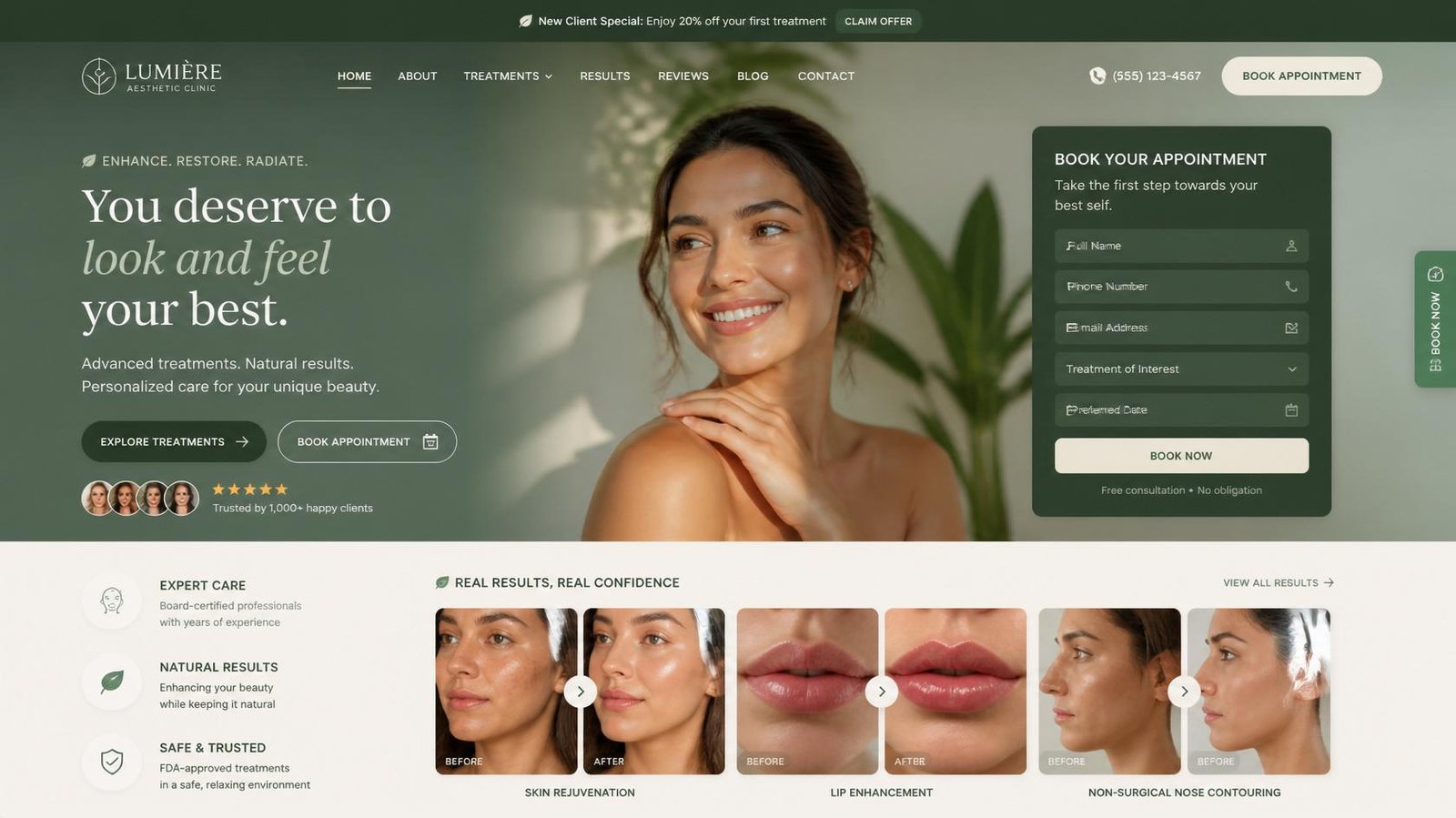
Aesthetic clinic website design services should focus on building a consultation funnel rather than simply showcasing treatments. The highest-performing aesthetic clinic websites don’t ask visitors to book treatment immediately. Instead, they guide prospective patients through a structured consultation journey that builds trust, answers common questions, demonstrates practitioner expertise, and makes booking a consultation feel like the natural next step. A well-designed consultation funnel also supports SEO, AI search visibility, and a better overall patient experience.
| Buyer Intent Element | Details |
|---|---|
| Article Type | Buyer Intent |
| Primary Audience | Owners and directors of aesthetic clinics, cosmetic dermatology clinics, medical spas, and skin clinics in the US, UK, Australia, Canada, Singapore, and UAE |
| Buyer Stage | Consideration → Decision |
| Primary Search Intent | Learn how to build a website that generates more qualified consultation bookings instead of unqualified inquiries |
| Top Concerns | Low consultation bookings, poor website conversion, ineffective treatment pages, outdated design, weak patient trust |
| Buyer Objections | “Will a new website actually generate consultations?” “Can my existing website be improved instead?” |
| Decision Factors | Industry expertise, healthcare experience, SEO knowledge, AI visibility, patient journey optimization, long-term ROI |
| Ideal Outcome | A consultation-focused website that attracts qualified patients, supports business growth, and builds long-term authority |
| Patient Journey | Patient Question | Website Goal | Business Impact |
|---|---|---|---|
| Awareness | Can this clinic help me? | Establish credibility | Build trust |
| Research | Is this treatment suitable for me? | Educate visitors | Reduce uncertainty |
| Evaluation | Why should I choose this clinic? | Demonstrate expertise | Differentiate from competitors |
| Consultation | What happens during my visit? | Remove anxiety | Increase consultation requests |
| Decision | How do I get started? | Simplify booking | Generate qualified inquiries |
Today’s aesthetic patients behave differently than they did just a few years ago.
Before contacting a clinic, they compare providers, read reviews, evaluate practitioner qualifications, explore treatment options, and often ask AI-powered search tools for recommendations. By the time they reach your website, they aren’t simply looking for attractive visuals. They’re looking for confidence. Investing in professional aesthetic clinic consultation booking website is no longer about having a modern-looking website.
That’s why many beautifully designed clinic websites still struggle to generate consultation requests.
They explain treatments but not the patient journey.
They showcase equipment but overlook practitioner credibility.
They ask visitors to “Book Now” before answering the questions patients actually have.
The result is predictable. Visitors continue researching other clinics because they haven’t yet developed enough confidence to take the next step.
The clinics generating consistent consultation requests approach their websites differently. Instead of functioning as online brochures, their websites guide prospective patients through a structured consultation funnel that mirrors how people naturally make healthcare decisions.
This guide explains that consultation funnel, why it matters in 2026, and how premium clinics can build websites that attract qualified patients while improving visibility in Google Search, AI search experiences, and traditional search engines.
“Patients rarely book aesthetic treatments after seeing a beautiful homepage. They book after they understand the consultation process, trust the practitioner, and feel confident they’ll receive the right advice. That’s why we design websites around patient decision-making rather than simply showcasing services.”
Kanika Gupta
Founder, KG Web Designer
Over the past several years, we’ve reviewed websites across healthcare, professional services, and premium service industries.
One pattern appears consistently among aesthetic clinics.
Most websites invest heavily in branding but very little in guiding patients toward a confident decision.
Some common issues include:
These issues don’t necessarily prevent visitors from finding your clinic. They prevent visitors from trusting your clinic enough to make contact.

The consultation has become the most important conversion point for modern aesthetic clinics.
Unlike many retail purchases, aesthetic treatments involve personal appearance, financial investment, and medical considerations. Patients rarely make immediate decisions. Instead, they move through several stages of research before choosing a provider.
A successful website supports every stage of that journey.
Instead of encouraging visitors to book treatment immediately, it helps them:
When this journey is clear, consultation requests tend to be better qualified because prospective patients have already answered many of their own questions before contacting the clinic.
Patients no longer compare your clinic only with local competitors.
They’re comparing the digital experience your website provides with every other premium brand they interact with online.
They expect:
A website that delivers this experience immediately communicates professionalism before the first conversation even begins.
This is where cosmetic clinic website development moves beyond aesthetics and become strategic business investments that support patient trust, search visibility, and long-term growth.
If your treatments are premium but your enquiries are price-sensitive, your website may be creating the wrong first impression. A refined clinic website can help position your brand for higher-value consultations.
Explore Aesthetic Clinic Website Design →Many clinic websites follow this path:
Homepage → Treatments → Contact Page
The problem is that this journey assumes visitors are already ready to book.
A consultation-focused website follows a different path:
Search → Treatment Page → Practitioner Trust → Consultation Process → FAQs → Reviews → Consultation Booking
Each stage reduces uncertainty and helps prospective patients feel more confident before making contact.
This approach aligns more closely with how patients naturally evaluate healthcare providers and creates a smoother transition from initial research to consultation request.
Imagine two clinics offering the same laser skin rejuvenation treatment.
The first website lists the treatment, shows a few stock images, and asks visitors to book immediately.
The second website explains who the treatment is suitable for, introduces the practitioner, outlines what happens during the consultation, answers common concerns, shares authentic patient testimonials, and finishes with a simple consultation booking form.
Both clinics provide similar services.
The difference is that one website builds confidence before asking for commitment.
That difference often determines which clinic receives the inquiry.
Your treatment pages are often the first pages prospective patients visit from Google Search or AI-powered search platforms. Instead of acting as service brochures, they should function as educational landing pages that answer questions, establish trust, and guide visitors naturally toward booking a consultation.
An effective treatment page should answer three questions:
When these questions are answered clearly, patients are more likely to continue their journey rather than returning to search results to compare competitors.
| Section | Purpose |
|---|---|
| Clear treatment overview | Help patients understand the procedure |
| Ideal candidate | Set expectations |
| Benefits and limitations | Build realistic trust |
| Consultation process | Reduce uncertainty |
| Practitioner credentials | Demonstrate expertise |
| Frequently asked questions | Address objections |
| Aftercare information | Improve confidence |
| Authentic patient testimonials | Reinforce credibility |
| Before-and-after gallery (where permitted by local regulations) | Visual reassurance |
| Consultation CTA | Encourage the next step |
The goal isn’t to convince visitors immediately. The goal is to help them make an informed decision.

Successful clinic websites don’t rely on a single “Book Now” button. Instead, they gradually increase patient confidence throughout the website.
Visitors arrive through:
Your homepage should immediately communicate:
Patients now want answers.
They typically ask:
This is where detailed treatment pages outperform short marketing copy.
Trust is created through multiple signals working together.
Examples include:
Each element reduces uncertainty and moves the visitor closer to making contact.
Only after building confidence should the website ask for a consultation.
Effective consultation forms are:
A consultation request should feel like the next logical step rather than a commitment to treatment.
“Patients don’t expect every treatment to have one fixed price. They expect honesty, clarity, and confidence before investing. We’ve consistently found that clinics generating the highest-quality consultations explain the value behind treatment pricing rather than asking patients to compare numbers alone.”
Many conversations with clinic owners begin with similar frustrations.
“We’re getting website visitors but very few consultation requests.”
“Patients keep asking questions that are already on our website.”
“We’re attracting people looking only for the cheapest treatment.”
“Our competitors seem to generate more inquiries despite offering similar services.”
“Our website looks good, but it isn’t helping the business grow.”
In many cases, the issue isn’t traffic. It’s the patient journey.
Visitors leave because they haven’t yet developed enough confidence to contact the clinic.
“Pricing should never become the headline of an aesthetic clinic website. Patients invest in expertise, safety, and outcomes. When your website explains those factors first, pricing becomes easier to understand and far less likely to become the deciding objection.”
Building a successful pricing strategy also requires an effective website structure. Our article Why Some Aesthetic Clinic Websites Convert Better (and How to Structure Yours) explains how patient journeys, treatment pages, trust signals, and conversion-focused design work together to generate more consultation requests.
Taruj
Explain the actual problems, for example:
Discuss what you actually did.
For example:
Use only real outcomes.
For example:
Do not invent percentages.
Then conclude with:
The Taruj project reinforced an important lesson: patients don’t book because a website looks attractive. They book because the website reduces uncertainty and builds confidence throughout the consultation journey.
A premium clinic website should reflect not only excellent design but also the expectations and regulatory environment of the markets it serves.
If consultation forms collect Protected Health Information (PHI), clinics should ensure patient data is handled through secure, HIPAA-appropriate workflows. Clear privacy notices and secure communication channels help reinforce trust.
Websites should present practitioner qualifications transparently and ensure advertising claims align with relevant guidance. Where appropriate, displaying professional registrations can strengthen credibility.
Advertising for cosmetic procedures is governed by organizations such as AHPRA and the TGA. Clinics should ensure treatment claims, promotional language, and imagery comply with current regulatory requirements.
Many patients expect bilingual experiences, culturally appropriate imagery, and convenient communication channels such as WhatsApp alongside traditional contact forms.
Patients increasingly expect accessible, mobile-first websites with transparent consultation information and straightforward booking experiences.
Designing with regional expectations in mind helps create a smoother patient journey while supporting long-term credibility.
“The clinics generating the most consultation requests are rarely the clinics with the most expensive websites. They are the clinics that remove uncertainty. Patients want evidence, expertise, outcomes, and trust. When those elements are missing, even beautiful websites struggle to convert.”

Patients are increasingly discovering clinics through AI-powered search experiences.
Platforms like Google AI Overviews, ChatGPT, Gemini, and Perplexity don’t simply rank pages by keywords. They prioritize content that is well-structured, trustworthy, comprehensive, and easy to understand.
This means your website should include:
A consultation-focused website naturally aligns with these principles because it prioritizes clarity and patient education.
Search behavior is changing rapidly. Prospective patients are increasingly asking AI platforms to recommend trusted clinics before they even visit Google Search. That means your website needs to demonstrate expertise, authority, and structured content that AI systems can easily understand. We explore this in more detail in How AI Search Recommends Skin Clinics: Aesthetic Clinic Website Design Guide for 2026, where we explain how AI evaluates healthcare websites and what clinics can do to improve their visibility.
One pattern stands out across almost every clinic website we review.
Most clinics invest heavily in attracting visitors but very little in preparing those visitors to become patients.
They focus on homepage design.
Patients focus on treatment pages.
They optimize advertising.
Patients evaluate trust.
They highlight services.
Patients want reassurance.
The highest-performing websites recognize this difference and design every page around the questions patients are already asking.
Many clinics assume that improving the visual design alone will increase consultation requests. In reality, trust, messaging, and patient education have a much greater influence on conversions. We explore this in detail in our guide, Why Beautiful Clinic Websites Still Fail to Generate Consultations in 2026, where we explain why attractive websites often underperform when the patient journey is overlooked.
If your clinic website attracts visitors but isn’t generating enough qualified consultation requests, the issue may not be your marketing. It may be the consultation journey.
At KG Web Designer, we design conversion-focused websites for aesthetic clinics that combine SEO, AI search optimization, user experience, accessibility, and patient psychology to help clinics attract qualified patients across the US, UK, Australia, Canada, Singapore, and the UAE.
Book a strategy call to discover how your website can become your strongest patient acquisition asset.
The biggest reason clinic websites underperform isn’t poor design or lack of traffic. It’s a disconnect between how clinics present their services and how patients actually make decisions.
Many websites are built around the clinic’s perspective:
Patients, however, think differently.
They’re asking:
If those questions aren’t answered before asking visitors to book, many will continue comparing competitors.
The highest-converting clinic websites remove uncertainty one step at a time.
Your website is often your first consultation.
Before a prospective patient speaks with your receptionist, reads a brochure, or visits your clinic, they’ve already formed an opinion based on your website.
Every page either increases confidence or creates doubt.
A consultation-focused website doesn’t pressure visitors into making a decision. Instead, it helps them make an informed one.
When patients feel informed and confident, clinics often experience:
Rather than functioning as an online brochure, your website becomes a long-term patient acquisition system that supports sustainable growth.
High-end clients notice design quality, photography, trust signals, and booking flow within seconds. Let’s identify what your current website is communicating before patients ever contact you.
Search engines and AI-powered search experiences rely on structured information to better understand your website.
Implementing schema markup helps platforms identify:
For aesthetic clinics, we typically recommend implementing:
When combined with well-written educational content and clear site architecture, structured data improves your website’s ability to be understood by Google Search and AI-powered search platforms.
Use this checklist to evaluate whether your clinic website is prepared for modern search experiences and patient expectations.
✅ Mobile-first design
✅ Fast loading pages
✅ Accessible navigation
✅ Clear consultation process
✅ Short booking forms
✅ Practitioner profiles
✅ Qualifications and certifications
✅ Authentic patient testimonials
✅ Real clinic photography
✅ Privacy policy
✅ Secure HTTPS website
✅ Comprehensive treatment pages
✅ Internal links between related content
✅ Descriptive headings
✅ Structured data implementation
✅ Optimized metadata
✅ Google Business Profile integration
✅ Multiple consultation CTAs
✅ FAQs answering patient concerns
✅ Educational treatment content
✅ Transparent patient journey
✅ Clear next steps after inquiry
The more items your website includes, the better positioned it is to support both traditional search engines and AI-powered discovery platforms.

A consultation funnel is much more than a marketing concept. It reflects how modern patients evaluate healthcare providers.
Every interaction, from the first Google search to the consultation booking form, shapes the patient’s confidence in your clinic.
The clinics that consistently generate qualified inquiries understand this. They don’t simply showcase treatments. They educate, reassure, and guide prospective patients through every stage of the decision-making process.
As search continues evolving with AI-generated results and increasingly informed patients, websites built around trust, expertise, accessibility, and patient education will continue to outperform brochure-style websites.
The goal isn’t simply to generate more traffic.
It’s to convert the right visitors into confident patients. Choosing the right aesthetic clinic website design services partner means building a website that attracts, educates, and converts qualified patients.
If your current website isn’t generating enough qualified consultation requests, it may be time to rethink the patient journey.
At KG Web Designer, we design premium clinic websites that combine:
The result is a website designed not only to attract visitors, but to convert them into qualified consultation requests.
Available across US, UK, Australia, Canada, Singapore, and UAE time zones. Fully remote. No obligation.
Most patients want professional advice before committing to treatment. A consultation-first approach allows clinics to educate patients, assess suitability, answer concerns, and build trust before recommending a treatment plan.
For most clinics, treatment pages receive the highest-intent visitors. These pages should educate prospective patients, introduce the practitioner, explain the consultation process, answer common questions, and naturally guide visitors toward requesting a consultation.
Improving consultation conversions starts with reducing uncertainty. Clear messaging, practitioner profiles, treatment education, authentic testimonials, mobile-friendly design, and straightforward consultation booking all contribute to a smoother patient journey.
Yes. Dedicated treatment pages help patients research specific concerns while improving visibility for treatment-related search queries. They also provide opportunities to answer detailed questions and build trust before the consultation.
AI-powered search platforms increasingly recommend content that is comprehensive, trustworthy, well-structured, and easy to understand. Clinics that invest in educational content, clear website architecture, and structured data are better positioned for future search visibility.
Rather than redesigning on a fixed schedule, clinics should review their website whenever it no longer reflects current services, patient expectations, branding, or modern search requirements. Regular improvements often deliver better long-term results than infrequent complete redesigns.
Absolutely. Marketing drives visitors to your website, but your website determines whether those visitors become consultation requests. A strong patient journey maximizes the return on every SEO, advertising, and referral effort.