
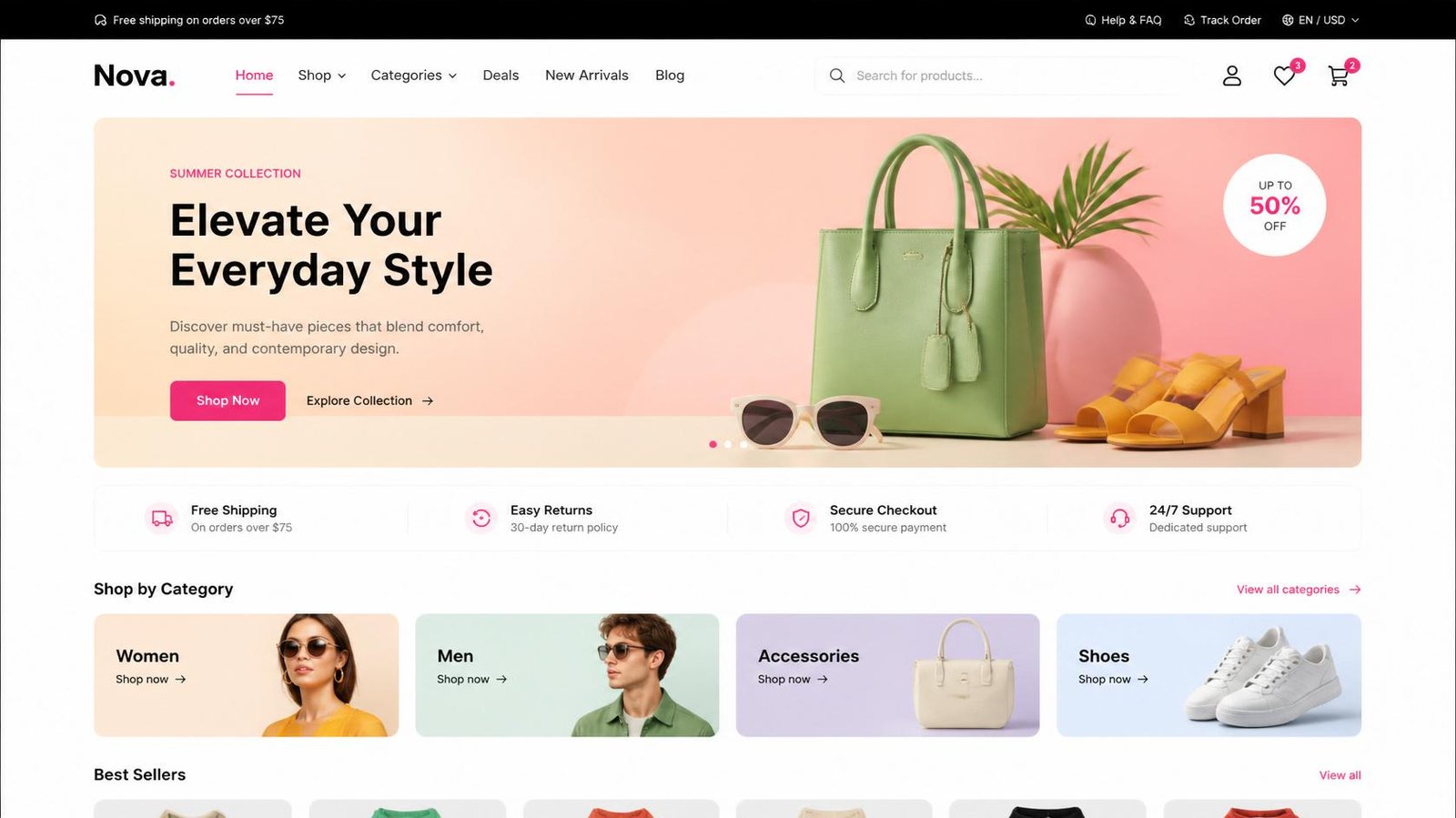
Premium brands use ecommerce website design services to increase Average Order Value (AOV) by creating shopping experiences that build trust, highlight product value, and encourage customers to purchase complete solutions rather than individual items. Instead of depending on discounts, they invest in strategic UX, premium merchandising, product storytelling, and friction-free checkout experiences that naturally lead to higher-value purchases.
| Buyer Intent Layer | Details |
|---|---|
| Buyer Stage | Consideration → Decision |
| Primary Goal | Increase Average Order Value without reducing profit margins |
| Key Questions | Will a website redesign improve revenue? Which UX improvements influence customer spending? |
| Buyer Concerns | Investing in a redesign that looks attractive but fails to improve business performance |
| Required Proof | Ecommerce expertise, proven process, UX strategy, industry knowledge, measurable business outcomes |
| Business Objective | Traditional Ecommerce Store | Premium Ecommerce Brand |
|---|---|---|
| Homepage Focus | Promote products | Build aspiration and trust |
| Product Pages | Features and specifications | Storytelling, craftsmanship, and lifestyle |
| Navigation | Category based | Customer journey based |
| Merchandising | Generic recommendations | Intent-driven product discovery |
| Customer Motivation | Find the lowest price | Buy the best solution |
| Revenue Strategy | Increase transactions | Increase transaction value and lifetime value |
| Long-Term Impact | Compete on price | Compete on brand experience |
Many ecommerce businesses believe the fastest way to grow revenue is to attract more visitors.
Premium brands take a different approach.
Instead of asking, “How can we generate more traffic?” they ask, “How can we help every customer discover more value during a single purchase?”
That shift in thinking changes everything.
Rather than competing on discounts, premium brands invest in better shopping experiences that justify higher prices, encourage complementary purchases, and strengthen long-term customer relationships.
At KG Web Designer, we design conversion-focused websites for ecommerce brands, manufacturers, healthcare businesses, professional services, and growing companies. During ecommerce website audits, one pattern appears repeatedly: businesses that prioritize customer experience consistently outperform those focused solely on advertising or promotional campaigns.
The website doesn’t simply influence whether someone buys.
It influences how much they’re willing to spend.
👉 Get your top 3 conversion leaks identified.
Growing Average Order Value is often a faster and more profitable path to revenue growth than continuously increasing customer acquisition.
Every additional visitor usually comes at a cost through advertising, SEO, partnerships, or marketing campaigns. When existing customers spend more during each transaction, businesses improve profitability without proportionally increasing acquisition costs.
Average Order Value (AOV) measures the average amount a customer spends in a single order and is widely recognized as one of the most important ecommerce profitability metrics. Shopify recommends monitoring AOV alongside conversion rate and customer lifetime value to understand overall business performance.
Successful premium brands approach this differently from mass-market retailers.
Instead of encouraging customers to purchase the cheapest option, they create buying experiences that help shoppers appreciate craftsmanship, product quality, and the value of purchasing complete collections or complementary products.
This is where ecommerce website design services become a business growth strategy rather than simply a visual redesign.
Website Traffic
│
▼
Conversion Rate
│
▼
Average Order Value
│
▼
Monthly Revenue
│
▼
Customer Lifetime Value
Every improvement in Average Order Value creates a compounding business impact.
When customers spend more during each purchase, businesses generate more revenue from existing traffic, improve Return on Ad Spend (ROAS), and increase Customer Lifetime Value (CLV) without continually raising customer acquisition costs.
For premium brands, optimizing AOV is often one of the highest-return investments they can make.

Across the ecommerce websites we’ve audited, one recurring trend stands out.
Businesses with stagnant Average Order Values often invest heavily in attracting new visitors while paying relatively little attention to what happens after customers land on the website.
Premium brands reverse that priority.
They invest first in a buying experience that builds confidence through clear product storytelling, premium visual presentation, intuitive navigation, relevant product recommendations, and friction-free checkout flows.
The result isn’t simply a better-looking website.
It’s a buying journey that naturally encourages customers to purchase more because every interaction reinforces quality, credibility, and value.
“One of the biggest misconceptions in ecommerce is believing design creates conversions. Design influences confidence, but customer behavior determines revenue. Before recommending any redesign, we first identify where customers hesitate, where they abandon the journey, and which pages generate the greatest commercial value. Data should always lead design—not the other way around.”
Customers are more likely to make higher-value purchases when the website consistently reduces uncertainty and reinforces confidence.
A premium ecommerce experience removes questions before they become objections. Every design decision-from the homepage to the checkout page-helps customers feel informed, reassured, and excited about their purchase.
The highest-performing ecommerce brands consistently invest in:
Collectively, these elements shape how customers perceive quality long before they compare prices.
This is why premium ecommerce website design influences Average Order Value as much as pricing or marketing.
“One of the biggest misconceptions we encounter is that customers spend more because a business has better products. In reality, customers spend more when a website helps them understand why those products are worth the investment. Premium ecommerce design isn’t about making a website look luxurious. It’s about creating confidence at every stage of the buying journey.”
Kanika Gupta
Founder, KG Web Designer
Premium ecommerce brands don’t optimize individual pages in isolation.
They design an end-to-end customer journey that gradually builds trust, answers objections, and increases purchase confidence.
Instagram / Pinterest
│
▼
Google Search
│
▼
ChatGPT / Gemini
│
▼
Homepage
│
▼
Category Discovery
│
▼
Product Story
│
▼
Trust Signals
│
▼
Product Recommendations
│
▼
Checkout
│
▼
Higher Average Order Value
Each interaction serves a specific purpose.
Social platforms generate interest. Search engines validate credibility. AI search introduces your brand to new buyers. Product pages reinforce value. Trust signals reduce hesitation. Recommendations encourage larger purchases. Checkout removes friction.
The brands that consistently increase Average Order Value understand that no single feature creates better results.
Higher-value purchases are the outcome of a carefully designed customer experience that makes every buying decision feel effortless and worthwhile.
“AI shopping platforms don’t simply recommend the cheapest or most popular product. They recommend the products they understand with the highest level of confidence. Brands that invest in structured information, trustworthy content, and technically sound ecommerce architecture are creating an advantage that will become even more valuable as conversational commerce continues to grow.”

The most effective ecommerce experiences increase Average Order Value by removing hesitation before customers reach the checkout. Instead of persuading shoppers with aggressive promotions, premium brands build confidence through exceptional product presentation, intuitive navigation, and thoughtful merchandising.
In practice, customers don’t decide to spend more because they’re encouraged to. They spend more because the buying experience makes premium products feel like the right choice.
Luxury fashion houses, premium beauty brands, and high-end consumer electronics companies all understand the same principle.
When customers clearly understand quality, craftsmanship, and product value, they become far more comfortable purchasing complete collections, accessories, and premium upgrades.
This is why ecommerce website design for higher average order value focuses as much on psychology as it does on visual design.
The website features that increase Average Order Value are the ones that reduce uncertainty and help customers make confident purchasing decisions.
Rather than overwhelming visitors with promotions, premium brands guide them toward discovering products that naturally complement their original purchase.
The highest-performing ecommerce websites consistently include:
Each of these features answers a customer’s question before it becomes a reason to leave the website.
That’s one reason luxury ecommerce website design consistently prioritizes clarity and confidence over promotional messaging.
At KG Web Designer, we’ve found that premium ecommerce brands rarely ask,
“How do we sell more products?”
Instead, they ask,
“How do we create a buying experience that justifies premium pricing?”
That subtle shift influences every design decision.
Homepage messaging becomes more strategic. Product pages focus on value instead of specifications alone. Recommendations feel personalized rather than promotional. Checkout removes unnecessary friction instead of introducing distractions.
The businesses that consistently increase Average Order Value understand that customers don’t simply buy products.
They buy confidence.
Product specifications explain what a product is.
Product storytelling explains why someone should own it.
This distinction becomes increasingly important as product prices rise.
A premium handbag, handcrafted watch, luxury skincare product, or designer furniture collection isn’t purchased solely because of technical specifications.
Customers also evaluate:
Consider two online stores selling identical leather travel bags.
The first simply lists:
The second explains:
Both stores sell the same type of product.
Only one creates perceived value.
That difference directly influences purchasing behavior.

I design ecommerce websites for founders in the US, UK, and Australia who are serious about revenue — not just a pretty storefront. Custom-built, conversion-focused, and delivered on time.
Imagine two premium home décor brands selling handcrafted dining tables at similar prices.
The first website provides product dimensions, material specifications, and several studio photographs.
The second website tells the story behind the craftsmanship, explains the sourcing of sustainable hardwood, includes close-up photography of the finishing process, showcases professionally styled dining spaces, features customer testimonials with real homes, and recommends matching chairs, lighting, and décor accessories.
Although both businesses sell comparable products, the second creates a richer buying experience that encourages customers to visualize an entire room instead of purchasing a single table.
Rather than comparing prices, customers begin imagining the complete lifestyle the brand represents.
That shift naturally increases Average Order Value.


A growing ecommerce brand approached KG Web Designer because website traffic continued to increase, but Average Order Value had remained largely unchanged despite ongoing marketing investment.
During our website audit, we discovered that customers could easily find products, yet the shopping experience wasn’t encouraging exploration beyond the initial purchase. Product pages lacked compelling storytelling, related products felt generic, and important trust signals appeared too late in the customer journey.
Instead of redesigning the website around visual trends, we focused on improving the buying experience.
Our recommendations included:
Following the redesign, the client reported stronger engagement with premium collections and a noticeable improvement in customer interaction throughout the shopping journey. More importantly, the redesigned website aligned with the brand’s premium positioning and encouraged customers to build larger orders without relying on discount-led campaigns.
This reflects something we repeatedly observe across ecommerce projects:
Improving the customer experience often creates a greater long-term impact on Average Order Value than increasing advertising spend alone.
Many premium brands struggle to identify the design decisions that separate high-performing ecommerce stores from average online retailers. If you’re looking for practical inspiration, read our guide We Analyzed 15 of the Best Ecommerce Website Designs in 2026: Lessons from Fashion, Beauty, Electronics & D2C Brands, where we break down the navigation strategies, merchandising techniques, product page layouts, and customer journeys used by leading brands to strengthen trust and encourage higher-value purchases.
One of the biggest misconceptions in ecommerce is believing that customers spend more simply because products are discounted.
In reality, excessive discounting often trains shoppers to delay purchases until the next promotion while gradually reducing perceived brand value.
Successful premium brands take a different approach.
They invest in experiences that help customers appreciate quality before discussing price.
They make navigation intuitive.
They simplify product discovery.
They reinforce trust through consistent messaging.
They recommend complementary products at appropriate moments.
Most importantly, they design websites that remove hesitation rather than create urgency through constant promotions.
This philosophy supports sustainable revenue growth while protecting profit margins and strengthening long-term brand equity.
If your ecommerce website attracts qualified visitors but Average Order Value has remained relatively unchanged, the opportunity may not lie in acquiring more traffic.
It may lie in improving the customer experience.
At KG Web Designer, we help premium ecommerce brands combine strategic UX, AI-ready content, conversion optimization, merchandising, and customer psychology to create shopping experiences that encourage larger purchases while strengthening long-term brand perception.
A comprehensive website audit often reveals untapped opportunities that can’t be solved through advertising alone.
Whether it’s product storytelling, category structure, trust signals, or checkout flow, small improvements throughout the customer journey can collectively have a meaningful impact on business performance.
Increasing Average Order Value is one of the most profitable ways to grow an ecommerce business because it improves revenue without requiring a proportional increase in marketing spend.
Every additional purchase, product upgrade, or complementary item added to an order increases the value of your existing traffic. Over time, this strengthens Return on Ad Spend (ROAS), Customer Lifetime Value (CLV), and overall profitability.
Businesses that invest in custom ecommerce website development services often discover that sustainable growth comes from improving the buying experience rather than constantly increasing advertising budgets.
For premium brands, a strategically designed ecommerce website delivers measurable business advantages:
A website should never function as an online catalog alone.
It should actively support your sales strategy, reinforce your brand positioning, and encourage customers to make confident purchasing decisions.


Today’s ecommerce buying journey begins long before someone lands on your website.
Prospective customers increasingly research products using:
Many buyers now ask AI assistants to compare products, recommend brands, explain differences, and summarize reviews before they visit an ecommerce store.
This changes how premium brands should think about website design.
Instead of creating pages only for search engines, businesses need websites that clearly communicate product value, category relationships, trust signals, and expertise in a format that both customers and AI systems can easily understand.
This is where high-converting ecommerce website design extends beyond traditional SEO. A well-structured website with clear content, logical navigation, and authoritative product information is more likely to be referenced in AI-generated answers, helping brands reach qualified buyers earlier in the decision-making process.
Before increasing your advertising budget, evaluate whether your website supports higher-value purchases.
The more items you can confidently check, the stronger your website is positioned to increase Average Order Value while improving the overall customer experience.
Before investing in a redesign, it’s worth understanding which website elements have the greatest influence on revenue. Our guide We Audited Ecommerce Stores: The 15 Metrics We Check Before Every Redesign (2026 Guide) explains the audit framework we use to evaluate homepage hierarchy, navigation, merchandising, trust signals, product pages, and checkout experience before recommending strategic improvements.
The most successful ecommerce brands don’t compete by offering the lowest prices.
They compete by creating experiences that make customers feel confident spending more.
Every interaction-from the homepage and product pages to merchandising and checkout-shapes how customers perceive your brand and determines whether they purchase a single product or invest in a complete solution.
At KG Web Designer, we’ve consistently found that premium ecommerce businesses achieve stronger long-term growth when website strategy aligns with business strategy. A thoughtful combination of user experience, AI-ready content, SEO, merchandising, and conversion optimization transforms a website from a digital storefront into a powerful revenue-generating asset.
If your online store attracts visitors but Average Order Value has plateaued, the opportunity may not be acquiring more traffic. It may be creating a better buying experience that helps customers recognize the full value of what you offer.
Whether you’re launching a premium ecommerce brand or redesigning an existing online store, investing in professional ecommerce website design services can influence far more than conversions. It can strengthen your brand positioning, improve customer loyalty, and increase the value of every transaction.
At KG Web Designer, we create conversion-focused ecommerce websites for premium brands across the United States, United Kingdom, Australia, Canada, Singapore, and the UAE. Every project is built around user experience, search visibility, AI readiness, and measurable business growth.


You now know what the right investment looks like. The next step is a quick call — no pitch, no pressure. Just clarity on what your store needs and what it’ll cost to build it right.
Website design influences Average Order Value by making products easier to discover, strengthening customer trust, and encouraging shoppers to purchase complementary or premium items through thoughtful merchandising, product storytelling, and a friction-free buying experience.
Increasing traffic often requires ongoing marketing investment. Improving Average Order Value allows businesses to generate more revenue from existing visitors, making customer acquisition efforts more profitable while supporting stronger long-term growth.
The most effective features include premium product photography, benefit-driven product storytelling, personalized recommendations, transparent shipping information, customer reviews, intuitive navigation, and streamlined checkout experiences. Together, these create a buying journey that encourages larger purchases.
AI-powered search platforms increasingly recommend brands based on clear website structure, authoritative content, and helpful product information. Ecommerce websites optimized for AI are better positioned to appear in AI-generated recommendations and summaries before customers begin comparing products.
A redesign is worth considering when Average Order Value stagnates, customers abandon their carts frequently, the website no longer reflects the brand’s positioning, or the shopping experience creates unnecessary friction that affects conversions and customer satisfaction.
Premium brands focus on increasing perceived value rather than lowering prices. A better user experience strengthens trust, reinforces quality, and encourages customers to purchase premium products without reducing profit margins through continuous promotional campaigns.