
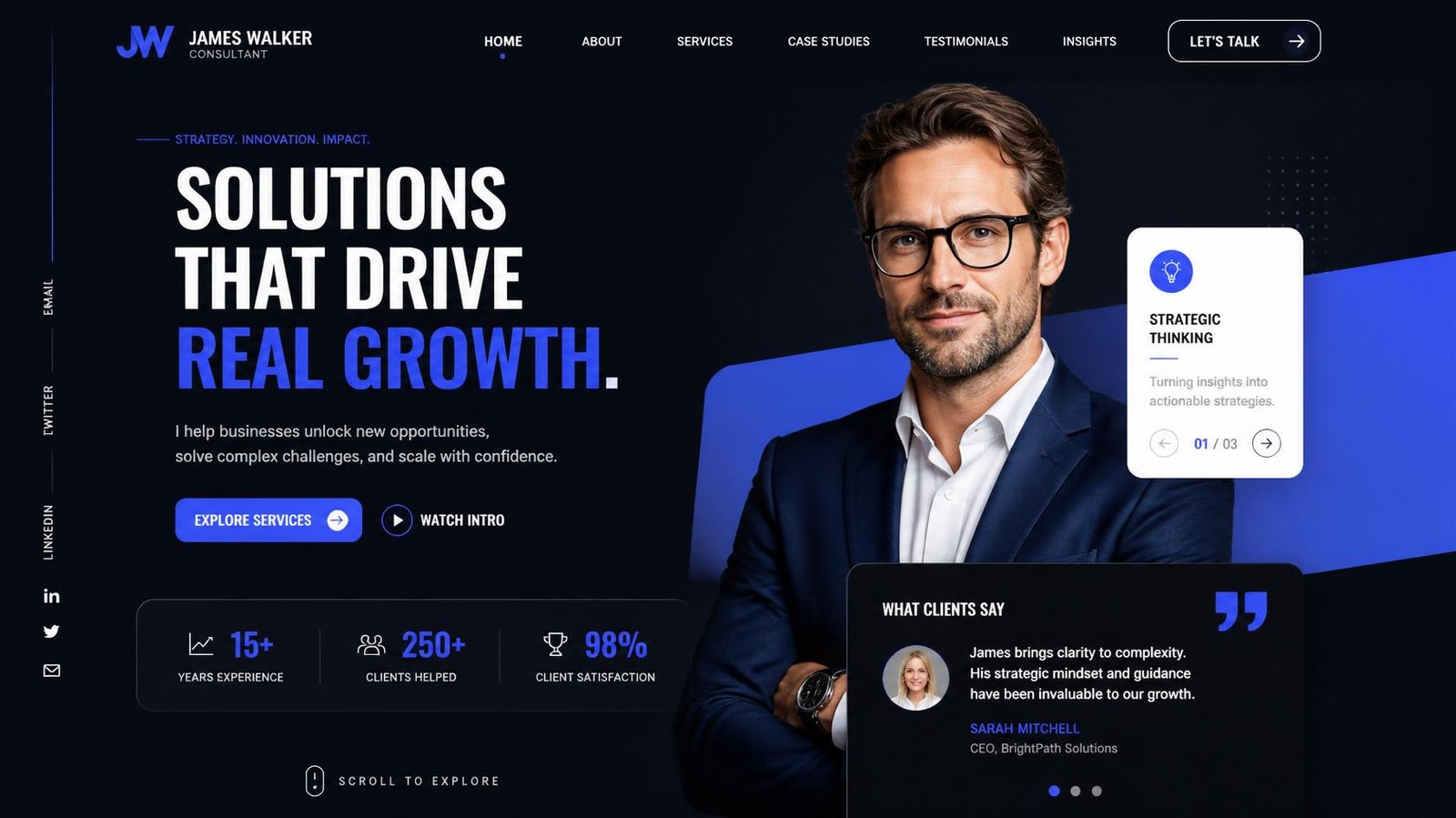
The biggest reason consultant websites fail isn’t poor design. It’s a lack of authority. Effective consultant website design helps prospective clients trust your expertise before they schedule a call by combining strategic positioning, thought leadership, credibility, and a seamless user experience. In 2026, authority has become a stronger competitive advantage than visual design because executive buyers increasingly rely on AI search, educational content, and trust signals before making contact.
| Buyer Stage | Consideration & Decision |
|---|---|
| Ideal Reader | Independent consultants, consulting firms, executive advisors, and professional service businesses targeting premium clients. |
| Core Question | Does design really matter more than authority when clients choose a consultant? |
| Biggest Fear | Investing in another website redesign without generating better-quality inquiries. |
| What You’ll Learn | Why authority influences AI visibility, buyer confidence, lead quality, and long-term business growth more than aesthetics alone. |
| Design-First Website | Authority-First Website |
|---|---|
| Focuses on appearance | Focuses on buyer confidence |
| Looks modern | Demonstrates expertise |
| Generic messaging | Clear specialization |
| Limited educational value | Teaches while selling |
| Relies on visuals | Relies on credibility |
| Generates mixed inquiries | Attracts qualified decision-makers |
| Easy for competitors to imitate | Difficult to replicate |
Here’s an opinion that might surprise you coming from someone who designs websites for a living.
Most consultants don’t need a prettier website.
They need a more believable one.
Every month, we review consultant websites that look exceptional. The photography is polished. The branding feels premium. The animations are smooth. On the surface, everything appears professional.
Yet many of those same websites struggle to generate qualified inquiries.
The issue usually isn’t WordPress.
It isn’t Webflow.
It isn’t typography.
And it certainly isn’t whether the homepage uses the latest design trend.
The real issue is that the website never gives a CEO, founder, or executive a compelling reason to believe the consultant is the safest person to solve a high-value business problem.
That’s why we approach projects differently at KG Web Designer.
Instead of asking, “How can we make this website look more impressive?”, we begin with a different question:
“If someone removed every image, every animation, and every design effect from this homepage, would the words alone convince an executive to trust you?”
If the answer is no, redesigning the visuals won’t solve the underlying business problem.
Because good design attracts attention.
Authority earns contracts.
If your website looks polished but still brings low-quality enquiries, the problem is usually structure, clarity, and trust. See how a conversion-focused consultant website design can help you filter better-fit clients before the first call.
Explore Consultant Website Design →Buying consulting services has always been based on trust.
What’s changed is how buyers establish that trust.
A decade ago, most prospects compared a handful of websites before requesting proposals.
Today, executive buyers often begin somewhere entirely different.
They ask ChatGPT for recommendations.
They read Google AI Overviews.
They compare LinkedIn thought leadership.
They review articles, interviews, podcasts, and industry publications before they ever visit your website.
By the time someone lands on your homepage, they’re already evaluating whether your expertise matches what they’ve discovered elsewhere.
Your website is no longer the beginning of the buyer journey.
It’s where your authority is either confirmed or questioned.
At KG Web Designer, we specialize in conversion-focused websites for consultants, professional service firms, healthcare organizations, manufacturers, ecommerce brands, and growing businesses. Across our consulting projects, one pattern appears repeatedly: businesses that invest in positioning and authority before visual design consistently generate stronger long-term results because their websites answer executive questions instead of simply showcasing attractive layouts.
Key Insight
Executives rarely hire the consultant with the flashiest website.
They hire the consultant who appears to understand their business better than everyone else.
Authority is the confidence your website creates before you ever join a discovery call.
Every section should answer an important buyer question before that prospect has to ask it.
An authority-driven consulting website communicates:
Notice what’s missing.
Animations.
Fancy scrolling effects.
Complex graphics.
Those features can improve user experience, but they cannot create trust on their own.
Authority is built when every page consistently reduces uncertainty.
Most agencies treat design as the destination.
We’ve found it’s actually the foundation.
Market Authority
▲
Thought Leadership
▲
Proof & Trust Signals
▲
Clear Positioning
▲
Professional Website Design
Consultants who stop at the bottom level usually end up with websites that look impressive but sound interchangeable.
The consultants attracting premium engagements invest in every layer.
They publish original insights.
They explain their thinking.
They share frameworks.
They educate before selling.
That’s significantly harder for competitors to copy than an attractive homepage.

“Here’s something I tell consultants almost every week. Hide your logo for a minute. Ignore the colors. Forget the animations. Now read only the words on your homepage.
If those words wouldn’t convince a skeptical CEO to trust you with a six-figure business challenge, changing the design won’t fix it. That’s like putting expensive paint on a house with weak foundations. Design amplifies authority. It doesn’t manufacture it.”
Kanika Gupta
Founder, KG Web Designer
Because beautiful isn’t the same as believable.
Consultants often assume premium visuals automatically communicate premium expertise.
Unfortunately, executive buyers don’t make high-value decisions that way.
Whether they’re evaluating a strategy consultant, financial advisor, operations specialist, or executive coach, they’re asking themselves a completely different set of questions.
If your website doesn’t answer those questions quickly, visitors leave with exactly the same uncertainty they arrived with.
And uncertainty delays buying decisions.
Across consultant website reviews, one pattern appears more often than any other.
Firms spend thousands of dollars improving design while leaving generic messaging untouched.
Not long ago, we reviewed the website of a London-based executive advisory firm specializing in organizational transformation. The visual presentation was excellent. Professional photography. Elegant typography. Smooth interactions.
But after reading the homepage, it was still difficult to answer one simple question:
“Why this consultancy instead of dozens of others?”
The website described the company beautifully.
It barely explained the client’s transformation.
Rather than recommending a complete redesign, we rewrote the messaging around executive priorities, clarified the firm’s specialization, highlighted its methodology, and reorganized the homepage around buyer questions.
The visual identity changed very little.
The credibility changed dramatically.
Experiences like this reinforce something we’ve learned repeatedly.
The most effective website redesign often begins with rewriting the strategy, not replacing the design.
This usually catches people off guard.
If your positioning is weak, spending another $10,000 or $20,000 on a redesign rarely fixes the real issue.
I’d rather help a consultant clarify their messaging than immediately recommend a new website.
Because here’s the truth.
Good design magnifies strategy.
It doesn’t create it.
If your homepage sounds like every other consultant in your market, a premium redesign simply makes generic messaging look more expensive.
That’s why we always recommend improving authority before investing heavily in aesthetics.
It’s the approach that consistently produces stronger business outcomes, higher-quality inquiries, and greater long-term return on investment.
“The strongest consulting websites never attempt to look bigger than they are. Instead, they make expertise impossible to ignore. When executives immediately understand your specialization, your thinking, and your track record, sales conversations begin with trust instead of skepticism. That single shift changes the quality of every inquiry.”
Before redesigning your consulting website, it’s worth understanding how investment levels influence positioning, functionality, and long-term lead generation. Our comprehensive pricing guide explains what solo consultants, boutique firms, and growing consultancies should realistically budget before starting a redesign.
Consultants often assume buyers hire the smartest advisor.
In reality, executives usually hire the advisor they trust first.
Trust is shaped by psychology long before pricing is discussed.
Decision-makers naturally look for signals that reduce perceived risk, including:
These signals create what psychologists call cognitive fluency. When your expertise is easy to understand and consistently reinforced, buyers feel more confident moving forward.
That confidence is far more valuable than another animation or visual trend.
Many consultants assume AI visibility happens automatically. It doesn’t. Our guide, “How Clients Find Consultants Through ChatGPT & AI Search: Consultant Website Design Guide for 2026,” explains how authority signals, structured expertise, and educational content help consultants become more discoverable while strengthening buyer trust before the first conversation.

Imagine two operations consultants pitching for the same manufacturing client in Chicago.
Both have similar experience.
Both have worked with companies of a similar size.
Both charge nearly identical fees.
The first consultant launches a visually impressive website with cinematic videos, animated graphics, premium stock photography, and an award-winning layout.
The second consultant’s website is simpler, but within the first minute it answers the questions every executive is already asking:
Three weeks later, only one consultant is invited to present a proposal.
It isn’t necessarily the consultant with the better-looking website.
It’s the consultant whose website made the buying decision feel less risky.
That’s what authority does.
It shortens the distance between curiosity and confidence.
Google AI Overviews, ChatGPT, Gemini, Claude, and Perplexity are changing how consulting firms are discovered.
These platforms don’t recommend businesses because their websites have elegant animations or expensive branding.
They recommend businesses that demonstrate expertise.
That means your website now needs to educate as effectively as it sells.
A modern authority-building consultant website contains far more than attractive service pages. It provides structured answers, explains industry challenges, introduces practical frameworks, and demonstrates genuine experience that both people and AI systems can understand.
The consultants who will benefit most from AI-driven discovery are those who consistently publish helpful, experience-based content rather than relying solely on marketing copy.
Executive Takeaway
AI search rewards demonstrated expertise, not marketing language. The clearer your thinking, the easier it becomes for both buyers and AI platforms to recognize your authority.
“One of the biggest misconceptions consultants have is believing they’re selling experience. They’re actually selling confidence. Before buyers invest in your expertise, they need confidence that you understand their challenges, have solved similar problems before, and can deliver predictable outcomes. Your website should build that confidence within minutes, not after multiple sales calls.”
Authority isn’t built by adding another testimonial or displaying more client logos.
It’s created through hundreds of small credibility signals working together.
The most effective consultant website design services focus on creating a consistent experience where every page strengthens buyer confidence.
Those credibility signals include:
When these elements reinforce one another, visitors stop asking,
“Can this consultant help us?”
Instead, they begin asking,
“When can we schedule a conversation?”
Every executive evaluating a consultant is trying to reduce uncertainty.
Whether consciously or subconsciously, they’re looking for answers to five questions.
Generalists describe industries.
Specialists understand them.
The faster you demonstrate familiarity with your client’s market, terminology, and commercial challenges, the easier it becomes to establish credibility.
Trust isn’t created by saying you’re experienced.
It’s earned by demonstrating how you think.
That’s why articles, frameworks, webinars, interviews, and educational resources often become more persuasive than lengthy marketing copy.
If your messaging could be copied and pasted onto another consulting firm’s website, it isn’t a differentiator.
Your positioning should clearly explain your perspective, methodology, or specialization in a way competitors can’t easily imitate.
Hiring a consultant is rarely about buying expertise.
It’s about reducing uncertainty around an important business decision.
Every page on your website should reassure buyers that you’ve solved similar challenges before and have a structured approach to achieving measurable outcomes.
The best consulting websites don’t pressure visitors.
They guide them.
After building trust, your website should make it easy to continue the conversation through a low-friction next step, whether that’s scheduling a discovery call or requesting a strategy session.
One of the most valuable lessons we’ve learned came from working with a boutique consulting firm that had invested heavily in visual design but wasn’t attracting the quality of inquiries they expected.
The homepage looked polished, loaded quickly, and reflected a premium brand. However, it focused almost entirely on the firm’s background instead of explaining how it solved client problems. Visitors had to search for the firm’s specialization, methodology, and business outcomes.
Rather than recommending another redesign, we started by revisiting the website strategy. We clarified the firm’s positioning, rewrote the homepage around executive priorities, strengthened service pages with industry-specific messaging, and highlighted thought leadership and trust signals throughout the site. The visual design changed only where it supported the new strategy.
The result wasn’t just a better-looking website. It became a stronger business development tool because prospective clients could quickly understand the firm’s expertise, how it approached complex challenges, and why it was different from competing consultancies.
The biggest lesson? Design improved the presentation, but authority transformed the buying experience.
A few months ago, we reviewed the website of a boutique executive advisory firm based in London.
The design was exceptional.
Premium photography.
Elegant typography.
Subtle animations.
Every visual detail suggested a high-end consultancy.
Yet something important was missing.
After spending several minutes on the homepage, we still couldn’t explain why a CEO should choose this firm instead of twenty others offering similar services.
That wasn’t a design issue.
It was an authority issue.
Rather than proposing a complete redesign, we recommended restructuring the homepage around executive questions, simplifying the messaging, highlighting the firm’s consulting philosophy, and showcasing practical insights that reflected years of experience.
The visual design changed very little.
The business story changed completely.
That project reinforced something we now tell nearly every consulting client:
People don’t hire consultants because they have beautiful websites. They hire consultants because those websites make them feel confident about making an important decision.
“The strongest consulting websites don’t simply rank higher. They reduce uncertainty. Every article, service page, case study, and FAQ should answer another buyer question while reinforcing your expertise. That’s how websites become trusted resources instead of digital brochures.”

Thought leadership is no longer just a content marketing strategy.
It’s one of the strongest indicators of authority.
When consultants consistently publish useful insights, challenge common assumptions, and explain complex business issues clearly, they begin earning trust long before a sales conversation begins.
That’s valuable for traditional search engines.
It’s equally valuable for AI-powered search experiences.
A strong library of articles demonstrates expertise at scale.
It answers buyer questions twenty-four hours a day.
It supports LinkedIn visibility.
It strengthens search performance.
Most importantly, it gives prospects confidence that they’re speaking with someone who understands their business rather than someone who simply markets consulting services.
That’s one reason we encourage clients to think beyond website pages.
Your articles often become your most persuasive salespeople.
Many consultants struggle with whether to build their reputation around themselves or their company. Our guide, “Personal Brand vs. Firm Brand Website: Which Wins More High-Value Clients? Consultant Website Design Guide for 2026,” explores the advantages of both approaches and explains how each influences trust, authority, and premium client acquisition.
Instead of immediately requesting proposals from website agencies, answer these questions honestly.
If the answer to any of these questions is “No,” your next investment should probably be authority rather than aesthetics.
That’s usually where the biggest return comes from.
Most consultants assume authority is established after the discovery call.
Today’s buyers expect to experience that authority before they ever schedule one.
That’s the fundamental shift happening in 2026.
Prospects compare LinkedIn profiles, read thought leadership, ask AI platforms for recommendations, evaluate Google AI Overviews, and research consulting firms long before speaking with anyone.
Your website has become the place where all those impressions are confirmed or quietly dismissed.
The firms winning more premium engagements understand that design is important, but they don’t confuse it with differentiation.
They invest in expertise that can be seen, understood, and trusted.
The design simply helps communicate that expertise more effectively.
And that’s a much stronger competitive advantage than another visual redesign.
If you’ve read this far, you’ve probably realized this article isn’t really about website design.
It’s about business strategy.
A consultant’s website is no longer judged solely by how it looks.
It’s judged by how quickly it answers one question:
“Can I trust this person with an important business decision?”
Everything else supports that answer.
Design.
Content.
SEO.
AI visibility.
Case studies.
Thought leadership.
All of it exists to reduce uncertainty.
The consultants who understand this consistently attract better opportunities because their websites begin building trust long before a discovery call is booked.
If you’re evaluating your own website this week, remember these five principles.
Those five ideas are the foundation of every successful consulting website we’ve built.
Before investing in another redesign, spend ten minutes answering these questions honestly.
✔ Can someone understand exactly who you help within fifteen seconds?
✔ Does your homepage explain why you’re different without relying on generic claims like “trusted partner” or “innovative solutions”?
✔ Would an executive immediately recognize your specialization?
✔ Is there proof of your expertise throughout the website instead of only on one testimonials page?
✔ Do visitors understand how you think, not just what you sell?
✔ Have you demonstrated experience instead of simply claiming it?
✔ Does every important page reduce uncertainty?
✔ Have you answered the objections buyers normally raise during discovery calls?
✔ Does your messaging make prospects feel confident rather than impressed?
✔ Are you publishing articles that help executives make better decisions?
✔ Do your insights sound different from competitors?
✔ Have you introduced any original ideas or frameworks that people associate with your business?
✔ Could Google AI Overviews summarize what your consultancy specializes in?
✔ Would ChatGPT understand your expertise after reading your website?
✔ Is your content structured clearly enough for AI platforms to reference confidently?
If several answers were “No,” your website doesn’t necessarily need a redesign.
It probably needs a stronger authority strategy.
One concern we hear regularly from businesses in the United States, the United Kingdom, Australia, Canada, Singapore, and the UAE isn’t about design quality.
It’s about collaboration.
Questions like:
“How will communication work across time zones?”
“Will feedback become complicated?”
“Can a remote team really understand our market?”
They’re fair questions.
High-value consulting websites require strategic conversations, not just attractive visuals.
That’s why our projects begin with a structured discovery process.
Before design starts, we document business objectives, audience insights, positioning, messaging priorities, milestones, and decision-making responsibilities. Every recommendation is recorded, feedback is centralized, and meetings are scheduled around your working hours whenever possible.
For international clients, we also establish clear project documentation, commercial terms, and collaboration expectations upfront so every stage of the engagement remains transparent and predictable across borders.
We’ve found that successful international projects aren’t determined by geography.
They’re determined by communication, documentation, and process.
One misconception about international website projects is that every market requires a completely different digital strategy.
While messaging should always reflect your audience, the principles that influence executive buying decisions remain remarkably consistent.
Whether someone is hiring a consultant in New York, London, Sydney, Dubai, or Singapore, they are usually asking the same questions.
Those questions transcend geography.
That’s why we build authority first.
The visual design can reflect your brand personality.
Trust is universal.
After years of designing websites for consultants and professional service businesses, I’ve reached one conclusion that surprises many people.
Most consultants don’t lose projects because their websites look outdated.
They lose projects because their websites don’t communicate authority quickly enough.
I’ve seen businesses invest heavily in redesigns that transformed the visuals without changing the results.
I’ve also seen relatively simple websites consistently outperform larger competitors because they answered buyer questions better, demonstrated deeper expertise, and removed uncertainty from the decision-making process.
If I had to choose between investing in another visual redesign or investing in stronger positioning, thought leadership, and credibility, I’d choose authority every single time.
Because design supports trust.
Authority creates it.

Consulting has always been a trust business.
What’s changing in 2026 is how that trust is earned.
Decision-makers no longer rely solely on referrals or polished presentations.
They compare LinkedIn profiles.
They read thought leadership.
They ask ChatGPT.
They review Google AI Overviews.
They evaluate websites before scheduling conversations.
By the time someone contacts you, they’ve often spent hours researching whether you’re the right advisor.
Your website has become the place where that research is validated.
That’s why consultant website design should focus on establishing authority, demonstrating expertise, and reducing buyer uncertainty before emphasizing aesthetics alone.
The consultants who will stand out over the next decade won’t necessarily have the most visually impressive websites.
They’ll have the clearest positioning.
The strongest expertise.
The most helpful ideas.
And the authority that makes buyers feel confident before the first conversation.
That’s the real competitive advantage.
And unlike design trends, authority continues to appreciate in value over time.
If your current website isn’t attracting the quality of consulting opportunities you expected, let’s identify what’s actually holding it back.
At KG Web Designer, we help consultants and professional service firms create websites that combine strategic positioning, authority-building content, and conversion-focused design. Every recommendation is tailored to support long-term visibility, buyer trust, and qualified lead generation.
If your website is attracting traffic but not the right enquiries, it is time to improve the messaging, trust signals, and conversion flow. I help consultants build websites that support premium positioning and better-fit leads.
We work with clients across the United States, United Kingdom, Australia, Canada, Singapore, and the UAE through a structured, collaborative process designed for seamless remote partnerships.
Authority is more important because consulting is built on trust, not transactions. Buyers aren’t purchasing software or a physical product. They’re investing in your judgment, expertise, and ability to solve expensive business problems. An attractive website may create a strong first impression, but authority is what convinces decision-makers to schedule a conversation. That’s why successful consulting websites combine strategic messaging, thought leadership, and proof with professional design.
A strategic website generates better leads by reducing uncertainty before prospects ever contact you. Instead of relying on persuasive marketing language, it answers buyer questions, demonstrates industry expertise, explains your methodology, and showcases credibility. When prospects already trust your thinking, conversations become more productive because you’re discussing business challenges rather than proving your expertise from scratch.
Authoritative consulting websites consistently demonstrate expertise instead of simply claiming it. They include clear positioning, educational articles, practical frameworks, client success stories, transparent consulting processes, industry insights, and trust signals throughout the buyer journey. Every page should reinforce why you’re the right advisor for a specific type of client rather than trying to appeal to everyone.
Yes. AI-powered search experiences increasingly surface businesses that publish well-structured, experience-driven, and genuinely helpful content. Websites that answer real business questions, demonstrate first-hand knowledge, and organize information clearly are more likely to be understood and referenced by AI systems than websites built primarily around promotional messaging.
The answer depends on your business model. Independent consultants often benefit from emphasizing their personal expertise because clients hire them directly. Larger consulting firms usually benefit from combining strong personal credibility with organizational authority. Regardless of the approach, buyers want to understand who they’ll work with, how problems are solved, and what makes your perspective different.
Your website should evolve continuously rather than waiting for a complete redesign every few years. Publishing new thought leadership, refining service pages, updating client success stories, expanding FAQs, and improving messaging all help strengthen authority. Continuous improvements also support SEO, AI visibility, and long-term lead generation.
If your website already provides a solid user experience, investing in thought leadership often creates a greater long-term return. Articles, original frameworks, webinars, speaking engagements, and educational resources continue building authority long after they’re published. The strongest consulting brands don’t choose between content and design. They use design to amplify expertise that’s already visible.