
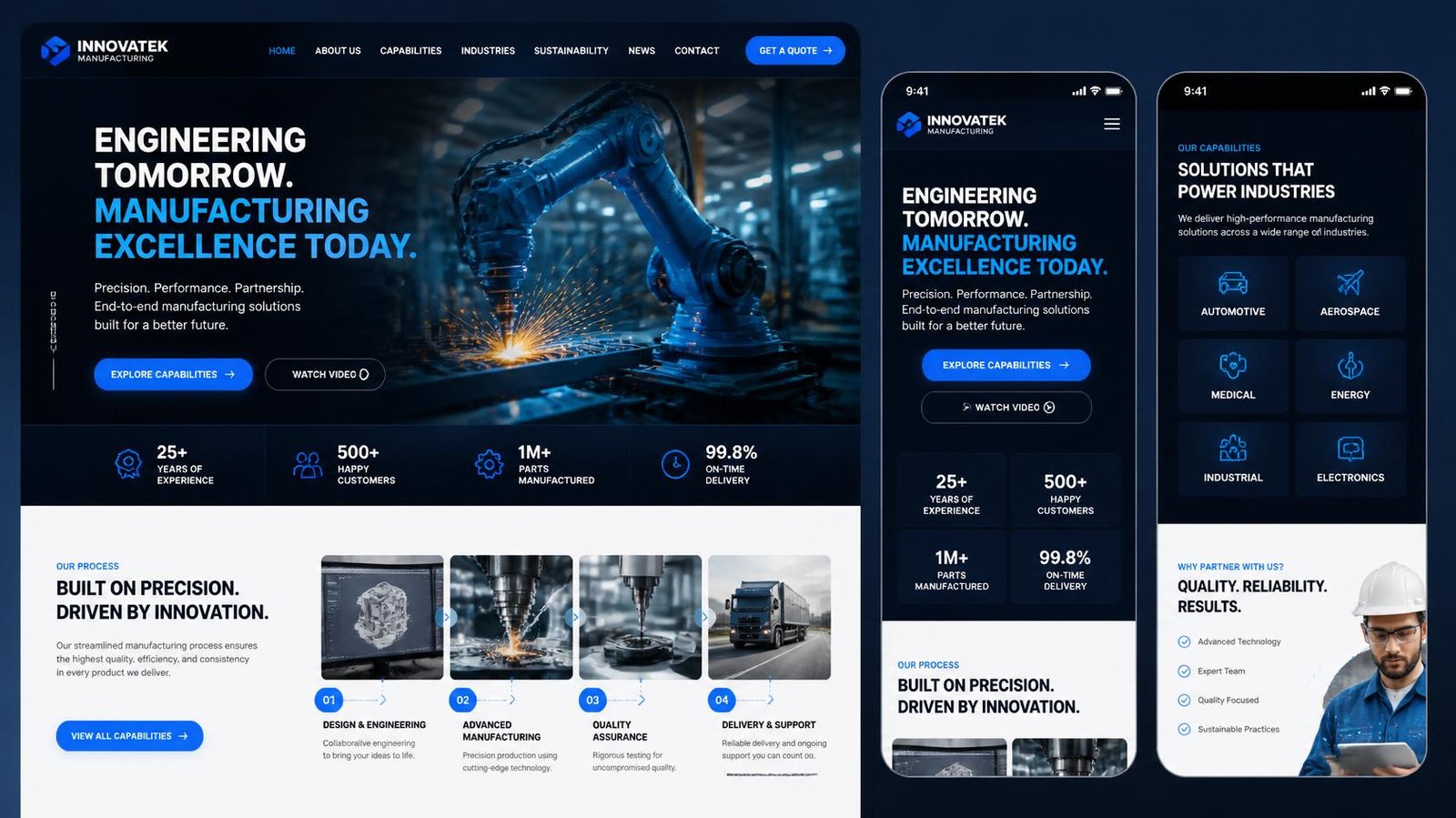
Procurement teams no longer rely only on Google searches or supplier directories when evaluating manufacturers. Increasingly, they use ChatGPT, Google AI Overviews, Gemini, and Perplexity to identify suppliers before requesting quotations. A modern manufacturing company website design should clearly communicate technical capabilities, certifications, engineering expertise, production capacity, and trust signals so both procurement professionals and AI systems can confidently shortlist your business.
Based on manufacturing website audits, supplier qualification requirements, and our experience working with industrial businesses, these are the most common issues preventing manufacturers from being shortlisted.
| Website Finding | Procurement Impact | Business Impact | Recommended Improvement |
|---|---|---|---|
| Generic capability pages | Buyers cannot verify expertise | Lower RFQ quality | Build detailed capability pages |
| Missing certifications | Reduced trust | Lost enterprise opportunities | Clearly display ISO and industry certifications |
| Weak technical documentation | Engineers continue researching competitors | Fewer qualified enquiries | Publish downloadable specifications and engineering resources |
| Limited manufacturing process information | AI struggles to understand capabilities | Lower AI visibility | Create process-specific content clusters |
| Poor internal linking | Weak topical authority | Lower search visibility | Connect products, industries, and manufacturing capabilities |
| Inconsistent company information across online platforms | Reduced entity confidence | Lower discoverability | Standardize company information across business profiles and directories |
| Weak RFQ workflow | Buyers hesitate to contact | Lower conversion rates | Simplify technical enquiry and quotation processes |
The supplier selection process has changed dramatically.
Procurement professionals no longer rely exclusively on search engines or industrial directories to identify manufacturing partners. Increasingly, they begin their research using AI-powered platforms such as ChatGPT, Google AI Overviews, Gemini, and Perplexity to compare suppliers before requesting quotations.
Instead of manually reviewing dozens of supplier websites, buyers ask highly specific questions that reflect their technical and commercial requirements.
Typical searches include:
Rather than returning a simple list of links, AI platforms summarize manufacturers that consistently demonstrate expertise, technical capability, certifications, engineering resources, and supplier credibility.
That means the question manufacturers should ask is no longer:
“Can buyers find our website?”
The more important question has become:
“Will AI confidently recommend our company?”
This shift has significant commercial implications.
A manufacturer that clearly demonstrates technical expertise, quality systems, production capabilities, and engineering knowledge is far more likely to appear in procurement conversations before competitors are even considered.
At KG Web Designer, we’ve found that many manufacturers continue investing heavily in trade exhibitions, paid advertising, and industrial directories while overlooking the one asset procurement teams consistently evaluate before making contact.
Their website.
Today, a manufacturing website isn’t simply a marketing asset.
It has become part of the supplier qualification process.
KG Web Designer is a conversion-focused website design studio specializing in manufacturing website design services for industrial companies, exporters, OEM suppliers, and engineering businesses. We build supplier-focused websites that combine SEO, GEO (Generative Engine Optimization), AI optimization, conversion strategy, and user experience to help manufacturers generate more qualified RFQs instead of simply increasing website traffic.
For manufacturers competing globally, the objective isn’t just attracting visitors.
It’s giving procurement professionals, engineers, and AI systems enough confidence to move your company onto the shortlist.
👉 Get your top 3 conversion leaks identified.
Procurement decisions have become significantly more research-driven over the past few years.
Before requesting a quotation, engineering teams and purchasing managers increasingly complete much of their supplier qualification online. They compare manufacturing capabilities, certifications, production expertise, engineering resources, and previous industry experience before ever speaking with a sales representative.
A typical procurement journey now looks like this:
AI Search
↓
Capability Research
↓
Supplier Comparison
↓
Technical Verification
↓
Certification Review
↓
RFQ Submission
↓
Supplier Qualification
Every stage either strengthens confidence or introduces uncertainty.
If procurement teams cannot quickly verify your expertise, they simply continue evaluating another supplier.
If AI platforms struggle to understand your manufacturing capabilities, your company may never become part of the initial comparison.
Today’s manufacturing website has three simultaneous responsibilities:
The manufacturers winning larger contracts increasingly succeed because they eliminate uncertainty long before the first sales conversation begins.
“The strongest manufacturing websites don’t try to impress buyers. They reduce uncertainty. When procurement teams can quickly verify capabilities, quality systems, certifications, engineering support, and production expertise, they move forward with confidence instead of hesitation.”

Across manufacturing website audits and industrial website projects, several recurring patterns appear.
Many manufacturers produce exceptional products yet unintentionally underrepresent their expertise online.
The most common issues include:
Interestingly, many of these companies already rank reasonably well in Google Search.
However, they provide insufficient evidence for procurement professionals and AI systems trying to determine which suppliers deserve serious consideration.
That gap increasingly determines who receives qualified enquiries.
One lesson consistently emerges during our manufacturing website projects.
Engineers evaluate competence.
Procurement evaluates risk.
AI evaluates evidence.
A manufacturing website that clearly communicates technical capability, quality systems, engineering expertise, certifications, and industry experience satisfies all three audiences simultaneously.
The strongest supplier websites don’t simply explain what a company manufactures.
They demonstrate why buyers should trust that company with technically demanding projects.
Procurement professionals increasingly use AI to reduce supplier research time while identifying manufacturers that meet highly specific technical requirements.
Rather than comparing dozens of supplier websites manually, buyers ask AI platforms to recommend companies based on certifications, manufacturing capabilities, export experience, production expertise, quality systems, and industry specialization.
Typical prompts include:
AI evaluates much more than keywords.
It increasingly compares structured evidence across your digital presence, including:
The stronger these signals become collectively, the greater the likelihood your company appears during supplier research.
AI search increasingly prioritizes demonstrated manufacturing expertise, technical authority, and consistent business identity over simple keyword optimization.
AI increasingly builds supplier recommendations by connecting multiple evidence points.
Manufacturer
│
├── Manufacturing Capabilities
├── Certifications
├── Products
├── Industries Served
├── Engineering Resources
├── Quality Systems
├── Export Markets
└── RFQ Process
When these elements consistently reinforce one another, AI gains greater confidence that your business is a credible supplier for a specific manufacturing requirement.

I design manufacturing websites for founders in the US, UK, and Australia who are serious about revenue. Custom-built, conversion-focused, and delivered on time.
Procurement teams trust evidence far more than marketing language.
Statements such as “industry-leading manufacturer,” “world-class quality,” or “trusted global supplier” sound impressive, but they rarely reduce procurement risk because they lack supporting evidence.
Instead, demonstrate expertise through:
Evidence builds confidence.
Marketing claims rarely do.
One common mistake we notice is manufacturers dedicating more homepage space to company history than to manufacturing capabilities.
Procurement teams want to understand what you can manufacture, how you manufacture it, and why your process is reliable before they care when the company was founded.
AI systems increasingly evaluate manufacturing websites using the same logic.
Every capability page should answer the technical questions procurement teams ask before requesting a quotation.
Many manufacturing websites still publish capability pages containing only a short description, several factory photographs, and a contact form.
That creates unnecessary uncertainty.
Procurement teams continue researching competitors because they cannot verify whether your company is the right technical fit.
High-authority capability pages should clearly explain:
Technical depth improves procurement confidence while simultaneously strengthening SEO, GEO, AI visibility, and supplier credibility.
Many manufacturers invest heavily in supplier directories while underinvesting in their own website. Our guide on Your Own Website vs. IndiaMART, Alibaba & Thomasnet explains why owning your digital authority gives manufacturers greater control over lead quality, brand positioning, AI visibility, and long-term procurement opportunities.
Procurement professionals make decisions using evidence, not aesthetics.
A professionally designed website creates a positive first impression, but appearance alone rarely earns a place on a supplier shortlist. Procurement teams evaluate how clearly your website communicates manufacturing capabilities, engineering expertise, certifications, production capacity, quality systems, and supply chain reliability before they ever request a quotation.
One of the most common issues we identify during manufacturing website audits is an imbalance between design and technical information. Many companies invest heavily in factory photography and branding while publishing capability pages that contain only a few paragraphs of technical detail.
The website looks impressive.
The procurement experience does not.
When buyers cannot quickly verify your capabilities, they continue evaluating other suppliers. AI systems face the same challenge. Without sufficient technical context, they struggle to confidently understand what your company manufactures and which industries you serve.
Beautiful design captures attention.
Technical clarity builds confidence.
Engineers rely on technical documentation.
AI systems rely on structured information.
Think of Schema markup as creating engineering documentation for search engines and AI assistants. Instead of guessing what your company manufactures, AI can clearly understand the relationships between your products, manufacturing capabilities, certifications, industries served, and business identity.
Clear presentation matters just as much as structured data. Procurement professionals prefer technical information that is easy to scan, and AI systems benefit from the same clarity. Well-organized tables, capability summaries, specification lists, engineering resources, and structured technical documentation are easier to interpret than pages dominated by animations or decorative layouts.
A manufacturing website should make engineering information immediately accessible to both human buyers and AI-powered search systems.
| Website Element | Why AI Uses It | Procurement Benefit |
|---|---|---|
| Organization Schema | Identifies the manufacturer | Stronger business identity |
| Product Schema | Understands manufactured products | Better product visibility |
| FAQPage Schema | Answers procurement questions | Higher AI visibility |
| Technical Resource Pages | Demonstrates engineering expertise | Increased buyer confidence |
| Industry-Specific Capability Pages | Establishes topical authority | More qualified RFQs |
| Certification Pages | Verifies compliance | Reduces procurement risk |
| Clear RFQ Process | Explains how buyers engage | Higher enquiry conversion |
AI recommendations are increasingly influenced by the consistency of your company’s technical information across trusted online sources, not just the content published on your website.
Procurement teams don’t buy from companies. They buy confidence in technical capability.
Before contacting a supplier, engineering teams usually verify whether a manufacturer can meet the project’s technical requirements. They review manufacturing processes, production tolerances, quality systems, certifications, inspection methods, and industry experience before requesting commercial discussions.
That’s why technical credibility should appear long before marketing claims.
High-performing manufacturing websites clearly present:
The more technical questions your website answers before procurement contacts you, the higher the quality of enquiries typically becomes.
One recurring pattern we see is manufacturers publishing one generic “Capabilities” page covering every service they offer.
Leading manufacturers instead create dedicated pages for each manufacturing capability, production process, material expertise, and industry served.
This approach improves:
“Procurement teams appreciate clarity more than persuasion. When your website answers technical, operational, and compliance questions before the first conversation, buyers arrive with greater confidence and your sales process becomes significantly more efficient.”
Technical content demonstrates expertise in ways brochures never can.
Procurement professionals rarely search for:
“Best manufacturing company.”
Instead, they search for highly specific engineering requirements.
Examples include:
Every technical question represents an opportunity.
Manufacturers consistently answering these questions become trusted engineering resources.
Those same resources provide AI systems with stronger evidence of technical expertise.
Imagine two CNC machining companies.
Publishes:
Precision CNC Machining
Publishes:
Both companies own similar equipment.
Only one demonstrates expertise.
That is the supplier procurement teams trust more quickly.
It is also the supplier AI understands more confidently.
Your website is only one component of your supplier credibility.
One of the biggest misconceptions manufacturers have is believing AI evaluates only website content.
It doesn’t.
Modern AI compares information from multiple trusted business sources before recommending suppliers.
That includes:
If those sources consistently reinforce your expertise, AI gains greater confidence in recommending your company.
If information conflicts, confidence decreases.
Before increasing advertising spend, confirm your company consistently demonstrates:
Authority is built across your entire digital presence, not just one landing page.
One pattern we frequently identify is manufacturers investing heavily in exhibitions while leaving outdated capability information across online business directories.
Procurement professionals compare multiple trusted sources before contacting suppliers.
AI increasingly does exactly the same thing.

AI optimization builds upon strong SEO rather than replacing it.
Many industrial companies still approach website projects primarily as branding exercises.
They focus on visual redesigns while overlooking the technical content, engineering resources, and information architecture procurement professionals actually need.
Traditional industrial website design for B2B companies often emphasizes:
These elements support branding.
They rarely reduce procurement risk.
Modern manufacturing websites should prioritize:
Traditional SEO answers:
Can this page rank?
AI increasingly asks:
Can this manufacturer be trusted with a technically demanding project?
That subtle shift is changing industrial marketing.
Manufacturers that invest in authority rather than appearance are far better positioned to win high-value RFQs.
Understanding technical capability is only one part of supplier selection. Our article on What Purchasing Managers Actually Look for on a Manufacturing Company Website Design in 2026 explains the trust signals, engineering documentation, certifications, and buying criteria procurement teams evaluate before sending a request for quotation.
Building procurement confidence requires more than publishing technical information.
It requires understanding how your website presents that information to engineers, procurement teams, and AI systems simultaneously.
The fastest way to identify missed opportunities is through a structured website audit.
If procurement teams or AI-powered search platforms evaluated your website today, would they clearly understand your manufacturing capabilities?
Our Manufacturing Website Audit reviews:
Book Your Manufacturing Website Strategy Session
One of the most insightful conversations we’ve had recently was with a precision manufacturing company that had invested consistently in trade exhibitions, distributor partnerships, and digital marketing.
Website traffic wasn’t the problem.
The company attracted engineers, sourcing managers, and procurement professionals from multiple countries.
The challenge was converting that attention into qualified RFQs.
Initially, the team believed a visual redesign would solve the issue. Instead, we conducted a comprehensive audit of the company’s website, technical content, and broader digital presence.
The findings reflected patterns we regularly observe across manufacturing websites.
We discovered:
Rather than focusing solely on aesthetics, we strengthened the company’s digital authority.
The project included:
Beyond the website itself, we aligned manufacturing capabilities, certifications, company descriptions, and product information across online profiles and industrial directories. That consistency reduced conflicting information, strengthened the company’s digital identity, and made it easier for procurement professionals and AI systems to understand the business.
The result wasn’t simply a more modern website.
It became a stronger supplier qualification platform that reduced uncertainty long before the first procurement conversation.
Procurement has become increasingly digital.
Before contacting your sales team, buyers often evaluate:
A modern high-converting manufacturing company website design should strengthen:
The strongest manufacturing websites don’t simply generate website traffic.
They help procurement professionals confidently shortlist your business.
Based on our manufacturing website projects and AI optimization experience, we recommend improving supplier websites through five practical phases.
Procurement teams and AI systems should immediately understand:
Evidence should always appear before promotional messaging.
Develop technical resources covering:
Educational technical content improves supplier credibility while supporting SEO, GEO, AI visibility, and procurement confidence.
Support AI understanding through:
Think of structured data as translating your engineering expertise into a language search engines and AI systems understand.
Engineers read specifications.
AI interprets relationships between products, manufacturing capabilities, certifications, industries served, and supplier credibility.
The easier your technical expertise is to interpret, the easier your company becomes to recommend.
As procurement research becomes increasingly AI-assisted, manufacturers with structured technical information, transparent enquiry processes, and clearly organized engineering resources will be better positioned for future search experiences.
Improve every stage of supplier evaluation by simplifying:
Every unnecessary obstacle increases buyer uncertainty.
Reducing procurement friction increases qualified enquiries.
Authority compounds over time.
Continue publishing:
The manufacturers most frequently recommended by AI aren’t publishing the most content.
They’re consistently publishing the most useful content.
International procurement teams evaluate suppliers differently from domestic buyers because distance increases perceived risk.
Before submitting an RFQ, overseas buyers typically want answers to questions such as:
Many international buyers also want reassurance that confidential engineering information will remain secure throughout the quotation process.
To build that confidence, manufacturers should clearly communicate:
Reducing uncertainty before the first conversation often improves both enquiry quality and buyer confidence.
At KG Web Designer, we’ve found that manufacturers targeting overseas markets often invest heavily in factory photography while overlooking the operational information international procurement teams actively search for.
Simple additions such as:
often improve enquiry quality far more than another homepage redesign.
For manufacturers serving multiple regions, localized capability pages, region-specific contact information, and clearly communicated response expectations help build confidence across North America, Europe, Australia, the Middle East, and Southeast Asia.
The strongest AI recommendations are built from consistent evidence across your entire digital ecosystem.
AI doesn’t evaluate only your homepage.
It compares information from multiple trusted sources.
That includes:
When those sources consistently reinforce your expertise, AI gains greater confidence in recommending your business.
When information conflicts, supplier confidence decreases.
Before investing in additional marketing, confirm your business consistently demonstrates:
Authority isn’t built on one webpage.
It’s built across your entire digital presence.
The future of industrial marketing isn’t about choosing between SEO and AI.
It’s about building technical authority that performs exceptionally well for both.
Procurement professionals increasingly rely on AI-assisted research before contacting suppliers.
AI increasingly recommends manufacturers that consistently demonstrate expertise, credibility, and trust.
Professional manufacturing company website design should become much more than a digital brochure.
It should function as a supplier qualification platform, a technical resource center, and a lead-generation engine that supports procurement teams throughout every stage of supplier evaluation.
The manufacturers investing in digital authority today will be the suppliers shortlisted tomorrow.
If you’re unsure whether your current website clearly communicates your manufacturing capabilities to procurement teams and AI-powered search platforms, a Manufacturing Website Audit is the ideal place to begin.
Our audit includes:
Over the past year, we reviewed manufacturing websites ranging from local machine shops to export-focused industrial suppliers. One pattern appeared repeatedly: most manufacturers already had strong technical capabilities, but their websites did not communicate those strengths clearly to buyers.
Many websites placed important specifications, certifications, and product details inside PDFs or deep navigation paths, making it harder for buyers to evaluate the company quickly.
Several manufacturing websites had enquiry forms, but they were hidden or disconnected from product and service pages where buyers were most likely to take action.
Buyers want to know whether a manufacturer understands their sector. Websites that lacked application pages or industry-focused content often failed to build enough confidence.
We’ll walk you through the three biggest opportunities to improve your manufacturing website’s AI visibility, procurement trust, and qualified RFQ generation, along with practical recommendations tailored to your business.
Available across the United States, United Kingdom, Australia, Canada, Singapore, and the UAE. Fully remote. No obligation.

Many procurement professionals use AI platforms to identify manufacturers based on technical capabilities, certifications, production expertise, export experience, and supplier credibility before requesting quotations. AI helps buyers reduce research time while identifying suppliers that best match specific engineering and commercial requirements.
Yes. Traditional SEO remains the foundation of AI visibility. Strong capability pages, technical documentation, structured data, internal linking, and fast website performance help both search engines and AI systems understand your manufacturing business more accurately.
Capability pages, engineering resources, technical guides, certification information, product documentation, manufacturing process content, FAQs, and industry-specific applications help establish expertise while improving AI understanding.
Most manufacturing companies benefit from Organization, Product, FAQPage, BreadcrumbList, WebSite, and Service Schema. Together they help search engines and AI platforms understand products, manufacturing capabilities, technical services, and overall business identity.
Procurement professionals need evidence that a supplier can meet project requirements. Detailed capability pages reduce uncertainty by explaining manufacturing processes, materials, tolerances, certifications, quality systems, equipment, and industry expertise before commercial discussions begin.
No. AI increasingly evaluates multiple trusted sources including your website, Google Business Profile, Thomasnet, business directories, certifications, technical publications, and other authoritative online resources. Consistency across these sources strengthens supplier credibility.
Rather than redesigning every few years, manufacturers should continuously improve capability pages, certifications, engineering resources, technical documentation, product information, and industry content. Ongoing updates help maintain authority as buyer expectations and AI-assisted procurement continue evolving.