
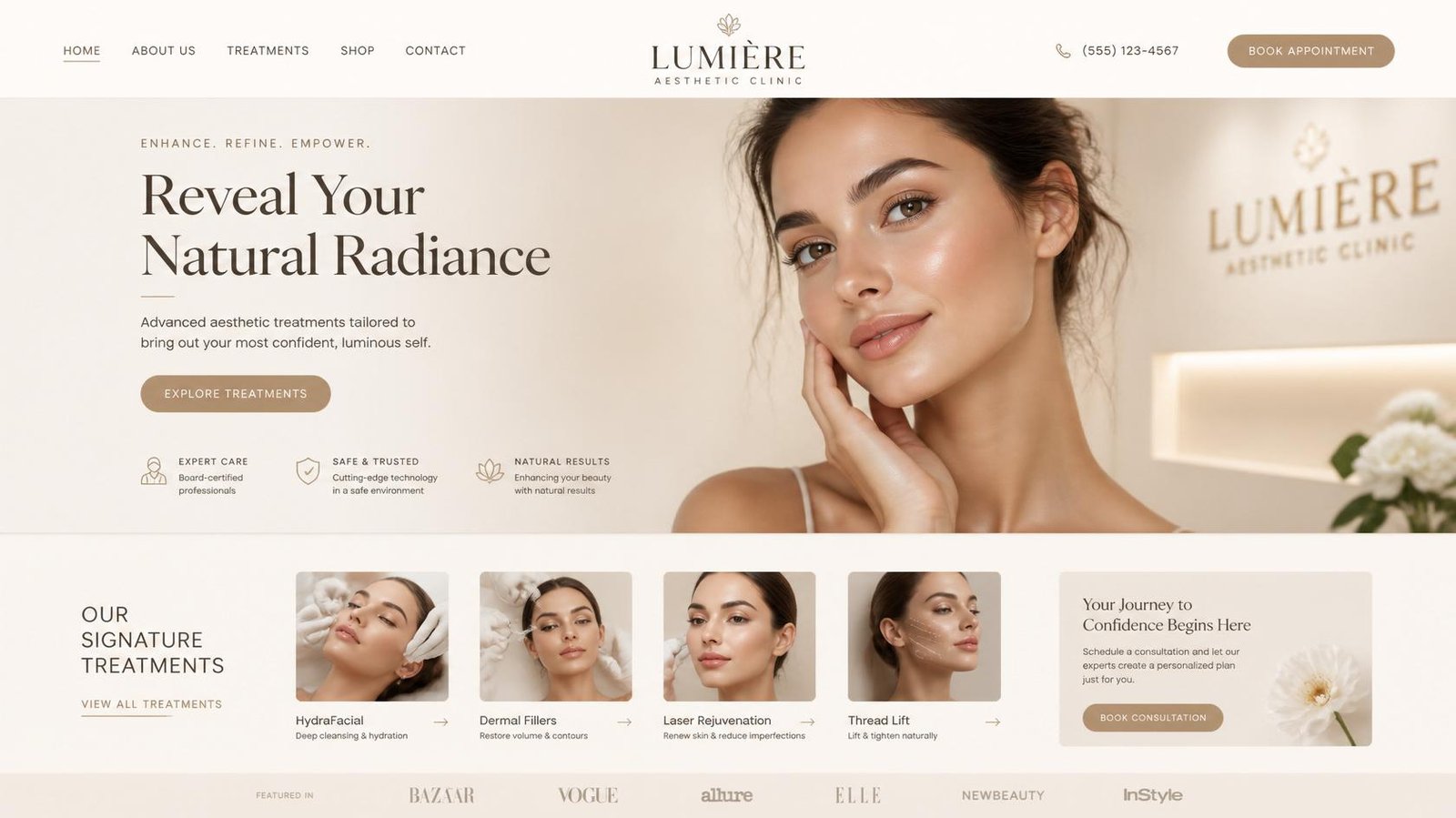
AI search platforms such as Google AI Overviews, ChatGPT, Gemini, and Perplexity no longer recommend aesthetic clinics based solely on search rankings. They increasingly recommend clinics that consistently demonstrate expertise, practitioner credibility, structured healthcare information, educational content, and a trustworthy digital reputation across the web. A modern aesthetic clinic website design should help both patients and AI systems understand who you are, what treatments you provide, why you’re qualified, and how patients can confidently book a consultation.
- AI search is changing how prospective patients discover aesthetic clinics.
- Ranking on Google is no longer enough. AI also evaluates expertise, authority, consistency, and trust.
- Educational treatment pages outperform promotional content in both patient engagement and AI understanding.
- Practitioner credibility is becoming one of the strongest digital trust signals.
- AI increasingly evaluates your entire digital footprint, not just your website.
- Clinics building authority today will earn greater visibility across both traditional search and AI-assisted search experiences.
Based on aesthetic clinic website audits, healthcare projects, and our observations of how AI platforms evaluate medical businesses, these are the most common issues limiting AI visibility.
| Website Finding | Effect on AI Understanding | Business Impact | Recommended Improvement |
|---|---|---|---|
| Thin treatment pages | Weak topical authority | Fewer qualified consultations | Create comprehensive educational treatment guides |
| Generic homepage messaging | AI cannot differentiate expertise | Lower patient trust | Clearly communicate specialization and practitioner expertise |
| Missing practitioner information | Weak EEAT signals | Reduced credibility | Expand practitioner profiles with qualifications and specialties |
| Poor structured healthcare data | AI understands less about the clinic | Lower AI visibility | Implement MedicalBusiness, Physician, FAQPage, and Organization Schema |
| Weak patient education | Limited citation opportunities | Reduced authority | Publish educational resources that answer real patient questions |
| Inconsistent clinic information across digital platforms | Weak entity confidence and reduced trust | Lower discoverability | Audit and standardize clinic name, practitioner details, contact information, business hours, and profiles across Google Business Profile, medical directories, review platforms, and social channels |
| Unclear consultation journey | AI and patients struggle to understand the booking process | Lower consultation conversions | Build clear, accessible consultation pathways with well-structured booking information |
The patient journey has fundamentally changed.
Someone researching Botox in London, laser resurfacing in Dubai, or acne scar treatment in New York is no longer opening dozens of websites and comparing clinics one by one.
Many now begin by asking ChatGPT.
Others receive recommendations through Google AI Overviews.
Some compare treatment options using Gemini or Perplexity before ever clicking a website.
The question has quietly shifted from:
“Can patients find your clinic?”
to
“Will AI confidently recommend your clinic?”
That distinction is reshaping digital marketing for aesthetic practices.
Traditional search engines primarily ranked webpages.
Modern AI systems attempt to recommend the businesses they believe demonstrate the highest levels of expertise, authority, trustworthiness, and consistency.
At KG Web Designer, we’ve found that many aesthetic clinics continue investing heavily in branding, photography, and advertising while overlooking the factors that increasingly influence both AI recommendations and patient confidence.
Beautiful websites capture attention.
Trusted websites generate consultations.
AI-recommended websites do both.
KG Web Designer is a conversion-focused website design studio specializing in custom websites for clinics, professional services, manufacturers, and growing businesses. We combine SEO, GEO (Generative Engine Optimization), AI optimization, conversion strategy, and user experience to build websites that support sustainable growth instead of depending solely on advertising.
For aesthetic clinics, that means creating websites that communicate expertise clearly enough for prospective patients and AI systems to reach the same conclusion:
This clinic can be trusted.
If your treatments are premium but your enquiries are price-sensitive, your website may be creating the wrong first impression. A refined clinic website can help position your brand for higher-value consultations.
Explore Aesthetic Clinic Website Design →Patients considering aesthetic treatments rarely make immediate decisions.
Instead, they research extensively.
Today’s patient journey increasingly looks like this:
AI Search
↓
Treatment Research
↓
Clinic Comparison
↓
Practitioner Evaluation
↓
Patient Reviews
↓
Consultation
↓
Treatment Booking
Every stage either increases confidence or introduces uncertainty.
If AI cannot confidently understand your clinic’s expertise, prospective patients may never discover your website.
If patients don’t immediately trust what they find, they continue comparing competitors.
Today’s clinic website has three simultaneous responsibilities:
The clinics succeeding in 2026 recognize that these objectives now support each other rather than compete.

Across aesthetic clinic website audits and healthcare projects, several recurring patterns appear.
Many clinics deliver exceptional patient care but unintentionally underrepresent their expertise online.
The most common problems include:
Interestingly, many of these clinics already rank reasonably well in Google Search.
However, they provide insufficient evidence for AI systems attempting to determine which providers deserve recommendation.
That difference is becoming increasingly important.
One lesson has become increasingly obvious during our healthcare website projects.
Patients still evaluate websites emotionally.
AI systems evaluate them structurally.
Patients notice photography, branding, and design.
AI evaluates practitioner expertise, educational depth, structured healthcare information, digital consistency, and evidence of authority.
The clinics appearing most frequently in AI-generated recommendations aren’t necessarily those with the biggest marketing budgets.
They’re the ones whose expertise is easiest to verify.
AI platforms recommend clinics they can confidently understand, verify, and trust.
Unlike traditional search engines that primarily organize webpages by relevance, AI systems increasingly synthesize information from multiple trusted sources before presenting recommendations.
That means your website becomes only one part of a much larger digital credibility profile.
AI evaluates signals including:
The stronger these signals become collectively, the more confidence AI systems have when recommending your clinic.
AI search increasingly prioritizes demonstrated expertise, consistent digital identity, and entity relationships over simple keyword repetition.
“Patients don’t expect every treatment to have one fixed price. They expect honesty, clarity, and confidence before investing. We’ve consistently found that clinics generating the highest-quality consultations explain the value behind treatment pricing rather than asking patients to compare numbers alone.”
One of the biggest mistakes aesthetic clinics make is describing themselves as experts instead of providing clear evidence that supports that expertise.
Statements such as:
sound persuasive.
They provide very little evidence for either prospective patients or AI systems.
Instead, demonstrate expertise through:
Evidence consistently builds more confidence than promotional language.
One recurring pattern we identify during clinic website audits is that promotional offers frequently appear before practitioner credibility.
Patients generally trust expertise before promotions.
AI systems increasingly evaluate websites in much the same way.
Every treatment page should answer patient questions so comprehensively that both patients and AI systems recognize it as an authoritative educational resource rather than a marketing page.
Many aesthetic clinic websites still dedicate only a few paragraphs to treatments that patients often spend weeks researching.
That creates an information gap.
Patients continue researching elsewhere.
AI systems find limited evidence of expertise.
High-authority treatment pages should answer:
Educational depth increases patient confidence while simultaneously strengthening topical authority, SEO performance, and AI understanding.
Many clinics improve treatment pages but still struggle to increase visibility because the content isn’t organized around how prospective patients actually search. Our guide on SEO for aesthetic clinic website design and ranking for treatment keywords explains how treatment-focused content clusters strengthen traditional SEO while also improving AI search visibility by answering the questions patients ask throughout their decision-making journey.
AI systems understand structured information far better than visual design alone.
Patients appreciate beautiful layouts.
AI systems cannot.
They evaluate how clearly your website explains the relationships between practitioners, treatments, patient concerns, clinic locations, reviews, and consultation pathways.
One of the biggest mistakes we see is clinics investing heavily in photography while publishing treatment pages containing very little educational information.
The website may look premium.
But AI sees an information gap.
Patients do too.
When visitors still have unanswered questions, they continue researching elsewhere.
When AI systems don’t find enough evidence of expertise, they’re less likely to recommend the clinic.
Beautiful design creates a strong first impression.
Structured information creates long-term authority.
Patients read your website using natural language.
AI assistants interpret structured relationships.
Think of Schema markup as translating your clinic’s expertise into a language search engines and AI assistants understand fluently.
Without structured healthcare data, AI has to infer relationships.
With structured data, it clearly understands:
The easier your expertise is to understand, the easier it becomes to recommend.
“The clinics generating the most consultation requests are rarely the clinics with the most expensive websites. They are the clinics that remove uncertainty. Patients want evidence, expertise, outcomes, and trust. When those elements are missing, even beautiful websites struggle to convert.”
| Website Element | Why AI Uses It | Business Impact |
|---|---|---|
| MedicalBusiness Schema | Identifies the clinic | Better entity recognition |
| Physician Schema | Connects practitioners with treatments | Stronger EEAT |
| FAQPage Schema | Answers conversational searches | Higher AI visibility |
| Internal Topic Clusters | Demonstrates topical authority | Better recommendations |
| Structured Treatment Pages | Connects treatments with patient intent | Stronger expertise signals |
| Consistent Clinic Information | Verifies business identity | Greater trust |
| Accessible Consultation Journey | Helps explain how patients book consultations | Higher conversion potential |
AI recommendations are increasingly influenced by the consistency of your clinic’s information across trusted online sources, not just the content published on your website.
Patients choose practitioners. AI systems verify practitioners.
Many aesthetic clinic websites dedicate more space to promotional campaigns than to the professionals delivering treatments.
That is becoming a significant competitive disadvantage.
Strong practitioner profiles should include:
Patients gain confidence.
AI gains evidence.
Those outcomes increasingly reinforce each other.
One recurring pattern we identify during website audits is clinics publishing one generic “Meet Our Team” page.
High-authority clinics instead create individual practitioner pages linked directly to relevant treatment pages.
This strengthens:
Educational content demonstrates expertise in ways promotional copy never can.
Patients rarely begin by searching for treatments.
They search for concerns.
Typical searches include:
Every one of those searches represents an opportunity.
Clinics consistently answering these questions become trusted educational resources.
Those same resources also provide AI systems with the evidence needed to confidently recommend the clinic.
Imagine two aesthetic clinics.
Publishes:
Dermal Fillers
Publishes:
Both clinics offer dermal fillers.
Only one demonstrates expertise.
That is the clinic patients trust more quickly.
It is also the clinic AI can understand more confidently.
Your website is only one part of your clinic’s digital identity.
One of the biggest misconceptions about AI search is that recommendations come only from website content.
They don’t.
Modern AI systems compare information from multiple trusted sources before recommending businesses.
These include:
If those sources consistently reinforce your expertise, AI confidence increases.
If information conflicts, confidence decreases.
High-end clients notice design quality, photography, trust signals, and booking flow within seconds. Let’s identify what your current website is communicating before patients ever contact you.
Before investing in additional advertising, make sure your clinic consistently demonstrates:
Authority isn’t built on one webpage.
It’s built across your entire digital ecosystem.
One pattern we frequently see is clinics investing heavily in redesigning their homepage while ignoring inconsistencies across Google Business Profile, healthcare directories, review websites, and practitioner profiles.
Patients compare multiple sources before choosing a clinic.
AI increasingly does exactly the same thing.
AI optimization doesn’t replace SEO. It expands on it.
Some clinic owners assume AI optimization is replacing traditional SEO.
In practice, the strongest AI recommendations usually begin with strong SEO fundamentals.
These include:
Traditional SEO answers:
“Can this page rank?”
AI increasingly asks:
“Can this clinic be trusted?”
That subtle shift changes everything.
Authority now matters as much as visibility.
Our companion guide on whether aesthetic clinic websites should display treatment prices explores another important trust signal. Pricing transparency influences patient expectations, consultation quality, trust, and search visibility, making it an important part of a clinic’s overall digital authority strategy.
Many clinics still approach AI as though it’s simply another search engine.
It isn’t.
AI isn’t looking for the clinic spending the most on advertising.
It is looking for the clinic with the strongest evidence of expertise.
Unfortunately, many websites continue prioritizing:
Those elements help branding.
They rarely establish authority.
The clinics appearing most frequently in AI-generated recommendations usually invest in:
Authority has become the strongest long-term marketing strategy.
If ChatGPT, Gemini, Google AI Overviews, and other AI-powered search experiences evaluated your website today, would they clearly understand your expertise?
Our AI Visibility Audit reviews:
Book Your AI Website Strategy Session

“Pricing should never become the headline of an aesthetic clinic website. Patients invest in expertise, safety, and outcomes. When your website explains those factors first, pricing becomes easier to understand and far less likely to become the deciding objection.”
Building a successful pricing strategy also requires an effective website structure. Our article Why Some Aesthetic Clinic Websites Convert Better (and How to Structure Yours) explains how patient journeys, treatment pages, trust signals, and conversion-focused design work together to generate more consultation requests.
One project that reinforced these principles was our work on the Taruj website.
Rather than approaching the project as a visual redesign alone, we focused on creating a stronger digital foundation that would support long-term visibility, credibility, and patient trust.
Our strategy included improving website architecture, strengthening treatment-focused content, refining user journeys, simplifying navigation, and creating a clearer information hierarchy so prospective patients could find relevant treatments more easily.
We also focused on presenting the clinic’s expertise more effectively by improving trust signals throughout the website, creating a more structured content experience, and ensuring the platform was prepared for future SEO and AI search optimization.
Although every clinic’s goals are different and results vary depending on market conditions, the project reinforced an important lesson we continue to see across healthcare websites.
A clinic doesn’t need more pages.
It needs better connected information.
When treatment pages, practitioner expertise, patient education, technical SEO, and user experience work together, the website becomes far more effective at building confidence before a patient ever schedules a consultation.
That same approach also creates a stronger foundation for AI-powered search experiences, where authority and clarity increasingly influence which clinics are recommended.
If you’d like to see the project in more detail, including the design approach, user experience improvements, and website strategy, explore our complete Taruj case study.
AI search is changing how aesthetic clinics compete.
Success is no longer determined only by where your website ranks.
Increasingly, it depends on whether your clinic consistently demonstrates expertise across every digital touchpoint.
A modern high-converting aesthetic clinic website design should strengthen:
The strongest clinic websites don’t optimize for algorithms.
They optimize for confidence.
When patients trust your expertise, AI systems are more likely to trust it too.
Based on our healthcare website projects and AI optimization experience, we recommend improving clinic websites in five practical phases.
Patients and AI systems should immediately understand:
Authority should always appear before promotions.
Develop treatment content that answers real patient questions, including:
Educational resources strengthen patient confidence while supporting SEO, GEO, and AI visibility.
Support AI understanding through:
Think of structured data as translating your clinic’s expertise into a language search engines and AI assistants understand.
Patients read webpages.
AI systems interpret relationships between practitioners, treatments, locations, reviews, and consultation pathways.
The easier your website is to interpret, the easier it becomes to recommend.
As search experiences become increasingly conversational and capable of assisting users with more complex tasks, clinics with clear, structured booking journeys and accessible consultation information will be better positioned to benefit from future AI-assisted experiences.
Improve every stage of the patient journey by simplifying:
Every unnecessary step creates uncertainty.
Reducing friction increases consultations.
Authority compounds over time.
Continue publishing:
The clinics most frequently recommended by AI aren’t publishing the most content.
They’re publishing the most useful content.
Patients traveling internationally evaluate clinics very differently from local patients.
Someone researching treatment abroad isn’t only comparing practitioners.
They’re evaluating risk.
Your website should answer practical questions before they’re asked.
International patients commonly want to know:
Answering these questions reduces uncertainty and increases consultation enquiries from overseas patients.
At KG Web Designer, we’ve found that clinics targeting international patients often invest heavily in treatment galleries while overlooking practical travel information.
Simple additions such as:
often improve enquiry quality more than another homepage redesign.
For clinics serving multiple countries, localized landing pages, region-specific contact details, and market-specific messaging can further reduce uncertainty while improving search relevance across the US, UK, Australia, Singapore, the UAE, and other target markets.
The strongest AI recommendations are rarely based on a single webpage. They are built from consistent evidence across your entire online presence.
Modern AI systems evaluate much more than your homepage.
They compare information from multiple trusted sources to determine whether your clinic consistently demonstrates expertise.
That includes:
When these sources consistently communicate the same story, AI systems gain greater confidence in recommending your clinic.
When information is inconsistent, incomplete, or contradictory, confidence decreases.
Before investing in more advertising, confirm your clinic consistently demonstrates:
Authority isn’t built on one page.
It’s built across your entire digital ecosystem.
The future of aesthetic clinic marketing isn’t about choosing between SEO and AI.
It’s about building digital authority that performs exceptionally well for both.
Patients increasingly rely on AI-assisted search experiences before visiting clinic websites.
AI increasingly recommends clinics that consistently demonstrate expertise, credibility, and trust.
Professional aesthetic clinic website design should therefore become much more than a marketing brochure.
It should function as an educational platform, a trust-building resource, and a conversion-focused consultation system that supports patients throughout every stage of their decision-making journey.
The clinics investing in authority today will be the clinics recommended tomorrow.
If you’re unsure whether your current website clearly communicates expertise to both patients and AI-powered search experiences, an AI Visibility Audit is the best place to begin.
Our review includes:
We’ll walk you through the three biggest opportunities to improve your clinic’s AI visibility, patient trust, and consultation conversions, along with practical recommendations tailored specifically to your practice.
Available across the United States, United Kingdom, Australia, Canada, Singapore, and the UAE. Fully remote. No obligation.

AI platforms evaluate multiple trust signals before recommending clinics. These include practitioner expertise, educational content, structured healthcare data, website quality, topical authority, patient-focused resources, and consistent digital identity across trusted online sources.
Yes. Traditional SEO provides the foundation for AI visibility. Comprehensive treatment pages, structured data, Core Web Vitals, local SEO, and internal linking help AI systems understand your clinic more accurately.
Educational treatment guides, practitioner biographies, consultation information, FAQs, before-and-after care instructions, and patient-focused resources demonstrate expertise while helping AI systems understand your clinic’s authority.
Most clinics benefit from MedicalBusiness, Physician, Organization, FAQPage, BreadcrumbList, and LocalBusiness Schema. Together they help search engines and AI assistants understand practitioners, treatments, clinic locations, and areas of expertise.
Detailed practitioner profiles strengthen EEAT by demonstrating qualifications, certifications, specialties, memberships, and clinical experience. They increase patient confidence while providing AI systems with stronger evidence of expertise.
No. AI increasingly evaluates multiple trusted sources including your website, Google Business Profile, healthcare directories, review platforms, and other reputable websites. A consistent digital reputation strengthens recommendation confidence.
Rather than redesigning every few years, clinics should continuously improve treatment content, practitioner information, structured healthcare data, educational resources, and patient experience. Continuous optimization helps maintain visibility as AI search and patient expectations evolve.