
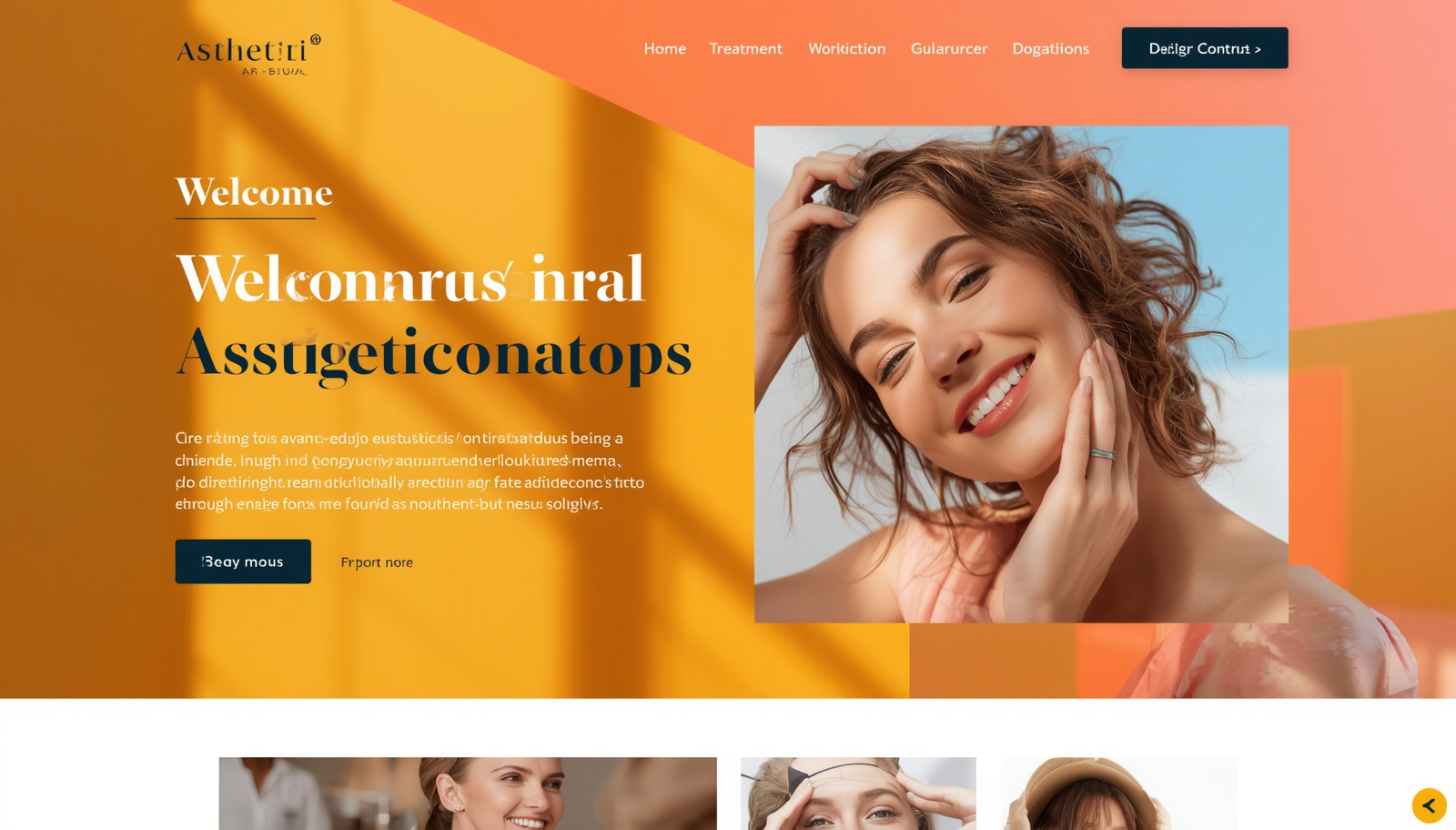
After reviewing 50 aesthetic clinic websites across the United States, United Kingdom, Australia, Canada, Singapore, and the UAE, we found that most clinics lose consultation requests because they focus on visual design while neglecting trust architecture, conversion strategy, compliance considerations, patient psychology, and authority signals. The highest-performing clinics consistently invest in aesthetic clinic website design services that support both patient decision-making and long-term business growth.
For this report, we reviewed 50 aesthetic clinic websites operating in highly competitive healthcare and aesthetics markets.
Locations included:
The sample included:
Each website was evaluated across five areas:
| Evaluation Category | Review Focus |
|---|---|
| Conversion Architecture | Consultation pathways and inquiry generation |
| Trust Signals | Reviews, authority, credentials, proof |
| Service Presentation | Treatment positioning and education |
| Mobile Experience | User journey and conversion usability |
| AI Visibility Readiness | Structured content and discoverability |
The objective was to identify the patterns that separate clinics consistently generating consultation requests from those struggling to convert website traffic into patients.
The most surprising finding was that visual quality was rarely the primary problem.
Most clinics had attractive branding, professional photography, and modern layouts.
The challenge was that many websites failed to answer the questions prospective patients ask before scheduling a consultation.
| Finding | Frequency Observed |
|---|---|
| Weak consultation pathways | 76% |
| Generic treatment descriptions | 72% |
| Limited practitioner authority content | 68% |
| Poor before-and-after presentation | 64% |
| Missing trust signals | 62% |
| Mobile usability issues | 58% |
| Limited AI-readable content structure | 54% |
| Weak differentiation from competitors | 49% |
Patients considering aesthetic treatments typically require more trust-building content than visitors researching general consumer services.
Patients now compare multiple clinics before making contact.
The buying journey has changed.
Prospective patients frequently evaluate:
A clinic may produce exceptional results, but if its website fails to communicate expertise, patients often continue their research elsewhere.
This creates a measurable revenue problem.
At KG Web Designer, we have found that clinics with stronger conversion systems often generate more consultations without increasing advertising budgets.
If your treatments are premium but your enquiries are price-sensitive, your website may be creating the wrong first impression. A refined clinic website can help position your brand for higher-value consultations.
Explore Aesthetic Clinic Website Design →Instead of repeating dozens of individual website issues, we identified five recurring revenue leaks that consistently reduced inquiries.
Patients need confidence before they request a consultation.
Many websites bury practitioner credentials, certifications, training, and specialties deep within the website structure.
High-performing clinics showcase expertise early.
Patients care about results.
The strongest websites explain candidacy, expectations, recovery considerations, and likely outcomes.
This creates confidence.
Long forms, unclear next steps, and weak calls-to-action reduce conversion rates.
Successful clinics simplify every step of the inquiry process.
Many clinics receive the majority of their traffic from mobile devices.
Mobile-first conversion pathways consistently outperform desktop-centric designs.
Many websites lack the structured content, authority signals, and entity relationships that help AI platforms understand expertise.
This limits future visibility.

“The clinics generating the most consultation requests are rarely the clinics with the most expensive websites. They are the clinics that remove uncertainty. Patients want evidence, expertise, outcomes, and trust. When those elements are missing, even beautiful websites struggle to convert.”
Aesthetic marketing regulations vary significantly across countries.
A clinic operating in Sydney faces different promotional restrictions than a clinic in London or New York.
Examples include:
High-performing clinics understand that compliance and conversion must work together.
Trust is difficult to build when patients question credibility or transparency.
Many clinic owners focus on aesthetics before understanding the financial implications of website strategy. If you’re evaluating a redesign, our detailed guide on aesthetic clinic website pricing explains what clinics typically invest and which website components directly influence consultation volume.
We provide strategic website audits focused on:
Most clinics discover revenue opportunities long before they increase advertising budgets.
The highest-performing clinics create trust before asking for a consultation.
Across the 50 websites we reviewed, the strongest performers consistently focused on patient decision-making rather than simply showcasing treatments.
They understand that patients researching aesthetic procedures are evaluating risk, expertise, credibility, and outcomes long before they evaluate pricing.
Patients want reassurance.
Top clinics prominently display:
Authority reduces hesitation.
The best-performing websites answer questions before patients ask them.
Examples include:
This is where custom aesthetic website development becomes a strategic business asset rather than a marketing expense.
Rather than sending every visitor to a generic contact page, successful clinics create consultation journeys specific to each treatment category.
This improves lead quality.
Trust signals are distributed strategically.
Examples include:
Patients frequently discover clinics through social media and mobile search.
High-performing clinics design for mobile-first decision-making.
Educational content consistently outperforms promotional content.
Patients trust expertise more than advertising.
AI platforms increasingly influence healthcare research.
Clinics with stronger content structures, authority signals, and entity relationships are better positioned for future visibility.
AI visibility is becoming a new patient acquisition channel.
Patients increasingly ask questions directly to AI platforms such as ChatGPT, Perplexity, Gemini, and Google AI Overviews.
Examples include:
These systems evaluate:
Clinics that prepare today will benefit tomorrow.
✓ Practitioner authority pages
✓ Treatment-specific content
✓ FAQ content
✓ Structured data
✓ Review signals
✓ Local entity optimization
✓ AI-readable information architecture
AI platforms increasingly favor websites that demonstrate expertise, authority, and trust rather than simply attractive design.
High-end clients notice design quality, photography, trust signals, and booking flow within seconds. Let’s identify what your current website is communicating before patients ever contact you.
The most effective clinic websites function as operational systems, not marketing brochures.
Modern clinics increasingly rely on technology integrations that improve patient experience and internal efficiency.
Common integrations include:
These capabilities are becoming increasingly important within cosmetic clinic website design services projects because clinics want measurable operational improvements alongside stronger marketing performance.

Imagine two premium aesthetic clinics operating in London.
Both have experienced practitioners.
Both invest in digital marketing.
Both offer similar treatments.
Clinic A has a visually attractive website with generic service descriptions and limited trust signals.
Clinic B provides educational treatment content, detailed practitioner profiles, before-and-after galleries, patient success stories, FAQs, and AI-friendly information architecture.
When prospective patients compare providers, Clinic B creates significantly greater confidence.
As a result, consultation requests increase without requiring additional advertising spend.
A growing skincare and aesthetics business approached KG Web Designer because their website looked modern but was not generating the expected number of consultation requests.
Traffic levels were healthy.
Branding was professional.
However, visitors were leaving without taking action.
The website lacked clear consultation pathways and failed to communicate expertise effectively.
We redesigned the website around patient psychology.
Service pages became educational resources.
Trust signals were integrated throughout the website.
Navigation was simplified.
Consultation opportunities became significantly easier to access.
The result was a more intuitive experience that helped visitors understand services, evaluate expertise, and move toward booking consultations.
If you would like to see a real example of how strategic website improvements transformed a clinic’s digital presence, explore the Taruj Skincare redesign case study.
Aesthetic clinics increasingly compete for patients beyond their immediate geographic area.
A patient in Dubai evaluates trust differently than a patient in London.
A patient in Sydney often has different concerns than a patient in New York.
High-performing clinics understand these differences.
Examples of international trust signals include:
Patients seeking elective procedures often conduct extensive research before making contact.
Trust becomes a competitive advantage.
Many overseas clinic owners share similar concerns:
Our process is built specifically for international collaboration.
We use:
This approach allows projects to move efficiently regardless of geography.
Many clinic owners focus heavily on homepage design while overlooking conversion structure. Understanding why some websites consistently generate more consultations often reveals opportunities that visual redesigns alone cannot solve. This guide explains the underlying framework used by stronger-performing aesthetic clinics.
Based on our review of aesthetic clinic websites, the most successful clinics do not treat their websites as marketing materials.
They treat them as patient acquisition systems.
That distinction consistently separates average performers from market leaders.
Most clinics believe more traffic will solve their growth problems.
In reality, many aesthetic clinics already receive enough traffic to generate more consultations.
The issue is conversion efficiency.
After reviewing 50 websites, we found that the biggest performance gap was not design quality.
It was how effectively websites reduced uncertainty.
Patients considering aesthetic procedures are making high-trust decisions.
They want evidence.
They want expertise.
They want reassurance.
They want confidence before they make contact.
Many clinics structure websites around treatments.
High-performing clinics structure websites around patient decisions.
That difference dramatically affects consultation rates.
The strongest clinics organize treatment pages around what prospective patients actually need to know.
We call this the Three-Tier Treatment Journey Framework.
Answer:
Answer:
Answer:
This framework consistently outperforms flat service pages.
Patients rarely convert because of treatment information alone.
They convert when expertise, trust, and next steps are presented clearly.
Generative Engine Optimization (GEO) is becoming increasingly important because AI systems are influencing how patients discover providers.
Traditional SEO focuses on rankings.
GEO focuses on citations.
AI platforms increasingly pull information from:
Many clinics have:
These weaknesses reduce visibility opportunities.
Patients do not evaluate websites in isolation.
They verify information.
They compare providers.
They research expertise.
The strongest clinics create a trust ecosystem.
For international patients, trust becomes even more important.
A prospective patient traveling from another city or country requires greater reassurance before making contact.
If your clinic website feels outdated, crowded, or disconnected from your premium services, you may be losing high-value consultations before patients ever call. Let’s turn your website into a luxury trust-building experience.
Your website is no longer just a marketing asset.
It is becoming a patient acquisition platform, trust-building system, and AI visibility asset.
The clinics that invest in authority, education, and conversion architecture today will likely be the clinics that dominate their markets tomorrow.
At KG Web Designer, we frequently see clinics increase consultation quality by improving positioning and trust rather than increasing advertising budgets.
The opportunity is often hidden in the existing website.
Many aesthetic clinics unintentionally make it difficult for prospective patients to understand treatment options and move toward a consultation. This guide explains how service presentation directly affects conversion rates and why stronger content structure often generates better business outcomes.
After reviewing 50 aesthetic clinic websites, one conclusion became clear.
Most clinics do not have a traffic problem.
They have a trust, positioning, and conversion problem.
The highest-performing clinics consistently invest in authority-building content, patient-focused service presentation, consultation architecture, and long-term visibility strategies.
A visually attractive website may capture attention.
A strategically designed website generates consultations.
A modern aesthetic clinic website design services strategy should help patients make decisions, support business growth, and improve visibility across both traditional search engines and AI-driven discovery platforms.
The clinics that build trust most effectively will be the clinics that win more consultations.

Whether your clinic operates in New York, London, Sydney, Toronto, Singapore, or Dubai, the right website strategy can help you attract more qualified patients, improve trust, and increase consultation requests.
| Need | Best Option | What You’ll Receive |
|---|---|---|
| Understand why your website isn’t generating enough consultations | Website Audit | Conversion analysis, trust signal review, mobile UX assessment, AI visibility evaluation, and actionable recommendations |
| Identify growth opportunities before investing in advertising | Strategy Session | A 30-minute consultation focused on patient acquisition, website performance, positioning, and conversion optimization |
| Discuss a redesign, migration, or new website project | Project Consultation | Personalized recommendations, project roadmap, timeline discussion, and investment guidance |
| Service | Link |
|---|---|
| Book a 30-Minute Strategy Call | https://calendly.com/kanika-kgwebdesigner/30min |
| Contact Kanika Gupta Directly | https://kgwebdesigner.com/contact-me/ |
Available across US, UK, Australia, Canada, Singapore, and UAE time zones. Fully remote. No commitment required.
Yes. Website strategy should consider local advertising requirements and compliance frameworks. Clinics operating in the UK, Australia, the US, and other regions often face different restrictions regarding treatment claims, testimonials, and promotional content.
We use structured project management systems, recorded feedback reviews, shared dashboards, and asynchronous communication workflows. This allows clinics in New York, London, Sydney, Dubai, Toronto, and Singapore to collaborate efficiently regardless of location.
Absolutely. Better positioning, stronger trust signals, and clearer qualification pathways frequently improve lead quality. The objective is not simply generating more inquiries but generating more relevant consultations.
Yes. Modern clinic websites can integrate with scheduling systems, patient management platforms, consultation forms, CRM solutions, and automation tools to improve operational efficiency and patient experience.
Patients increasingly use AI-powered platforms to research providers, treatments, and local options. Clinics with stronger authority signals, educational content, and structured information are more likely to benefit from future AI-driven discovery.
Most clinics should review performance annually and continuously improve service pages, trust signals, educational content, practitioner profiles, and consultation pathways based on patient behavior and business goals.
Yes. Patients frequently form opinions about expertise, professionalism, and credibility before speaking with a provider. Website experience directly affects those perceptions.