
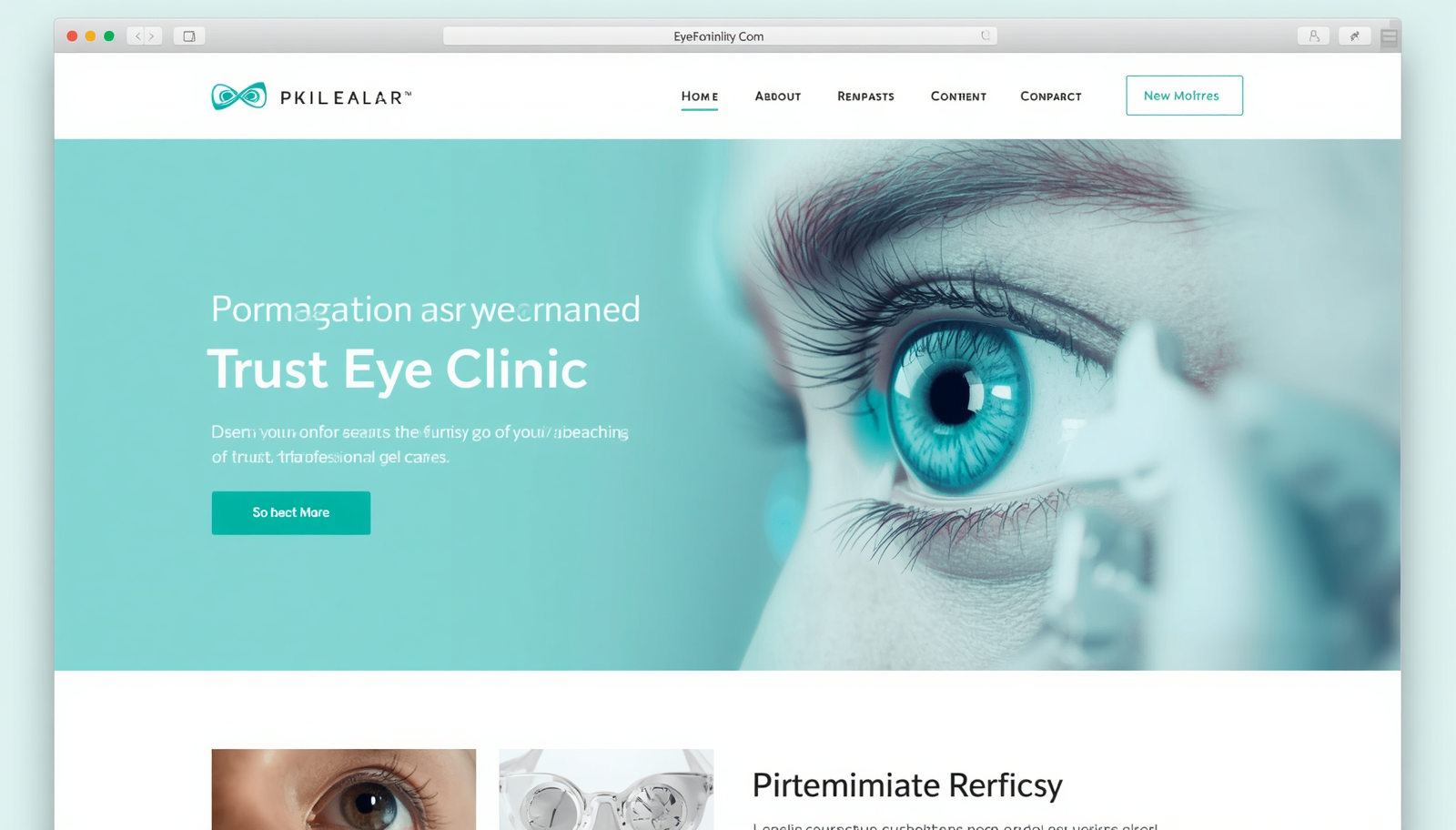
AI platforms such as ChatGPT, Perplexity, Google AI Overviews, and Gemini increasingly recommend eye clinics that demonstrate expertise, authority, trustworthiness, and patient-focused content. A strategically built eye clinic website design helps AI systems understand services, physician credentials, treatment specialties, patient experience, and local authority signals, making the clinic more likely to appear in AI-generated recommendations and patient research journeys.
Before discussing AI visibility, it is important to understand what we repeatedly see during healthcare website reviews.
Based on website audits we conducted across eye clinics, ophthalmology practices, and vision care providers, the most common problem was not poor visual design.
The biggest issue was insufficient expertise communication.
| Audit Finding | Frequency Observed |
|---|---|
| Generic service descriptions | Very High |
| Missing physician authority content | High |
| Weak local authority signals | High |
| Poor FAQ coverage | Very High |
| Limited patient education resources | High |
| Missing healthcare schema markup | Moderate |
| Weak review integration | High |
| No AI-friendly content structure | High |
Based on our review of eye clinic websites, practices that provide detailed educational content, physician expertise pages, treatment-specific FAQs, and structured healthcare data consistently create more opportunities for AI citations than clinics relying primarily on marketing-focused content.
This is becoming increasingly important as AI-generated answers influence more patient decisions.
Patients are changing how they research healthcare providers.
Instead of typing short keywords into search engines, they increasingly ask complete questions such as:
AI systems answer these questions directly.
This creates a new visibility layer that sits above traditional search rankings.
Practices that become trusted citation sources gain exposure before a patient even clicks a website.
For many clinics, this represents one of the most important patient acquisition shifts of the decade.
AI systems rarely rely on a clinic website alone.
Before recommending a healthcare provider, they often cross-reference information from multiple authority sources.
Common sources include:
This process helps AI systems verify whether a clinic appears legitimate, authoritative, and trustworthy.
The more consistent your information appears across these platforms, the more confidence AI systems can have when referencing your clinic.

If your website isn’t converting visitors into appointments, the problem is usually trust, clarity, and booking flow. Discover how a conversion-focused optometrist website can increase patient enquiries.
NENT consistency is becoming one of the most overlooked GEO factors in healthcare marketing.
NENT refers to:
When information differs across platforms, AI systems encounter ambiguity.
For example, if a clinic appears as:
AI systems may struggle to determine whether these references describe the same organization.
Consistent NENT signals help improve entity confidence.
Entity confidence influences whether AI systems feel comfortable citing a clinic in generated answers.
AI systems trust evidence.
One common mistake we notice is that clinics often describe themselves as “leading,” “trusted,” or “experienced” without providing supporting proof.
Healthcare-related searches belong to Google’s highest trust category.
As a result, evidence matters more than marketing language.
Many clinics invest heavily in advertising while their treatment pages contain only a few hundred words of generic information.
AI systems cannot confidently assess expertise when content lacks depth.
Physician qualifications are often buried several clicks deep within a website.
Strong AI visibility requires expertise signals to be highly accessible.
Many clinics answer very few patient questions directly.
The clinics receiving AI citations most frequently often publish educational resources that closely mirror real patient concerns.
For example, clinics interested in creating stronger patient experiences can benefit from reviewing our guide on accessible and patient-friendly eye clinic websites.
Structured data helps AI systems understand your organization, services, physicians, and specialties.
Every clinic should evaluate whether the following schema types are implemented.
✓ MedicalBusiness Schema
✓ MedicalOrganization Schema
✓ Physician Schema
✓ LocalBusiness Schema
✓ FAQ Schema
✓ Review Schema
✓ Ophthalmology
✓ Optometry
✓ Cataract Surgery
✓ LASIK
✓ Retina Care
✓ Pediatric Eye Care
✓ Board certifications
✓ Medical education history
✓ Professional associations
✓ Hospital affiliations
✓ Research publications
Strong schema implementation improves machine readability and supports both SEO and GEO visibility.
This is one reason AI-optimized eye clinic website design is becoming increasingly important for modern healthcare practices.

“One trend we repeatedly observe is that AI search engines reward clarity over promotion. Clinics often invest significant resources into visual design while underinvesting in expertise communication. AI systems are not impressed by claims. They respond to evidence. Physician credentials, treatment authority, educational content, patient trust signals, and structured information consistently outperform marketing language when it comes to earning citations.”
A premium LASIK patient in Dubai evaluates trust differently than an NHS patient in London or a privately insured patient in New York.
AI systems increasingly recognize these differences.
Practices serving international patients should clearly communicate:
These signals help reduce uncertainty while strengthening credibility across different regions.
They also provide additional trust indicators AI systems can evaluate when generating healthcare recommendations.
Imagine an ophthalmology clinic in Sydney specializing in cataract surgery.
The clinic has excellent surgeons, advanced diagnostic equipment, and strong patient outcomes.
However, its website contains only one short cataract treatment page and minimal physician information.
A competing clinic publishes detailed treatment guides, recovery timelines, surgeon profiles, patient FAQs, technology explanations, and educational resources.
When a patient asks ChatGPT:
“Which eye clinic should I consider for cataract surgery in Sydney?”
The second clinic provides substantially more evidence for AI systems to evaluate.
As a result, it is far more likely to be cited and recommended.
AI platforms do not “search” the way traditional search engines do.
They retrieve, compare, verify, and synthesize information from multiple sources before generating recommendations.
When a patient asks:
AI systems evaluate hundreds of signals before deciding which providers to mention.
These signals typically include:
The goal is confidence.
AI platforms recommend providers they can verify.
AI systems understand expertise when clinics create content around specific treatments rather than broad service categories.
A generic “Services” page provides limited context.
Dedicated treatment pages provide substantially more.
Instead of:
Create:
This structure allows AI systems to connect specialties with patient questions.
The more specific the content, the easier it becomes for AI systems to identify expertise.
Treatment pages often provide stronger citation opportunities than homepages.
Patients rarely ask AI systems:
“Show me an eye clinic homepage.”
They ask:
AI systems seek pages that answer these questions directly.
In our experience, treatment pages often become the strongest authority assets on an eye clinic website.
This is one reason many clinics invest in ophthalmology website design services that focus on content architecture rather than visual design alone.
The most cited healthcare content follows a predictable structure.
AI systems perform best when information is organized clearly.
This format mirrors patient research behavior.
It also mirrors how AI systems summarize information.
Healthcare websites that answer patient questions directly are easier for AI systems to cite than websites that rely primarily on marketing copy.
Entity authority refers to how confidently AI systems can identify a person, clinic, or organization.
Strong entities are easier to recommend.
Weak entities create uncertainty.
For eye clinics, entity authority often comes from:
When AI systems repeatedly encounter the same entity connected to the same specialty, confidence increases.
Higher confidence often leads to greater visibility.
The strongest clinics consistently reinforce expertise across multiple digital touchpoints.
Authority is cumulative.
Every credible mention strengthens the overall entity profile.
Content clusters help AI systems understand topical expertise.
Instead of publishing isolated articles, clinics should create connected topic ecosystems.
Main Page:
Supporting Pages:
This creates semantic depth.
Semantic depth improves AI understanding.
Clinics focused on eye care website SEO and AI visibility increasingly rely on cluster-based content strategies rather than standalone pages.
A multi-specialty eye clinic in London approached KG Web Designer because they were receiving very little visibility for their specialty treatments despite having a strong reputation locally.
The clinic had extensive expertise but minimal topical depth.
Multiple treatments were grouped together on a single page.
Physician credentials were difficult to locate.
Patient education resources were almost nonexistent.
We reorganized the website around treatment-specific authority.
Dedicated content clusters were developed.
Physician expertise sections were expanded.
FAQs were integrated throughout the website.
Healthcare schema implementation was improved.
The clinic created significantly more opportunities for AI systems to understand specialty expertise.
Most importantly, the website became easier for both patients and AI platforms to evaluate and trust.
Patients don’t just compare clinics — they compare clarity, professionalism, and ease of booking. A well-designed eye clinic website builds confidence before they even call.
Clinics seeking long-term AI visibility should build a structured authority ecosystem.
This structure creates multiple citation opportunities.
It also improves patient decision-making.
Many clinic owners exploring AI visibility also evaluate the broader investment required for modern healthcare websites. Our detailed guide on eye clinic website design costs and investment considerations explains how content architecture, patient acquisition goals, and advanced functionality influence overall website budgets.

Before investing in a complete redesign, it is useful to understand how AI systems currently interpret your digital presence.
The assessment evaluates:
Many clinics discover that relatively small structural improvements can significantly increase AI visibility.
This provides a lower-friction starting point before committing to a larger website project.
SEO, GEO, and AI optimization overlap but serve different purposes.
| Strategy | Primary Goal |
|---|---|
| SEO | Improve search rankings |
| GEO | Increase AI citations |
| AI Optimization | Improve machine understanding |
| CRO | Increase patient inquiries |
| Authority Building | Strengthen trust and expertise |
The highest-performing clinics combine all five.
This is where healthcare website design for eye specialists increasingly differs from traditional healthcare website development.
Modern visibility requires websites designed for patients, search engines, and AI systems simultaneously.
Most eye clinics assume AI visibility is simply an extension of traditional SEO.
It is not.
The clinics struggling to appear in AI-generated recommendations often focus on rankings while ignoring authority architecture.
A first-page ranking does not automatically make a clinic an AI citation source.
AI systems evaluate whether they trust the information enough to recommend it.
One common mistake we notice is that clinics invest heavily in design aesthetics while underinvesting in expertise communication.
AI systems evaluate evidence, not marketing claims.
AI systems increasingly validate healthcare providers using third-party authority sources.
A clinic website is important, but it is rarely the only source AI platforms evaluate.
Common healthcare authority platforms include:
When information is consistent across these platforms, AI systems gain confidence in the clinic’s legitimacy.
When information conflicts, confidence decreases.
This is why authority management is becoming just as important as website optimization.
The most visible clinics consistently demonstrate expertise across multiple digital environments.
Visibility is rarely created by a website alone.
It comes from the combination of:
The stronger these signals become, the easier it is for AI systems to confidently recommend a clinic.
This is where eye clinic website for patient acquisition increasingly intersects with AI optimization strategy.
Patient acquisition is becoming a visibility problem before it becomes a conversion problem.
AI systems increasingly evaluate trust indicators that matter across different markets.
A premium LASIK patient in Dubai often evaluates credibility differently than a patient in London or New York.
Practices serving international patients should communicate:
These trust signals help reduce uncertainty while improving AI confidence.
AI visibility is becoming a competitive advantage for eye clinics.
The practices that become trusted sources often gain visibility before a patient visits search results.
This creates an entirely new layer of patient acquisition.
At KG Web Designer, we have found that practices investing in authority-focused digital ecosystems often outperform clinics relying solely on advertising campaigns.
The strongest-performing clinics create educational resources that continue generating visibility long after publication.
AI search is reshaping healthcare discovery.
Patients increasingly ask conversational questions instead of entering short keyword phrases.
Examples include:
AI systems answer these questions directly.
The clinics that prepare now will have a significant advantage.
The practices that build authority today are positioning themselves for future visibility.
The clinics most likely to win visibility over the next five years are not necessarily the clinics with the largest advertising budgets.
They are the clinics that become trusted entities.
AI systems increasingly recommend providers they can verify.
Verification comes from:
The future of healthcare marketing is moving from ranking pages to building trusted entities.
A multi-location ophthalmology practice serving patients across a major metropolitan region approached KG Web Designer because their organic visibility had plateaued.
The clinic had experienced physicians and advanced equipment but struggled to communicate expertise online.
Their website relied heavily on marketing language.
Treatment information was limited.
Physician profiles lacked depth.
We reorganized the website around authority signals.
Treatment-specific educational content was expanded.
Healthcare schema was implemented.
FAQs were developed around real patient questions.
Physician expertise pages were significantly strengthened.
Within months, the clinic’s digital presence became substantially easier for both patients and AI systems to evaluate.
More importantly, the practice stopped looking like a generic healthcare provider and started communicating specialist-level authority.
The difference was not visual design alone.
The difference was evidence.
Patients could immediately see physician expertise, treatment depth, advanced technology, and educational resources. AI systems could verify the same information through structured content and supporting authority signals.
This transformed the website from a digital brochure into a patient acquisition asset.
Authority is becoming more valuable because AI systems increasingly prioritize confidence over position.
A clinic ranked lower in search results can still appear in AI-generated answers if it demonstrates stronger expertise.
This shift is changing healthcare marketing.
Clinics that communicate expertise clearly are becoming easier to cite, recommend, and trust.
For clinics operating in competitive metropolitan markets, our guide on what makes a vision care website stand out in competitive cities explores additional strategies that strengthen differentiation and authority,
Many of the principles discussed there directly support AI visibility and patient acquisition.
AI platforms are changing how patients discover healthcare providers.
The clinics that become trusted sources are increasingly positioned to benefit from this shift.
A strong eye clinic website design is no longer just about appearance, usability, or rankings. It is about helping AI systems understand expertise, physician authority, patient value, and trustworthiness.
Based on our experience at KG Web Designer, clinics that combine SEO, GEO, structured healthcare content, physician authority signals, and patient-focused education consistently build stronger long-term visibility than practices relying solely on traditional marketing methods.
The clinics that dominate AI recommendations in 2026 and beyond will not simply have better websites.
They will have stronger digital authority ecosystems.
The opportunity is no longer just ranking higher.
The opportunity is becoming the trusted source AI systems choose to cite, recommend, and reference when patients ask for help.
Download our AI Visibility Assessment Checklist to evaluate:
This is ideal for clinics beginning their AI visibility journey.
| Region | Engagement Model | Direct Access |
|---|---|---|
| US, UK, Australia, Canada, Singapore & UAE Clinics | 30-Minute AI Visibility & Patient Acquisition Strategy Session | Book Strategy Call |
| Eye Clinic Website Projects | Website Audit, GEO Assessment & Growth Roadmap | Contact Kanika Gupta |
If your current website is not converting visitors into appointments, it’s time to fix the experience. I help optometrists and eye clinics build websites that drive real patient enquiries.

ChatGPT evaluates publicly available information from trusted sources. Clinics with stronger expertise signals, physician authority, educational content, structured data, and trust indicators create more opportunities to appear in AI-generated recommendations.
Yes. AI systems evaluate expertise, trust, authority, and relevance. A clinic does not necessarily need the top search ranking to be cited if it provides stronger supporting evidence.
NENT stands for Name, Entity Category, NAP (Name, Address, Phone), and Taxonomy. Consistency across websites, directories, and medical platforms helps AI systems verify clinic legitimacy.
Most clinics benefit from MedicalBusiness, Physician, MedicalOrganization, FAQ, Review, and specialty-related schema. Structured data helps AI systems understand services and expertise.
Physician profiles provide expertise signals. Detailed credentials, specialties, certifications, publications, and affiliations help AI systems assess authority.
Yes. Reviews contribute trust and credibility. While reviews alone are not enough, they strengthen overall authority and patient confidence.
SEO focuses on rankings. GEO focuses on becoming a citation source for AI-generated answers. The two strategies complement one another but serve different goals.