
In a world where travelers expect to book quickly from any device, travel agencies can no longer treat their website as a brochure. A booking-friendly website turns interest into revenue: it makes inventory easy to search, comparison simple, checkout painless, and payments trustworthy. For travel businesses — from traditional brick-and-mortar agents to niche tour operators — the website is often the first (and sometimes only) opportunity to convert a motivated visitor into a paying customer.
This article unpacks why travel agencies need a booking-friendly website, what features move the needle, how to measure success, and which technical services to invest in to make every click count. Where relevant, I highlight services I provide on this site — for example Web Development, WordPress Development, Website Speed Optimization, Digital Marketing, eCommerce Solutions, and WordPress Malware Removal Service — which directly support a booking-friendly experience.
Why a Booking-Friendly Website Matters
Most travelers now expect to research, compare, and book travel online in just a few clicks. A booking-friendly travel agency website makes this possible by combining attractive design, clear information, and a seamless online booking engine so visitors can move from browsing to payment without friction.
Global travel and tourism now rely on online channels for around 70% of total sector revenue, and roughly 72% of travelers say they prefer to book online instead of using traditional offline agents. For any agency selling tours, hotels, flights, or holiday packages, a responsive travel website with integrated booking system is no longer optional; it is the core sales channel.
A booking-friendly travel website delivers benefits across revenue, operations, and customer experience.
The global online travel booking market is large and growing. Market research projects significant year-over-year growth — from roughly $576.4 billion in 2024 to $641.1 billion in 2025, showing the scale and momentum of online bookings. Investing in a website designed to capture that demand is an investment in market share.
Users behave differently on mobile vs desktop: mobile booking conversion rates are much lower — industry figures show ~0.7% for mobile compared with ~2.4% for desktop — and overall booking abandonment on travel sites can be extremely high (sources report abandonment as high as ~80.8%). Fixing friction on your booking flow can therefore unlock meaningful revenue.
Industry benchmarks also show that conversion rates in travel vary widely, but a site above ~2% is considered in the top tier; hitting 3–4% places you among best-performers. These benchmarks give practical targets when redesigning booking flows.
Key quick facts:
A booking-friendly travel website design should blend user experience, performance, and robust booking functionality.
User experience and design
Booking engine and integrations
Content, SEO, and trust
These figures highlight that without a strong online travel booking website, agencies risk missing the majority of market demand.
1. Fast loading pages (performance first)
Speed is revenue: pages that load in 1–2 seconds convert far better than pages taking 4–5 seconds. Studies show conversion rates drop for each second of delay — one authoritative consolidation reports conversions can fall roughly 7% per second of additional load time, and other provider data show major conversion gains when times improve. Investing in Website Speed Optimization is therefore foundational.
Technical checklist:
2. Mobile-first booking UX
Given mobile’s dominance for browsing and a still-lower conversion, design booking flows around thumbs: large touch targets, single-field inputs, minimal typing, progressive disclosure (show more options only when needed), and mobile wallets for payment.
3. Simple, transparent pricing and fees
Surprise fees trigger abandonment. Display full price early, and show policies (cancellation, change fees) clearly. Where possible, support instant ticketing, vouchers, or immediate confirmation to remove doubt.
4. One-page or progressive checkout
A long form with many steps is a conversion killer. Use a single page or short progressive steps, persist user data if they drop off (email capture), and support guest checkout.
5. Multiple payment options and trust signals
Offer cards, wallets, BNPL where legal, and display security badges, payment provider logos, and a clear refund policy.
6. Real-time availability and inventory sync
Booking failures (double bookings) damage reputation. Use reliable inventory integrations or booking engines; if you use WordPress, integrate via robust APIs or a third-party booking platform.
7. Search and filtering tuned for travel shoppers
Quick filters (date, price band, duration, destination highlights) and an intelligent search (auto-suggest, synonym handling) shorten time-to-book.
8. Personalization and remarketing hooks
Show related experiences, upsell insurance or transfers, and use email/SMS remarketing for abandoned bookings. Persist cart data for logged-out users when possible.
9. Accessibility and internationalization
Support multiple currencies, language options, and accessible forms (labels, ARIA) to expand market reach.
Use your services strategically:
A booking-friendly website helps agencies reduce reliance on OTAs and control their own sales funnel.
| Aspect | OTA-Dependent Agency | Agency with Direct Travel Website |
| Control over branding | Limited, OTA controls page layout and messaging | Full control over design, storytelling, and unique selling points on your tour and travel website |
| Commission and margins | High commissions reduce profit per booking | Better margins through direct online booking on your own portal |
| Customer data | OTA owns most of the customer data | First-party data captured via your travel CRM and booking system |
| Upselling potential | Limited room to promote custom add-ons | High ability to promote add-ons, upgrades, and custom itineraries via your travel website development |
| Long-term loyalty | Customers loyal to OTA brand | Customers become loyal to your travel agency brand and services |
| Feature area | Booking-friendly site (ideal) | Non-booking site (common problems) |
| Page speed | <2s load, optimized booking flow | 4–8s, heavy scripts |
| Checkout | Single-page / progressive, guest checkout | Multi-step, forced account creation |
| Mobile UX | Mobile-first, wallet payments | Desktop-first, tiny targets |
| Pricing | Fully transparent fees, taxes shown early | Hidden fees at final step |
| Inventory | Real-time sync, instant confirmation | Manual updates → double-bookings |
| Security | HTTPS, payment badges, PCI-compliant flows | Mixed content, unclear trust signals |
| Personalization | Cross-sells & remarketing | Generic product pages |
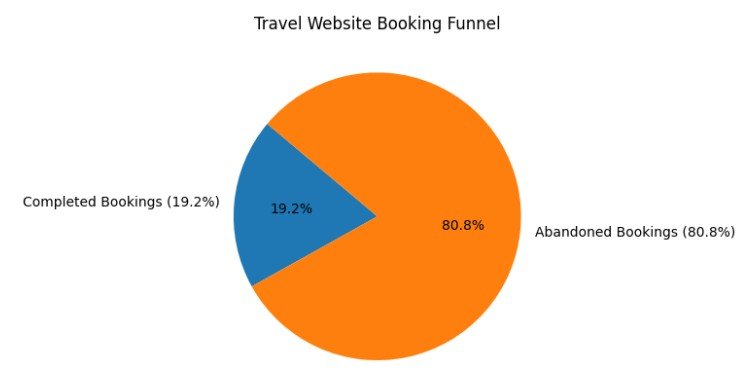
Over 80% of users abandon travel bookings due to friction in the booking process.
Week 0–1 — Audit
Week 2–4 — Quick wins
Week 5–8 — UX & integration
Week 9–12 — Test & refine
Digital transformation in travel is clear when comparing online and offline booking preferences. The chart below illustrates a simple split where online channels take the majority share of bookings.
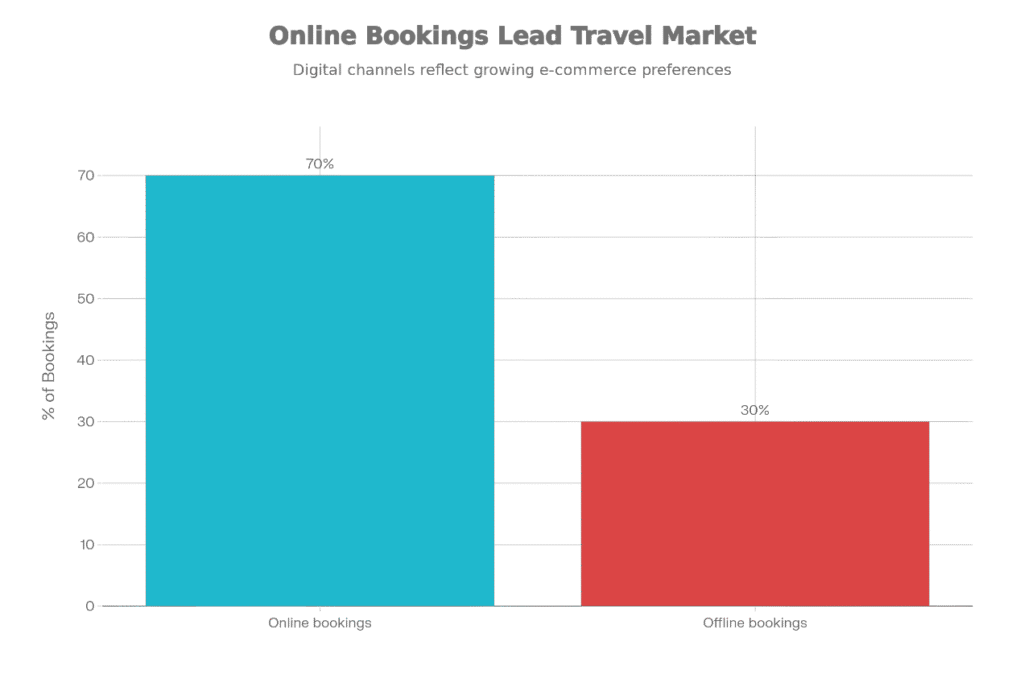
A booking-optimized travel agency website allows your business to ride this growth instead of losing customers to competitors or OTAs.
Q1: What makes a website “booking-friendly”?
A: A booking-friendly website is fast, mobile-optimized, uses clear pricing, supports multiple payment methods, offers transparent policies, and has a minimal, secure checkout flow that reduces friction.
Q2: How much does it cost to make my travel website booking-friendly?
A: Costs vary by scope — minor performance and UX fixes can start small, while full integrations with CRS/booking engines or custom development are larger investments. I recommend auditing first to estimate work. (I offer audits under Web Development and Digital Marketing services.)
Q3: Will website speed improvements increase bookings?
A: Yes — industry analyses show conversion declines per second of delay; addressing speed often yields immediate lifts in conversion and revenue.
Q4: Should I build on WordPress or a custom platform?
A: Both can work. WordPress is cost-effective and extensible if properly optimized and secured (and I provide WordPress Development and WordPress Malware Removal Service). Larger agencies with complex real-time inventory may need a custom backend or headless approach.
Q5: How do I reduce booking abandonment?
A: Simplify checkout, show full pricing, enable guest checkout, persist form data, add trust signals, optimize payments, and use email/SMS remarketing for abandons. Measure where users drop off through funnel analytics and iterate.
Q6: Why should a small travel agency invest in an online booking system?
A: Even small agencies benefit from automation, 24/7 sales, and access to wider inventories via APIs and supplier connections. An online travel booking system also helps you collect customer data and build long-term relationships instead of competing only on price.
Q7: How does a booking-friendly website increase revenue?
A: By reducing friction in the booking process, improving trust, and enabling upsell/cross-sell of add-ons like transfers, insurance, and activities. Agencies also save time and costs on manual handling, allowing the team to focus on complex itineraries and high-value clients.
Q8: What features should I prioritize when redesigning my travel website?
A: Focus first on responsive design, clear navigation, powerful search and filters, secure online booking, and fast page load. Then add advanced features like personalized recommendations, multi-currency support, and marketing integrations as your traffic and bookings grow.
Q9: How important is mobile optimization for travel booking?
A: Mobile is now a primary research channel, and mobile travel revenue exceeds 2 billion dollars globally, so a mobile-friendly travel website is essential. Even if many users complete bookings on desktop, a poor mobile experience will drive them away before they ever convert.
If you’d like, I can run a free audit of your booking funnel, speed, and mobile UX and deliver a prioritized list of improvements (technical + content) with estimated uplift. This ties directly to Website Speed Optimization, Web Development, and Digital Marketing services.